A French Word to Live By
Translate Tous les deux to English
/tus le dø/
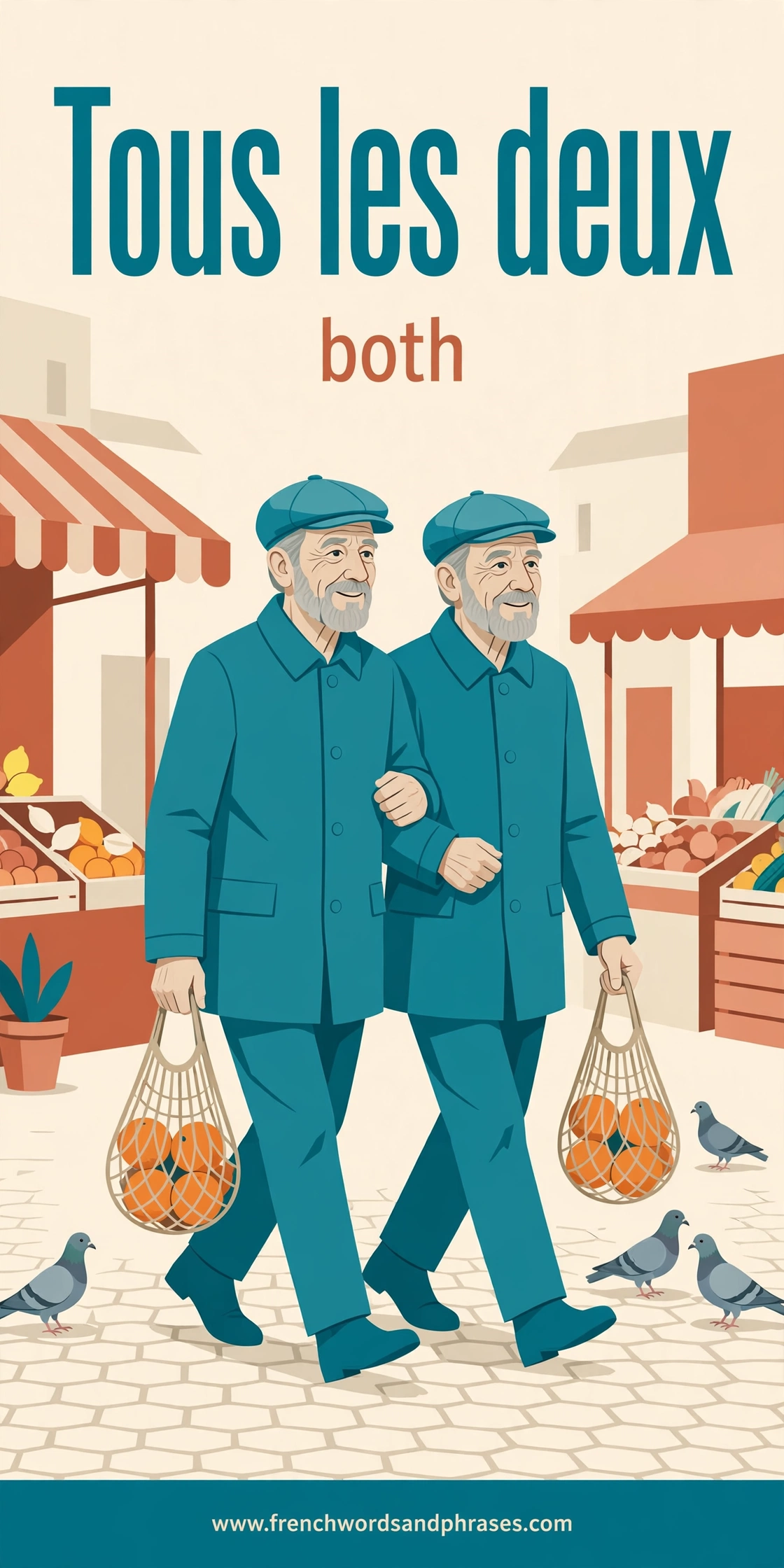
Tous les deux means both — the two of them, both of them.
Two brothers, one bicycle built for neither of them, and a mother who settles it with three words: « Tous les deux, à table ! » Tous les deux is the phrase of the pair taken together: both of them, the two of them, neither left out — French’s way of counting to two and wrapping both in one breath.
Let’s explore how tous les deux works in French, beginning with the whole phrase on one card.
Understanding the French Phrase Tous les deux
Tous les deux is a French fixed expression built from tous (all), les (the) and deux (two): literally « all the two ». It names a pair as a complete set — both members, together, with none left over. It has a feminine twin, toutes les deux, for two women or two feminine things, and it belongs to a whole family: tous les trois, tous les quatre, for larger complete sets.
It means both — both of them, the two of them: ils sont venus tous les deux, they both came; tous les deux sont d’accord, both agree. It can open a sentence for emphasis — tous les deux, ils ont ri, both of them laughed — or follow the verb as a complete little summary: je les ai vus tous les deux, I saw them both. With a possessive it turns intimate: nous deux, you and I — the pair that matters.
Type: Fixed expression — the complete pair (tous + les + deux)
Answers the need: Naming two people or things together, with none left out
Register: Everyday French, all situations
Strength: Exact — it closes the set at two: not one, not some, both
One important usage detail: the feminine is toutes les deux — elles sont venues toutes les deux, both (women) came. And mind the sound: in tous les deux, the s of tous is pronounced — say « touss ». The phrase can also float after the pronoun or the verb for rhythm: ils ont tous les deux répondu, they both answered.
Experience the Word
Tous les deux is the smallest possible crowd — a set that is complete at two, where adding a third would break the spell.
Imagine the twins at the school gate, same satchel, same scarf, answering every question in chorus. The teacher stops trying to separate them by Friday: tous les deux, toujours — both of them, always, a single plural person.
English says both, one flat word. French counts the whole set aloud — all, the, two — and the pair stands complete.
How to Use Tous les deux in French: Complete Guide
Let’s explore how tous les deux works in French, beginning with the whole phrase on one card.
Tous les deux at a Glance
The Whole Phrase on One Card
Real meaning, literal picture, English twin and register — tous les deux in five lines.
| Point | Tous les deux |
|---|---|
| What it really means | both — the two of them, together |
| Word for word | all the two — the complete set of two |
| English equivalent | both; both of them; the two of them |
| Register | everyday French, everywhere |
| Use it for | pairs taken together — people, things, choices |
Example
Ils sont arrivés tous les deux en retard.
They both arrived late.
Word by Word: Building the Phrase
Three pieces — all, the, two — a whole set counted in one breath.
| Word | Literal meaning | Its job in the phrase |
|---|---|---|
| tous | all, every one | the completeness: no member left out |
| les | the | points at the known pair |
| deux | two | the size of the set — exactly two |
Example
Tous les deux ont signé le registre.
Both of them signed the register.
Quick Quiz 1
How do you say ‘both’ for two women — tous les deux or toutes les deux?
Reveal the answer
toutes les deux — tous becomes toutes for a feminine pair.
Elles sont venues toutes les deux.
They both came (two women).
Where the Phrase Stands: Around the Verb
Tous les deux is a traveller: it can open the sentence, follow the subject, or close the verb’s phrase as a summary.
| Situation | Example |
|---|---|
| At the opening | tous les deux, ils ont ri — both of them laughed |
| After the subject | ils sont tous les deux d’accord — they both agree |
| After the verb | je les ai vus tous les deux — I saw them both |
| As the subject | tous les deux sont partis — both left |
Example
Nous les avons invités tous les deux.
We invited them both.
The Whole Family: Tous les trois, Tous les quatre…
The pattern grows with the set: change deux and the whole family follows.
| Set | French |
|---|---|
| both (masculine / mixed) | tous les deux |
| both (feminine) | toutes les deux |
| all three | tous les trois |
| all four | tous les quatre |
| both of us | nous deux / tous les deux |
Example
Les enfants sont venus tous les trois.
The children all three came.
When You Say It: The Pairing Moments
Tous les deux turns up at moments like these — wherever two act, arrive or agree as one set.
| Situation | Example |
|---|---|
| Calling children | tous les deux, à table ! — both of you, to the table! |
| Reporting agreement | ils sont tous les deux d’accord — they both agree |
| Introducing a couple | je vous présente mes parents, tous les deux médecins — both doctors |
| Counting guests | ils viendront tous les deux — they will both come |
Example
Tous les deux ont signé la carte.
Both of them signed the card.
Quick Quiz 2
How do you say ‘all three of them came’?
Reveal the answer
Ils sont venus tous les trois
The pattern is tous les + number: deux, trois, quatre…
They all three came.
Everyday Expressions with Tous les deux
Tous les deux turns up wherever pairs act together — at tables, gates and altars.
| Expression | In English |
|---|---|
| tous les deux | both, both of them |
| toutes les deux | both (feminine pair) |
| nous deux | the two of us, you and I |
| entre nous deux | between the two of us |
| tous les deux jours | every other day, every two days |
Example
Entre nous deux, ce secret doit rester.
Between the two of us, this secret must stay.
Tous les deux and Its Neighbours
The phrase keeps company with the other counters of small sets — each draws the line at a different place.
| French | In English |
|---|---|
| les deux | the two, both — without the completeness of tous |
| l’un et l’autre | both, one and the other (a little formal) |
| chacun | each — the members one by one |
| ensemble | together — the manner, not the count |
| ni l’un ni l’autre | neither one nor the other — the negative twin |
Example
L’un et l’autre ont refusé : ni l’un ni l’autre ne viendra.
Both refused: neither one nor the other will come.
Quick Quiz 3
What does tous les deux jours mean?
Reveal the answer
Every other day — every two days; the phrase counts a rhythm, not a pair of people.
Il s’entraîne tous les deux jours.
He trains every other day.
Watch Out: The Traps Around Tous les deux
The traps here are the feminine, the pronounced s, and the cousin tous deux, which belongs to formal French.
| Trap | The truth |
|---|---|
| The feminine pair | toutes les deux — for two women or two feminine nouns |
| The sound | say « touss les deux » — the s of tous is pronounced before les |
| tous deux | the shorter form exists but is formal and literary: ils sont tous deux partis |
| Not « les deux tous » | the order is fixed: tous first, then les, then deux |
Example
Elles ont répondu toutes les deux en même temps.
They both answered at the same time.
Quick Quiz 4
How do you say ‘I saw them both’ with tous les deux at the end?
Reveal the answer
Je les ai vus tous les deux
The phrase closes the sentence as a summary of the pair.
I saw them both.
Tous les deux in Everyday French: Real-Life Examples
Now that you know the word, let’s see how tous les deux appears in everyday French.
Example 1 — Family
Tous les deux, à table, le dîner est prêt !
Both of you, to the table, dinner is ready!
Example 2 — Agreement
Ils sont tous les deux d’accord pour une fois.
They both agree for once.
Example 3 — An invitation
Je vous invite tous les deux dimanche.
I’m inviting you both on Sunday.
Example 4 — Sisters
Les jumelles sont arrivées toutes les deux.
The twins both arrived (girls).
Example 5 — A rhythm
Il court tous les deux jours avant le travail.
He runs every other day before work.
Example 6 — A secret
Entre nous deux, elle ne sait encore rien.
Between the two of us, she knows nothing yet.
Beyond Translation: The Meaning of Tous les deux
Tous les deux performs a tiny act of arithmetic in public: it refuses to say « both » until it has counted the set — all of them, and there are two. The construction is pure French logic, the same that builds tous les trois and tous les jours: totality first, then the count. It is also the phrase of fairness in every French household, the mother’s guarantee that the pair will be treated as one set, with no favourite and no forgotten one.
To say tous les deux is to close the set at two and lock the door.
It evokes the twins in chorus, the couple at the altar, and the two slices of cake exactly the same size.
How to Remember the French Phrase Tous les deux
Remember it this way: Tous les deux is both — the complete pair, with toutes les deux for a feminine pair.
- You count the set — tous les deux: all, the, two, none left out.
- You match the pair — toutes les deux for two women; tous les trois grows the family.
- You sound the s — « touss les deux », the s of tous is pronounced.
The key idea is tous les deux = both (of them); feminine toutes les deux.
Test Your Knowledge of Tous les deux
Let’s see how much you’ve learned. Try answering these questions before revealing the answers.
Question 1
What does tous les deux mean?
Reveal the answer
Both — the two of them, the complete pair.
Question 2
What is the feminine of tous les deux?
Reveal the answer
Toutes les deux — for two women or two feminine nouns.
Question 3
Translate: They both agree.
Reveal the answer
Ils sont tous les deux d’accord.
Question 4
Complete the sentence:
Elles sont venues ______ ______ ______. (both, feminine)
Reveal the answer
toutes les deux
Elles sont venues toutes les deux.
They both came.
Question 5
How do you say all three of them?
Reveal the answer
Tous les trois — the pattern is tous les + the number.
Your Final Challenge
Can You Use It?
How would you say this in French?
“I’m inviting you both on Sunday.”
Reveal the answer
Je vous invite tous les deux dimanche.
I’m inviting you both on Sunday.
A little French. A little curiosity. A richer everyday life.
LEARN FRENCH ONE WORD AT A TIME