A French Word to Live By
How to Conjugate Troubler in French
/tʁu.ble/
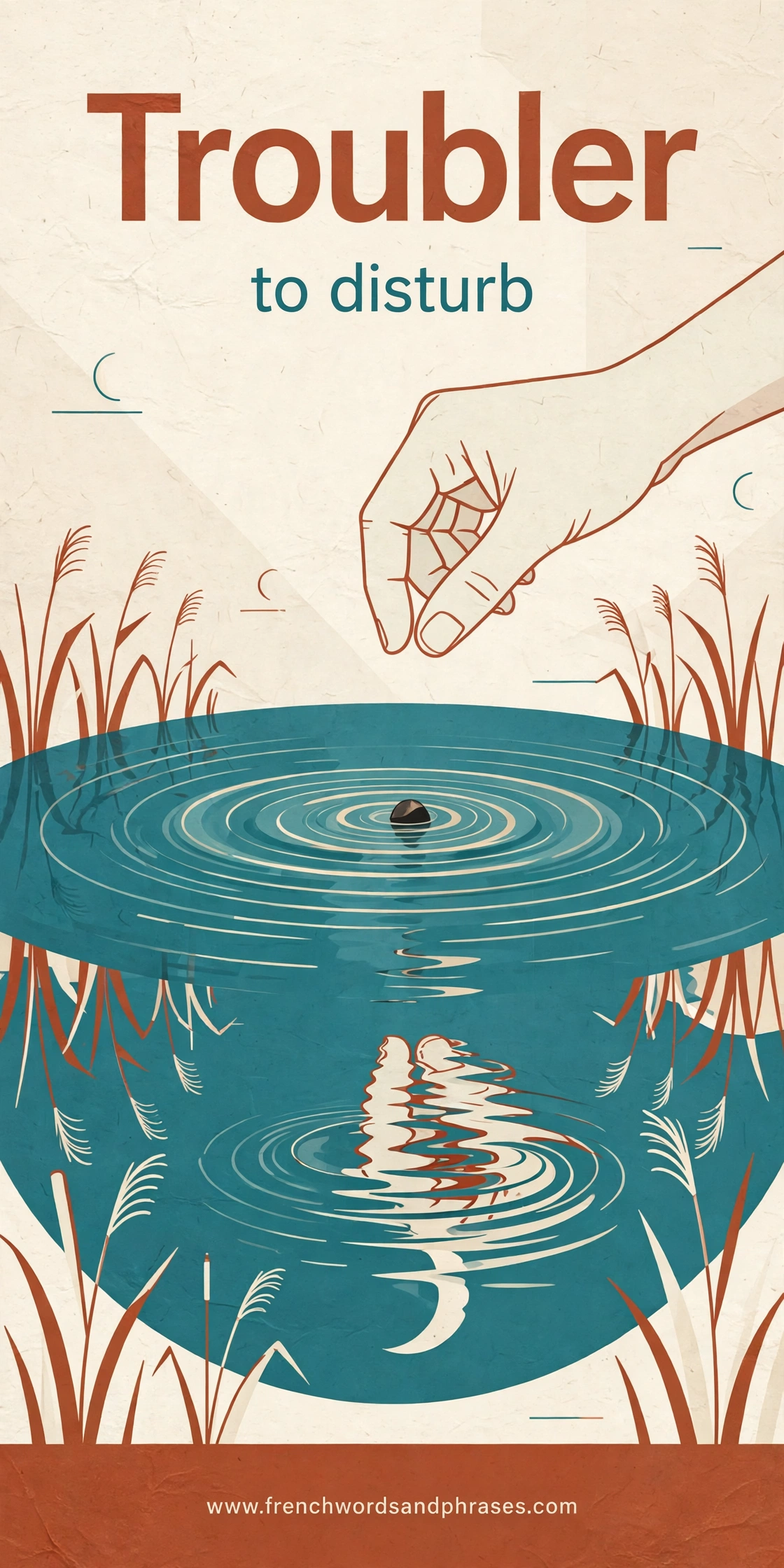
Troubler means to disturb — to stir up what was calm, clear or quiet.
A stone dropped into a still pond, a piece of news that silences a dinner table, a face that clouds over mid-sentence — troubler is the verb of calm water stirred, of peace interrupted, of a mind that can no longer think straight.
In this guide, you’ll learn how to conjugate troubler in all the major French tenses and moods. Explore complete conjugation tables, French examples, English translations, and practice quizzes.
Understanding the French Verb Troubler
Troubler is a regular French verb belonging to the first group of verbs, those ending in -er.
It means to disturb. It is commonly used for disturbing peace, silence and sleep, for news that upsets a person or a whole room, for water turning cloudy, and for the flustered feeling of losing your thread in public — un regard troublé, une voix troublée.
Verb classification: First group (-er)
Auxiliary verb: Avoir
Past participle: troublé
Present participle: troublant
English equivalents: To disturb, to upset, to trouble; troubler le silence — to break the silence; troubler l’eau — to muddy the water; être troublé — to be flustered, upset.
One important detail: troubler has a reflexive twin you will meet constantly. Se troubler means to get flustered or to cloud over: elle s’est troublée pendant son discours — she got flustered during her speech; l’eau se trouble — the water clouds over. The plain verb disturbs someone or something else (la nouvelle a troublé la famille); the reflexive turns the disturbance inward. Notice too the adjective trouble — cloudy, hazy — as in une eau trouble, murky water.
Experience the Word
Troubler is the verb of the ripple — something small lands, and the whole surface changes.
Imagine a village meeting on a quiet evening. The mayor reads the letter aloud, and halfway through, a murmur runs round the room: la nouvelle trouble l’assemblée. Nobody shouts; everybody is quietly, thoroughly disturbed.
Nothing has broken, nothing has fallen. The calm has simply been troubled — and it will take time to settle again.
How to Conjugate Troubler: Complete French Conjugation Guide
Let’s explore every major conjugation of troubler, beginning with the indicative mood.
How to Conjugate Troubler in the Indicative Mood
The indicative mood is used to express facts, observations, actions, and events.
How to Conjugate Troubler in the Present Tense (Présent)
Used for actions happening now, habitual actions, and general truths.
| Subject | Conjugation |
|---|---|
| je | trouble |
| tu | troubles |
| il / elle | trouble |
| nous | troublons |
| vous | troublez |
| ils / elles | troublent |
Example
Ce bruit constant trouble sa concentration.
That constant noise disturbs her concentration.
Quick Quiz 1
Complete the sentence:
Ce bruit ______ ma concentration.
Reveal the answer
trouble
Ce bruit trouble ma concentration.
That noise disturbs my concentration.
How to Conjugate Troubler in the Passé Composé
Used for completed actions in the past. Troubler takes the auxiliary verb avoir.
| Subject | Conjugation |
|---|---|
| j’ | ai troublé |
| tu | as troublé |
| il / elle | a troublé |
| nous | avons troublé |
| vous | avez troublé |
| ils / elles | ont troublé |
Example
La nouvelle a troublé toute la famille.
The news disturbed the whole family.
How to Conjugate Troubler in the Imparfait (Imperfect Tense)
Used for habitual past actions, descriptions, and ongoing situations in the past.
| Subject | Conjugation |
|---|---|
| je | troublais |
| tu | troublais |
| il / elle | troublait |
| nous | troublions |
| vous | troubliez |
| ils / elles | troublaient |
Example
Le vent troublait la surface du lac.
The wind used to ripple the surface of the lake.
Quick Quiz 2
Choose the correct form:
The news disturbed everyone.
La nouvelle ______ tout le monde. (a troublé / est troublée)
Reveal the answer
a troublé
La nouvelle a troublé tout le monde.
Troubler takes avoir.
How to Conjugate Troubler in the Plus-que-parfait
Used to describe an action that had already been completed before another past event.
| Subject | Conjugation |
|---|---|
| j’ | avais troublé |
| tu | avais troublé |
| il / elle | avait troublé |
| nous | avions troublé |
| vous | aviez troublé |
| ils / elles | avaient troublé |
Example
Quelque chose avait troublé son sommeil toute la nuit.
Something had disturbed his sleep all night.
How to Conjugate Troubler in the Passé Simple
Primarily used in formal writing, literature, and historical narratives. It is rarely used in everyday conversation.
| Subject | Conjugation |
|---|---|
| je | troublai |
| tu | troublas |
| il / elle | troubla |
| nous | troublâmes |
| vous | troublâtes |
| ils / elles | troublèrent |
Example
Un cri troubla le silence de la nuit.
A cry broke the silence of the night.
How to Conjugate Troubler in the Passé Antérieur
A literary tense used to express an action completed immediately before another past action, generally in the passé simple.
| Subject | Conjugation |
|---|---|
| j’ | eus troublé |
| tu | eus troublé |
| il / elle | eut troublé |
| nous | eûmes troublé |
| vous | eûtes troublé |
| ils / elles | eurent troublé |
Example
Quand la nouvelle eut troublé l’assemblée, le président suspendit la séance.
When the news had disturbed the assembly, the chairman adjourned the meeting.
How to Conjugate Troubler in the Future Tense (Futur Simple)
Used to describe actions that will take place in the future.
| Subject | Conjugation |
|---|---|
| je | troublerai |
| tu | troubleras |
| il / elle | troublera |
| nous | troublerons |
| vous | troublerez |
| ils / elles | troubleront |
Example
Rien ne troublera notre tranquillité ce week-end.
Nothing will disturb our peace and quiet this weekend.
How to Conjugate Troubler in the Futur Antérieur (Future Perfect)
Used for an action that will have been completed before a particular point in the future.
| Subject | Conjugation |
|---|---|
| j’ | aurai troublé |
| tu | auras troublé |
| il / elle | aura troublé |
| nous | aurons troublé |
| vous | aurez troublé |
| ils / elles | auront troublé |
Example
À la fin du discours, il aura troublé plus d’un auditeur.
By the end of the speech, he will have unsettled more than one listener.
How to Conjugate Troubler in the Near Future (Futur Proche)
Used to describe something that is going to happen soon. Formed with aller + infinitive.
| Subject | Conjugation |
|---|---|
| je | vais troubler |
| tu | vas troubler |
| il / elle | va troubler |
| nous | allons troubler |
| vous | allez troubler |
| ils / elles | vont troubler |
Example
Je sens que cette lettre va troubler ta journée.
I feel this letter is going to upset your day.
How to Conjugate Troubler in the Conditional Mood
The conditional mood expresses what would happen under certain circumstances. It is also frequently used to make polite requests or express wishes.
How to Conjugate Troubler in the Present Conditional
| Subject | Conjugation |
|---|---|
| je | troublerais |
| tu | troublerais |
| il / elle | troublerait |
| nous | troublerions |
| vous | troubleriez |
| ils / elles | troubleraient |
Example
Sans ce brouillard, rien ne troublerait la vue.
Without this fog, nothing would cloud the view.
How to Conjugate Troubler in the Past Conditional
| Subject | Conjugation |
|---|---|
| j’ | aurais troublé |
| tu | aurais troublé |
| il / elle | aurait troublé |
| nous | aurions troublé |
| vous | auriez troublé |
| ils / elles | auraient troublé |
Example
Il aurait troublé la fête s’il avait pris la parole.
He would have spoiled the party if he had spoken.
Troubler in the Literary Past Conditional Form
This less common literary form uses the imperfect subjunctive of avoir.
| Subject | Conjugation |
|---|---|
| j’ | eusse troublé |
| tu | eusses troublé |
| il / elle | eût troublé |
| nous | eussions troublé |
| vous | eussiez troublé |
| ils / elles | eussent troublé |
Example
Il eût troublé la cérémonie s’il était entré.
He would have disturbed the ceremony if he had come in.
How to Conjugate Troubler in the Subjunctive Mood
The subjunctive is used to express wishes, emotions, doubts, necessity, and uncertainty. It frequently follows expressions such as il faut que (it is necessary that) or bien que (although).
How to Conjugate Troubler in the Present Subjunctive
| Subject | Conjugation |
|---|---|
| que je | trouble |
| que tu | troubles |
| qu’il / qu’elle | trouble |
| que nous | troublions |
| que vous | troubliez |
| qu’ils / qu’elles | troublent |
Example
Il faut que rien ne trouble votre repos.
Nothing must disturb your rest.
Quick Quiz 3
Complete the sentence using the subjunctive:
Elle craignait qu’un incident ______ la soirée.
Reveal the answer
troublât
Elle craignait qu’un incident troublât la soirée.
She feared an incident might disturb the evening.
How to Conjugate Troubler in the Imperfect Subjunctive
A literary tense, rarely encountered in modern spoken French.
| Subject | Conjugation |
|---|---|
| que je | troublasse |
| que tu | troublasses |
| qu’il / qu’elle | troublât |
| que nous | troublassions |
| que vous | troublassiez |
| qu’ils / qu’elles | troublassent |
Example
Elle craignait qu’un incident troublât la soirée.
She feared an incident might disturb the evening.
How to Conjugate Troubler in the Pluperfect Subjunctive
A literary construction used to express an action completed before another past action.
| Subject | Conjugation |
|---|---|
| que j’ | eusse troublé |
| que tu | eusses troublé |
| qu’il / qu’elle | eût troublé |
| que nous | eussions troublé |
| que vous | eussiez troublé |
| qu’ils / qu’elles | eussent troublé |
Example
On s’étonnait qu’il eût troublé tant de monde.
People were surprised he had upset so many people.
How to Conjugate Troubler in the Past Subjunctive
| Subject | Conjugation |
|---|---|
| que j’ | aie troublé |
| que tu | aies troublé |
| qu’il / qu’elle | ait troublé |
| que nous | ayons troublé |
| que vous | ayez troublé |
| qu’ils / qu’elles | aient troublé |
Example
Je regrette que ce retard ait troublé vos plans.
I am sorry this delay has upset your plans.
How to Conjugate Troubler in the Imperative
The imperative is used to give commands, instructions, invitations, or suggestions. Subject pronouns are omitted.
How to Conjugate Troubler in the Present Imperative
| Person | Conjugation |
|---|---|
| (tu) | trouble |
| (nous) | troublons |
| (vous) | troublez |
Example
Ne trouble pas l’eau du bassin !
Do not stir up the water in the pond!
Quick Quiz 4
How would you say Do not get flustered (tu form)?
Reveal the answer
Ne te trouble pas !
French Participles of Troubler
Participles are verb forms that can be used in compound tenses and other grammatical constructions.
Present Participle of Troubler
troublant
En troublant l’eau, tu effraies les poissons.
By muddying the water, you frighten the fish.
Past Participle of Troubler
troublé
Troublée par la nouvelle, elle est restée sans voix.
Disturbed by the news, she was left speechless.
Troubler in Everyday French: Real-Life Examples
Now that you know the conjugations, let’s see how troubler appears in everyday French.
Example 1 — Present
Le bruit des travaux trouble ma lecture.
The noise of the roadworks disturbs my reading.
Example 2 — Passé composé
Son annonce a troublé toute la salle.
His announcement unsettled the whole room.
Example 3 — Imparfait
Le vent troublait la surface du lac.
The wind rippled the surface of the lake.
Example 4 — Future
Rien ne troublera vos vacances.
Nothing will disturb your holiday.
Example 5 — Conditional
Un seul mot troublerait son bonheur.
A single word would disturb her happiness.
Example 6 — Imperative
Ne te trouble pas pour si peu !
Do not get flustered over so little!
Beyond Translation: The Meaning of Troubler
English trouble and French troubler are cousins, but the French verb keeps an older, physical picture: water that was clear turning cloudy.
Every disturbance in French is a clouding.
A troubled silence, a troubled mind, a troubled sky before a storm — troubler stirs the sediment up from the bottom, and se troubler is what happens when the sediment is in you.
How to Remember the French Verb Troubler
Remember it this way: Troubler is about a stone in still water — calm stirred, clarity clouded.
- Troubler starts as water turning cloudy — then minds, silences and evenings.
- Se troubler — to get flustered: elle s’est troublée pendant son discours.
- Regular -er: je trouble, nous troublons, past participle troublé.
The key idea is a stone in still water — calm stirred, clarity clouded.
Test Your Knowledge of Troubler
Let’s see how much you’ve learned. Try answering these questions before revealing the answers.
Question 1
How do you say to break the silence in French, using troubler?
Reveal the answer
Troubler le silence.
Question 2
How do you say The news disturbed the whole family in French?
Reveal the answer
La nouvelle a troublé toute la famille.
Question 3
What does elle s’est troublée mean?
Reveal the answer
She got flustered — se troubler turns the disturbance inward.
Question 4
What is the past participle of troubler?
Reveal the answer
Troublé.
Question 5
Complete the sentence:
Il faut que rien ne ______ votre repos.
Reveal the answer
trouble
Il faut que rien ne trouble votre repos.
Nothing must disturb your rest.
Your Final Challenge
Can You Use It?
How would you say this in French?
A cry disturbs the silence of the lake, then the water becomes smooth as a mirror again.
Reveal the answer
Un cri trouble le silence du lac, puis l’eau redevient lisse comme un miroir.
A cry disturbs the silence of the lake, then the water becomes smooth as a mirror again.
A little French. A little curiosity. A richer everyday life.
LEARN FRENCH ONE WORD AT A TIME