
A French Word to Live By
How to Conjugate Trottiner in French
/tʁɔ.ti.ne/
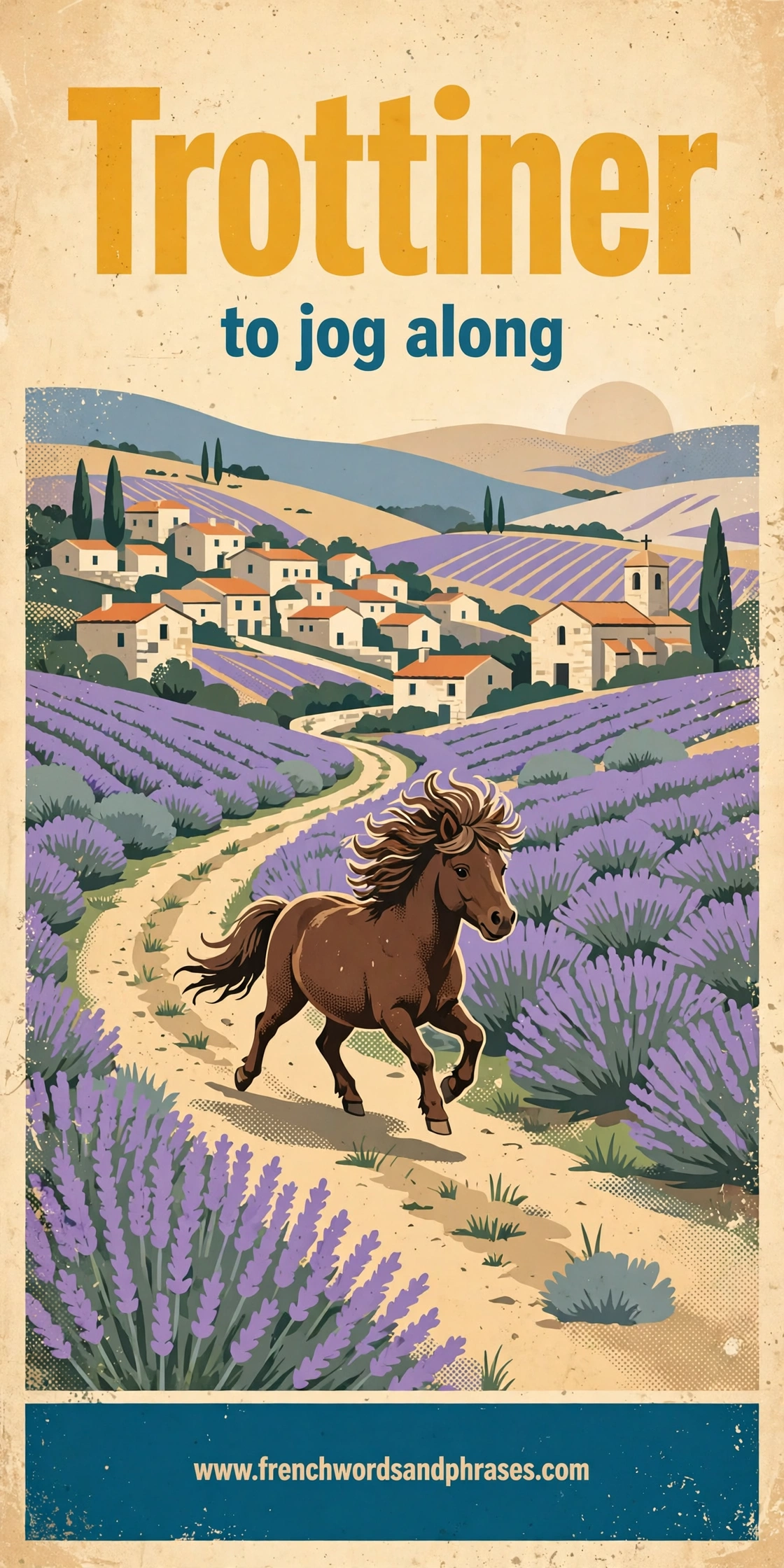
Trottiner means to jog along — to move at a little trot, with quick, small steps.
The baker’s little dog comes out of the shop at exactly the same hour every morning, legs a blur, nose to the pavement, on his way to inspect the whole street. Trottiner is the verb of that cheerful scurry — trotting, but smaller, quicker and entirely unhurried about dignity.
In this guide, you’ll learn how to conjugate trottiner in all the major French tenses and moods. Explore complete conjugation tables, French examples, English translations, and practice quizzes.
Understanding the French Verb Trottiner
Trottiner is a regular French verb belonging to the first group of verbs, those ending in -er.
It means to jog along. It is commonly used of small dogs trotting at their owner’s heels, of children hurrying along beside adults, and of sprightly elderly people who are always off somewhere on quick little feet.
Verb classification: First group (-er)
Auxiliary verb: Avoir
Past participle: trottiné
Present participle: trottinant
English equivalents: To jog along, to trot along, to scurry; trottiner derrière quelqu’un — to trot along behind someone; of small dogs, children and busy grandmothers hurrying about their errands.
One important detail: trottiner is trotter made small — the ending -iner shrinks the gait, the way French loves to shrink a word to shrink the action. The double tt of trotter survives: je trottine, nous trottinons, je trottinais, past participle trottiné, and everything else is regular. Never use it for a horse’s proper gait: a horse trotte; a puppy, a toddler or a grandmother trottine.
Experience the Word
Trottiner is the verb of the small and the busy — short legs, quick steps, important errands.
Imagine a market town on a Saturday morning. Madame Berthe, eighty-two years old, basket on her arm, trottine from the cheese stall to the flowers to the baker’s, greeting everyone, missing nothing, home before the church bell has finished. The whole town sets its watch by her.
She is never late and never rushed. She simply jogs along — elle trottine — and the morning arranges itself around her.
How to Conjugate Trottiner: Complete French Conjugation Guide
Let’s explore every major conjugation of trottiner, beginning with the indicative mood.
How to Conjugate Trottiner in the Indicative Mood
The indicative mood is used to express facts, observations, actions, and events.
How to Conjugate Trottiner in the Present Tense (Présent)
Used for actions happening now, habitual actions, and general truths.
| Subject | Conjugation |
|---|---|
| je | trottine |
| tu | trottines |
| il / elle | trottine |
| nous | trottinons |
| vous | trottinez |
| ils / elles | trottinent |
Example
Le petit chien trottine derrière sa maîtresse sans jamais se fatiguer.
The little dog jogs along behind its owner without ever getting tired.
Quick Quiz 1
Complete the sentence:
Nous ______ derrière la grand-mère au marché.
Reveal the answer
trottinons
Nous trottinons derrière la grand-mère au marché.
We jog along behind grandmother at the market.
How to Conjugate Trottiner in the Passé Composé
Used for completed actions in the past. Trottiner takes the auxiliary verb avoir.
| Subject | Conjugation |
|---|---|
| j’ | ai trottiné |
| tu | as trottiné |
| il / elle | a trottiné |
| nous | avons trottiné |
| vous | avez trottiné |
| ils / elles | ont trottiné |
Example
Elle a trottiné jusqu’à la boulangerie sous la pluie fine.
She jogged along to the bakery in the fine rain.
How to Conjugate Trottiner in the Imparfait (Imperfect Tense)
Used for habitual past actions, descriptions, and ongoing situations in the past.
| Subject | Conjugation |
|---|---|
| je | trottinais |
| tu | trottinais |
| il / elle | trottinait |
| nous | trottinions |
| vous | trottiniez |
| ils / elles | trottinaient |
Example
Ma grand-mère trottinait au marché dès sept heures du matin.
My grandmother used to jog along to the market from seven in the morning.
Quick Quiz 2
Choose the correct form:
She jogged along to the bakery.
Elle ______ jusqu’à la boulangerie. (a trottiné / est trottinée)
Reveal the answer
a trottiné
Elle a trottiné jusqu’à la boulangerie.
Trottiner takes avoir.
How to Conjugate Trottiner in the Plus-que-parfait
Used to describe an action that had already been completed before another past event.
| Subject | Conjugation |
|---|---|
| j’ | avais trottiné |
| tu | avais trottiné |
| il / elle | avait trottiné |
| nous | avions trottiné |
| vous | aviez trottiné |
| ils / elles | avaient trottiné |
Example
Le chien avait trottiné toute la journée derrière les enfants.
The dog had jogged along behind the children all day.
How to Conjugate Trottiner in the Passé Simple
Primarily used in formal writing, literature, and historical narratives. It is rarely used in everyday conversation.
| Subject | Conjugation |
|---|---|
| je | trottinai |
| tu | trottinas |
| il / elle | trottina |
| nous | trottinâmes |
| vous | trottinâtes |
| ils / elles | trottinèrent |
Example
La petite fille trottina jusqu’à l’école, son cartable sur le dos.
The little girl jogged along to school, her satchel on her back.
How to Conjugate Trottiner in the Passé Antérieur
A literary tense used to express an action completed immediately before another past action, generally in the passé simple.
| Subject | Conjugation |
|---|---|
| j’ | eus trottiné |
| tu | eus trottiné |
| il / elle | eut trottiné |
| nous | eûmes trottiné |
| vous | eûtes trottiné |
| ils / elles | eurent trottiné |
Example
Quand elle eut trottiné jusqu’à la place, le marché fermait déjà.
When she had jogged along to the square, the market was already closing.
How to Conjugate Trottiner in the Future Tense (Futur Simple)
Used to describe actions that will take place in the future.
| Subject | Conjugation |
|---|---|
| je | trottinerai |
| tu | trottineras |
| il / elle | trottinera |
| nous | trottinerons |
| vous | trottinerez |
| ils / elles | trottineront |
Example
Demain, nous trottinerons jusqu’à la gare si le bus est en panne.
Tomorrow, we will jog along to the station if the bus has broken down.
How to Conjugate Trottiner in the Futur Antérieur (Future Perfect)
Used for an action that will have been completed before a particular point in the future.
| Subject | Conjugation |
|---|---|
| j’ | aurai trottiné |
| tu | auras trottiné |
| il / elle | aura trottiné |
| nous | aurons trottiné |
| vous | aurez trottiné |
| ils / elles | auront trottiné |
Example
À midi, le chien aura trottiné dix fois autour du jardin.
By noon, the dog will have jogged around the garden ten times.
How to Conjugate Trottiner in the Near Future (Futur Proche)
Used to describe something that is going to happen soon. Formed with aller + infinitive.
| Subject | Conjugation |
|---|---|
| je | vais trottiner |
| tu | vas trottiner |
| il / elle | va trottiner |
| nous | allons trottiner |
| vous | allez trottiner |
| ils / elles | vont trottiner |
Example
Regarde, le chiot va trottiner jusqu’à toi !
Look, the puppy is going to jog along over to you!
How to Conjugate Trottiner in the Conditional Mood
The conditional mood expresses what would happen under certain circumstances. It is also frequently used to make polite requests or express wishes.
How to Conjugate Trottiner in the Present Conditional
| Subject | Conjugation |
|---|---|
| je | trottinerais |
| tu | trottinerais |
| il / elle | trottinerait |
| nous | trottinerions |
| vous | trottineriez |
| ils / elles | trottineraient |
Example
Avec de meilleures jambes, elle trottinerait encore partout à quatre-vingt-dix ans.
With better legs, she would still jog along everywhere at ninety.
How to Conjugate Trottiner in the Past Conditional
| Subject | Conjugation |
|---|---|
| j’ | aurais trottiné |
| tu | aurais trottiné |
| il / elle | aurait trottiné |
| nous | aurions trottiné |
| vous | auriez trottiné |
| ils / elles | auraient trottiné |
Example
Il aurait trottiné jusqu’au village si la pluie ne l’avait pas arrêté.
He would have jogged along to the village if the rain had not stopped him.
Trottiner in the Literary Past Conditional Form
This less common literary form uses the imperfect subjunctive of avoir.
| Subject | Conjugation |
|---|---|
| j’ | eusse trottiné |
| tu | eusses trottiné |
| il / elle | eût trottiné |
| nous | eussions trottiné |
| vous | eussiez trottiné |
| ils / elles | eussent trottiné |
Example
La servante eût trottiné jusqu’au marché dès l’aube.
The maid would have jogged along to the market at dawn.
How to Conjugate Trottiner in the Subjunctive Mood
The subjunctive is used to express wishes, emotions, doubts, necessity, and uncertainty. It frequently follows expressions such as il faut que (it is necessary that) or bien que (although).
How to Conjugate Trottiner in the Present Subjunctive
| Subject | Conjugation |
|---|---|
| que je | trottine |
| que tu | trottines |
| qu’il / qu’elle | trottine |
| que nous | trottinions |
| que vous | trottiniez |
| qu’ils / qu’elles | trottinent |
Example
Il faut que le petit chien trottine un peu, il a besoin d’exercice.
The little dog must jog along a bit, it needs exercise.
Quick Quiz 3
Complete the sentence using the subjunctive:
Il faut que vous ______ moins vite sur la glace.
Reveal the answer
trottiniez
Il faut que vous trottiniez moins vite sur la glace.
You must jog along less quickly on the ice.
How to Conjugate Trottiner in the Imperfect Subjunctive
A literary tense, rarely encountered in modern spoken French.
| Subject | Conjugation |
|---|---|
| que je | trottinasse |
| que tu | trottinasses |
| qu’il / qu’elle | trottinât |
| que nous | trottinassions |
| que vous | trottinassiez |
| qu’ils / qu’elles | trottinassent |
Example
Sa mère voulait qu’elle trottinât moins vite sur le trottoir glacé.
Her mother wanted her to jog along less quickly on the icy pavement.
How to Conjugate Trottiner in the Pluperfect Subjunctive
A literary construction used to express an action completed before another past action.
| Subject | Conjugation |
|---|---|
| que j’ | eusse trottiné |
| que tu | eusses trottiné |
| qu’il / qu’elle | eût trottiné |
| que nous | eussions trottiné |
| que vous | eussiez trottiné |
| qu’ils / qu’elles | eussent trottiné |
Example
On disait que la vieille dame eût trottiné jusqu’à la gare sous la neige.
People said the old lady had jogged along to the station through the snow.
How to Conjugate Trottiner in the Past Subjunctive
| Subject | Conjugation |
|---|---|
| que j’ | aie trottiné |
| que tu | aies trottiné |
| qu’il / qu’elle | ait trottiné |
| que nous | ayons trottiné |
| que vous | ayez trottiné |
| qu’ils / qu’elles | aient trottiné |
Example
Je suis amusé que le chiot ait trottiné jusqu’à la porte tout seul.
I am amused that the puppy jogged along to the door all by itself.
How to Conjugate Trottiner in the Imperative
The imperative is used to give commands, instructions, invitations, or suggestions. Subject pronouns are omitted.
How to Conjugate Trottiner in the Present Imperative
| Person | Conjugation |
|---|---|
| (tu) | trottine |
| (nous) | trottinons |
| (vous) | trottinez |
Example
Trottine jusqu’à la maison, mais ne cours pas sur la glace !
Jog along home, but don’t run on the ice!
Quick Quiz 4
How would you say Jog along home (tu form)?
Reveal the answer
Trottine jusqu’à la maison !
French Participles of Trottiner
Participles are verb forms that can be used in compound tenses and other grammatical constructions.
Present Participle of Trottiner
trottinant
En trottinant derrière les enfants, le petit chien ne les quitte pas des yeux.
Jogging along behind the children, the little dog never takes its eyes off them.
Past Participle of Trottiner
trottiné
Après avoir trottiné toute la matinée, la grand-mère s’est enfin reposée.
After jogging along all morning, the grandmother finally had a rest.
Trottiner in Everyday French: Real-Life Examples
Now that you know the conjugations, let’s see how trottiner appears in everyday French.
Example 1 — Present
Le petit chien trottine dans le jardin.
The little dog jogs along in the garden.
Example 2 — Passé composé
Elle a trottiné jusqu’au marché ce matin.
She jogged along to the market this morning.
Example 3 — Imparfait
Ma grand-mère trottinait partout, infatigable.
My grandmother used to jog along everywhere, tireless.
Example 4 — Future
Le chiot trottinera bientôt jusqu’à la porte.
The puppy will soon jog along to the door.
Example 5 — Conditional
Tu trottinerais plus vite avec de bonnes chaussures.
You would jog along faster with good shoes.
Example 6 — Imperative
Trottinez jusqu’à la maison, les enfants !
Jog along home, children!
Beyond Translation: The Meaning of Trottiner
English needs a phrase — jog along, trot along, scurry; French simply shrinks the verb.
Trottiner is trotter in miniature.
That little -iner ending is a French secret worth collecting: it makes an action smaller, lighter, a touch affectionate. Say elle trottine of a grandmother and the whole street smiles with her — the verb itself is fond of her.
How to Remember the French Verb Trottiner
Remember it this way: Trottiner is about the baker’s little dog and Madame Berthe at the market — small steps, great speed, everywhere at once.
- Trottiner is trotter made small: quick little steps, short legs, busy errands.
- The double tt of trotter survives: je trottine, nous trottinons, trottiné.
- Horses trottent; puppies, toddlers and grandmothers trottinent.
The key idea is the baker’s little dog and Madame Berthe at the market — small steps, great speed, everywhere at once.
Test Your Knowledge of Trottiner
Let’s see how much you’ve learned. Try answering these questions before revealing the answers.
Question 1
How do you say the little dog jogs along in French?
Reveal the answer
Le petit chien trottine.
Question 2
How do you say My grandmother used to jog along to the market in French?
Reveal the answer
Ma grand-mère trottinait au marché.
Question 3
Translate: The puppy jogged along to the door.
Reveal the answer
Le chiot a trottiné jusqu’à la porte.
Question 4
What is the past participle of trottiner?
Reveal the answer
Trottiné.
Question 5
Complete the sentence:
Il faut que le petit chien ______ un peu chaque jour.
Reveal the answer
trottine
Il faut que le petit chien trottine un peu chaque jour.
The little dog must jog along a little every day.
Your Final Challenge
Can You Use It?
How would you say this in French?
The little dog jogs along behind the children, faithful as a shadow.
Reveal the answer
Le petit chien trottine derrière les enfants, fidèle comme une ombre.
The little dog jogs along behind the children, faithful as a shadow.
A little French. A little curiosity. A richer everyday life.
LEARN FRENCH ONE WORD AT A TIME




