A French Word to Live By
How to Conjugate Trouer in French
/tʁu.e/
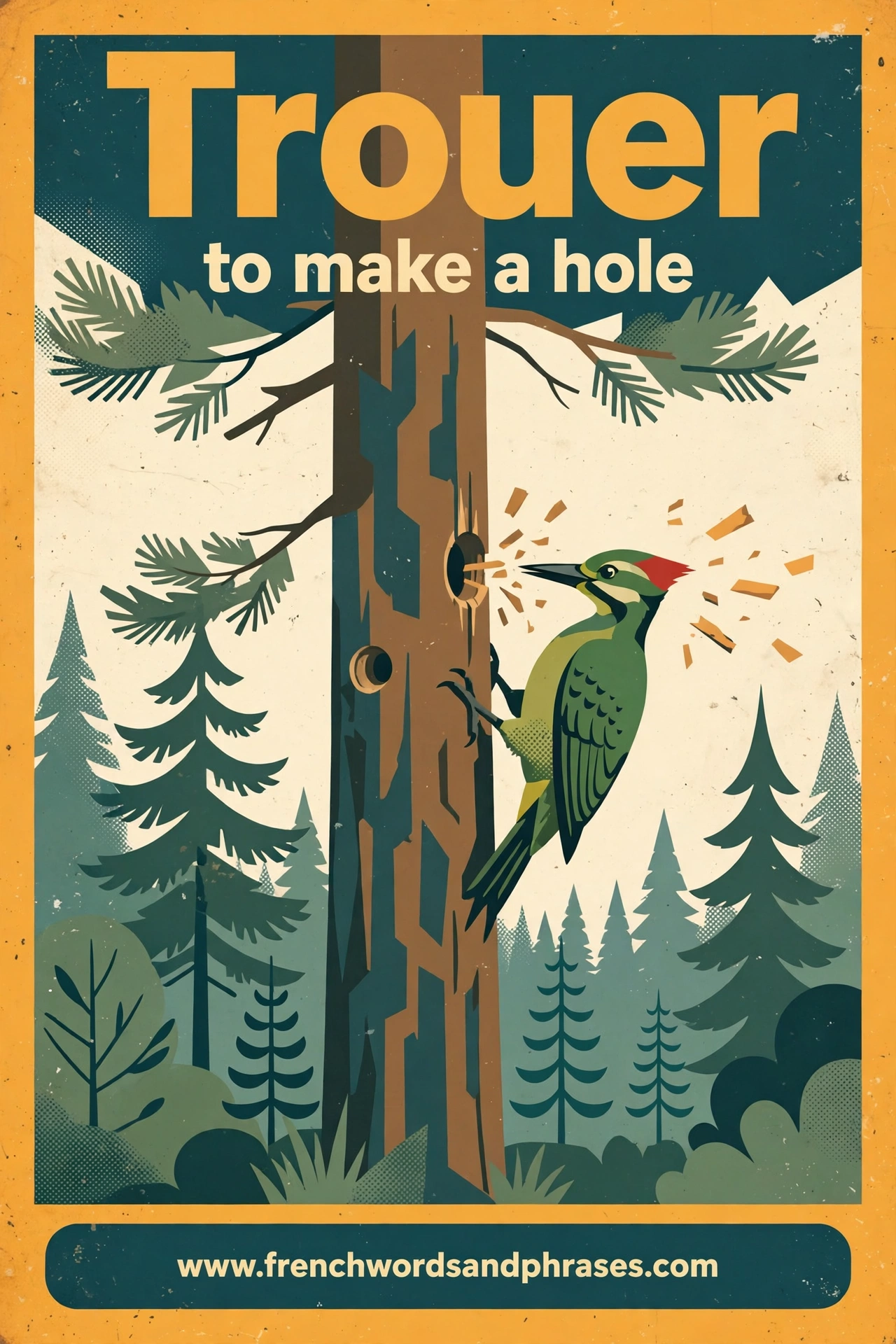
Trouer means to make a hole — to pierce something right through.
Moths in a woollen jumper, a drill biting into a wall, a bullet through a target — trouer is the verb of the hole appearing where solid material used to be, whether you planned it or not.
In this guide, you’ll learn how to conjugate trouer in all the major French tenses and moods. Explore complete conjugation tables, French examples, English translations, and practice quizzes.
Understanding the French Verb Trouer
Trouer is a regular French verb belonging to the first group of verbs, those ending in -er.
It means to make a hole. It is commonly used for drilling or piercing walls, wood, leather and paper, for clothes worn into holes by moths, rust or friction, and for anything — a target, a tyre, a cloud layer — that ends up with a hole through it.
Verb classification: First group (-er)
Auxiliary verb: Avoir
Past participle: troué
Present participle: trouant
English equivalents: To make a hole in, to pierce; un trou — a hole; une chaussette trouée — a sock with a hole in it; trouer une feuille — to punch a hole in a sheet of paper.
One important detail: trouer is simply the noun un trou (a hole) turned into a verb — to trou is to make a trou. The past participle troué works as an everyday adjective: un jean troué, jeans with holes; des bas troués, stockings with holes in them. And the noun returns in the famous trou de mémoire — a memory blank, a hole in your memory.
Experience the Word
Trouer is the verb of the breakthrough — the moment solid becomes opening.
Imagine a schoolchild with a hole punch and a stack of worksheets. Each sheet gets its two clean holes — trouée, classée — and the binder fills up in perfect order, page after page.
The paper is the same paper, minus two small circles. It has been holed — trouée — and now it belongs in the file.
How to Conjugate Trouer: Complete French Conjugation Guide
Let’s explore every major conjugation of trouer, beginning with the indicative mood.
How to Conjugate Trouer in the Indicative Mood
The indicative mood is used to express facts, observations, actions, and events.
How to Conjugate Trouer in the Present Tense (Présent)
Used for actions happening now, habitual actions, and general truths.
| Subject | Conjugation |
|---|---|
| je | troue |
| tu | troues |
| il / elle | troue |
| nous | trouons |
| vous | trouez |
| ils / elles | trouent |
Example
Les mites trouent les vieux lainages.
Moths make holes in old woollens.
Quick Quiz 1
Complete the sentence:
Les mites ______ les vieux lainages.
Reveal the answer
trouent
Les mites trouent les vieux lainages.
Moths make holes in old woollens.
How to Conjugate Trouer in the Passé Composé
Used for completed actions in the past. Trouer takes the auxiliary verb avoir.
| Subject | Conjugation |
|---|---|
| j’ | ai troué |
| tu | as troué |
| il / elle | a troué |
| nous | avons troué |
| vous | avez troué |
| ils / elles | ont troué |
Example
Il a troué son jean au genou.
He wore a hole in his jeans at the knee.
How to Conjugate Trouer in the Imparfait (Imperfect Tense)
Used for habitual past actions, descriptions, and ongoing situations in the past.
| Subject | Conjugation |
|---|---|
| je | trouais |
| tu | trouais |
| il / elle | trouait |
| nous | trouions |
| vous | trouiez |
| ils / elles | trouaient |
Example
La rouille trouait lentement la tôle.
Rust was slowly eating holes in the sheet metal.
Quick Quiz 2
Choose the correct form:
She punched a hole in the sheet.
Elle ______ la feuille. (a troué / est trouée)
Reveal the answer
a troué
Elle a troué la feuille.
Trouer takes avoir.
How to Conjugate Trouer in the Plus-que-parfait
Used to describe an action that had already been completed before another past event.
| Subject | Conjugation |
|---|---|
| j’ | avais troué |
| tu | avais troué |
| il / elle | avait troué |
| nous | avions troué |
| vous | aviez troué |
| ils / elles | avaient troué |
Example
Elle avait troué la feuille pour la classer.
She had punched a hole in the sheet to file it.
How to Conjugate Trouer in the Passé Simple
Primarily used in formal writing, literature, and historical narratives. It is rarely used in everyday conversation.
| Subject | Conjugation |
|---|---|
| je | trouai |
| tu | trouas |
| il / elle | troua |
| nous | trouâmes |
| vous | trouâtes |
| ils / elles | trouèrent |
Example
La balle troua la cible en plein centre.
The bullet pierced the target right in the centre.
How to Conjugate Trouer in the Passé Antérieur
A literary tense used to express an action completed immediately before another past action, generally in the passé simple.
| Subject | Conjugation |
|---|---|
| j’ | eus troué |
| tu | eus troué |
| il / elle | eut troué |
| nous | eûmes troué |
| vous | eûtes troué |
| ils / elles | eurent troué |
Example
Quand il eut troué le mur, il passa le câble.
When he had drilled through the wall, he fed the cable through.
How to Conjugate Trouer in the Future Tense (Futur Simple)
Used to describe actions that will take place in the future.
| Subject | Conjugation |
|---|---|
| je | trouerai |
| tu | troueras |
| il / elle | trouera |
| nous | trouerons |
| vous | trouerez |
| ils / elles | troueront |
Example
Nous trouerons la planche à cet endroit.
We will drill a hole in the board at this spot.
How to Conjugate Trouer in the Futur Antérieur (Future Perfect)
Used for an action that will have been completed before a particular point in the future.
| Subject | Conjugation |
|---|---|
| j’ | aurai troué |
| tu | auras troué |
| il / elle | aura troué |
| nous | aurons troué |
| vous | aurez troué |
| ils / elles | auront troué |
Example
À la fin, tu auras troué toutes les feuilles du dossier.
By the end, you will have punched holes in all the sheets in the file.
How to Conjugate Trouer in the Near Future (Futur Proche)
Used to describe something that is going to happen soon. Formed with aller + infinitive.
| Subject | Conjugation |
|---|---|
| je | vais trouer |
| tu | vas trouer |
| il / elle | va trouer |
| nous | allons trouer |
| vous | allez trouer |
| ils / elles | vont trouer |
Example
Attention, tu vas trouer la nappe !
Careful, you are going to make a hole in the tablecloth!
How to Conjugate Trouer in the Conditional Mood
The conditional mood expresses what would happen under certain circumstances. It is also frequently used to make polite requests or express wishes.
How to Conjugate Trouer in the Present Conditional
| Subject | Conjugation |
|---|---|
| je | trouerais |
| tu | trouerais |
| il / elle | trouerait |
| nous | trouerions |
| vous | troueriez |
| ils / elles | troueraient |
Example
Avec une perceuse, on trouerait ce métal facilement.
With a drill, we could pierce this metal easily.
How to Conjugate Trouer in the Past Conditional
| Subject | Conjugation |
|---|---|
| j’ | aurais troué |
| tu | aurais troué |
| il / elle | aurait troué |
| nous | aurions troué |
| vous | auriez troué |
| ils / elles | auraient troué |
Example
Il aurait troué le mur si la mèche n’avait pas cassé.
He would have drilled the wall if the drill bit had not snapped.
Trouer in the Literary Past Conditional Form
This less common literary form uses the imperfect subjunctive of avoir.
| Subject | Conjugation |
|---|---|
| j’ | eusse troué |
| tu | eusses troué |
| il / elle | eût troué |
| nous | eussions troué |
| vous | eussiez troué |
| ils / elles | eussent troué |
Example
Il eût troué la porte plutôt que d’attendre la clé.
He would have bored through the door rather than wait for the key.
How to Conjugate Trouer in the Subjunctive Mood
The subjunctive is used to express wishes, emotions, doubts, necessity, and uncertainty. It frequently follows expressions such as il faut que (it is necessary that) or bien que (although).
How to Conjugate Trouer in the Present Subjunctive
| Subject | Conjugation |
|---|---|
| que je | troue |
| que tu | troues |
| qu’il / qu’elle | troue |
| que nous | trouions |
| que vous | trouiez |
| qu’ils / qu’elles | trouent |
Example
Il faut que tu troues le cuir avant de coudre.
You must punch the leather before sewing.
Quick Quiz 3
Complete the sentence using the subjunctive:
Il faut que vous ______ le cuir avant de coudre.
Reveal the answer
trouiez
Il faut que vous trouiez le cuir avant de coudre.
You must punch the leather before sewing.
How to Conjugate Trouer in the Imperfect Subjunctive
A literary tense, rarely encountered in modern spoken French.
| Subject | Conjugation |
|---|---|
| que je | trouasse |
| que tu | trouasses |
| qu’il / qu’elle | trouât |
| que nous | trouassions |
| que vous | trouassiez |
| qu’ils / qu’elles | trouassent |
Example
Je voulais qu’il trouât la planche au centre.
I wanted him to drill the board in the centre.
How to Conjugate Trouer in the Pluperfect Subjunctive
A literary construction used to express an action completed before another past action.
| Subject | Conjugation |
|---|---|
| que j’ | eusse troué |
| que tu | eusses troué |
| qu’il / qu’elle | eût troué |
| que nous | eussions troué |
| que vous | eussiez troué |
| qu’ils / qu’elles | eussent troué |
Example
On vérifia qu’ils eussent troué au bon endroit.
They checked that the holes had been made in the right place.
How to Conjugate Trouer in the Past Subjunctive
| Subject | Conjugation |
|---|---|
| que j’ | aie troué |
| que tu | aies troué |
| qu’il / qu’elle | ait troué |
| que nous | ayons troué |
| que vous | ayez troué |
| qu’ils / qu’elles | aient troué |
Example
Je suis content que tu aies troué sans fissurer le bois.
I am glad you made the hole without splitting the wood.
How to Conjugate Trouer in the Imperative
The imperative is used to give commands, instructions, invitations, or suggestions. Subject pronouns are omitted.
How to Conjugate Trouer in the Present Imperative
| Person | Conjugation |
|---|---|
| (tu) | troue |
| (nous) | trouons |
| (vous) | trouez |
Example
Troue la feuille ici, entre les deux lignes !
Punch a hole in the sheet here, between the two lines!
Quick Quiz 4
How would you say Punch a hole here (tu form)?
Reveal the answer
Troue ici !
French Participles of Trouer
Participles are verb forms that can be used in compound tenses and other grammatical constructions.
Present Participle of Trouer
trouant
En trouant le mur, il a réveillé tout l’immeuble.
By drilling through the wall, he woke the whole building.
Past Participle of Trouer
troué
Trouée par les mites, la robe était perdue.
Holed by moths, the dress was ruined.
Trouer in Everyday French: Real-Life Examples
Now that you know the conjugations, let’s see how trouer appears in everyday French.
Example 1 — Present
Les mites trouent les pulls en laine.
Moths make holes in woollen jumpers.
Example 2 — Passé composé
J’ai troué mon jean en tombant.
I tore a hole in my jeans when I fell.
Example 3 — Imparfait
La rouille trouait la vieille tôle.
Rust was eating holes in the old sheet metal.
Example 4 — Future
Nous trouerons le mur pour le câble.
We will drill through the wall for the cable.
Example 5 — Conditional
Avec une perceuse, tu trouerais plus vite.
With a drill, you would make holes faster.
Example 6 — Imperative
Troue les feuilles avant de les classer !
Punch the sheets before filing them!
Beyond Translation: The Meaning of Trouer
English needs a whole toolkit of phrases — make a hole, drill through, wear a hole in, punch — where French simply turns the noun into a verb: trouer.
Un trou, trouer, troué.
The hole, the making of it, and the thing that has one: learn the little family and half the DIY shop — and every moth-eaten sock in France — starts to make sense.
How to Remember the French Verb Trouer
Remember it this way: Trouer is about un trou turned into an action — the hole appearing.
- Un trou is a hole; trouer is to make one — noun first, verb second.
- Troué works as an adjective: un jean troué, une chaussette trouée.
- Regular -er: je troue, nous trouons, past participle troué.
The key idea is un trou turned into an action — the hole appearing.
Test Your Knowledge of Trouer
Let’s see how much you’ve learned. Try answering these questions before revealing the answers.
Question 1
What is the French noun inside trouer?
Reveal the answer
Un trou — a hole. Trouer is to make a trou.
Question 2
How do you say He wore a hole in his jeans in French?
Reveal the answer
Il a troué son jean.
Question 3
Translate: Moths make holes in old woollens.
Reveal the answer
Les mites trouent les vieux lainages.
Question 4
What is the past participle of trouer?
Reveal the answer
Troué.
Question 5
Complete the sentence:
Il faut que tu ______ le cuir avant de coudre.
Reveal the answer
troues
Il faut que tu troues le cuir avant de coudre.
You must punch the leather before sewing.
Your Final Challenge
Can You Use It?
How would you say this in French?
She punches a hole in each sheet, files it in the binder, and the file becomes immaculate.
Reveal the answer
Elle troue chaque feuille, la classe dans le classeur, et le dossier devient impeccable.
She punches a hole in each sheet, files it in the binder, and the file becomes immaculate.
A little French. A little curiosity. A richer everyday life.
LEARN FRENCH ONE WORD AT A TIME