
A French Word to Live By
How to Conjugate Trotter in French
/tʁɔ.te/
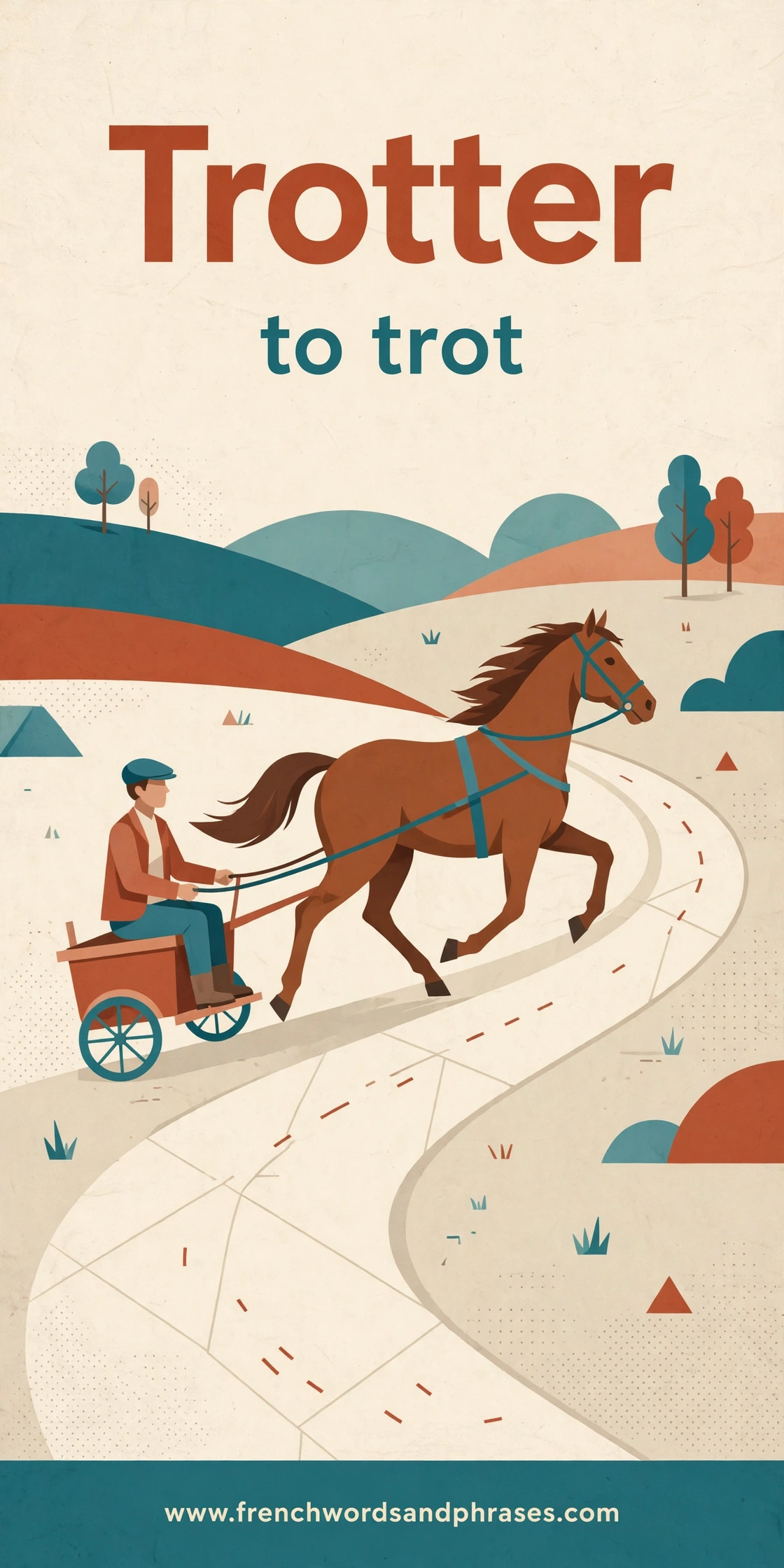
Trotter means to trot — the horse’s brisk, two-beat gait that falls between the walk and the gallop.
In the riding school the instructor calls out, and the pony lifts into a neat, springy rhythm — one-two, one-two, hooves tapping the sand. Trotter is the verb of that gait, and French also lends it to people hurrying along and to tunes that will not leave your head.
In this guide, you’ll learn how to conjugate trotter in all the major French tenses and moods. Explore complete conjugation tables, French examples, English translations, and practice quizzes.
Understanding the French Verb Trotter
Trotter is a regular French verb belonging to the first group of verbs, those ending in -er.
It means to trot. It is commonly used in riding and horse-racing for the trot itself, of people walking briskly with short quick steps, and figuratively for thoughts, tunes and worries that keep going round in someone’s head.
Verb classification: First group (-er)
Auxiliary verb: Avoir
Past participle: trotté
Present participle: trottant
English equivalents: To trot (of a horse); le trot — the trot; the three gaits are le pas (the walk), le trot (the trot), le galop (the gallop); une idée qui trotte dans la tête — an idea that keeps running round one’s head; (of a person) to trip along briskly.
One important detail: the double t is already inside the infinitive, so there is nothing extra to learn — je trotte, nous trottons, je trottais, future je trotterai, past participle trotté. Unlike trompéter, which must double its consonant as it goes, trotter carries its pair of t’s everywhere from the start. Do not miss its figurative rider: une chanson qui trotte dans la tête is a tune that trots round and round in your head.
Experience the Word
Trotter is the verb of the in-between gait — faster than a walk, calmer than a gallop, and full of spring.
Imagine a Sunday morning at the stables. A little girl in a velvet cap posts up and down in rhythm as her pony trots the long side of the arena, ears forward, tail floating. The instructor nods: the trot is the gait where horse and rider learn to dance together.
Hooves, sand, one-two, one-two. The pony has settled into its trot — il trotte — and the whole arena moves to its beat.
How to Conjugate Trotter: Complete French Conjugation Guide
Let’s explore every major conjugation of trotter, beginning with the indicative mood.
How to Conjugate Trotter in the Indicative Mood
The indicative mood is used to express facts, observations, actions, and events.
How to Conjugate Trotter in the Present Tense (Présent)
Used for actions happening now, habitual actions, and general truths.
| Subject | Conjugation |
|---|---|
| je | trotte |
| tu | trottes |
| il / elle | trotte |
| nous | trottons |
| vous | trottez |
| ils / elles | trottent |
Example
Le cheval trotte autour de la carrière sous l’œil du moniteur.
The horse trots around the arena under the instructor’s eye.
Quick Quiz 1
Complete the sentence:
Nous ______ derrière le moniteur dans la carrière.
Reveal the answer
trottons
Nous trottons derrière le moniteur dans la carrière.
We trot behind the instructor in the arena.
How to Conjugate Trotter in the Passé Composé
Used for completed actions in the past. Trotter takes the auxiliary verb avoir.
| Subject | Conjugation |
|---|---|
| j’ | ai trotté |
| tu | as trotté |
| il / elle | a trotté |
| nous | avons trotté |
| vous | avez trotté |
| ils / elles | ont trotté |
Example
Le poney a trotté trois tours de piste sans ralentir.
The pony trotted three laps of the track without slowing down.
How to Conjugate Trotter in the Imparfait (Imperfect Tense)
Used for habitual past actions, descriptions, and ongoing situations in the past.
| Subject | Conjugation |
|---|---|
| je | trottais |
| tu | trottais |
| il / elle | trottait |
| nous | trottions |
| vous | trottiez |
| ils / elles | trottaient |
Example
Le vieux cheval trottait encore fièrement devant la calèche.
The old horse still used to trot proudly in front of the carriage.
Quick Quiz 2
Choose the correct form:
The pony trotted three laps.
Le poney ______ trois tours. (a trotté / est trotté)
Reveal the answer
a trotté
Le poney a trotté trois tours.
Trotter takes avoir.
How to Conjugate Trotter in the Plus-que-parfait
Used to describe an action that had already been completed before another past event.
| Subject | Conjugation |
|---|---|
| j’ | avais trotté |
| tu | avais trotté |
| il / elle | avait trotté |
| nous | avions trotté |
| vous | aviez trotté |
| ils / elles | avaient trotté |
Example
Elle avait trotté jusqu’au village pour porter la nouvelle à temps.
She had hurried along to the village to bring the news in time.
How to Conjugate Trotter in the Passé Simple
Primarily used in formal writing, literature, and historical narratives. It is rarely used in everyday conversation.
| Subject | Conjugation |
|---|---|
| je | trottai |
| tu | trottas |
| il / elle | trotta |
| nous | trottâmes |
| vous | trottâtes |
| ils / elles | trottèrent |
Example
Le cheval trotta jusqu’à la barrière puis s’arrêta net.
The horse trotted up to the fence and then stopped dead.
How to Conjugate Trotter in the Passé Antérieur
A literary tense used to express an action completed immediately before another past action, generally in the passé simple.
| Subject | Conjugation |
|---|---|
| j’ | eus trotté |
| tu | eus trotté |
| il / elle | eut trotté |
| nous | eûmes trotté |
| vous | eûtes trotté |
| ils / elles | eurent trotté |
Example
Quand le poney eut trotté trois tours, l’enfant descendit en riant.
When the pony had trotted three laps, the child climbed down laughing.
How to Conjugate Trotter in the Future Tense (Futur Simple)
Used to describe actions that will take place in the future.
| Subject | Conjugation |
|---|---|
| je | trotterai |
| tu | trotteras |
| il / elle | trottera |
| nous | trotterons |
| vous | trotterez |
| ils / elles | trotteront |
Example
Demain, les chevaux trotteront dans le pré dès l’aube.
Tomorrow, the horses will trot in the meadow from dawn.
How to Conjugate Trotter in the Futur Antérieur (Future Perfect)
Used for an action that will have been completed before a particular point in the future.
| Subject | Conjugation |
|---|---|
| j’ | aurai trotté |
| tu | auras trotté |
| il / elle | aura trotté |
| nous | aurons trotté |
| vous | aurez trotté |
| ils / elles | auront trotté |
Example
À midi, le cheval aura trotté dix kilomètres sans effort.
By noon, the horse will have trotted ten kilometres without effort.
How to Conjugate Trotter in the Near Future (Futur Proche)
Used to describe something that is going to happen soon. Formed with aller + infinitive.
| Subject | Conjugation |
|---|---|
| je | vais trotter |
| tu | vas trotter |
| il / elle | va trotter |
| nous | allons trotter |
| vous | allez trotter |
| ils / elles | vont trotter |
Example
Le poney va trotter, tiens bien les rênes !
The pony is going to trot, hold the reins tight!
How to Conjugate Trotter in the Conditional Mood
The conditional mood expresses what would happen under certain circumstances. It is also frequently used to make polite requests or express wishes.
How to Conjugate Trotter in the Present Conditional
| Subject | Conjugation |
|---|---|
| je | trotterais |
| tu | trotterais |
| il / elle | trotterait |
| nous | trotterions |
| vous | trotteriez |
| ils / elles | trotteraient |
Example
Sans cette boue, le cheval trotterait plus volontiers.
Without this mud, the horse would trot more willingly.
How to Conjugate Trotter in the Past Conditional
| Subject | Conjugation |
|---|---|
| j’ | aurais trotté |
| tu | aurais trotté |
| il / elle | aurait trotté |
| nous | aurions trotté |
| vous | auriez trotté |
| ils / elles | auraient trotté |
Example
Il aurait trotté jusqu’à la ferme si la nuit n’était pas tombée.
He would have trotted all the way to the farm if night had not fallen.
Trotter in the Literary Past Conditional Form
This less common literary form uses the imperfect subjunctive of avoir.
| Subject | Conjugation |
|---|---|
| j’ | eusse trotté |
| tu | eusses trotté |
| il / elle | eût trotté |
| nous | eussions trotté |
| vous | eussiez trotté |
| ils / elles | eussent trotté |
Example
Le cheval eût trotté jusqu’au village voisin sans se fatiguer.
The horse would have trotted to the neighbouring village without tiring.
How to Conjugate Trotter in the Subjunctive Mood
The subjunctive is used to express wishes, emotions, doubts, necessity, and uncertainty. It frequently follows expressions such as il faut que (it is necessary that) or bien que (although).
How to Conjugate Trotter in the Present Subjunctive
| Subject | Conjugation |
|---|---|
| que je | trotte |
| que tu | trottes |
| qu’il / qu’elle | trotte |
| que nous | trottions |
| que vous | trottiez |
| qu’ils / qu’elles | trottent |
Example
Il faut que le cheval trotte régulièrement, sans précipitation.
The horse must trot steadily, without rushing.
Quick Quiz 3
Complete the sentence using the subjunctive:
Il faut que vous ______ sans précipitation.
Reveal the answer
trottiez
Il faut que vous trottiez sans précipitation.
You must trot without rushing.
How to Conjugate Trotter in the Imperfect Subjunctive
A literary tense, rarely encountered in modern spoken French.
| Subject | Conjugation |
|---|---|
| que je | trottasse |
| que tu | trottasses |
| qu’il / qu’elle | trottât |
| que nous | trottassions |
| que vous | trottassiez |
| qu’ils / qu’elles | trottassent |
Example
Le moniteur voulait que le poney trottât en cercle bien rond.
The instructor wanted the pony to trot in a nice round circle.
How to Conjugate Trotter in the Pluperfect Subjunctive
A literary construction used to express an action completed before another past action.
| Subject | Conjugation |
|---|---|
| que j’ | eusse trotté |
| que tu | eusses trotté |
| qu’il / qu’elle | eût trotté |
| que nous | eussions trotté |
| que vous | eussiez trotté |
| qu’ils / qu’elles | eussent trotté |
Example
On doutait que le vieux cheval eût trotté si loin autrefois.
People doubted that the old horse had ever trotted so far.
How to Conjugate Trotter in the Past Subjunctive
| Subject | Conjugation |
|---|---|
| que j’ | aie trotté |
| que tu | aies trotté |
| qu’il / qu’elle | ait trotté |
| que nous | ayons trotté |
| que vous | ayez trotté |
| qu’ils / qu’elles | aient trotté |
Example
Je suis content que le poney ait trotté sans faire d’écart.
I am glad the pony trotted without shying once.
How to Conjugate Trotter in the Imperative
The imperative is used to give commands, instructions, invitations, or suggestions. Subject pronouns are omitted.
How to Conjugate Trotter in the Present Imperative
| Person | Conjugation |
|---|---|
| (tu) | trotte |
| (nous) | trottons |
| (vous) | trottez |
Example
Trotte, mon beau, montre-nous ta belle allure !
Trot, my beauty, show us your fine gait!
Quick Quiz 4
How would you say Trot gently (tu form, to a horse)?
Reveal the answer
Trotte doucement !
French Participles of Trotter
Participles are verb forms that can be used in compound tenses and other grammatical constructions.
Present Participle of Trotter
trottant
En trottant le long de la rivière, le cheval respirait l’air frais du matin.
Trotting along the river, the horse breathed in the fresh morning air.
Past Participle of Trotter
trotté
Après avoir trotté une heure, le cheval était couvert de sueur.
After trotting for an hour, the horse was covered in sweat.
Trotter in Everyday French: Real-Life Examples
Now that you know the conjugations, let’s see how trotter appears in everyday French.
Example 1 — Present
Le cheval trotte dans la carrière.
The horse trots in the arena.
Example 2 — Passé composé
Le poney a trotté trois tours de piste.
The pony trotted three laps of the track.
Example 3 — Imparfait
Cette chanson me trottait dans la tête toute la journée.
That song kept running through my head all day.
Example 4 — Future
Les chevaux trotteront dans le pré demain.
The horses will trot in the meadow tomorrow.
Example 5 — Conditional
Le cheval trotterait mieux sur un sol sec.
The horse would trot better on dry ground.
Example 6 — Imperative
Trotte doucement, ne passe pas au galop !
Trot gently, don’t break into a gallop!
Beyond Translation: The Meaning of Trotter
English trot stays mostly at the stables; French trotter wanders much further.
It is the gait of anything that keeps moving in small, quick steps.
A tune trots in your head, an idea trots at the back of your mind, and a busy grandmother trots off to the shops. Learn the horse first — le pas, le trot, le galop — then listen for the verb trotting through everyday French.
How to Remember the French Verb Trotter
Remember it this way: Trotter is about one-two, one-two in the riding arena — and the tune that trots round your head all day.
- Le trot is the gait between le pas (walk) and le galop (gallop); trotter is to move at that gait.
- The double t is built into the infinitive: je trotte, nous trottons, je trotterai — nothing changes.
- Une chanson qui trotte dans la tête — a song that keeps running through your head.
The key idea is one-two, one-two in the riding arena — and the tune that trots round your head all day.
Test Your Knowledge of Trotter
Let’s see how much you’ve learned. Try answering these questions before revealing the answers.
Question 1
How do you say the horse trots in French?
Reveal the answer
Le cheval trotte.
Question 2
What are the horse’s three gaits in French?
Reveal the answer
Le pas, le trot et le galop.
Question 3
Translate: That song kept running through my head.
Reveal the answer
Cette chanson me trottait dans la tête.
Question 4
What is the past participle of trotter?
Reveal the answer
Trotté.
Question 5
Complete the sentence:
Il faut que le cheval ______ régulièrement.
Reveal the answer
trotte
Il faut que le cheval trotte régulièrement.
The horse must trot steadily.
Your Final Challenge
Can You Use It?
How would you say this in French?
The horse trots along the river, and its mane dances in the wind.
Reveal the answer
Le cheval trotte le long de la rivière, et sa crinière danse dans le vent.
The horse trots along the river, and its mane dances in the wind.
A little French. A little curiosity. A richer everyday life.
LEARN FRENCH ONE WORD AT A TIME




