A French Word to Live By
Translate Très to English
/tʁɛ/
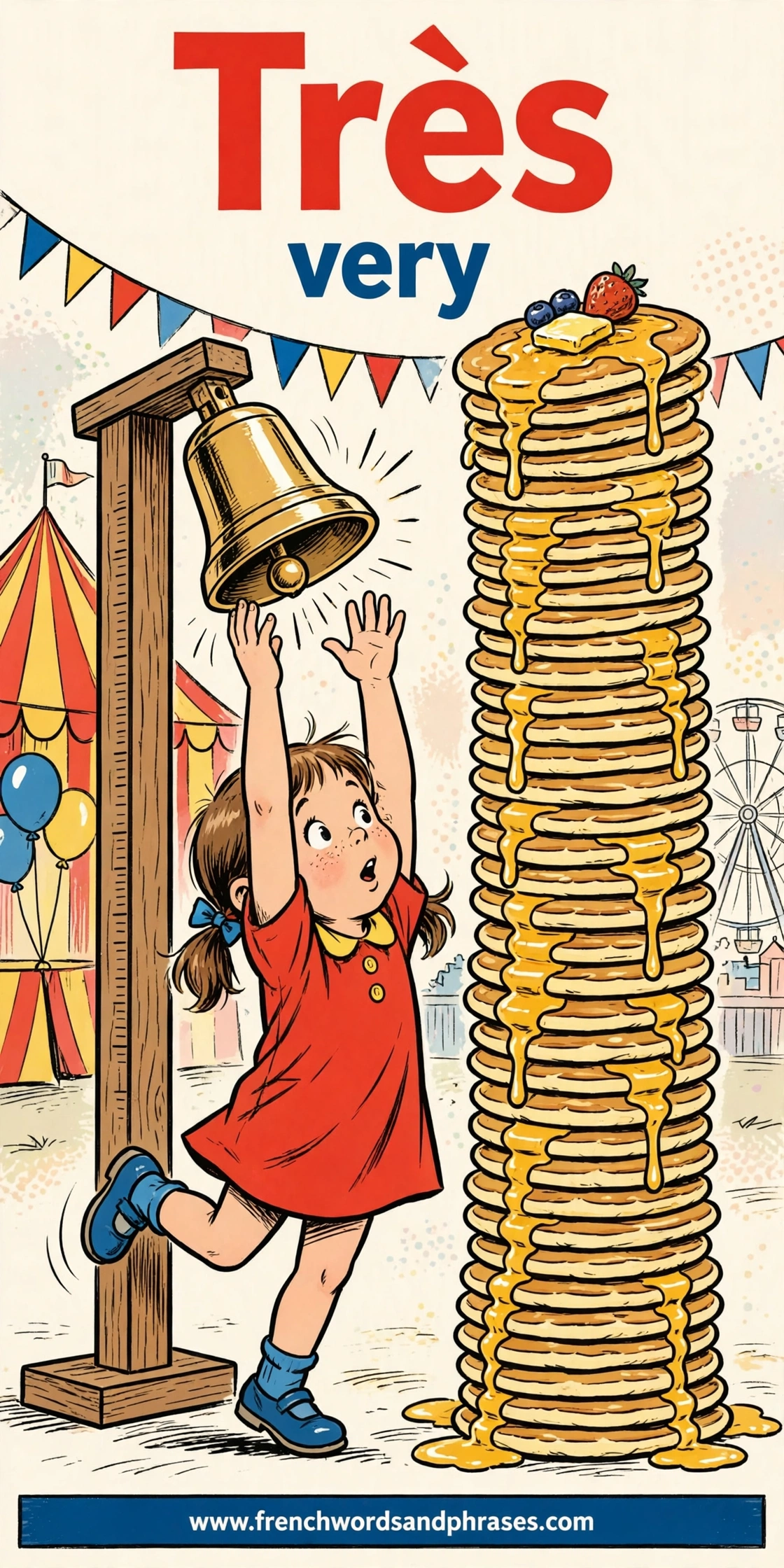
Très means very.
The soup arrives steaming, the bread is still warm from the oven, and the little restaurant hums with approval. « C’est très bon », says the woman at the next table — not just good, very good indeed.
In this guide, you’ll learn what très means in English, why it is not the same as trop, where it stands before adjectives and adverbs, and why it can never stand before a noun or a verb. Explore French examples, English translations, and practice quizzes.
Understanding the French Adverb Très
Très is a French adverb of degree. It strengthens the word that follows it — an adjective or another adverb — and it never changes form: no feminine, no plural, just très everywhere.
It means very. Très is the everyday amplifier of French: très content, very happy; très vite, very fast; très froid, very cold. It turns the volume up one clear notch without tipping into excess — that danger zone belongs to its neighbour trop, too much.
Type: Adverb of degree — intensity
Answers the question: How much? — to a high degree
Changes form: Never — très is invariable
English equivalents: Very; really (before an adjective).
One important usage detail: très goes before adjectives and adverbs only. It cannot stand before a noun — for a very big crowd of nouns, French switches to beaucoup de — and it cannot strengthen a verb: I like it very much is je l’aime beaucoup, never « je l’aime très ».
Experience the Word
Très is the small word of emphasis you will hear a hundred times a day in France — in compliments, in weather reports, in the market, at the family table.
Imagine the market stall at noon: the cheese is très frais, the strawberries are très parfumées, the queue is très longue, and the stallholder, smiling, declares that business is très bonne aujourd’hui.
You have not just said good or fast or cold. You have turned the volume up, cleanly and exactly.
How to Use Très in French: Complete Guide
Let’s explore how très works in French, beginning with the whole word on one card.
Très at a Glance
Before the details, here is the whole word on one card.
The Whole Word on One Card
Meaning, type, position and form — très in four lines.
| Point | Très |
|---|---|
| Meaning | very |
| Type | adverb of degree — intensity |
| Usual position | immediately before an adjective or an adverb |
| Form | invariable — never changes |
Ce café est très chaud.
This coffee is very hot.
Where Très Goes in the Sentence
Très is glued to the word it strengthens: it stands directly in front of an adjective or an adverb, and the pair travels together.
| Situation | Pattern |
|---|---|
| Before an adjective | très + adjective — un livre très intéressant |
| Before an adverb | très + adverb — elle parle très vite |
| After être | être très + adjective — le ciel est très bleu |
| In a negative | ne + verb + très + adjective — il n’est pas très grand |
Example
Elle court très vite le matin.
She runs very fast in the morning.
Quick Quiz 1
True or false: « je l’aime très » is correct French for I like it very much.
Reveal the answer
False
Très cannot strengthen a verb. Use beaucoup: Je l’aime beaucoup.
I like it very much.
Très with Adjectives: The Everyday Pairs
Très spends most of its life in front of the adjectives of daily life — weather, feelings, food and people.
| French | In English |
|---|---|
| très content | very happy |
| très fatigué | very tired |
| très intéressant | very interesting |
| très beau | very beautiful |
| très froid | very cold |
Example
Les enfants sont très contents aujourd’hui.
The children are very happy today.
Très with Adverbs: Very Fast, Very Well, Very Often
Très also strengthens adverbs, making an action faster, better, sooner or more frequent.
| French | In English |
|---|---|
| très vite | very fast |
| très bien | very well |
| très souvent | very often |
| très tôt | very early |
| très lentement | very slowly |
Example
Il se lève très tôt tous les jours.
He gets up very early every day.
Complete the sentence:
Ce gâteau est ______ délicieux. (very)
Reveal the answer
très
Ce gâteau est très délicieux.
This cake is very delicious.
Très or Trop? Very, or Too Much?
The most important choice on this page. Très praises; trop complains. Très stops at a high degree — trop goes one step too far.
| Word | The Difference |
|---|---|
| très chaud | very hot — a strong, neutral fact |
| trop chaud | too hot — hotter than wanted, a problem |
| très bon | very good — praise |
| trop bon | too good — suspicious, or more than is wise |
| Safe rule | If English too would spoil the sentence, choose très |
Example
La soupe est très bonne, mais elle est trop chaude.
The soup is very good, but it is too hot.
When Très Cannot Be Used
Two places are closed to très: before a noun, and directly after a verb to mean very much. French hands those jobs to beaucoup.
| You want to say | Correct French |
|---|---|
| very many people | beaucoup de gens (never « très de gens ») |
| I work very much / a lot | je travaille beaucoup |
| thank you very much | merci beaucoup |
| a very interesting book | un livre très intéressant (très is fine here — an adjective follows) |
Example
Merci beaucoup pour ce très beau cadeau.
Thank you very much for this very beautiful present.
Quick Quiz 3
Which is the compliment: « ce vin est très bon » or « ce vin est trop bon »?
Reveal the answer
Très bon
Très bon is simple praise: very good. Trop bon suggests too good — more than is wise, or too good to be true.
Très in Polite and Everyday Phrases
Très oils the wheels of French politeness and daily chat — in greetings, wishes and small courtesies.
| Expression | In English |
|---|---|
| très bien | very well / very good (also an answer: very well then) |
| très volontiers | with great pleasure |
| à très bientôt | see you very soon |
| très heureux de vous rencontrer | very pleased to meet you |
| un très bon anniversaire | a very happy birthday |
Example
À très bientôt, et merci pour tout !
See you very soon, and thank you for everything!
Turning the Volume: From Assez to Trop
Très sits on a scale of degree with its neighbours. Learn the scale and you can grade anything in French.
| French | In English |
|---|---|
| assez | quite, fairly — enough |
| bien | quite, rather (bien content — quite pleased) |
| très | very |
| tellement | so (much) — stronger, more emotional |
| trop | too (much) — past the limit |
Example
Il fait assez froid, très froid même, mais pas trop froid pour une promenade.
It is quite cold, very cold even, but not too cold for a walk.
Translate: Thank you very much.
Reveal the answer
Merci beaucoup.
Never « merci très » — after a verb and before a noun, French always chooses beaucoup.
Très in Everyday French: Real-Life Examples
Now that you know the word, let’s see how très appears in everyday French.
Example 1 — At the table
Ce plat est très bon, je vais reprendre un peu.
This dish is very good, I am going to have a little more.
Example 2 — Weather
Il fait très froid ce matin, mets ton manteau.
It is very cold this morning, put your coat on.
Example 3 — At work
La réunion a été très intéressante.
The meeting was very interesting.
Example 4 — Family
Les enfants sont très fatigués ce soir.
The children are very tired this evening.
Example 5 — Travel
Le train roule très vite entre les deux villes.
The train travels very fast between the two cities.
Example 6 — Shopping
Cette robe est très jolie, mais un peu chère.
This dress is very pretty, but a little expensive.
Beyond Translation: The Meaning of Très
English very is a workhorse that goes anywhere; French splits the work with unusual tidiness. Très handles the adjectives and adverbs, beaucoup handles the verbs and the nouns, and trop stands guard at the border of excess.
To say très is to praise without alarming.
It is the most encouraging word in the language: très bien from a teacher, très bon from a cook, très beau from a friend — approval, turned up one warm notch.
How to Remember the French Adverb Très
Remember it this way: Très means very — it stands before adjectives and adverbs, and it never tips into too much.
- You praise with it — c’est très bon, elle est très contente.
- You keep it off verbs and nouns — je l’aime beaucoup, merci beaucoup.
- You stop before excess — très chaud is very hot; trop chaud is a complaint.
The key idea is very — before adjectives and adverbs only; beaucoup for verbs and nouns; trop = too much.
Test Your Knowledge of Très
Let’s see how much you’ve learned. Try answering these questions before revealing the answers.
Question 1
What does très mean?
Reveal the answer
Very — it strengthens an adjective or an adverb.
Question 2
How do you say thank you very much in French?
Reveal the answer
Merci beaucoup — never « merci très ».
Question 3
Translate: She runs very fast.
Reveal the answer
Elle court très vite.
Question 4
What is the difference between très chaud and trop chaud?
Reveal the answer
Très chaud is very hot (a fact); trop chaud is too hot (a problem).
Question 5
Complete the sentence:
Je travaille ______ en ce moment. (a lot)
Reveal the answer
beaucoup
Je travaille beaucoup en ce moment.
Très cannot strengthen a verb.
Your Final Challenge
Can You Use It?
How would you say this in French?
“This soup is very good, but it is too hot.”
Reveal the answer
Cette soupe est très bonne, mais elle est trop chaude.
This soup is very good, but it is too hot.
A little French. A little curiosity. A richer everyday life.
LEARN FRENCH ONE WORD AT A TIME