
A French Word to Live By
How to Conjugate Hacher in French
/a.ʃe/
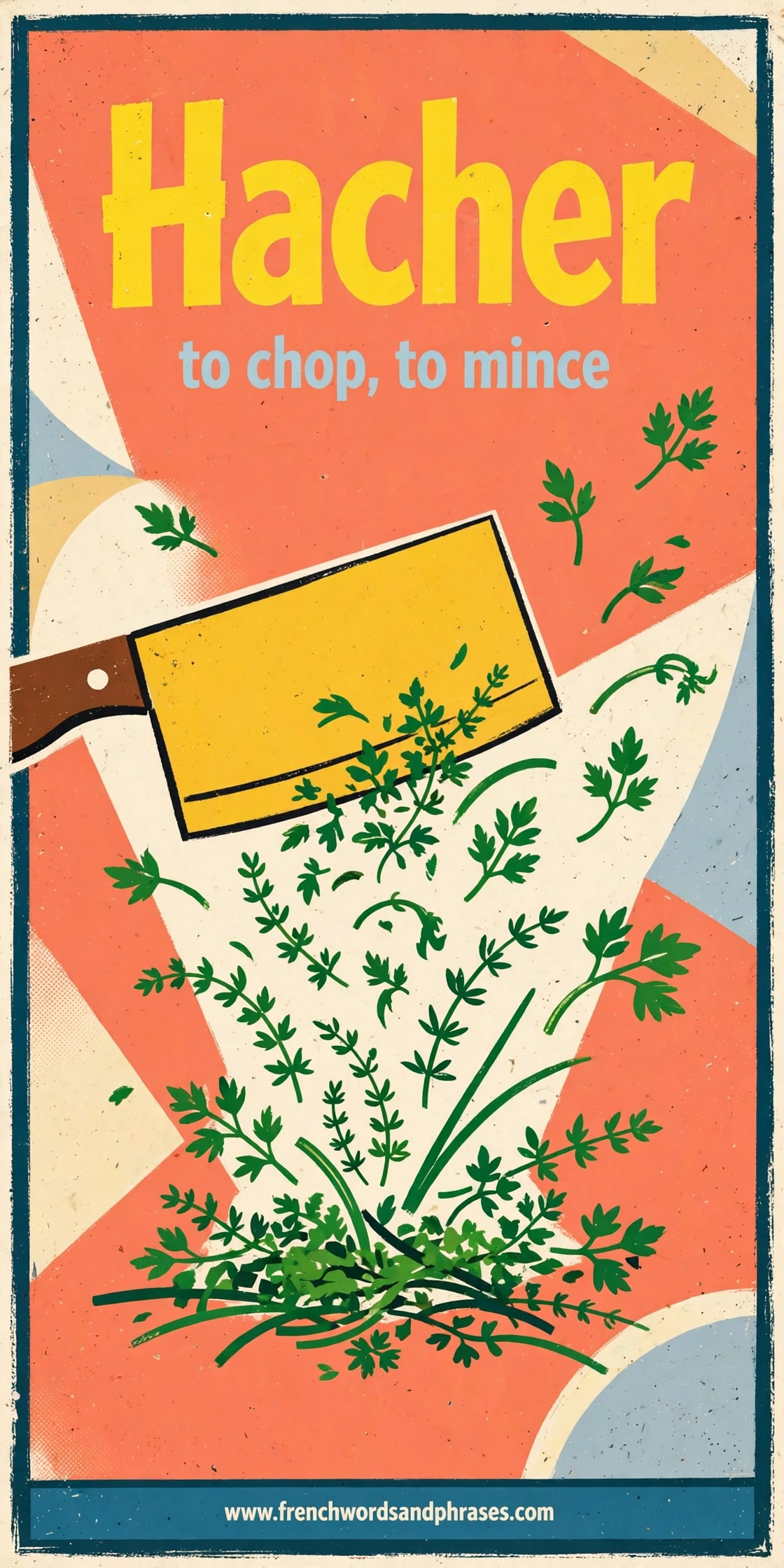
Hacher means to chop or to mince.
Parsley scattered over a soup, onions reduced to a fine rain, meat ground for meatballs — hacher is the verb of the knife in quick rhythm, cutting small and smaller until the pieces are ready to disappear into a dish.
In this guide, you’ll learn how to conjugate hacher in all the major French tenses and moods. Explore complete conjugation tables, French examples, English translations, and practice quizzes.
Understanding the French Verb Hacher
Hacher is a regular French verb belonging to the first group of verbs, those ending in -er.
It means to chop, to mince. It is commonly used for chopping herbs, onions, garlic and nuts, for mincing meat for meatballs, burgers and stuffings, and for the cook’s precision scale — hacher gros (coarsely) against hacher menu (finely).
Verb classification: First group (-er)
Auxiliary verb: Avoir
Past participle: haché
Present participle: hachant
English equivalents: To chop, to mince, to hash; hacher menu — to chop finely.
One important detail: hacher hides a famous instruction — hacher menu, to chop finely, where menu means small and fine, not a restaurant list. Its h is aspirate, so French never links or elides before it: le hachis (the mince), le hachoir (the chopper), je hache — never l’hacher. The result you order at the butcher’s is la viande hachée, minced meat.
Experience the Word
Hacher is the verb of the rocking knife — a rhythm, a sound, a little percussion section at the heart of every kitchen.
Imagine a bistro kitchen at six in the evening. The board is already white with onion, the knife rises and falls like a metronome, and the chef hache le persil menu without even looking down.
The pieces are not cut once. They are chopped — small enough to melt into the dish.
How to Conjugate Hacher: Complete French Conjugation Guide
Let’s explore every major conjugation of hacher, beginning with the indicative mood.
How to Conjugate Hacher in the Indicative Mood
The indicative mood is used to express facts, observations, actions, and events.
How to Conjugate Hacher in the Present Tense (Présent)
Used for actions happening now, habitual actions, and general truths.
| Subject | Conjugation |
|---|---|
| je | hache |
| tu | haches |
| il / elle | hache |
| nous | hachons |
| vous | hachez |
| ils / elles | hachent |
Example
Elle hache le persil menu pour la salade.
She finely chops the parsley for the salad.
Quick Quiz 1
Complete the sentence:
Nous ______ les oignons pour la sauce.
Reveal the answer
hachons
Nous hachons les oignons pour la sauce.
We chop the onions for the sauce.
How to Conjugate Hacher in the Passé Composé
Used for completed actions in the past. Hacher takes the auxiliary verb avoir.
| Subject | Conjugation |
|---|---|
| j’ | ai haché |
| tu | as haché |
| il / elle | a haché |
| nous | avons haché |
| vous | avez haché |
| ils / elles | ont haché |
Example
Il a haché les oignons et l’ail ensemble.
He chopped the onions and the garlic together.
How to Conjugate Hacher in the Imparfait (Imperfect Tense)
Used for habitual past actions, descriptions, and ongoing situations in the past.
| Subject | Conjugation |
|---|---|
| je | hachais |
| tu | hachais |
| il / elle | hachait |
| nous | hachions |
| vous | hachiez |
| ils / elles | hachaient |
Example
Chaque soir, le cuisinier hachait les herbes du jardin.
Every evening, the cook used to chop the garden herbs.
Quick Quiz 2
Choose the correct form:
She chopped the parsley.
Elle ______ le persil. (a haché / est hachée)
Reveal the answer
a haché
Elle a haché le persil.
Hacher takes avoir.
How to Conjugate Hacher in the Plus-que-parfait
Used to describe an action that had already been completed before another past event.
| Subject | Conjugation |
|---|---|
| j’ | avais haché |
| tu | avais haché |
| il / elle | avait haché |
| nous | avions haché |
| vous | aviez haché |
| ils / elles | avaient haché |
Example
Nous avions haché la viande avant de préparer les boulettes.
We had minced the meat before preparing the meatballs.
How to Conjugate Hacher in the Passé Simple
Primarily used in formal writing, literature, and historical narratives. It is rarely used in everyday conversation.
| Subject | Conjugation |
|---|---|
| je | hachai |
| tu | hachas |
| il / elle | hacha |
| nous | hachâmes |
| vous | hachâtes |
| ils / elles | hachèrent |
Example
Elle hacha l’oignon en quelques secondes.
She chopped the onion in a few seconds.
How to Conjugate Hacher in the Passé Antérieur
A literary tense used to express an action completed immediately before another past action, generally in the passé simple.
| Subject | Conjugation |
|---|---|
| j’ | eus haché |
| tu | eus haché |
| il / elle | eut haché |
| nous | eûmes haché |
| vous | eûtes haché |
| ils / elles | eurent haché |
Example
Quand il eut haché les noix, il les ajouta à la pâte.
When he had chopped the walnuts, he added them to the dough.
How to Conjugate Hacher in the Future Tense (Futur Simple)
Used to describe actions that will take place in the future.
| Subject | Conjugation |
|---|---|
| je | hacherai |
| tu | hacheras |
| il / elle | hachera |
| nous | hacherons |
| vous | hacherez |
| ils / elles | hacheront |
Example
Demain, je hacherai les champignons pour la sauce.
Tomorrow, I will chop the mushrooms for the sauce.
How to Conjugate Hacher in the Futur Antérieur (Future Perfect)
Used for an action that will have been completed before a particular point in the future.
| Subject | Conjugation |
|---|---|
| j’ | aurai haché |
| tu | auras haché |
| il / elle | aura haché |
| nous | aurons haché |
| vous | aurez haché |
| ils / elles | auront haché |
Example
À six heures, elle aura haché tous les légumes de la soupe.
By six o’clock, she will have chopped all the soup vegetables.
How to Conjugate Hacher in the Near Future (Futur Proche)
Used to describe something that is going to happen soon. Formed with aller + infinitive.
| Subject | Conjugation |
|---|---|
| je | vais hacher |
| tu | vas hacher |
| il / elle | va hacher |
| nous | allons hacher |
| vous | allez hacher |
| ils / elles | vont hacher |
Example
Je vais hacher le chocolat pour les cookies.
I am going to chop the chocolate for the cookies.
How to Conjugate Hacher in the Conditional Mood
The conditional mood expresses what would happen under certain circumstances. It is also frequently used to make polite requests or express wishes.
How to Conjugate Hacher in the Present Conditional
| Subject | Conjugation |
|---|---|
| je | hacherais |
| tu | hacherais |
| il / elle | hacherait |
| nous | hacherions |
| vous | hacheriez |
| ils / elles | hacheraient |
Example
Avec un bon couteau, tu hacherais cet oignon sans pleurer.
With a good knife, you would chop this onion without crying.
How to Conjugate Hacher in the Past Conditional
| Subject | Conjugation |
|---|---|
| j’ | aurais haché |
| tu | aurais haché |
| il / elle | aurait haché |
| nous | aurions haché |
| vous | auriez haché |
| ils / elles | auraient haché |
Example
Elle aurait haché les herbes plus finement pour la sauce.
She would have chopped the herbs more finely for the sauce.
Hacher in the Literary Past Conditional Form
This less common literary form uses the imperfect subjunctive of avoir.
| Subject | Conjugation |
|---|---|
| j’ | eusse haché |
| tu | eusses haché |
| il / elle | eût haché |
| nous | eussions haché |
| vous | eussiez haché |
| ils / elles | eussent haché |
Example
Il eût haché la viande lui-même, comme autrefois.
He would have minced the meat himself, as in the old days.
How to Conjugate Hacher in the Subjunctive Mood
The subjunctive is used to express wishes, emotions, doubts, necessity, and uncertainty. It frequently follows expressions such as il faut que (it is necessary that) or bien que (although).
How to Conjugate Hacher in the Present Subjunctive
| Subject | Conjugation |
|---|---|
| que je | hache |
| que tu | haches |
| qu’il / qu’elle | hache |
| que nous | hachions |
| que vous | hachiez |
| qu’ils / qu’elles | hachent |
Example
Il faut que tu haches l’ail très menu.
You must chop the garlic very finely.
Quick Quiz 3
Complete the sentence using the subjunctive:
Il faut que vous ______ les herbes.
Reveal the answer
hachiez
Il faut que vous hachiez les herbes.
You must chop the herbs.
How to Conjugate Hacher in the Imperfect Subjunctive
A literary tense, rarely encountered in modern spoken French.
| Subject | Conjugation |
|---|---|
| que je | hachasse |
| que tu | hachasses |
| qu’il / qu’elle | hachât |
| que nous | hachassions |
| que vous | hachassiez |
| qu’ils / qu’elles | hachassent |
Example
Je voulais qu’elle hachât le persil au dernier moment.
I wanted her to chop the parsley at the last moment.
How to Conjugate Hacher in the Pluperfect Subjunctive
A literary construction used to express an action completed before another past action.
| Subject | Conjugation |
|---|---|
| que j’ | eusse haché |
| que tu | eusses haché |
| qu’il / qu’elle | eût haché |
| que nous | eussions haché |
| que vous | eussiez haché |
| qu’ils / qu’elles | eussent haché |
Example
Il regrettait que nous eussions haché les oignons si gros.
He regretted that we had chopped the onions so coarsely.
How to Conjugate Hacher in the Past Subjunctive
| Subject | Conjugation |
|---|---|
| que j’ | aie haché |
| que tu | aies haché |
| qu’il / qu’elle | ait haché |
| que nous | ayons haché |
| que vous | ayez haché |
| qu’ils / qu’elles | aient haché |
Example
Je suis content que tu aies haché les noix pour le gâteau.
I am glad you chopped the walnuts for the cake.
How to Conjugate Hacher in the Imperative
The imperative is used to give commands, instructions, invitations, or suggestions. Subject pronouns are omitted.
How to Conjugate Hacher in the Present Imperative
| Person | Conjugation |
|---|---|
| (tu) | hache |
| (nous) | hachons |
| (vous) | hachez |
Example
Hache les herbes, mais pas trop fin !
Chop the herbs, but not too fine!
Quick Quiz 4
How would you say Chop the herbs (tu form)?
Reveal the answer
Hache les herbes !
French Participles of Hacher
Participles are verb forms that can be used in compound tenses and other grammatical constructions.
Present Participle of Hacher
hachant
En hachant le persil, il chantait doucement.
While chopping the parsley, he hummed softly.
Past Participle of Hacher
haché
Haché menu, le persil parfume tout le plat.
Finely chopped, the parsley flavours the whole dish.
Hacher in Everyday French: Real-Life Examples
Now that you know the conjugations, let’s see how hacher appears in everyday French.
Example 1 — Present
Je hache toujours l’oignon avant de commencer.
I always chop the onion before starting.
Example 2 — Passé composé
Nous avons haché la viande pour les boulettes.
We minced the meat for the meatballs.
Example 3 — Imparfait
Grand-mère hachait les herbes au couteau, jamais au robot.
Grandmother used to chop herbs with a knife, never in the food processor.
Example 4 — Future
Tu hacheras les noix pour la tarte.
You will chop the walnuts for the tart.
Example 5 — Conditional
Je hacherais le chocolat plus gros, si j’étais toi.
I would chop the chocolate more coarsely, if I were you.
Example 6 — Imperative
Hachez l’ail et ajoutez-le à la poêle !
Chop the garlic and add it to the pan!
Beyond Translation: The Meaning of Hacher
English separates chop from mince and gives them different tools; French hacher covers both with one rocking knife.
And it keeps its most famous dish on the menu.
Le hachis parmentier — minced beef under a golden roof of mashed potato — is hacher’s monument: humble chopped meat, dressed for Sunday.
How to Remember the French Verb Hacher
Remember it this way: Hacher is about the rocking knife — herbs, onions and minced meat.
- Hacher menu — to chop finely: menu means small and fine here, not a list of dishes.
- La viande hachée — minced meat, the butcher’s everyday order.
- Regular -er with an aspirate h: je hache, le hachis — no elision, past participle haché.
The key idea is the rocking knife — herbs, onions and minced meat.
Test Your Knowledge of Hacher
Let’s see how much you’ve learned. Try answering these questions before revealing the answers.
Question 1
What does hacher menu mean?
Reveal the answer
To chop finely — menu here means small and fine.
Question 2
How do you say minced meat in French?
Reveal the answer
La viande hachée.
Question 3
Translate: She finely chops the parsley.
Reveal the answer
Elle hache le persil menu.
Question 4
What is the past participle of hacher?
Reveal the answer
Haché.
Question 5
Complete the sentence:
Il faut que tu ______ l’ail très menu.
Reveal the answer
haches
Il faut que tu haches l’ail très menu.
You must chop the garlic very finely.
Your Final Challenge
Can You Use It?
How would you say this in French?
He finely chops the parsley, and the soup finally takes on its flavour.
Reveal the answer
Il hache le persil menu, et la soupe prend enfin son parfum.
He finely chops the parsley, and the soup finally takes on its flavour.
A little French. A little curiosity. A richer everyday life.
LEARN FRENCH ONE WORD AT A TIME




