A French Word to Live By
How to Conjugate Tracer in French
/tʁa.se/
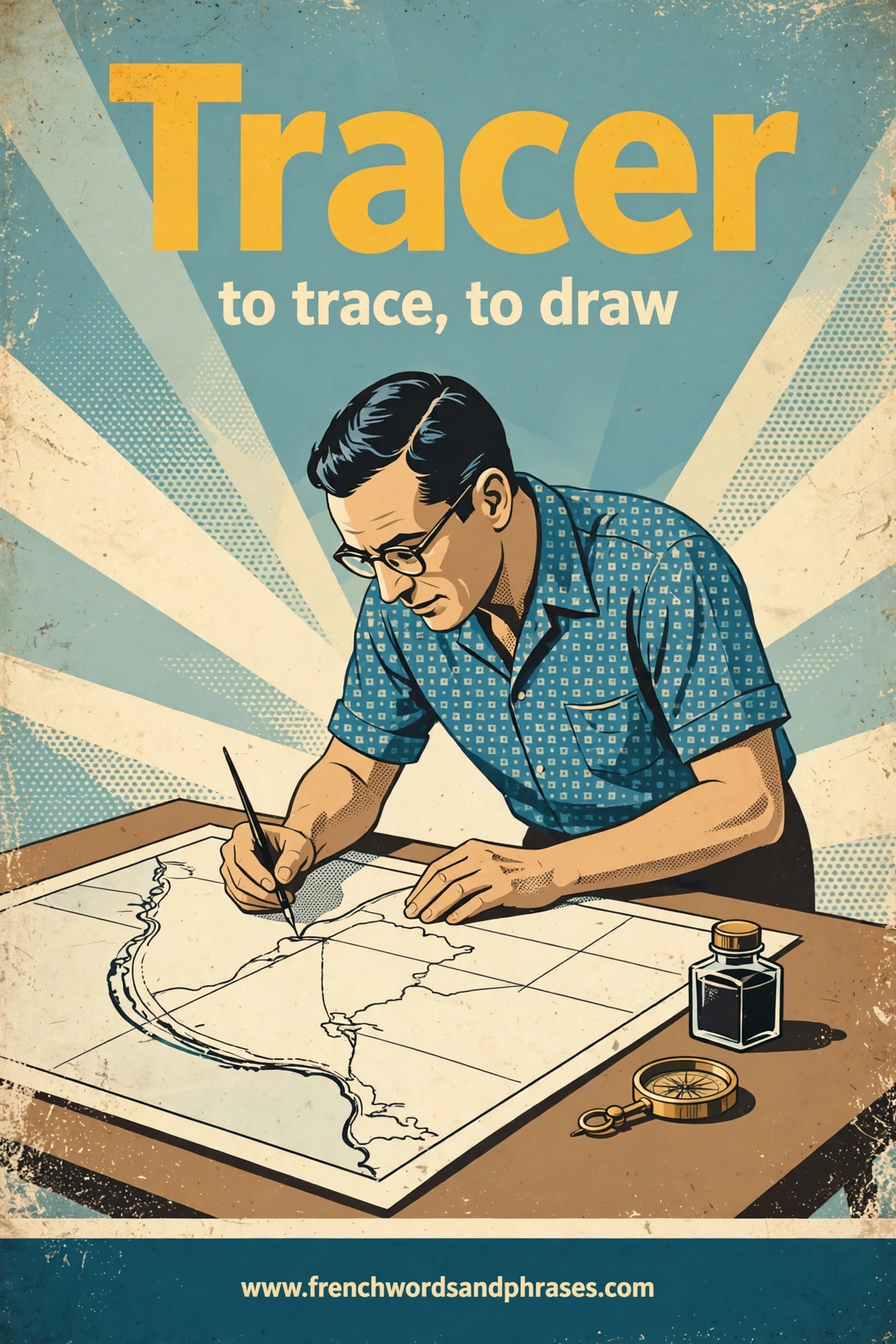
Tracer means to trace, to draw or to lay out — to draw a line, a plan or a route, on paper, on a map or on the ground itself.
A gardener stretches a string between two pegs and follows it with his spade; an architect’s pencil hovers, then commits. Tracer is the verb of the deliberate line — every plan, path, furrow and boundary begins with someone traçant it first.
In this guide, you’ll learn how to conjugate tracer in all the major French tenses and moods. Explore complete conjugation tables, French examples, English translations, and practice quizzes.
Understanding the French Verb Tracer
Tracer is a regular French verb belonging to the first group of verbs, those ending in -er.
It means to trace, to draw. It is commonly used for drawing lines and letters, drafting plans, laying out gardens and building plots, marking out sports routes and race courses, and for tracing a route on a map before a journey.
Verb classification: First group (-er)
Auxiliary verb: Avoir
Past participle: tracé
Present participle: traçant
English equivalents: To trace, to draw, to lay out, to mark out; tracer une ligne — to draw a line; tracer un plan — to draw up a plan; tracer sa route — to make one’s way; tracer au cordeau — to mark out with a string line.
One important detail: tracer is a -cer verb, and its c must stay soft. Before a and o it puts on a cedilla — nous traçons, je traçais, en traçant — while before e and i it needs none: je trace, nous tracions. Forget the cedilla and the word hardens into a k sound. In familiar speech, tracer (or tracer la route) also means to speed off, to be gone in a flash — the line of your departure drawn behind you.
Experience the Word
Tracer is the verb of the first line — the moment an idea becomes visible on paper or on land.
Imagine a market gardener in early spring, string line in hand. He pegs one end, walks the row taut, and traces his line along it, straight as a ruler across the dark earth. By August, that invisible decision will be a wall of beans.
Every straight row, every road, every plan begins the same way. Somebody traced it first.
How to Conjugate Tracer: Complete French Conjugation Guide
Let’s explore every major conjugation of tracer, beginning with the indicative mood.
How to Conjugate Tracer in the Indicative Mood
The indicative mood is used to express facts, observations, actions, and events.
How to Conjugate Tracer in the Present Tense (Présent)
Used for actions happening now, habitual actions, and general truths.
| Subject | Conjugation |
|---|---|
| je | trace |
| tu | traces |
| il / elle | trace |
| nous | traçons |
| vous | tracez |
| ils / elles | tracent |
Example
L’architecte trace les plans de la maison.
The architect draws the plans of the house.
Quick Quiz 1
Complete the sentence:
Nous ______ une ligne droite. (tracer, present)
Reveal the answer
traçons
Nous traçons une ligne droite.
We draw a straight line — note the cedilla.
How to Conjugate Tracer in the Passé Composé
Used for completed actions in the past. Tracer takes the auxiliary verb avoir.
| Subject | Conjugation |
|---|---|
| j’ | ai tracé |
| tu | as tracé |
| il / elle | a tracé |
| nous | avons tracé |
| vous | avez tracé |
| ils / elles | ont tracé |
Example
Nous avons tracé une ligne droite sur la carte.
We drew a straight line on the map.
How to Conjugate Tracer in the Imparfait (Imperfect Tense)
Used for habitual past actions, descriptions, and ongoing situations in the past.
| Subject | Conjugation |
|---|---|
| je | traçais |
| tu | traçais |
| il / elle | traçait |
| nous | tracions |
| vous | traciez |
| ils / elles | traçaient |
Example
Enfant, elle traçait des cercles parfaits à main levée.
As a child, she used to draw perfect circles freehand.
Quick Quiz 2
Choose the correct form:
He drew a circle in the sand.
Il ______ un cercle dans le sable. (a tracé / est tracé)
Reveal the answer
a tracé
Il a tracé un cercle dans le sable.
Tracer takes avoir.
How to Conjugate Tracer in the Plus-que-parfait
Used to describe an action that had already been completed before another past event.
| Subject | Conjugation |
|---|---|
| j’ | avais tracé |
| tu | avais tracé |
| il / elle | avait tracé |
| nous | avions tracé |
| vous | aviez tracé |
| ils / elles | avaient tracé |
Example
Le jardinier avait tracé les allées avant l’hiver.
The gardener had laid out the paths before winter.
How to Conjugate Tracer in the Passé Simple
Primarily used in formal writing, literature, and historical narratives. It is rarely used in everyday conversation.
| Subject | Conjugation |
|---|---|
| je | traçai |
| tu | traças |
| il / elle | traça |
| nous | traçâmes |
| vous | traçâtes |
| ils / elles | traçèrent |
Example
Il traça un cercle dans le sable.
He drew a circle in the sand.
How to Conjugate Tracer in the Passé Antérieur
A literary tense used to express an action completed immediately before another past action, generally in the passé simple.
| Subject | Conjugation |
|---|---|
| j’ | eus tracé |
| tu | eus tracé |
| il / elle | eut tracé |
| nous | eûmes tracé |
| vous | eûtes tracé |
| ils / elles | eurent tracé |
Example
Quand elle eut tracé la dernière ligne, le plan était complet.
When she had drawn the last line, the plan was complete.
How to Conjugate Tracer in the Future Tense (Futur Simple)
Used to describe actions that will take place in the future.
| Subject | Conjugation |
|---|---|
| je | tracerai |
| tu | traceras |
| il / elle | tracera |
| nous | tracerons |
| vous | tracerez |
| ils / elles | traceront |
Example
Demain, nous tracerons le parcours de la course.
Tomorrow, we will mark out the race route.
How to Conjugate Tracer in the Futur Antérieur (Future Perfect)
Used for an action that will have been completed before a particular point in the future.
| Subject | Conjugation |
|---|---|
| j’ | aurai tracé |
| tu | auras tracé |
| il / elle | aura tracé |
| nous | aurons tracé |
| vous | aurez tracé |
| ils / elles | auront tracé |
Example
À midi, ils auront tracé toutes les limites du terrain.
By noon, they will have marked out all the boundaries of the plot.
How to Conjugate Tracer in the Near Future (Futur Proche)
Used to describe something that is going to happen soon. Formed with aller + infinitive.
| Subject | Conjugation |
|---|---|
| je | vais tracer |
| tu | vas tracer |
| il / elle | va tracer |
| nous | allons tracer |
| vous | allez tracer |
| ils / elles | vont tracer |
Example
Je vais tracer un trait, ne bouge pas.
I am going to draw a line, do not move.
How to Conjugate Tracer in the Conditional Mood
The conditional mood expresses what would happen under certain circumstances. It is also frequently used to make polite requests or express wishes.
How to Conjugate Tracer in the Present Conditional
| Subject | Conjugation |
|---|---|
| je | tracerais |
| tu | tracerais |
| il / elle | tracerait |
| nous | tracerions |
| vous | traceriez |
| ils / elles | traceraient |
Example
Avec une meilleure règle, tu tracerais des lignes parfaites.
With a better ruler, you would draw perfect lines.
How to Conjugate Tracer in the Past Conditional
| Subject | Conjugation |
|---|---|
| j’ | aurais tracé |
| tu | aurais tracé |
| il / elle | aurait tracé |
| nous | aurions tracé |
| vous | auriez tracé |
| ils / elles | auraient tracé |
Example
Il aurait tracé le plan si on le lui avait demandé.
He would have drawn the plan if he had been asked.
Tracer in the Literary Past Conditional Form
This less common literary form uses the imperfect subjunctive of avoir.
| Subject | Conjugation |
|---|---|
| j’ | eusse tracé |
| tu | eusses tracé |
| il / elle | eût tracé |
| nous | eussions tracé |
| vous | eussiez tracé |
| ils / elles | eussent tracé |
Example
Elle eût tracé la route des caravanes sur la carte ancienne.
She would have traced the caravan route on the old map.
How to Conjugate Tracer in the Subjunctive Mood
The subjunctive is used to express wishes, emotions, doubts, necessity, and uncertainty. It frequently follows expressions such as il faut que (it is necessary that) or bien que (although).
How to Conjugate Tracer in the Present Subjunctive
| Subject | Conjugation |
|---|---|
| que je | trace |
| que tu | traces |
| qu’il / qu’elle | trace |
| que nous | tracions |
| que vous | traciez |
| qu’ils / qu’elles | tracent |
Example
Il faut que nous tracions le chemin avant la nuit.
We must mark out the path before nightfall.
Quick Quiz 3
Complete the sentence using the subjunctive:
Le professeur voulait que l’élève ______ un angle droit.
Reveal the answer
traçât
Le professeur voulait que l’élève traçât un angle droit.
The teacher wanted the pupil to draw a right angle.
How to Conjugate Tracer in the Imperfect Subjunctive
A literary tense, rarely encountered in modern spoken French.
| Subject | Conjugation |
|---|---|
| que je | tracasse |
| que tu | tracasses |
| qu’il / qu’elle | tracât |
| que nous | tracassions |
| que vous | tracassiez |
| qu’ils / qu’elles | tracassent |
Example
Le professeur voulait que l’élève traçât un angle droit.
The teacher wanted the pupil to draw a right angle.
How to Conjugate Tracer in the Pluperfect Subjunctive
A literary construction used to express an action completed before another past action.
| Subject | Conjugation |
|---|---|
| que j’ | eusse tracé |
| que tu | eusses tracé |
| qu’il / qu’elle | eût tracé |
| que nous | eussions tracé |
| que vous | eussiez tracé |
| qu’ils / qu’elles | eussent tracé |
Example
On admirait qu’il eût tracé ce jardin sans aucun plan.
People admired that he had laid out this garden without any plan.
How to Conjugate Tracer in the Past Subjunctive
| Subject | Conjugation |
|---|---|
| que j’ | aie tracé |
| que tu | aies tracé |
| qu’il / qu’elle | ait tracé |
| que nous | ayons tracé |
| que vous | ayez tracé |
| qu’ils / qu’elles | aient tracé |
Example
Je suis content que vous ayez tracé la piste à temps.
I am glad you marked out the trail in time.
How to Conjugate Tracer in the Imperative
The imperative is used to give commands, instructions, invitations, or suggestions. Subject pronouns are omitted.
How to Conjugate Tracer in the Present Imperative
| Person | Conjugation |
|---|---|
| (tu) | trace |
| (nous) | traçons |
| (vous) | tracez |
Example
Tracez la ligne ici, au cordeau !
Mark the line here, with the string line!
Quick Quiz 4
How would you say Let us map out the route (nous form)?
Reveal the answer
Traçons la route !
French Participles of Tracer
Participles are verb forms that can be used in compound tenses and other grammatical constructions.
Present Participle of Tracer
traçant
En traçant son sillon, le laboureur chantait.
As he traced his furrow, the ploughman sang.
Past Participle of Tracer
tracé
Tracées au cordeau, les rangées de légumes sont parfaitement droites.
Laid out with a string line, the rows of vegetables are perfectly straight.
Tracer in Everyday French: Real-Life Examples
Now that you know the conjugations, let’s see how tracer appears in everyday French.
Example 1 — Present
L’enfant trace des lettres sur son cahier.
The child traces letters in his notebook.
Example 2 — Passé composé
Nous avons tracé le parcours ce matin.
We marked out the route this morning.
Example 3 — Imparfait
Elle traçait ses lignes à la règle.
She used to draw her lines with a ruler.
Example 4 — Future
Ils traceront la piste demain.
They will mark out the trail tomorrow.
Example 5 — Conditional
Je tracerais le plan autrement.
I would draw the plan differently.
Example 6 — Imperative
Traçons la route ensemble !
Let us map out the route together!
Beyond Translation: The Meaning of Tracer
English splits this verb four ways — trace, draw, lay out, mark out — and French covers the whole territory with tracer, because all four are the same gesture: a hand making a line that means something.
And then the line starts to move.
Tracer sa route is to make your way in life, line by line; and in familiar French, tracer alone means to dash off, to be gone — your route drawn behind you at speed.
How to Remember the French Verb Tracer
Remember it this way: Tracer is about every line, plan and route that a hand lays down.
- A -cer verb: c becomes ç before a and o — nous traçons, je traçais, traçant.
- Tracer une ligne, un plan, un parcours — to draw a line, draw up a plan, mark out a route.
- Regular -er pattern otherwise: je trace, nous traçons, past participle tracé.
The key idea is every line, plan and route that a hand lays down.
Test Your Knowledge of Tracer
Let’s see how much you’ve learned. Try answering these questions before revealing the answers.
Question 1
How do you say to draw a line in French?
Reveal the answer
Tracer une ligne.
Question 2
Why does nous traçons have a cedilla?
Reveal the answer
Because the c must stay soft before o — without the cedilla it would sound like a k.
Question 3
Translate: We marked out the route this morning.
Reveal the answer
Nous avons tracé le parcours ce matin.
Question 4
What is the past participle of tracer?
Reveal the answer
Tracé.
Question 5
Complete the sentence:
Il faut que nous ______ le chemin avant la nuit.
Reveal the answer
tracions
Il faut que nous tracions le chemin avant la nuit.
We must mark out the path before nightfall.
Your Final Challenge
Can You Use It?
How would you say this in French?
From her window, she traces on the map the route of her next holiday.
Reveal the answer
De sa fenêtre, elle trace sur la carte la route de ses prochaines vacances.
From her window, she traces on the map the route of her next holiday.
A little French. A little curiosity. A richer everyday life.
LEARN FRENCH ONE WORD AT A TIME