
A French Word to Live By
How to Conjugate Tracasser in French
/tʁa.ka.se/
Tracasser means to worry or to bother — and its reflexive form, se tracasser, is the everyday French way to say to fret and worry yourself.
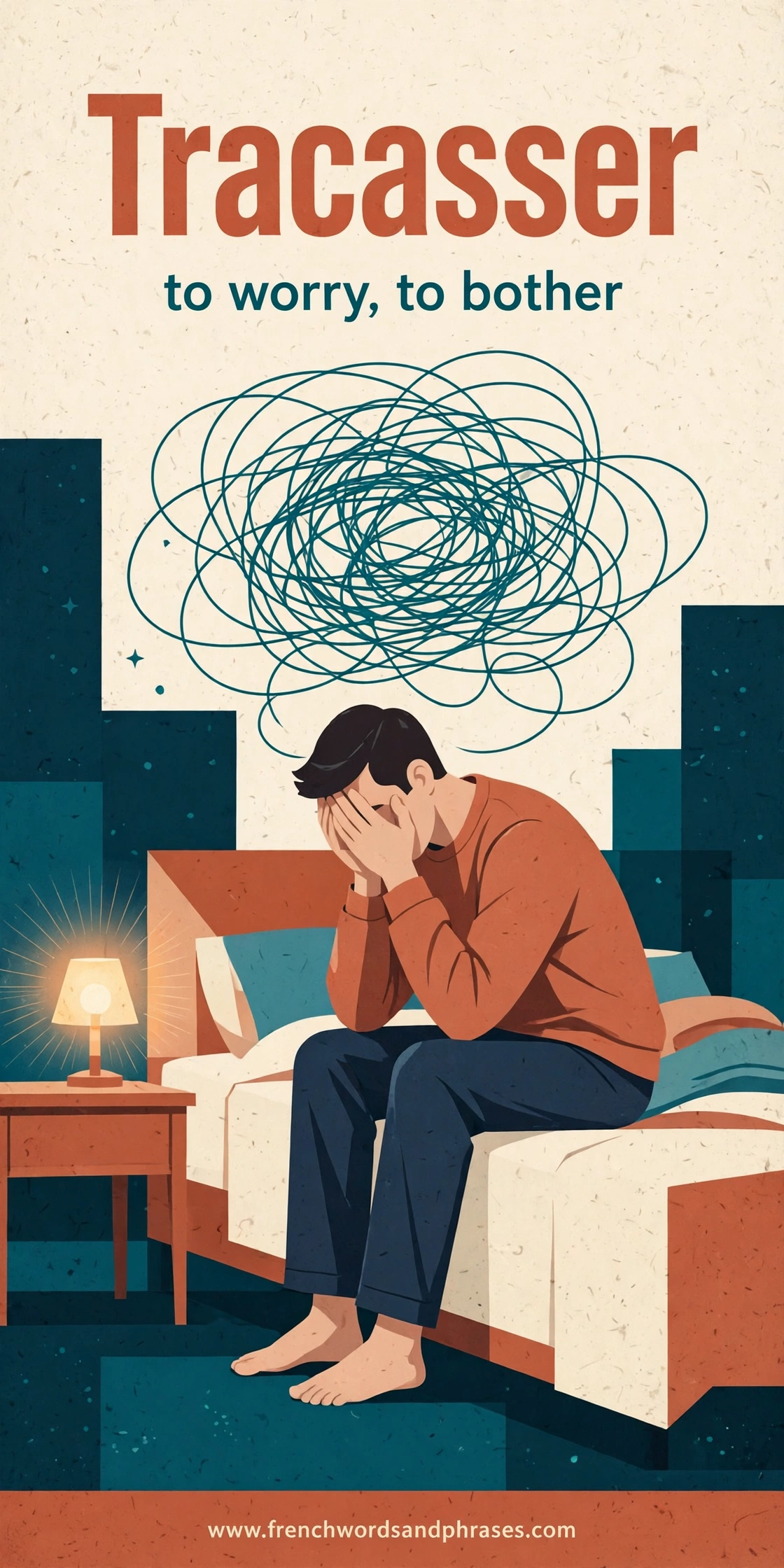
It is three in the morning and the brain will not switch off: the bill, the appointment, the thing said at dinner. Something is tracassant you — and if you are doing it to yourself, French says you are vous tracassant, chewing over the same worry in the dark.
In this guide, you’ll learn how to conjugate tracasser in all the major French tenses and moods. Explore complete conjugation tables, French examples, English translations, and practice quizzes.
Understanding the French Verb Tracasser
Tracasser is a regular French verb belonging to the first group of verbs, those ending in -er.
It means to worry, to bother. It is commonly used for the small and medium worries of life — bills, noises, delays, other people’s problems — and above all in its reflexive form, se tracasser, which is how French people describe lying awake fretting, and how their friends tell them to stop.
Verb classification: First group (-er)
Auxiliary verb: Avoir
Past participle: tracassé
Present participle: tracassant
English equivalents: To worry, to bother, to trouble; se tracasser — to worry, to fret; ne te tracasse pas ! — do not worry!; un tracas — a worry, a hassle; les tracas du quotidien — everyday hassles.
One important detail: tracasser works in two directions. Tracasser quelqu’un is to worry or bother someone else — ce bruit me tracasse, that noise bothers me — and it conjugates with avoir. Turn it reflexive and the worry comes home: se tracasser, to fret, takes être in compound tenses — je me suis tracassé, I worried myself. The noun from the same family is un tracas, a worry or a hassle, and the kindest sentence in the family is ne te tracasse pas — don’t fret.
Experience the Word
Tracasser is the verb of the worry that follows you from room to room, asking for attention.
Imagine a young couple at their first kitchen table, a pile of envelopes between them. Nothing is catastrophic — a bill here, a form there — but each envelope tracasse them a little, and the evening is spent sharing the worries out loud until they shrink.
Said out loud, the tracas lose their power. A worry shared is a worry halved — tracassé à deux, il pèse moins lourd.
How to Conjugate Tracasser: Complete French Conjugation Guide
Let’s explore every major conjugation of tracasser, beginning with the indicative mood.
How to Conjugate Tracasser in the Indicative Mood
The indicative mood is used to express facts, observations, actions, and events.
How to Conjugate Tracasser in the Present Tense (Présent)
Used for actions happening now, habitual actions, and general truths.
| Subject | Conjugation |
|---|---|
| je | tracasse |
| tu | tracasses |
| il / elle | tracasse |
| nous | tracassons |
| vous | tracassez |
| ils / elles | tracassent |
Example
Ce bruit de goutte d’eau me tracasse.
That dripping sound bothers me.
Quick Quiz 1
Complete the sentence:
Ce projet ______ un peu le directeur. (tracasser, present)
Reveal the answer
tracasse
Ce projet tracasse un peu le directeur.
This project worries the manager a little.
How to Conjugate Tracasser in the Passé Composé
Used for completed actions in the past. Tracasser takes the auxiliary verb avoir.
| Subject | Conjugation |
|---|---|
| j’ | ai tracassé |
| tu | as tracassé |
| il / elle | a tracassé |
| nous | avons tracassé |
| vous | avez tracassé |
| ils / elles | ont tracassé |
Example
Cette histoire l’a tracassé toute la semaine.
That business worried him all week.
How to Conjugate Tracasser in the Imparfait (Imperfect Tense)
Used for habitual past actions, descriptions, and ongoing situations in the past.
| Subject | Conjugation |
|---|---|
| je | tracassais |
| tu | tracassais |
| il / elle | tracassait |
| nous | tracassions |
| vous | tracassiez |
| ils / elles | tracassaient |
Example
Les factures tracassaient le jeune couple.
The bills used to worry the young couple.
Quick Quiz 2
Choose the correct form:
I worried myself all night.
Je ______ toute la nuit. (me suis tracassé / ai tracassé)
Reveal the answer
me suis tracassé
Je me suis tracassé toute la nuit.
The reflexive se tracasser takes être.
How to Conjugate Tracasser in the Plus-que-parfait
Used to describe an action that had already been completed before another past event.
| Subject | Conjugation |
|---|---|
| j’ | avais tracassé |
| tu | avais tracassé |
| il / elle | avait tracassé |
| nous | avions tracassé |
| vous | aviez tracassé |
| ils / elles | avaient tracassé |
Example
Un détail l’avait tracassée avant le départ.
A detail had been worrying her before the departure.
How to Conjugate Tracasser in the Passé Simple
Primarily used in formal writing, literature, and historical narratives. It is rarely used in everyday conversation.
| Subject | Conjugation |
|---|---|
| je | tracassai |
| tu | tracassas |
| il / elle | tracassa |
| nous | tracassâmes |
| vous | tracassâtes |
| ils / elles | tracassèrent |
Example
La nouvelle tracassa le directeur toute la soirée.
The news worried the manager all evening.
How to Conjugate Tracasser in the Passé Antérieur
A literary tense used to express an action completed immediately before another past action, generally in the passé simple.
| Subject | Conjugation |
|---|---|
| j’ | eus tracassé |
| tu | eus tracassé |
| il / elle | eut tracassé |
| nous | eûmes tracassé |
| vous | eûtes tracassé |
| ils / elles | eurent tracassé |
Example
Quand la lettre eut tracassé le village entier, la vérité éclata.
When the letter had worried the whole village, the truth came out.
How to Conjugate Tracasser in the Future Tense (Futur Simple)
Used to describe actions that will take place in the future.
| Subject | Conjugation |
|---|---|
| je | tracasserai |
| tu | tracasseras |
| il / elle | tracassera |
| nous | tracasserons |
| vous | tracasserez |
| ils / elles | tracasseront |
Example
Rassure-toi, cela ne te tracassera plus.
Set your mind at rest, that will not bother you any more.
How to Conjugate Tracasser in the Futur Antérieur (Future Perfect)
Used for an action that will have been completed before a particular point in the future.
| Subject | Conjugation |
|---|---|
| j’ | aurai tracassé |
| tu | auras tracassé |
| il / elle | aura tracassé |
| nous | aurons tracassé |
| vous | aurez tracassé |
| ils / elles | auront tracassé |
Example
À demain, cette affaire aura tracassé tout le bureau.
By tomorrow, this affair will have worried the whole office.
How to Conjugate Tracasser in the Near Future (Futur Proche)
Used to describe something that is going to happen soon. Formed with aller + infinitive.
| Subject | Conjugation |
|---|---|
| je | vais tracasser |
| tu | vas tracasser |
| il / elle | va tracasser |
| nous | allons tracasser |
| vous | allez tracasser |
| ils / elles | vont tracasser |
Example
Ce retard va tracasser les organisateurs.
This delay is going to worry the organisers.
How to Conjugate Tracasser in the Conditional Mood
The conditional mood expresses what would happen under certain circumstances. It is also frequently used to make polite requests or express wishes.
How to Conjugate Tracasser in the Present Conditional
| Subject | Conjugation |
|---|---|
| je | tracasserais |
| tu | tracasserais |
| il / elle | tracasserait |
| nous | tracasserions |
| vous | tracasseriez |
| ils / elles | tracasseraient |
Example
Un rien te tracasserait, toi !
The slightest thing would worry you!
How to Conjugate Tracasser in the Past Conditional
| Subject | Conjugation |
|---|---|
| j’ | aurais tracassé |
| tu | aurais tracassé |
| il / elle | aurait tracassé |
| nous | aurions tracassé |
| vous | auriez tracassé |
| ils / elles | auraient tracassé |
Example
Sans ce coup de fil, elle aurait tracassé ses parents.
Without that phone call, she would have worried her parents.
Tracasser in the Literary Past Conditional Form
This less common literary form uses the imperfect subjunctive of avoir.
| Subject | Conjugation |
|---|---|
| j’ | eusse tracassé |
| tu | eusses tracassé |
| il / elle | eût tracassé |
| nous | eussions tracassé |
| vous | eussiez tracassé |
| ils / elles | eussent tracassé |
Example
Il eût tracassé sa famille sans la lettre rassurante.
He would have worried his family without the reassuring letter.
How to Conjugate Tracasser in the Subjunctive Mood
The subjunctive is used to express wishes, emotions, doubts, necessity, and uncertainty. It frequently follows expressions such as il faut que (it is necessary that) or bien que (although).
How to Conjugate Tracasser in the Present Subjunctive
| Subject | Conjugation |
|---|---|
| que je | tracasse |
| que tu | tracasses |
| qu’il / qu’elle | tracasse |
| que nous | tracassions |
| que vous | tracassiez |
| qu’ils / qu’elles | tracassent |
Example
Je ne veux pas que cela vous tracasse.
I do not want that to worry you.
Quick Quiz 3
Complete the sentence using the subjunctive:
Il craignait que le bruit ne ______ les voisins.
Reveal the answer
tracassât
Il craignait que le bruit ne tracassât les voisins.
He feared the noise might bother the neighbours.
How to Conjugate Tracasser in the Imperfect Subjunctive
A literary tense, rarely encountered in modern spoken French.
| Subject | Conjugation |
|---|---|
| que je | tracassasse |
| que tu | tracassasses |
| qu’il / qu’elle | tracassât |
| que nous | tracassassions |
| que vous | tracassassiez |
| qu’ils / qu’elles | tracassassent |
Example
Il craignait que le bruit ne tracassât les voisins.
He feared the noise might bother the neighbours.
How to Conjugate Tracasser in the Pluperfect Subjunctive
A literary construction used to express an action completed before another past action.
| Subject | Conjugation |
|---|---|
| que j’ | eusse tracassé |
| que tu | eusses tracassé |
| qu’il / qu’elle | eût tracassé |
| que nous | eussions tracassé |
| que vous | eussiez tracassé |
| qu’ils / qu’elles | eussent tracassé |
Example
Elle regrettait que l’affaire eût tracassé tant de monde.
She regretted that the affair had worried so many people.
How to Conjugate Tracasser in the Past Subjunctive
| Subject | Conjugation |
|---|---|
| que j’ | aie tracassé |
| que tu | aies tracassé |
| qu’il / qu’elle | ait tracassé |
| que nous | ayons tracassé |
| que vous | ayez tracassé |
| qu’ils / qu’elles | aient tracassé |
Example
Je suis désolé que cela t’ait tracassé.
I am sorry that worried you.
How to Conjugate Tracasser in the Imperative
The imperative is used to give commands, instructions, invitations, or suggestions. Subject pronouns are omitted.
How to Conjugate Tracasser in the Present Imperative
| Person | Conjugation |
|---|---|
| (tu) | tracasse |
| (nous) | tracassons |
| (vous) | tracassez |
Example
Ne tracasse pas ton frère avec ces questions !
Do not bother your brother with those questions!
Quick Quiz 4
How would you say Do not worry (vous form)?
Reveal the answer
Ne vous tracassez pas !
French Participles of Tracasser
Participles are verb forms that can be used in compound tenses and other grammatical constructions.
Present Participle of Tracasser
tracassant
En tracassant tout le monde, il n’a rien résolu.
By worrying everyone, he solved nothing.
Past Participle of Tracasser
tracassé
Tracassée par les factures, elle comptait chaque euro.
Worried by the bills, she counted every euro.
Tracasser in Everyday French: Real-Life Examples
Now that you know the conjugations, let’s see how tracasser appears in everyday French.
Example 1 — Present
Ce projet me tracasse un peu.
This project worries me a little.
Example 2 — Passé composé
Cette panne nous a tracassés toute la journée.
That breakdown worried us all day.
Example 3 — Imparfait
Autrefois, les examens le tracassaient beaucoup.
In the old days, exams used to worry him a lot.
Example 4 — Future
Cela ne te tracassera plus demain.
That will not worry you any more tomorrow.
Example 5 — Conditional
À ta place, rien ne me tracasserait.
In your place, nothing would worry me.
Example 6 — Imperative
Ne tracassez pas les enfants avec ça !
Do not worry the children with that!
Beyond Translation: The Meaning of Tracasser
English worry faces both ways at once — something worries me, and I worry. French makes you choose the direction.
Tracasser for the cause, se tracasser for the feeling.
Ce bruit me tracasse — the noise bothers me. Je me tracasse — I am fretting. And the reflexive is the one you will hear daily, usually in the negative, from someone who cares about you: ne te tracasse pas !
How to Remember the French Verb Tracasser
Remember it this way: Tracasser is about the worry that follows you around — and learning not to fret.
- Tracasser quelqu’un — to worry or bother someone; se tracasser — to fret (with être: je me suis tracassé).
- Un tracas — a worry, a hassle; les tracas du quotidien — everyday hassles.
- Regular -er: je tracasse, nous tracassons, past participle tracassé.
The key idea is the worry that follows you around — and learning not to fret.
Test Your Knowledge of Tracasser
Let’s see how much you’ve learned. Try answering these questions before revealing the answers.
Question 1
How do you say Do not worry! (tu form) in French?
Reveal the answer
Ne te tracasse pas !
Question 2
How do you say That noise bothers me in French?
Reveal the answer
Ce bruit me tracasse.
Question 3
Translate: She worried herself all week. (reflexive)
Reveal the answer
Elle s’est tracassée toute la semaine.
Question 4
What is the past participle of tracasser?
Reveal the answer
Tracassé.
Question 5
Complete the sentence:
Je ne veux pas que cela vous ______.
Reveal the answer
tracasse
Je ne veux pas que cela vous tracasse.
I do not want that to worry you.
Your Final Challenge
Can You Use It?
How would you say this in French?
Do not fret about tomorrow: each day has its own worries.
Reveal the answer
Ne te tracasse pas pour demain : chaque jour a ses propres tracas.
Do not fret about tomorrow: each day has its own worries.
A little French. A little curiosity. A richer everyday life.
LEARN FRENCH ONE WORD AT A TIME




