A French Word to Live By
Translate Toutes mes condoléances to English
/tut me kɔ̃.dɔ.le.ɑ̃s/
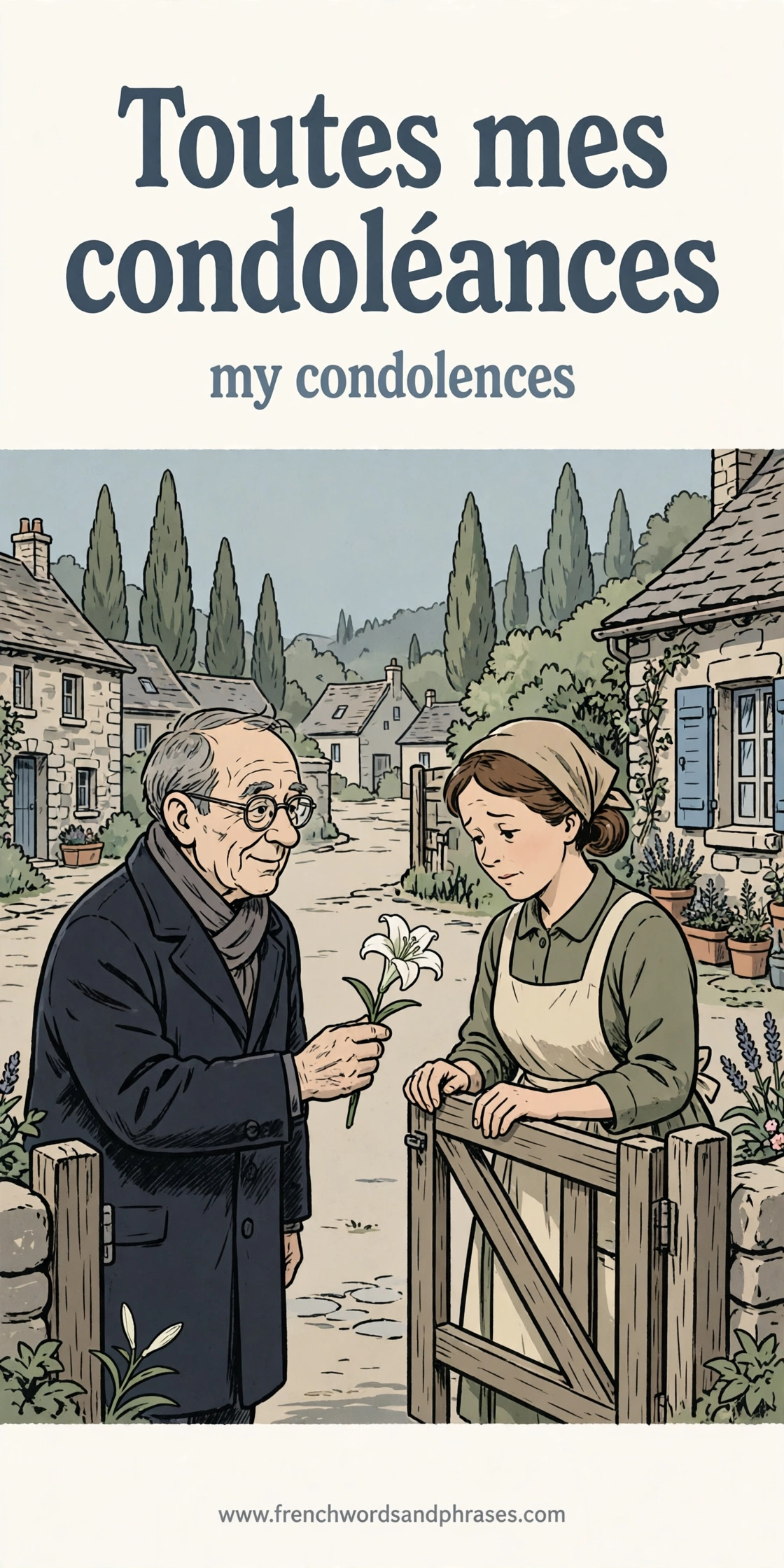
Toutes mes condoléances means my condolences.
A black-bordered envelope lies on the hall table. Inside, under a handwritten line of sympathy, the card ends with three formal words: « Toutes mes condoléances. » This is the phrase French reaches for when someone has died — the correct, dignified words of sorrow, spoken at funerals, written in cards, and never, ever used for anything smaller than a death.
Let’s explore how toutes mes condoléances works in French, beginning with the whole phrase on one card.
Understanding the French Phrase Toutes mes condoléances
Toutes mes condoléances is a French sympathy formula built from toutes (all, feminine plural), mes (my), and condoléances — a feminine plural noun that exists only in the plural, from the old verb condouloir, to share someone’s pain (Latin con-, with, + dolere, to suffer). Word for word: all my shared-pains. It is a complete sentence by courtesy — the verb (je vous présente, I offer you) is understood.
It means my condolences — the formal expression of sympathy after a death, said to the bereaved: toutes mes condoléances pour la perte de votre père, my condolences on the loss of your father. The fuller forms make the offering explicit: je vous présente toutes mes condoléances, je vous adresse mes sincères condoléances. It belongs to funerals, sympathy cards and solemn letters — and it is reserved for bereavement alone: a failed exam, a lost job or a broken leg gets courage or je suis désolé, never condoléances.
Type: Sympathy formula — condolence (toutes + mes + condoléances, always plural)
Answers the need: Expressing formal sympathy to someone bereaved
Register: Formal and solemn — funerals, cards, letters; never casual
Strength: Full and dignified — the complete, correct offering of sorrow
One important usage detail: condoléances is always plural and always about death. The verb that carries it is présenter or adresser: présenter ses condoléances à la famille. In speech at a funeral, the phrase often stands alone, said quietly with a handshake or an embrace: « Toutes mes condoléances. » Nothing needs adding — and adding jokes, details or questions about the death is exactly what the formula protects everyone from.
Experience the Word
Toutes mes condoléances is the phrase that speaks when you have no words — a hand extended in the exact shape French politeness has prepared for grief.
Imagine the church porch after the service, the line of neighbours moving slowly past the widow. Each one stops, takes her hand, and says the same three words — « toutes mes condoléances » — and she nods, and the line moves on. The sameness is the kindness: nobody improvises at grief.
English says my condolences, and French agrees — almost. French adds toutes: ALL my condolences, the whole of my sympathy, nothing held back.
How to Use Toutes mes condoléances in French: Complete Guide
Let’s explore how toutes mes condoléances works in French, beginning with the whole phrase on one card.
Toutes mes condoléances at a Glance
The Whole Phrase on One Card
Real meaning, literal picture, English twin and register — toutes mes condoléances in five lines.
| Point | Toutes mes condoléances |
|---|---|
| What it really means | my condolences — I share your grief at this death |
| Word for word | all my shared-pains — condoléances, from suffering-with |
| English equivalent | my condolences; my deepest sympathy |
| Register | formal and solemn — funerals, sympathy cards, letters |
| Use it for | bereavement only — said to the family of someone who has died |
Example
Toutes mes condoléances, madame. Nous pensons à vous.
My condolences, madam. We are thinking of you.
Word by Word: Building the Phrase
Three pieces — totality, possession, and a noun that means suffering alongside someone.
| Word | Literal meaning | Its job in the phrase |
|---|---|---|
| toutes | all (feminine plural) | the whole of the sympathy — nothing held back |
| mes | my | whose sympathy it is — the speaker’s own |
| condoléances | shared pains, sufferings-with | the offering itself — a noun that lives only in the plural |
Example
Je vous présente toutes mes condoléances.
I offer you my condolences.
Quick Quiz 1
A colleague has failed his driving test. Do you say toutes mes condoléances?
Reveal the answer
No — condoléances are for a death only. For a failure: je suis désolé, courage, la prochaine fois.
Je suis désolé pour ton examen. Courage, la prochaine fois !
I’m sorry about your exam. Courage, next time!
When You Say It: The Bereavement Moments
Toutes mes condoléances turns up in a small, solemn set of moments — each one about a death, each one addressed to the grieving.
| Situation | Example |
|---|---|
| At the funeral | toutes mes condoléances, je suis là si besoin — my condolences, I am here if needed |
| In a sympathy card | nous vous présentons toutes nos condoléances — we offer you our condolences |
| To a colleague bereaved | toutes mes condoléances pour ton père — my condolences for your father |
| In a formal letter | veuillez recevoir nos sincères condoléances — please accept our sincere condolences |
| On the phone | je viens d’apprendre… toutes mes condoléances — I have just heard… my condolences |
Example
Toutes nos condoléances à toute la famille.
Our condolences to the whole family.
Make It Yours: The Fuller Forms
The short formula expands with a verb of offering — présenter or adresser — and sincerity has its own adjectives.
| Form | French | In English |
|---|---|---|
| Short form (spoken) | toutes mes condoléances | my condolences |
| With présenter | je vous présente toutes mes condoléances | I offer you my condolences |
| Sincere | mes sincères condoléances | my sincere condolences |
| Deepest | mes condoléances les plus sincères | my deepest condolences |
| From a group | toutes nos condoléances | our condolences (from all of us) |
Example
Veuillez recevoir nos condoléances les plus sincères.
Please accept our deepest condolences.
Quick Quiz 2
Complete it: je vous présente toutes mes ______
Reveal the answer
condoléances — always plural, always with its accent: condoléances.
Je vous présente toutes mes condoléances.
I offer you my condolences.
Everyday Expressions: Building on Condoléances
Around the formula stand the other sentences of the sympathy card — each one ready to use with care.
| Frame | In English |
|---|---|
| toutes mes condoléances | my condolences |
| je pense fort à vous | I am thinking of you (warm support) |
| nous partageons votre peine | we share your sorrow |
| je suis de tout cœur avec toi | I am with you with all my heart |
| présenter ses condoléances | to offer one’s condolences (the verb frame) |
Example
Nous partageons votre peine et pensons fort à vous.
We share your sorrow and are thinking of you.
Close Cousins: The Other Words of Sympathy
French comforts in several keys — condoléances is the formal, bereavement-only one.
| Expression | The difference |
|---|---|
| je suis désolé | I am sorry — the general word, for any sorrow, great or small |
| mes condoléances | my condolences — the same formula without toutes, a shade lighter |
| bon courage | take courage — for hard times and trials, not for grief alone |
| je compatis | I sympathise, I feel for you — warm, less formal |
| toutes mes condoléances | the full formal offering — funerals, cards, solemn letters |
Example
Je suis désolé pour ta voiture ; mais pour son père, ce sont des condoléances.
I am sorry about your car; but for her father, it is condolences.
Quick Quiz 3
Which phrase is reserved for a death — bon courage or toutes mes condoléances?
Reveal the answer
Toutes mes condoléances — bon courage serves every hard moment; condoléances serve bereavement alone.
Pour l’enterrement : toutes mes condoléances. Pour l’examen : bon courage !
For the funeral: my condolences. For the exam: take courage!
Toutes mes condoléances and Its Neighbours
The grief shelf around the phrase — death, mourning and the family who receives the words.
| French | In English |
|---|---|
| le décès | the death (formal word) — le décès de son père |
| le deuil | mourning, bereavement — être en deuil, to be in mourning |
| les funérailles | the funeral (formal) |
| la peine | sorrow, grief — partager la peine de quelqu’un |
| un faire-part | a death announcement card |
Example
La famille, en deuil, remercie pour les condoléances reçues.
The family, in mourning, thanks everyone for the condolences received.
Watch Out: The Traps Around Toutes mes condoléances
The traps: using it for small sorrows, dropping the plural, and translating it word for word into jokes.
| Trap | The truth |
|---|---|
| Using it for any bad news | condoléances are for death only — a lost job or a failed exam takes je suis désolé |
| Writing condoléance in the singular | the noun lives in the plural: des condoléances, toutes mes condoléances |
| Saying it cheerfully | the phrase is solemn — voice low, words few, no follow-up questions about the death |
| Joking with it | French does use it ironically between close friends (« ton téléphone est mort ? toutes mes condoléances ») — but only where the joke is certainly safe |
Example
Pour un deuil, des condoléances ; pour un échec, un mot de courage.
For a bereavement, condolences; for a failure, a word of courage.
Quick Quiz 4
Is condoléances singular or plural in the formula?
Reveal the answer
Always plural
Toutes agrees with it: toutes mes condoléances — the noun has no singular life in this use.
Toutes mes condoléances à la famille. — My condolences to the family.
Toutes mes condoléances in Everyday French: Real-Life Examples
Now that you know the word, let’s see how toutes mes condoléances appears in everyday French.
Example 1 — At the funeral
Toutes mes condoléances, madame.
My condolences, madam.
Example 2 — A sympathy card
Nous vous présentons toutes nos condoléances.
We offer you our condolences.
Example 3 — A bereaved colleague
Toutes mes condoléances pour ta maman.
My condolences for your mum.
Example 4 — A formal letter
Veuillez recevoir nos sincères condoléances.
Please accept our sincere condolences.
Example 5 — On the phone
Je viens d’apprendre la nouvelle… toutes mes condoléances.
I have just heard the news… my condolences.
Example 6 — With support
Toutes mes condoléances. Je suis là, appelle-moi.
My condolences. I am here, call me.
Beyond Translation: The Meaning of Toutes mes condoléances
Condoléances is built on an old French verb, condouloir — to suffer with — itself from Latin condolere: con-, together, and dolere, to hurt. The word does exactly what it says: it does not observe the grief, it joins it. That is why the formula has survived unchanged for centuries while other politenesses faded: at the worst moment of a life, French offers not advice, not explanation, but company in the pain.
Toutes mes condoléances is the phrase of shared sorrow — French for: your grief is not yours alone.
Handle it with the care it handles others: plural always, solemn always, and for death alone — everything smaller has its own, lighter words.
How to Remember the French Phrase Toutes mes condoléances
Remember it this way: Toutes mes condoléances is the bereavement formula — always plural, always solemn, and only ever for a death.
- Death only — condoléances pour un décès, jamais pour un échec.
- Always plural — toutes mes condoléances, le mot ne vit qu’au pluriel.
- The verb of offering — présenter ses condoléances à la famille.
The key idea is toutes mes condoléances = my condolences (formal, bereavement only, always plural).
Test Your Knowledge of Toutes mes condoléances
Let’s see how much you’ve learned. Try answering these questions before revealing the answers.
Question 1
What does toutes mes condoléances mean?
Reveal the answer
My condolences — the formal expression of sympathy after a death.
Question 2
When is the phrase used?
Reveal the answer
Only for a bereavement — at funerals, in sympathy cards and solemn letters.
Question 3
Translate: We offer you our condolences.
Reveal the answer
Nous vous présentons toutes nos condoléances.
Question 4
Complete the sentence:
Je vous présente toutes mes ______.
Reveal the answer
condoléances
Je vous présente toutes mes condoléances.
I offer you my condolences.
Question 5
What verb carries the formula in its full form?
Reveal the answer
Présenter (or adresser) — présenter ses condoléances à quelqu’un.
Your Final Challenge
Can You Use It?
How would you say this in French?
“My condolences, madam. We are thinking of you.”
Reveal the answer
Toutes mes condoléances, madame. Nous pensons à vous.
My condolences, madam. We are thinking of you.
A little French. A little curiosity. A richer everyday life.
LEARN FRENCH ONE WORD AT A TIME