A French Word to Live By
Translate Belle-fille to English
/bɛl.fij/
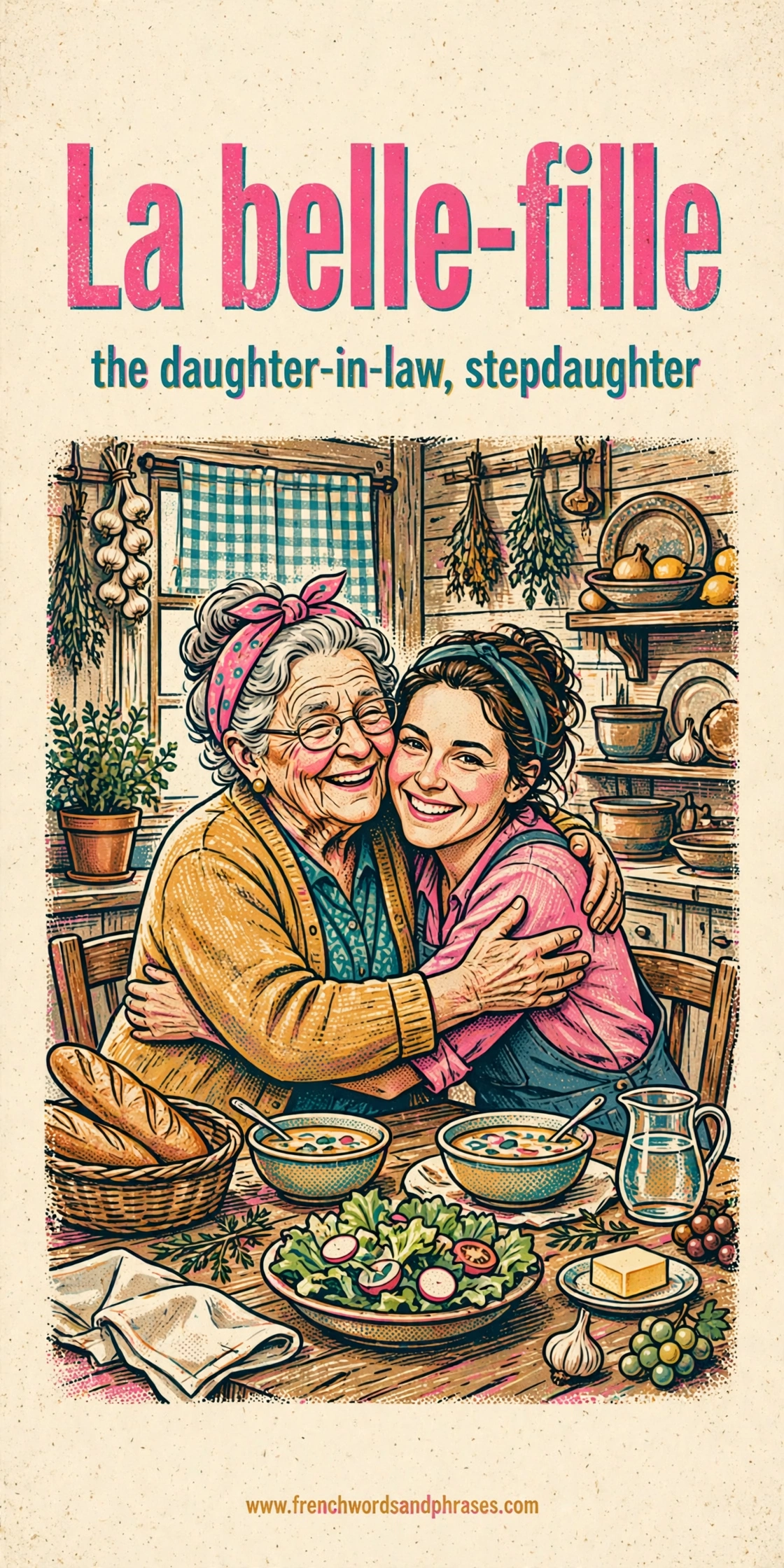
La belle-fille means the daughter-in-law, stepdaughter.
At the Sunday table she arrives with flowers for her husband’s mother and a story that makes the whole family laugh: la belle-fille, the daughter-in-law — the daughter a family gains by marriage, or the daughter a new partner brings with them. French wraps both gifts in one word.
In this guide, you’ll learn what belle-fille means in English, how to use it with its articles, how to form its plural, and how it appears in everyday French. Explore French examples, English translations, and practice quizzes.
Understanding the French Noun Belle-fille
Belle-fille is a feminine French noun, learned with its article: la belle-fille, une belle-fille. It is built from belle (beautiful, here the polite prefix of family-by-marriage, as in belle-mère) and fille, daughter. Its plural is les belles-filles — both halves take the s. The masculine twin is le gendre for a son-in-law by marriage, and beau-fils for a stepson or son-in-law in looser speech.
It means, first, a daughter-in-law — your son’s wife: mon fils et ma belle-fille, my son and my daughter-in-law. And second, a stepdaughter — your partner’s daughter from an earlier union: sa belle-fille, la fille de sa femme, his stepdaughter, his wife’s daughter. Context separates the two: a wedding in the story points to the in-law, a blended family to the stepdaughter. The affectionate short form in families is simply son prénom — once she is family, the label retires.
Gender: Feminine — la belle-fille
Definite article: la — la belle-fille (the daughter-in-law)
Indefinite article: une — une belle-fille (a daughter-in-law)
Plural: les belles-filles — both halves take an s
Two senses: daughter-in-law (son’s wife) and stepdaughter (partner’s daughter)
Masculine side: le gendre (son-in-law); le beau-fils (stepson, son-in-law)
English equivalents: The daughter-in-law; the stepdaughter.
French families often soften the label with the possessive: ma belle-fille sounds warmer than the bare noun, and many belles-filles are simply called by their first name. The in-law sense dominates in everyday speech; for a stepdaughter, speakers add a word if it matters — ma belle-fille, la fille de mon mari. Never confuse her with la bru, the old-fashioned, literary word for a daughter-in-law that survives in proverbs.
Experience the Word
Belle-fille is the daughter the family did not raise but gets to keep — chosen by love twice over: once by the son, once by everyone who makes her a place at the table.
Imagine the first Christmas: she does not know where the glasses live, she offers to wash up three times, and by dessert she is arguing happily about the cheese like someone born to the house. La belle-fille est devenue de la famille.
You have not just named a relative. You have named the family’s chosen daughter — la belle-fille.
How to Use Belle-fille in French: Complete Guide
Let’s explore how belle-fille works in French, beginning with its articles — la belle-fille, une belle-fille, ma belle-fille.
Belle-fille with the Definite Article (La, Les)
Used for the specific belle-fille — yours, theirs, the one at the table.
| Form | French |
|---|---|
| Feminine singular | la belle-fille |
| Plural | les belles-filles |
Example
La belle-fille de Madame Roux est médecin.
Mrs Roux’s daughter-in-law is a doctor.
Belle-fille with the Indefinite Article (Une, Des)
Used for a belle-fille in general — one joining a family, one being described.
| Form | French |
|---|---|
| Feminine singular | une belle-fille |
| Plural | des belles-filles |
Example
Elle est devenue une belle-fille très aimée.
She has become a much-loved daughter-in-law.
Belle-fille with Quantities (Une, Deux, Assez de…)
Belles-filles are counted as families grow — by marriages and by blended households.
| Quantity | French |
|---|---|
| one daughter-in-law | une belle-fille |
| two daughters-in-law | deux belles-filles |
| both stepdaughters | les deux belles-filles |
| several daughters-in-law | plusieurs belles-filles |
| the whole set | toutes ses belles-filles |
Example
Il a deux belles-filles, les femmes de ses deux fils.
He has two daughters-in-law, his two sons’ wives.
Quick Quiz 1
Complete the sentence:
______ belle-fille arrive demain avec mon fils. (the)
Reveal the answer
La
La belle-fille arrive demain avec mon fils.
The daughter-in-law arrives tomorrow with my son — belle-fille is feminine, so la.
The Plural of Belle-fille
Compound family words pluralise both halves: belle becomes belles, fille becomes filles.
| Number | French |
|---|---|
| Singular | la belle-fille |
| Plural | les belles-filles |
Example
Ses belles-filles s’entendent très bien.
His daughters-in-law get on very well.
Belle-fille with Possessive Adjectives (Ma, Ta, Sa…)
Possessives agree with the noun: belle-fille is feminine, so ma, ta, sa in the singular.
| Owner | French |
|---|---|
| my | ma belle-fille |
| your (tu) | ta belle-fille |
| his / her | sa belle-fille |
| our | notre belle-fille |
| your (vous) | votre belle-fille |
| their | leur belle-fille |
Example
Ma belle-fille fait les meilleurs gâteaux.
My daughter-in-law makes the best cakes.
Quick Quiz 2
Complete the sentence:
Il présente ______ belle-fille à ses amis. (his)
Reveal the answer
sa
Il présente sa belle-fille à ses amis.
He introduces his daughter-in-law to his friends — sa, because belle-fille is feminine.
Belle-fille with Demonstrative Adjectives (Cette, Ces)
Used to point: cette belle-fille, this daughter-in-law — usually with pride.
| Form | French |
|---|---|
| Feminine singular | cette belle-fille |
| Plural | ces belles-filles |
Example
Cette belle-fille-là, c’est un trésor.
That daughter-in-law is a treasure.
Belle-fille with Adjectives
Adjectives agree with belle-fille — feminine singular, and feminine plural for several.
| Adjective | With Belle-fille |
|---|---|
| adorable (adorable) | une belle-fille adorable |
| aînée (elder) | la belle-fille aînée |
| jeune (young) | une jeune belle-fille |
| nouvelle (new) | sa nouvelle belle-fille |
| proches (close, plural) | des belles-filles proches |
Example
Sa nouvelle belle-fille parle trois langues.
His new daughter-in-law speaks three languages.
Quick Quiz 3
What is the plural of la belle-fille?
Reveal the answer
les belles-filles
Both halves take the s: belle → belles, fille → filles.
Ses belles-filles arrivent dimanche. — His daughters-in-law are coming on Sunday.
Everyday Expressions with Belle-fille
Weddings, blended families and Sunday lunches — the belle-fille phrases of daily life.
| Expression | In English |
|---|---|
| ma belle-fille et mon fils | my daughter-in-law and my son |
| devenir belle-fille | to become a daughter-in-law (by marrying) |
| la belle-fille de quelqu’un | someone’s daughter-in-law / stepdaughter |
| présenter sa belle-fille | to introduce one’s daughter-in-law |
| s’entendre avec sa belle-fille | to get on with one’s daughter-in-law |
Example
Elle s’entend à merveille avec sa belle-fille.
She gets on wonderfully with her daughter-in-law.
Words from the Same Family as Belle-fille
The by-marriage family — the belle- shelf of French kinship.
| French | In English |
|---|---|
| la belle-mère | the mother-in-law, stepmother |
| le beau-père | the father-in-law, stepfather |
| le gendre | the son-in-law |
| le beau-frère | the brother-in-law |
| la belle-sœur | the sister-in-law |
Example
La belle-mère et la belle-fille préparent le repas ensemble.
The mother-in-law and the daughter-in-law prepare the meal together.
Quick Quiz 4
What are the two meanings of belle-fille?
Reveal the answer
Daughter-in-law and stepdaughter — your son’s wife, or your partner’s daughter.
Ma belle-fille, la femme de mon fils, arrive. — My daughter-in-law, my son’s wife, is coming.
Belle-fille in Everyday French: Real-Life Examples
Now that you know the word, let’s see how belle-fille appears in everyday French.
Example 1 — Family lunch
Ma belle-fille apporte le dessert dimanche.
My daughter-in-law is bringing dessert on Sunday.
Example 2 — The wedding
Voici ma belle-fille, la femme de Thomas.
This is my daughter-in-law, Thomas’s wife.
Example 3 — Blended family
Sa belle-fille a quinze ans, elle adore le dessin.
His stepdaughter is fifteen, she loves drawing.
Example 4 — Pride
Ma belle-fille vient d’ouvrir sa librairie.
My daughter-in-law has just opened her bookshop.
Example 5 — Getting on well
Elles s’entendent comme mère et fille.
They get on like mother and daughter.
Example 6 — Two of them
Ses deux belles-filles organisent l’anniversaire.
His two daughters-in-law are organising the birthday.
Beyond Translation: The Meaning of Belle-fille
The belle- family of French kinship is a piece of politeness fossilised in grammar: the relatives gained by marriage were called beaux and belles — beautiful — by courtesy, however they looked or behaved. Belle-fille, belle-mère, beau-père: the whole in-law shelf wears the compliment permanently.
To say belle-fille is to call her beautiful by law — the family’s courtesy, built into her name.
It evokes weddings and blended households alike: every belle-fille is a door through which a family grows.
How to Remember the French Noun Belle-fille
Remember it this way: Belle-fille is the family’s gained daughter — daughter-in-law or stepdaughter, feminine, and its plural dresses both halves: belles-filles.
- Always feminine — la belle-fille, une belle-fille, ma belle-fille.
- Two daughters in one word — la femme de mon fils, ou la fille de mon conjoint.
- Plural on both halves — les belles-filles, jamais les belle-filles.
The key idea is la belle-fille — the daughter-in-law, the stepdaughter; plural les belles-filles.
Test Your Knowledge of Belle-fille
Let’s see how much you’ve learned. Try answering these questions before revealing the answers.
Question 1
Is belle-fille masculine or feminine?
Reveal the answer
Feminine — la belle-fille, une belle-fille.
Question 2
How do you say my daughter-in-law?
Reveal the answer
Ma belle-fille.
Question 3
Translate: His daughters-in-law are coming on Sunday.
Reveal the answer
Ses belles-filles arrivent dimanche.
Question 4
What is the masculine equivalent for a son-in-law?
Reveal the answer
Le gendre — and le beau-fils covers stepson and son-in-law in looser speech.
Question 5
Complete the sentence:
______ belle-fille est médecin. (the)
Reveal the answer
La
La belle-fille est médecin.
The daughter-in-law is a doctor.
Your Final Challenge
Can You Use It?
How would you say this in French?
“My daughter-in-law is bringing dessert on Sunday.”
Reveal the answer
Ma belle-fille apporte le dessert dimanche.
My daughter-in-law is bringing dessert on Sunday.
A little French. A little curiosity. A richer everyday life.
LEARN FRENCH ONE WORD AT A TIME