A French Word to Live By
Translate Tout to English
/tu/
Tout means all / every.
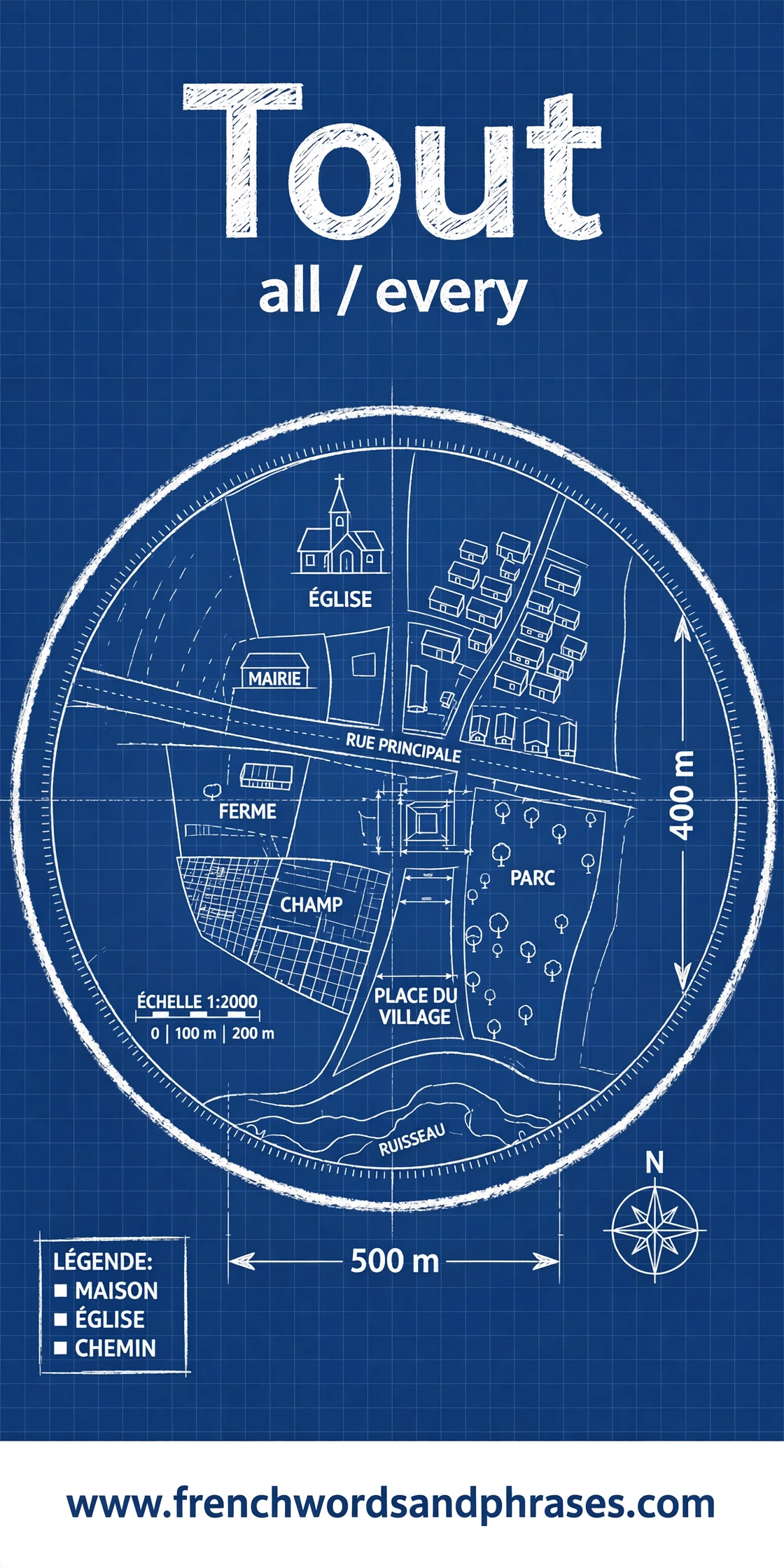
On the last day of the village fête, the mayor thanks the crowd from the steps of the mairie. « Tout le monde est venu » — everybody came. Tout is the French word for the whole of anything: all the people, every day, the entire day — the determiner that leaves nothing and nobody out.
Let’s explore how tout works in French, beginning with the whole word on one card.
Understanding the French Determiner Tout
Tout is a French quantifying determiner — an indefinite determiner of total quantity. Unlike chaque, it agrees with its noun, changing through four forms — tout, toute, tous, toutes — and it usually works hand in hand with the definite article: tout le, toute la, tous les, toutes les.
It means all or every. The picture it paints is a full basket with nothing left on the tree: tout le monde (everybody), toute la journée (the whole day), tous les jours (every day). Where chaque visits one by one, tout gathers the whole set at once — and its form bends to match whatever it gathers.
Type: Quantifying determiner — agrees: tout / toute / tous / toutes
Answers the question: Combien ? — How much / how many? (Answer: all of it, every one)
What follows it: Usually the definite article + noun: tout le pain, toute la nuit, tous les enfants
Watch the pair: tout (all, the whole set + article) vs chaque (each, one by one, no article) — tous les jours = every day; chaque jour = each day
One important usage detail: tout le monde means ‘everybody’ but takes a singular verb — tout le monde est là (everybody is here), never ‘sont’. The grammar sees one single crowd-word, even though the sense is a whole village of people.
Experience the Word
Tout is the determiner of the full sweep — it opens its arms and takes in the whole set, the whole day, the whole world.
Imagine the village square on market morning: toutes les femmes du marché, tous les enfants du village, tout le pain du boulanger — all the women of the market, all the children of the village, all the baker’s bread, nothing left outside the picture.
You have not just counted. You have closed the circle — tout means there is nothing left to add.
How to Use Tout in French: Complete Guide
Let’s explore how tout works in French, beginning with the whole word on one card.
Tout at a Glance
The Whole Word on One Card
Meaning, job, forms and partner — tout in four lines.
| Point | Tout |
|---|---|
| Meaning | all / every (the whole of) |
| Job | quantifying determiner — total quantity |
| Its forms | tout (m. sg.), toute (f. sg.), tous (m. pl.), toutes (f. pl.) |
| Its favourite partner | the definite article: tout le, toute la, tous les, toutes les |
Example
Tout le village connaît cette histoire.
The whole village knows this story.
The Pattern in Action: The Whole Set at Once
Tout connects a noun to its totality — the whole amount, the whole stretch, everybody.
| Pattern | Example |
|---|---|
| everybody | tout le monde est venu — everybody came |
| a whole stretch of time | toute la journée, toute la nuit — the whole day, the whole night |
| every, repeated | tous les jours, toutes les semaines — every day, every week |
| the whole amount | tout le pain, toute l’eau — all the bread, all the water |
Example
Elle a travaillé toute la journée dans le jardin.
She worked the whole day in the garden.
Quick Quiz 1
Does tout change form, or is it invariable like chaque?
Reveal the answer
It changes — tout agrees with its noun: tout le, toute la, tous les, toutes les.
Toutes les fleurs sont ouvertes.
All the flowers are open.
The Tricky Bit: Four Forms and One Singular Crowd
Tout bends through four forms to match its noun — and its most famous phrase hides a singular verb.
| Point | How it works |
|---|---|
| the four forms | tout + masculine singular, toute + feminine singular, tous + masculine plural, toutes + feminine plural |
| the article rides along | tout rarely touches the noun directly: tout le monde, toute la famille — the article stands between |
| tout le monde + singular verb | everybody is one word to the grammar: tout le monde est (not ‘sont’) d’accord |
| tout seul | without an article, tout seul / toute seule means ‘all alone’ — tout becomes an adverb of completeness |
Example
Tout le monde est d’accord, même les enfants.
Everybody agrees, even the children.
Where It Goes: In Front, Article in Hand
Tout always leads its phrase — determiner first, then the article, then the noun it totals.
| Position / pattern | Example |
|---|---|
| before the article + noun | tout le / toute la / tous les / toutes les + noun — tout always leads |
| agreement with the noun | the noun decides the form: le pain → tout le pain; les sœurs → toutes les sœurs |
| in time phrases | tous les jours, toutes les heures, toute la matinée — every…, the whole… |
| tout seul, no article | elle vit toute seule — she lives all alone (agreement still applies) |
Example
Toutes les sœurs de Marie habitent à Paris.
All of Marie’s sisters live in Paris.
Quick Quiz 2
Complete: ______ la famille est réunie. (The whole family is together.)
Reveal the answer
Toute — famille is feminine singular, so tout becomes toute.
Toute la famille est réunie.
The whole family is together.
Everyday Expressions with Tout
Tout runs some of the most-heard phrases in French — crowds, days and quick returns.
| Expression | In English |
|---|---|
| tout le monde | everybody |
| tous les jours | every day |
| toute la journée | all day long / the whole day |
| tout seul | all alone / by oneself |
| tout de suite | right away, immediately |
Example
Reviens tout de suite, le dîner est prêt !
Come back right away, dinner is ready!
Close Cousins: Tout, Chaque, Aucun
Three ways to face a set — sweep it, visit it one by one, or empty it.
| Word | The difference |
|---|---|
| chaque | each — one by one, singular, no article: chaque jour |
| tout / tous / toutes | all — the whole set at once, with the article: tous les jours |
| aucun | none, not one — the negative of tout: aucun jour sans pluie |
| tous (pronoun) | the same word standing alone as a pronoun: ils sont tous là — they are all here |
Example
Chaque jour, il lit ; tous les jours se ressemblent, mais aucun n’est perdu.
Each day, he reads; every day looks alike, but none is wasted.
Quick Quiz 3
Which cousin visits one by one — tout or chaque?
Reveal the answer
chaque — chaque jour takes the days separately; tous les jours sweeps them together.
Chaque jour, elle écrit une page.
Each day, she writes a page.
Tout and Its Neighbours
The quantity shelf: the determiners that count, from one by one to all together.
| French | In English |
|---|---|
| chaque | each / every (singular) |
| quelques | a few / some (plural) |
| plusieurs | several (plural) |
| tout / tous / toutes | all / every |
| aucun | no, not a single (with ne) |
Example
Tous les invités ont pris quelques fleurs du jardin.
All the guests took a few flowers from the garden.
Watch Out: The Traps Around Tout
The traps: the missing article, the plural verb with monde, and agreement slips.
| Trap | The truth |
|---|---|
| dropping the article | French says tout le monde, not ‘tout monde’ — the article is part of the pattern |
| tout le monde sont | the verb is singular: tout le monde est là |
| agreement slips | feminine plural takes toutes: toutes les réponses (not ‘tous les réponses’) |
| translating ‘every day’ as tout jour | every day is tous les jours (the plural sweep) or chaque jour (one by one) — never ‘tout jour’ |
Example
Toutes les réponses sont dans le livre.
All the answers are in the book.
Quick Quiz 4
Complete: Tout le monde ______ content. (Everybody is happy.)
Reveal the answer
est — tout le monde takes a singular verb, however many people it means.
Tout le monde est content.
Everybody is happy.
Tout in Everyday French: Real-Life Examples
Now that you know the word, let’s see how tout appears in everyday French.
Example Example 1 — People
Tout le monde aime les crêpes de ma grand-mère.
Everybody loves my grandmother’s crêpes.
Example Example 2 — Time
Il travaille tous les jours sauf le dimanche.
He works every day except Sunday.
Example Example 3 — Family
Toute la famille se réunit à Noël.
The whole family gets together at Christmas.
Example Example 4 — Nature
Toutes les feuilles sont tombées en une nuit.
All the leaves fell in one night.
Example Example 5 — Food
Elle a mangé tout le gâteau à elle seule.
She ate the whole cake all by herself.
Example Example 6 — Weather
Il a plu toute la nuit.
It rained all night long.
Beyond Translation: The Meaning of Tout
Some words count and some words complete — tout completes. Tout le monde, toute la vie, tous les jours: tout refuses leftovers and half-measures, and French trusts it with the biggest nouns there are — le monde, la vie, le temps.
To say tout is to draw the circle closed: everything inside, nothing forgotten outside.
It even carries the language’s warmest exaggeration: when a French speaker says tout le monde, the whole village really does feel invited — grammar’s way of opening every door at once.
How to Remember the French Determiner Tout
Remember it this way: Remember it this way: Tout gathers the whole set — it agrees in four forms and almost always brings the article with it.
- You run the grid — tout le, toute la, tous les, toutes les, matched to the noun.
- You keep the article — tout le monde, toute la journée, never a bare noun.
- You watch the crowd’s verb — tout le monde est, singular, always.
The key idea is tout means all / every in four agreeing forms — tout, toute, tous, toutes — usually followed by le, la or les.
Test Your Knowledge of Tout
Let’s see how much you’ve learned. Try answering these questions before revealing the answers.
Question 1
What does tout mean?
Reveal the answer
All / every — the whole of a set, a period or an amount.
Question 2
What are the four forms of tout?
Reveal the answer
Tout, toute, tous, toutes — masculine singular, feminine singular, masculine plural, feminine plural.
Question 3
Translate: Everybody is here.
Reveal the answer
Tout le monde est là.
Question 4
Why is the verb singular in ‘tout le monde est là’?
Reveal the answer
Monde is grammatically singular — tout le monde means everybody, but the grammar treats it as one singular block.
Question 5
Complete the sentence:
______ les enfants jouent dans la cour. (All the children are playing in the courtyard.)
Reveal the answer
Tous
Tous les enfants jouent dans la cour.
All the children are playing in the courtyard.
Your Final Challenge
Can You Use It?
How would you say this in French?
“How would you say this in French?”
Reveal the answer
Tous les matins, tout le village se réveille tôt.
Every morning, the whole village wakes up early.
A little French. A little curiosity. A richer everyday life.
LEARN FRENCH ONE WORD AT A TIME