A French Word to Live By
Translate Comment to English
/kɔ.mɑ̃/
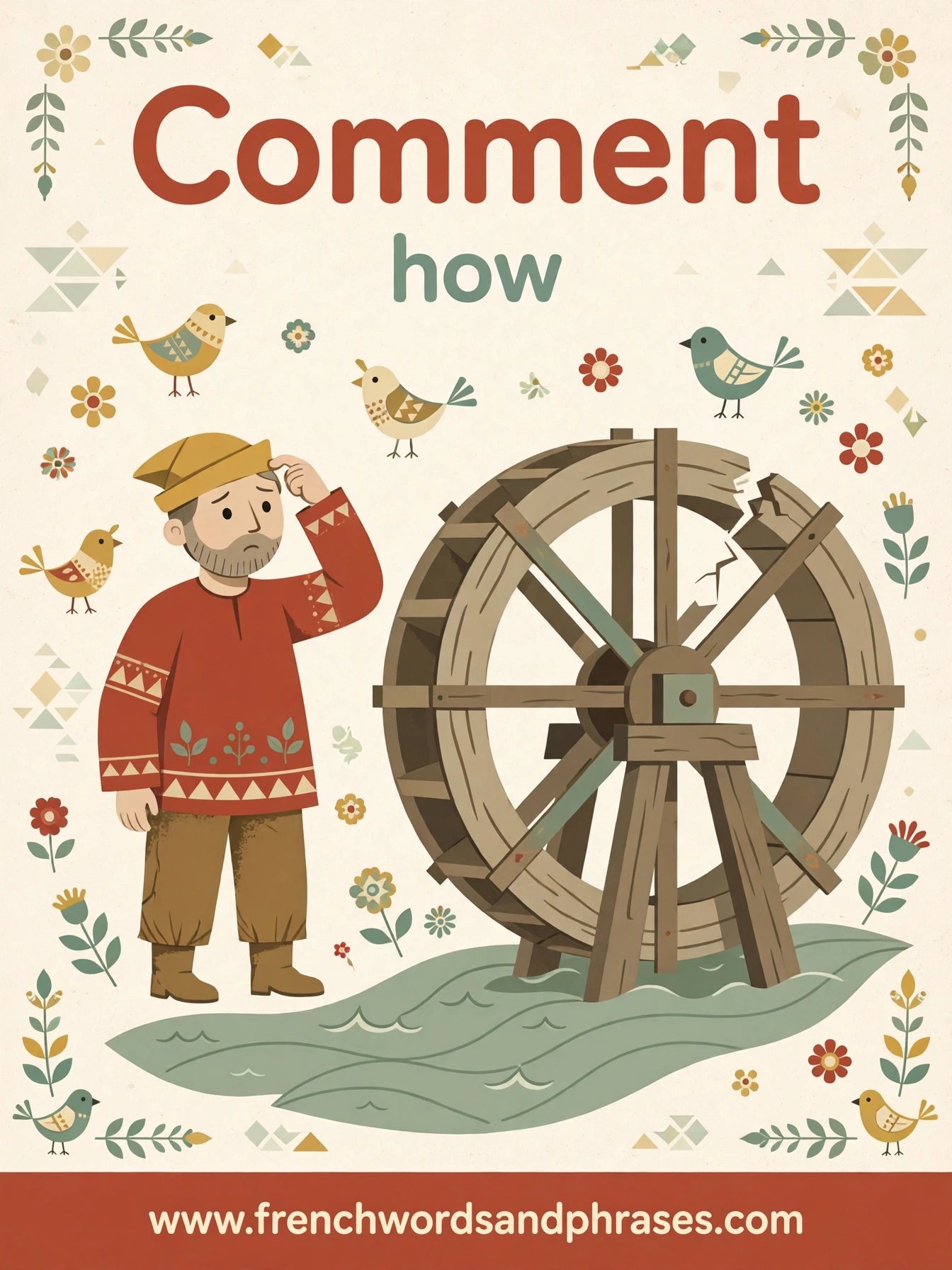
Comment means how.
Two old friends meet again on a station platform after ten years apart. « Comment ça va ? — Ça va bien, merci, et toi ? » — How is it going? — Very well, thanks, and you? Comment is the French word for asking how: how someone feels, how something works, how a thing is done — the first question of every reunion.
Let’s explore how comment works in French, beginning with the whole word on one card.
Understanding the French Pronoun Comment
Comment is a French interrogative pronoun — a question word that asks about manner: how something is done, how someone is, how a thing happens. It belongs to the question family with qui, que, quoi, où, quand, pourquoi, combien and lequel.
It means how. The picture it paints is a workshop door swinging open: comment opens up any situation and asks to see the works — comment ça marche (how does it work), comment tu t’appelles (what is your name, literally how are you called), comment il a fait (how he did it).
Type: Interrogative pronoun — asks about manner and state
Answers the question: Comment ? — How? (Answer: in this way, like this)
What follows it: A verb, often with inversion or est-ce que: comment allez-vous ?, comment est-ce que tu viens ?
Watch the pair: comment (how) vs combien (how much / how many) — comment tu paies ? = how do you pay?, combien tu paies ? = how much do you pay?
One important usage detail: comment is also the polite way to ask someone to repeat — « Comment ? » on its own, with a rising voice, means ‘Sorry, what was that?’ It is softer than a blunt quoi ? and safe in any company.
Experience the Word
Comment is the question of the curious friend — it does not ask what or who, it asks in what way, and it wants the story behind the thing.
Imagine a grandmother watching her grandson fix a bicycle chain in two minutes flat. « Mais comment tu fais ça ? » — But how do you do that? Behind every comment there is a little admiration hiding.
You have not just asked a question. You have asked for the method, the manner, the secret of how it is done.
How to Use Comment in French: Complete Guide
Let’s explore how comment works in French, beginning with the whole word on one card.
Comment at a Glance
The Whole Word on One Card
Meaning, job, pattern and pair — comment in four lines.
| Point | Comment |
|---|---|
| Meaning | how |
| Job | interrogative pronoun — asks about manner, method and state |
| What it asks about | the way something is done, or the way someone is: comment tu viens ?, comment ça va ? |
| Its forms | comment stays comment — it never changes for gender or number |
Example
Comment allez-vous ce matin ?
How are you this morning?
The Pattern in Action: Asking How
Comment connects a question to the manner of an action — the way, the means, the state.
| Pattern | Example |
|---|---|
| asking about health | comment ça va ? — how is it going? |
| asking about method | comment tu ouvres cette boîte ? — how do you open this box? |
| asking about a name | comment tu t’appelles ? — what is your name? (how are you called?) |
| asking about transport | comment vous venez demain ? — how are you coming tomorrow? |
Example
Comment est-ce que je peux t’aider ?
How can I help you?
Quick Quiz 1
What does comment ask about — the price, or the manner?
Reveal the answer
The manner — comment asks how something is done or how someone is; the price is combien.
Comment tu paies ?
How do you pay? (by card, in cash…)
The Tricky Bit: Three Ways to Build the Question
Comment can open three different question shapes — pick the one that fits the moment.
| Shape | How it works |
|---|---|
| comment + inversion (formal) | comment allez-vous ? — verb and pronoun swap places; the classic written form |
| comment est-ce que (neutral) | comment est-ce que tu t’appelles ? — est-ce que carries the question, the rest stays in normal order |
| comment + normal order (spoken) | comment tu t’appelles ? — everyday spoken French keeps subject and verb in place |
| comment all alone | « Comment ? » — pardon?, what was that? — the polite way to ask for a repeat |
Example
Comment est-ce que vous avez appris le français ?
How did you learn French?
Where It Goes: Always at the Front
Comment leads the question — it stands first, and the rest of the sentence follows behind it.
| Position / pattern | Example |
|---|---|
| question opener | comment va ta sœur ? — how is your sister? |
| comment + est-ce que | comment est-ce que ça marche ? — how does it work? |
| in an indirect question | je ne sais pas comment il fait — I do not know how he does it |
| comment + adjective (exclaiming) | comment c’est beau ! — how beautiful it is! |
Example
Dis-moi comment tu as fait ce gâteau.
Tell me how you made this cake.
Quick Quiz 2
Which shape is the formal, written one — comment tu vas ? or comment vas-tu ?
Reveal the answer
comment vas-tu — inversion of verb and pronoun is the formal written pattern; comment tu vas is everyday speech.
Comment vas-tu, mon ami ?
How are you, my friend?
Everyday Expressions with Comment
Comment lives in greetings, introductions and small daily repairs.
| Expression | In English |
|---|---|
| comment ça va ? | how is it going? / how are you? |
| comment allez-vous ? | how are you? (formal) |
| comment tu t’appelles ? | what is your name? |
| comment dit-on… ? | how do you say… ? |
| comment ça se fait ? | how come? / how does that happen? |
Example
Comment dit-on « bonjour » en espagnol ?
How do you say ‘hello’ in Spanish?
Close Cousins: Comment, Combien, Comme
Three neighbours that learners mix up — manner, quantity, and comparison.
| Word | The difference |
|---|---|
| comment | how — manner and method: comment tu cuisines ? (how do you cook?) |
| combien | how much / how many — quantity: combien de temps ? (how much time?) |
| comme | like, as — a comparison, not a question: il chante comme un oiseau (he sings like a bird) |
| comment vs pourquoi | comment asks the way (how did it happen?), pourquoi asks the reason (why did it happen?) |
Example
Comment tu paies, et combien tu paies ?
How do you pay, and how much do you pay?
Quick Quiz 3
“How many brothers do you have?” — comment or combien?
Reveal the answer
combien — counting takes combien (de); comment is for manner.
Combien de frères as-tu ?
How many brothers do you have?
Comment and Its Neighbours
The question shelf: the interrogative family that comment belongs to.
| French | In English |
|---|---|
| qui | who |
| que / quoi | what |
| où | where |
| pourquoi | why |
| comment | how |
Example
Qui vient, et comment vous voyagez ?
Who is coming, and how are you travelling?
Watch Out: The Traps Around Comment
The traps: the word-for-word name, the quantity mix-up, and comme sneaking in.
| Trap | The truth |
|---|---|
| translating ‘what is your name’ word for word | French asks how you are called: comment tu t’appelles ? — never ‘quoi est ton nom’ |
| using comment for quantity | how much and how many take combien: combien ça coûte ? |
| confusing comment and comme | comme means like / as: fort comme un lion — comment cannot compare |
| dropping comment in indirect questions | the question word stays: je me demande comment il fait — I wonder how he does it |
Example
Je me demande comment elle connaît tout le monde ici.
I wonder how she knows everyone here.
Quick Quiz 4
Complete: ______ tu t’appelles ? (What is your name?)
Reveal the answer
Comment — French asks how you are called.
Comment tu t’appelles ?
What is your name?
Comment in Everyday French: Real-Life Examples
Now that you know the word, let’s see how comment appears in everyday French.
Example Example 1 — A greeting
Salut Léa, comment ça va aujourd’hui ?
Hi Léa, how is it going today?
Example Example 2 — At the repair shop
Comment est-ce que je répare ce robinet ?
How do I fix this tap?
Example Example 3 — Meeting someone
Comment vous appelez-vous, madame ?
What is your name, madam?
Example Example 4 — Cooking
Comment tu fais cette sauce ? Elle est délicieuse.
How do you make this sauce? It is delicious.
Example Example 5 — Travel
Comment on va à la gare, s’il vous plaît ?
How do we get to the station, please?
Example Example 6 — Wonder
Je ne comprends pas comment il reste si calme.
I do not understand how he stays so calm.
Beyond Translation: The Meaning of Comment
English ‘how’ is a workhorse: how are you, how does it work, how beautiful. French comment carries the same load, and adds one small politeness of its own — said alone with a smile, « Comment ? » asks someone to repeat without a trace of rudeness.
To ask comment is to ask for the inside of things — the method, the manner, the way.
It is the question of cooks, mechanics and grandparents: not what happened, but comment ça se fait — how it came to be.
How to Remember the French Pronoun Comment
Remember it this way: Remember it this way: Comment is the method question — it never asks what or how much, it asks in what way.
- You ask for the manner — comment ça va, comment tu fais: the way, not the thing.
- You pick your shape — comment vas-tu ? (formal), comment est-ce que tu vas ? (neutral), comment tu vas ? (spoken).
- You keep quantity apart — how much and how many are always combien.
The key idea is comment means how — it asks about manner and method, and builds its questions with inversion, est-ce que, or plain spoken order.
Test Your Knowledge of Comment
Let’s see how much you’ve learned. Try answering these questions before revealing the answers.
Question 1
What does comment mean?
Reveal the answer
How — it asks about manner, method and state.
Question 2
How do you say ‘What is your name?’ in French?
Reveal the answer
Comment tu t’appelles ? — literally ‘how are you called?’.
Question 3
Translate: How does this machine work?
Reveal the answer
Comment est-ce que cette machine marche ?
Question 4
What does a lone « Comment ? » mean in conversation?
Reveal the answer
Pardon? / What was that? — the polite way to ask someone to repeat.
Question 5
Complete the sentence:
______ allez-vous ? (How are you? — formal)
Reveal the answer
Comment
Comment allez-vous ?
How are you?
Your Final Challenge
Can You Use It?
How would you say this in French?
“How would you say this in French?”
Reveal the answer
Comment est-ce que tu fais ce pain ?
How do you make this bread?
A little French. A little curiosity. A richer everyday life.
LEARN FRENCH ONE WORD AT A TIME