A French Word to Live By
How to Conjugate Tendre in French
/tɑ̃dʁ/
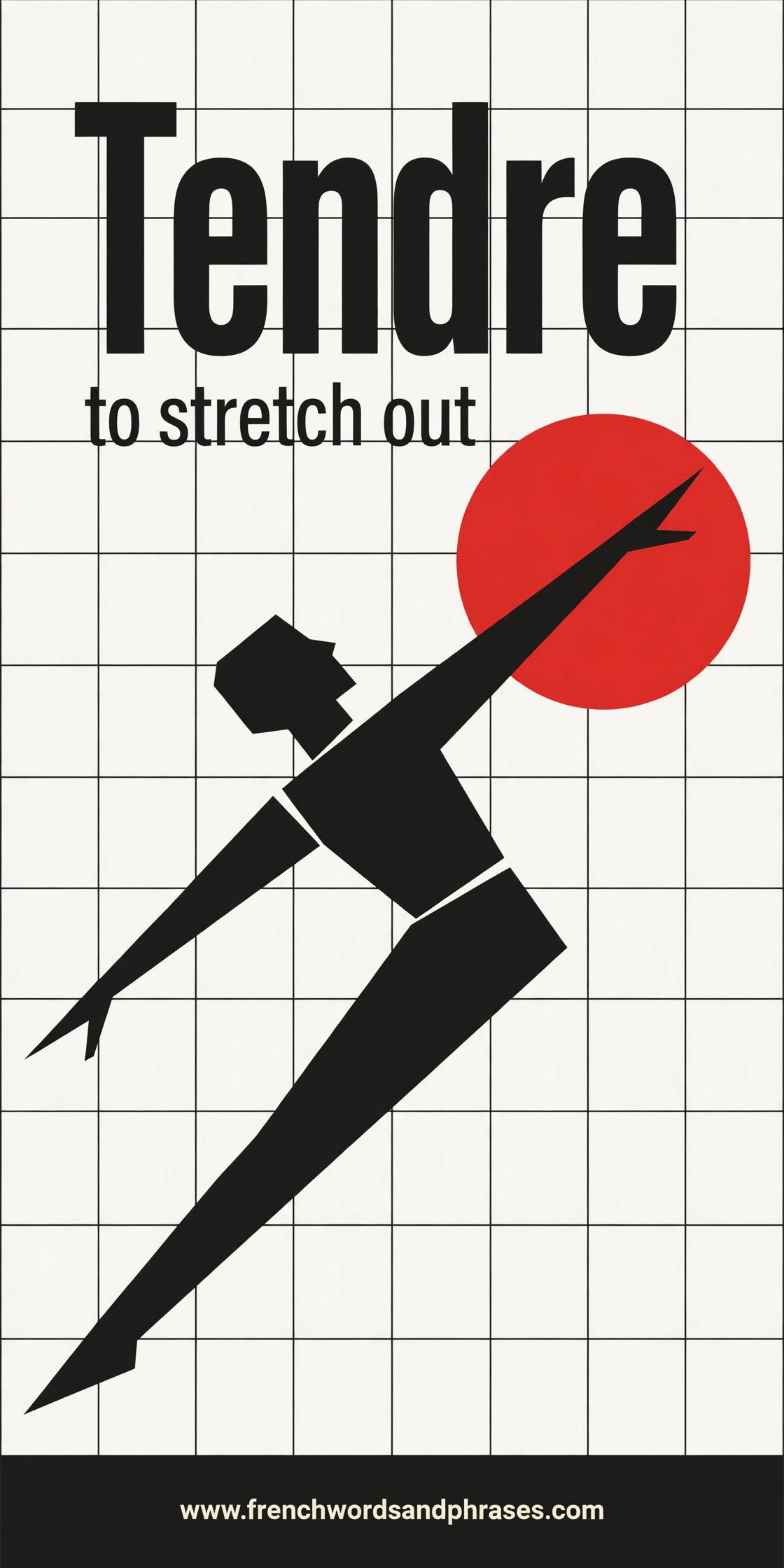
Tendre means to stretch out — to hold out a hand, strain a rope tight, or prick up an ear towards a distant sound.
A hand stretched out in greeting, a rope pulled drum-tight between two posts, an ear turned towards a whisper behind a door — tendre is the verb of stretching out: hands, arms, ropes, traps and ears all reach or tighten under it.
In this guide, you’ll learn how to conjugate tendre in all the major French tenses and moods. Explore complete conjugation tables, French examples, English translations, and practice quizzes.
Understanding the French Verb Tendre
Tendre is a regular French verb belonging to the third group of verbs, those ending in -re.
It means to stretch out. It covers the physical stretching of ropes, wires and cloth until they are taut, the holding out of hands and arms, the setting of traps and nets, and the abstract drift of things that tend towards an outcome — les esprits tendent à s’échauffer, tempers tend to heat up. Where English splits stretch, hold out, tighten and tend across four verbs, French gathers them all into tendre.
Verb classification: Third group (-re)
Auxiliary verb: Avoir
Past participle: tendu
Present participle: tendant
English equivalents: To stretch out, to hold out, to tighten; tendre la main — to hold out one’s hand (to help, or to beg); tendre l’oreille — to prick up one’s ears, to listen hard; tendre un piège — to set a trap; tendre à — to tend to, to lead to; une corde tendue — a tight rope.
One important detail: tendre is a regular -re verb of the attendre family: je tends, tu tends, il tend — the singular ends in a bare -ds, -ds, -d — then nous tendons, vous tendez, ils tendent, past participle tendu. Do not confuse the verb with its twin the adjective tendre, tender: une viande tendre is tender meat, but elle tend la main is she holds out her hand. Its great constructions are tendre la main (a hand held out in help — or in begging), tendre l’oreille (to listen with all one’s might) and tendre à + infinitive, to tend to: les prix tendent à monter.
Experience the Word
Tendre is the verb of reaching — everything in it leans forward: the hand towards the friend, the ear towards the sound, the rope towards the far post.
Imagine a kitchen at dusk, and behind the closed door, the murmur of a surprise being prepared. A small boy stands on tiptoe, one ear flat against the wood — il tend l’oreille, il retient son souffle — and catches, or thinks he catches, the word gâteau.
He has heard almost nothing. He has listened — il a tendu l’oreille — with his whole body stretched towards the sound.
How to Conjugate Tendre: Complete French Conjugation Guide
Let’s explore every major conjugation of tendre, beginning with the indicative mood.
How to Conjugate Tendre in the Indicative Mood
The indicative mood is used to express facts, observations, actions, and events.
How to Conjugate Tendre in the Present Tense (Présent)
Used for actions happening now, habitual actions, and general truths.
| Subject | Conjugation |
|---|---|
| je | tends |
| tu | tends |
| il / elle | tend |
| nous | tendons |
| vous | tendez |
| ils / elles | tendent |
Example
Elle tend la main à l’enfant pour traverser.
She holds out her hand to the child to cross the road.
Quick Quiz 1
Complete the sentence:
Nous ______ la main aux voyageurs perdus.
Reveal the answer
tendons
Nous tendons la main aux voyageurs perdus.
We hold out a hand to the lost travellers.
How to Conjugate Tendre in the Passé Composé
Used for completed actions in the past. Tendre takes the auxiliary verb avoir.
| Subject | Conjugation |
|---|---|
| j’ | ai tendu |
| tu | as tendu |
| il / elle | a tendu |
| nous | avons tendu |
| vous | avez tendu |
| ils / elles | ont tendu |
Example
Il a tendu l’oreille pour écouter la conversation.
He pricked up his ears to listen to the conversation.
How to Conjugate Tendre in the Imparfait (Imperfect Tense)
Used for habitual past actions, descriptions, and ongoing situations in the past.
| Subject | Conjugation |
|---|---|
| je | tendais |
| tu | tendais |
| il / elle | tendait |
| nous | tendions |
| vous | tendiez |
| ils / elles | tendaient |
Example
Le funambule tendait les bras pour garder l’équilibre.
The tightrope walker held out his arms to keep his balance.
Quick Quiz 2
Choose the correct form:
He set a trap.
Il ______ un piège. (a tendu / est tendu)
Reveal the answer
a tendu
Il a tendu un piège.
Tendre takes avoir.
How to Conjugate Tendre in the Plus-que-parfait
Used to describe an action that had already been completed before another past event.
| Subject | Conjugation |
|---|---|
| j’ | avais tendu |
| tu | avais tendu |
| il / elle | avait tendu |
| nous | avions tendu |
| vous | aviez tendu |
| ils / elles | avaient tendu |
Example
Nous avions tendu la nappe sur la table du jardin.
We had stretched the cloth over the garden table.
How to Conjugate Tendre in the Passé Simple
Primarily used in formal writing, literature, and historical narratives. It is rarely used in everyday conversation.
| Subject | Conjugation |
|---|---|
| je | tendis |
| tu | tendis |
| il / elle | tendit |
| nous | tendîmes |
| vous | tendîtes |
| ils / elles | tendirent |
Example
Le mendiant tendit la main aux passants.
The beggar held out his hand to the passers-by.
How to Conjugate Tendre in the Passé Antérieur
A literary tense used to express an action completed immediately before another past action, generally in the passé simple.
| Subject | Conjugation |
|---|---|
| j’ | eus tendu |
| tu | eus tendu |
| il / elle | eut tendu |
| nous | eûmes tendu |
| vous | eûtes tendu |
| ils / elles | eurent tendu |
Example
Quand il eut tendu le piège, il se cacha derrière les buissons.
When he had set the trap, he hid behind the bushes.
How to Conjugate Tendre in the Future Tense (Futur Simple)
Used to describe actions that will take place in the future.
| Subject | Conjugation |
|---|---|
| je | tendrai |
| tu | tendras |
| il / elle | tendra |
| nous | tendrons |
| vous | tendrez |
| ils / elles | tendront |
Example
Je te tendrai la main quand tu en auras besoin.
I will hold out my hand to you when you need it.
How to Conjugate Tendre in the Futur Antérieur (Future Perfect)
Used for an action that will have been completed before a particular point in the future.
| Subject | Conjugation |
|---|---|
| j’ | aurai tendu |
| tu | auras tendu |
| il / elle | aura tendu |
| nous | aurons tendu |
| vous | aurez tendu |
| ils / elles | auront tendu |
Example
À midi, les ouvriers auront tendu le câble d’un bout à l’autre.
By noon, the workmen will have stretched the cable from one end to the other.
How to Conjugate Tendre in the Near Future (Futur Proche)
Used to describe something that is going to happen soon. Formed with aller + infinitive.
| Subject | Conjugation |
|---|---|
| je | vais tendre |
| tu | vas tendre |
| il / elle | va tendre |
| nous | allons tendre |
| vous | allez tendre |
| ils / elles | vont tendre |
Example
Le jardinier va tendre un fil pour les haricots.
The gardener is going to stretch a wire for the beans.
How to Conjugate Tendre in the Conditional Mood
The conditional mood expresses what would happen under certain circumstances. It is also frequently used to make polite requests or express wishes.
How to Conjugate Tendre in the Present Conditional
| Subject | Conjugation |
|---|---|
| je | tendrais |
| tu | tendrais |
| il / elle | tendrait |
| nous | tendrions |
| vous | tendriez |
| ils / elles | tendraient |
Example
À ta place, je tendrais la main à mon voisin.
In your place, I would hold out a hand to my neighbour.
How to Conjugate Tendre in the Past Conditional
| Subject | Conjugation |
|---|---|
| j’ | aurais tendu |
| tu | aurais tendu |
| il / elle | aurait tendu |
| nous | aurions tendu |
| vous | auriez tendu |
| ils / elles | auraient tendu |
Example
Elle aurait tendu l’oreille si la porte avait été ouverte.
She would have listened hard if the door had been open.
Tendre in the Literary Past Conditional Form
This less common literary form uses the imperfect subjunctive of avoir.
| Subject | Conjugation |
|---|---|
| j’ | eusse tendu |
| tu | eusses tendu |
| il / elle | eût tendu |
| nous | eussions tendu |
| vous | eussiez tendu |
| ils / elles | eussent tendu |
Example
Il eût tendu la main au pauvre sans hésiter.
He would have held out his hand to the poor man without hesitating.
How to Conjugate Tendre in the Subjunctive Mood
The subjunctive is used to express wishes, emotions, doubts, necessity, and uncertainty. It frequently follows expressions such as il faut que (it is necessary that) or bien que (although).
How to Conjugate Tendre in the Present Subjunctive
| Subject | Conjugation |
|---|---|
| que je | tende |
| que tu | tendes |
| qu’il / qu’elle | tende |
| que nous | tendions |
| que vous | tendiez |
| qu’ils / qu’elles | tendent |
Example
Il faut que tu tendes le bras pour attraper la corde.
You must stretch out your arm to catch the rope.
Quick Quiz 3
Complete the sentence using the subjunctive:
Il faut que vous ______ l’oreille pour entendre la mer.
Reveal the answer
tendiez
Il faut que vous tendiez l’oreille pour entendre la mer.
You must listen hard to hear the sea.
How to Conjugate Tendre in the Imperfect Subjunctive
A literary tense, rarely encountered in modern spoken French.
| Subject | Conjugation |
|---|---|
| que je | tendisse |
| que tu | tendisses |
| qu’il / qu’elle | tendît |
| que nous | tendissions |
| que vous | tendissiez |
| qu’ils / qu’elles | tendissent |
Example
Elle attendait qu’il tendît la main vers elle.
She was waiting for him to hold out his hand to her.
How to Conjugate Tendre in the Pluperfect Subjunctive
A literary construction used to express an action completed before another past action.
| Subject | Conjugation |
|---|---|
| que j’ | eusse tendu |
| que tu | eusses tendu |
| qu’il / qu’elle | eût tendu |
| que nous | eussions tendu |
| que vous | eussiez tendu |
| qu’ils / qu’elles | eussent tendu |
Example
On racontait qu’il eût tendu un piège à ses ennemis.
People said he had set a trap for his enemies.
How to Conjugate Tendre in the Past Subjunctive
| Subject | Conjugation |
|---|---|
| que j’ | aie tendu |
| que tu | aies tendu |
| qu’il / qu’elle | ait tendu |
| que nous | ayons tendu |
| que vous | ayez tendu |
| qu’ils / qu’elles | aient tendu |
Example
Je suis heureux qu’elle ait tendu la main à sa sœur.
I am glad she held out a hand to her sister.
How to Conjugate Tendre in the Imperative
The imperative is used to give commands, instructions, invitations, or suggestions. Subject pronouns are omitted.
How to Conjugate Tendre in the Present Imperative
| Person | Conjugation |
|---|---|
| (tu) | tends |
| (nous) | tendons |
| (vous) | tendez |
Example
Tends l’oreille, on entend la mer !
Listen hard, you can hear the sea!
Quick Quiz 4
How would you say Listen hard (tu form)?
Reveal the answer
Tends l’oreille !
French Participles of Tendre
Participles are verb forms that can be used in compound tenses and other grammatical constructions.
Present Participle of Tendre
tendant
En tendant le bras, il a attrapé la branche.
By stretching out his arm, he caught hold of the branch.
Past Participle of Tendre
tendu
Tendue entre deux arbres, la corde à linge pliait sous les draps.
Stretched between two trees, the washing line sagged under the sheets.
Tendre in Everyday French: Real-Life Examples
Now that you know the conjugations, let’s see how tendre appears in everyday French.
Example 1 — Present
Elle tend la main à l’enfant.
She holds out her hand to the child.
Example 2 — Passé composé
Il a tendu l’oreille à la porte.
He listened hard at the door.
Example 3 — Imparfait
Le funambule tendait les bras.
The tightrope walker held out his arms.
Example 4 — Future
Je te tendrai la main.
I will hold out my hand to you.
Example 5 — Conditional
Je tendrais la main à mon voisin.
I would hold out a hand to my neighbour.
Example 6 — Imperative
Tends l’oreille, écoute !
Listen hard, listen!
Beyond Translation: The Meaning of Tendre
Tendre comes from Latin tendere, to stretch — the root English keeps in tend, tension, extend and tent, which is, after all, cloth stretched on poles.
Its most beautiful gesture is an ear.
Tendre l’oreille — to stretch out the ear — pictures listening as a physical reaching, the whole body leaning towards a sound. It is the idiom this page grows from, and once you have seen the picture, you will never merely ‘listen’ again.
How to Remember the French Verb Tendre
Remember it this way: Tendre is about the hand held out, the rope pulled tight, the ear stretched towards the door.
- Attendre family: je tends, il tend, nous tendons, past participle tendu — no surprises, just the bare -d in il tend.
- Three great gestures: tendre la main (help or begging), tendre l’oreille (listen hard), tendre un piège (set a trap).
- The adjective tendre means tender; the verb tendre stretches — une corde tendue is a tight rope, not a tender one.
The key idea is the hand held out, the rope pulled tight, the ear stretched towards the door.
Test Your Knowledge of Tendre
Let’s see how much you’ve learned. Try answering these questions before revealing the answers.
Question 1
How do you say to listen hard, to prick up one’s ears, in French?
Reveal the answer
Tendre l’oreille — literally, to stretch out the ear.
Question 2
How do you say She holds out her hand to the child in French?
Reveal the answer
Elle tend la main à l’enfant.
Question 3
Translate: He set a trap and hid behind the bushes.
Reveal the answer
Il a tendu un piège et s’est caché derrière les buissons.
Question 4
What is the past participle of tendre?
Reveal the answer
Tendu.
Question 5
Complete the sentence:
Il faut que tu ______ le bras pour attraper la corde.
Reveal the answer
tendes
Il faut que tu tendes le bras pour attraper la corde.
You must stretch out your arm to catch the rope.
Your Final Challenge
Can You Use It?
How would you say this in French?
Listen hard at the foot of the door: behind it, a whole world is whispering.
Reveal the answer
Tends l’oreille au pied de la porte : derrière, tout un monde chuchote.
Listen hard at the foot of the door: behind it, a whole world is whispering.
A little French. A little curiosity. A richer everyday life.
LEARN FRENCH ONE WORD AT A TIME