A French Word to Live By
How to Conjugate Toucher in French
/tu.ʃe/
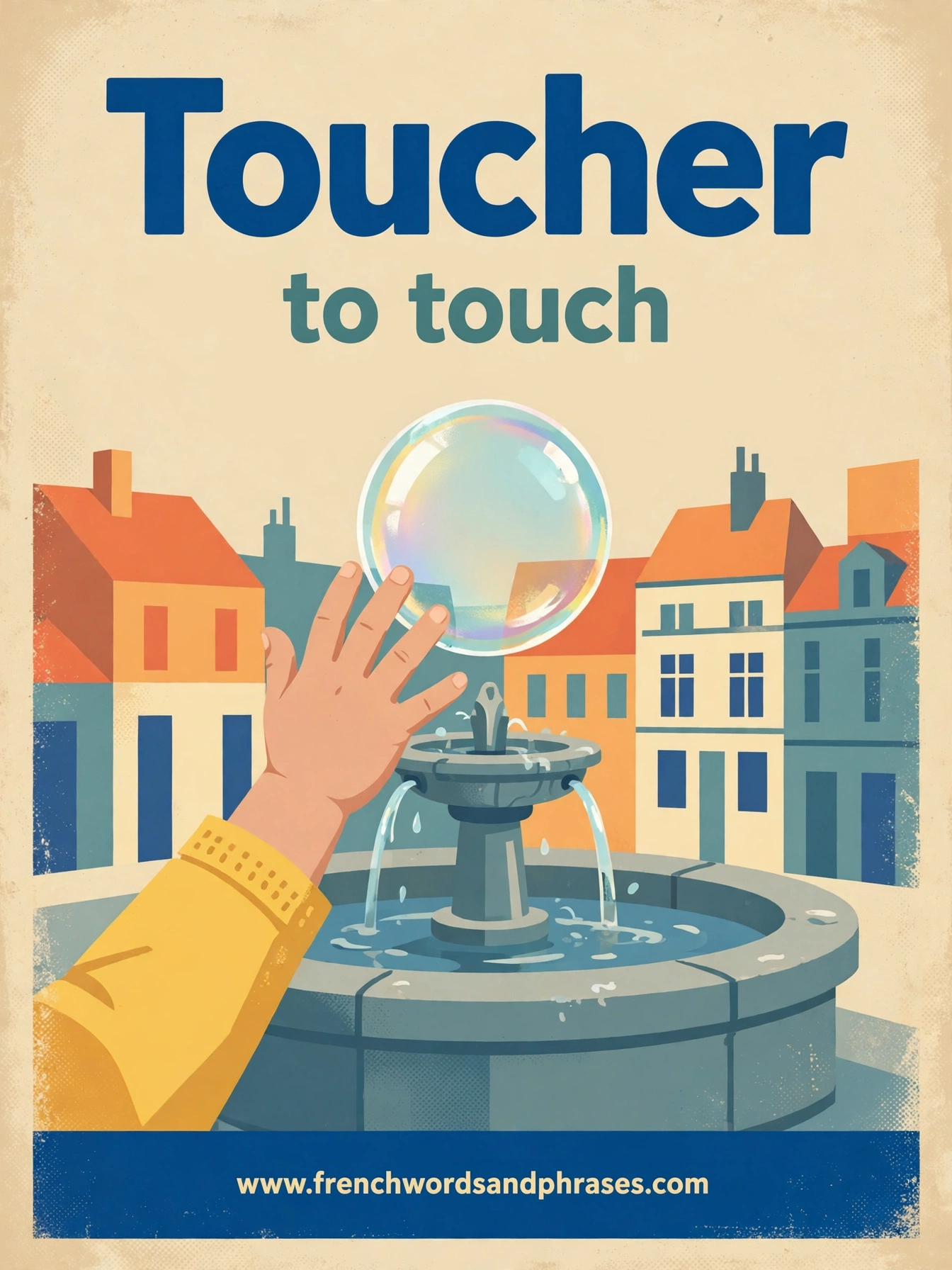
Toucher means to touch — to lay a hand on something, to reach it, to move it, and sometimes to be paid for it.
A child’s hand reaching for a museum vase, a swimmer’s toes finding the bottom of the pool, a kind word landing exactly where it hurts — toucher is the verb of contact: fingers, feelings, borders and bank accounts all touch, and are touched, through it.
In this guide, you’ll learn how to conjugate toucher in all the major French tenses and moods. Explore complete conjugation tables, French examples, English translations, and practice quizzes.
Understanding the French Verb Toucher
Toucher is a regular French verb belonging to the first group of verbs, those ending in-er.
It means to touch. It runs from the fingertips (touching objects, instruments, food) through geography (lands and gardens that touch, toucher à) and finance (touching a salary, a bonus, an inheritance) to the feelings: a speech, a letter or a kindness touche its audience, and the person moved is touché, touchée. Few French verbs travel so far on one pair of hands.
Verb classification: First group (-er)
Auxiliary verb: Avoir
Past participle: touché
Present participle: touchant
English equivalents: To touch, to feel, to reach, to receive (pay); toucher du bois — to touch wood (for luck); ne pas toucher à — to leave alone, not to touch; toucher un salaire — to receive a salary; toucher le fond — to touch bottom, to hit rock bottom; être touché — to be moved, affected.
One important detail: toucher is a perfectly regular -er verb — je touche, nous touchons, ils touchent, past participle touché — and everything depends on the little word that follows. Toucher quelque chose is to touch a thing directly; toucher à quelque chose is to lay a hand on it, meddle with it, or border on it: ne touche pas à mes affaires ! — don’t touch my things! The same verb receives money (toucher un salaire, toucher une prime), reaches places (le jardin touche à la forêt) and moves hearts — touché is also the adjective for being emotionally moved.
Experience the Word
Toucher is the verb of the meeting point — the instant where a hand, a border, a payment or a feeling makes contact.
Imagine a museum guard watching a small boy drift closer and closer to a Roman vase, one hand rising slowly behind his back. The guard clears his throat: « On ne touche pas, jeune homme. » The hand stops a centimetre from two thousand years of history.
The boy has touched nothing at all. He has learned — il a appris — that toucher is the verb every museum in France is built to forbid.
How to Conjugate Toucher: Complete French Conjugation Guide
Let’s explore every major conjugation of toucher, beginning with the indicative mood.
How to Conjugate Toucher in the Indicative Mood
The indicative mood is used to express facts, observations, actions, and events.
How to Conjugate Toucher in the Present Tense (Présent)
Used for actions happening now, habitual actions, and general truths.
| Subject | Conjugation |
|---|---|
| je | touche |
| tu | touches |
| il / elle | touche |
| nous | touchons |
| vous | touchez |
| ils / elles | touchent |
Example
L’enfant touche tout ce qu’il voit.
The child touches everything he sees.
Quick Quiz 1
Complete the sentence:
Nous ______ le fond de la piscine.
Reveal the answer
touchons
Nous touchons le fond de la piscine.
We are touching the bottom of the pool.
How to Conjugate Toucher in the Passé Composé
Used for completed actions in the past. Toucher takes the auxiliary verb avoir.
| Subject | Conjugation |
|---|---|
| j’ | ai touché |
| tu | as touché |
| il / elle | a touché |
| nous | avons touché |
| vous | avez touché |
| ils / elles | ont touché |
Example
Elle a touché le fond de la piscine avec ses pieds.
She touched the bottom of the pool with her feet.
How to Conjugate Toucher in the Imparfait (Imperfect Tense)
Used for habitual past actions, descriptions, and ongoing situations in the past.
| Subject | Conjugation |
|---|---|
| je | touchais |
| tu | touchais |
| il / elle | touchait |
| nous | touchions |
| vous | touchiez |
| ils / elles | touchaient |
Example
Le jardin touchait à la forêt.
The garden bordered on the forest.
Quick Quiz 2
Choose the correct form:
She touched the bottom of the pool.
Elle ______ le fond de la piscine. (a touché / est touchée)
Reveal the answer
a touché
Elle a touché le fond de la piscine.
Toucher takes avoir.
How to Conjugate Toucher in the Plus-que-parfait
Used to describe an action that had already been completed before another past event.
| Subject | Conjugation |
|---|---|
| j’ | avais touché |
| tu | avais touché |
| il / elle | avait touché |
| nous | avions touché |
| vous | aviez touché |
| ils / elles | avaient touché |
Example
Il avait touché son premier salaire avec fierté.
He had received his first salary with pride.
How to Conjugate Toucher in the Passé Simple
Primarily used in formal writing, literature, and historical narratives. It is rarely used in everyday conversation.
| Subject | Conjugation |
|---|---|
| je | touchai |
| tu | touchas |
| il / elle | toucha |
| nous | touchâmes |
| vous | touchâtes |
| ils / elles | touchèrent |
Example
La foudre toucha le vieux chêne du village.
The lightning struck the old oak of the village.
How to Conjugate Toucher in the Passé Antérieur
A literary tense used to express an action completed immediately before another past action, generally in the passé simple.
| Subject | Conjugation |
|---|---|
| j’ | eus touché |
| tu | eus touché |
| il / elle | eut touché |
| nous | eûmes touché |
| vous | eûtes touché |
| ils / elles | eurent touché |
Example
Quand il eut touché l’héritage, il quitta son emploi.
When he had received the inheritance, he left his job.
How to Conjugate Toucher in the Future Tense (Futur Simple)
Used to describe actions that will take place in the future.
| Subject | Conjugation |
|---|---|
| je | toucherai |
| tu | toucheras |
| il / elle | touchera |
| nous | toucherons |
| vous | toucherez |
| ils / elles | toucheront |
Example
Demain, tu toucheras enfin le fruit de ton travail.
Tomorrow, you will finally receive the fruit of your work.
How to Conjugate Toucher in the Futur Antérieur (Future Perfect)
Used for an action that will have been completed before a particular point in the future.
| Subject | Conjugation |
|---|---|
| j’ | aurai touché |
| tu | auras touché |
| il / elle | aura touché |
| nous | aurons touché |
| vous | aurez touché |
| ils / elles | auront touché |
Example
À la fin du mois, elle aura touché sa prime.
By the end of the month, she will have received her bonus.
How to Conjugate Toucher in the Near Future (Futur Proche)
Used to describe something that is going to happen soon. Formed with aller + infinitive.
| Subject | Conjugation |
|---|---|
| je | vais toucher |
| tu | vas toucher |
| il / elle | va toucher |
| nous | allons toucher |
| vous | allez toucher |
| ils / elles | vont toucher |
Example
Attention, tu vas toucher le fil électrique !
Careful, you are going to touch the electric wire!
How to Conjugate Toucher in the Conditional Mood
The conditional mood expresses what would happen under certain circumstances. It is also frequently used to make polite requests or express wishes.
How to Conjugate Toucher in the Present Conditional
| Subject | Conjugation |
|---|---|
| je | toucherais |
| tu | toucherais |
| il / elle | toucherait |
| nous | toucherions |
| vous | toucheriez |
| ils / elles | toucheraient |
Example
Sans ce mur, la maison toucherait la rivière.
Without that wall, the house would reach the river.
How to Conjugate Toucher in the Past Conditional
| Subject | Conjugation |
|---|---|
| j’ | aurais touché |
| tu | aurais touché |
| il / elle | aurait touché |
| nous | aurions touché |
| vous | auriez touché |
| ils / elles | auraient touché |
Example
Il aurait touché une belle somme s’il avait vendu à temps.
He would have received a fine sum if he had sold in time.
Toucher in the Literary Past Conditional Form
This less common literary form uses the imperfect subjunctive of avoir.
| Subject | Conjugation |
|---|---|
| j’ | eusse touché |
| tu | eusses touché |
| il / elle | eût touché |
| nous | eussions touché |
| vous | eussiez touché |
| ils / elles | eussent touché |
Example
Il eût touché le ciel du doigt, tant il était heureux.
He would have touched the sky with his finger, he was so happy.
How to Conjugate Toucher in the Subjunctive Mood
The subjunctive is used to express wishes, emotions, doubts, necessity, and uncertainty. It frequently follows expressions such as il faut que (it is necessary that) or bien que (although).
How to Conjugate Toucher in the Present Subjunctive
| Subject | Conjugation |
|---|---|
| que je | touche |
| que tu | touches |
| qu’il / qu’elle | touche |
| que nous | touchions |
| que vous | touchiez |
| qu’ils / qu’elles | touchent |
Example
Il ne faut pas que les enfants touchent aux prises.
The children must not touch the sockets.
Quick Quiz 3
Complete the sentence using the subjunctive:
Il ne faut pas que vous ______ aux prises électriques.
Reveal the answer
touchiez
Il ne faut pas que vous touchiez aux prises électriques.
You must not touch the electric sockets.
How to Conjugate Toucher in the Imperfect Subjunctive
A literary tense, rarely encountered in modern spoken French.
| Subject | Conjugation |
|---|---|
| que je | touchasse |
| que tu | touchasses |
| qu’il / qu’elle | touchât |
| que nous | touchassions |
| que vous | touchassiez |
| qu’ils / qu’elles | touchassent |
Example
Elle craignait qu’il touchât au vase précieux.
She feared he might lay a hand on the precious vase.
How to Conjugate Toucher in the Pluperfect Subjunctive
A literary construction used to express an action completed before another past action.
| Subject | Conjugation |
|---|---|
| que j’ | eusse touché |
| que tu | eusses touché |
| qu’il / qu’elle | eût touché |
| que nous | eussions touché |
| que vous | eussiez touché |
| qu’ils / qu’elles | eussent touché |
Example
On disait qu’il eût touché à des affaires louches.
People said he had dabbled in shady dealings.
How to Conjugate Toucher in the Past Subjunctive
| Subject | Conjugation |
|---|---|
| que j’ | aie touché |
| que tu | aies touché |
| qu’il / qu’elle | ait touché |
| que nous | ayons touché |
| que vous | ayez touché |
| qu’ils / qu’elles | aient touché |
Example
Je suis surpris qu’elle ait touché à mon bureau.
I am surprised she touched my desk.
How to Conjugate Toucher in the Imperative
The imperative is used to give commands, instructions, invitations, or suggestions. Subject pronouns are omitted.
How to Conjugate Toucher in the Present Imperative
| Person | Conjugation |
|---|---|
| (tu) | touche |
| (nous) | touchons |
| (vous) | touchez |
Example
Touchez du bois, ça porte bonheur !
Touch wood, it brings luck!
Quick Quiz 4
How would you say Touch wood (tu form)?
Reveal the answer
Touche du bois !
French Participles of Toucher
Participles are verb forms that can be used in compound tenses and other grammatical constructions.
Present Participle of Toucher
touchant
En touchant la corde, il sentit qu’elle vibrait encore.
Touching the string, he felt that it was still vibrating.
Past Participle of Toucher
touché
Touchée par ses paroles, elle lui pardonna tout.
Moved by his words, she forgave him everything.
Toucher in Everyday French: Real-Life Examples
Now that you know the conjugations, let’s see how toucher appears in everyday French.
Example 1 — Present
L’enfant touche à tout.
The child touches everything.
Example 2 — Passé composé
Elle a touché le fond de la piscine.
She touched the bottom of the pool.
Example 3 — Imparfait
Le jardin touchait à la forêt.
The garden bordered on the forest.
Example 4 — Future
Tu toucheras ta prime à la fin du mois.
You will receive your bonus at the end of the month.
Example 5 — Conditional
Il toucherait une belle somme en vendant la maison.
He would receive a fine sum by selling the house.
Example 6 — Imperative
Touchez du bois !
Touch wood!
Beyond Translation: The Meaning of Toucher
Toucher probably begins as an imitation — toc, the little knock of a fingertip on wood — and the knock is still there in its most famous idiom.
Knock on wood, French style.
Toucher du bois — to touch wood — is exactly the English superstition wearing French clothes, and it is the idiom this page grows from. But notice how far the verb walks from that knock: the same toucher receives your salary, borders on the forest and breaks your heart, all without moving a finger more than a centimetre.
How to Remember the French Verb Toucher
Remember it this way: Toucher is about the fingertip on the vase, the knock on wood, and the salary landing in the account.
- Regular -er: je touche, nous touchons, past participle touché — also the adjective ‘moved’.
- Toucher quelque chose = touch it; toucher à quelque chose = lay a hand on it, meddle, or border on it — ne touche pas à mes affaires !
- Toucher du bois: knock on wood — and toucher un salaire: pay day.
The key idea is the fingertip on the vase, the knock on wood, and the salary landing in the account.
Test Your Knowledge of Toucher
Let’s see how much you’ve learned. Try answering these questions before revealing the answers.
Question 1
What does toucher du bois mean, and when do you say it?
Reveal the answer
To touch wood — said, while touching something wooden, to ward off bad luck after a hopeful statement.
Question 2
How do you say The child touches everything he sees in French?
Reveal the answer
L’enfant touche tout ce qu’il voit.
Question 3
Translate: She touched the bottom of the pool.
Reveal the answer
Elle a touché le fond de la piscine.
Question 4
What is the past participle of toucher?
Reveal the answer
Touché — also the adjective meaning moved, affected.
Question 5
Complete the sentence:
Il ne faut pas que les enfants ______ aux prises.
Reveal the answer
touchent
Il ne faut pas que les enfants touchent aux prises.
The children must not touch the sockets.
Your Final Challenge
Can You Use It?
How would you say this in French?
Touch wood and say it anyway: sometimes words reach further than hands.
Reveal the answer
Touche du bois et dis-le quand même : parfois, les mots touchent plus loin que les mains.
Touch wood and say it anyway: sometimes words reach further than hands.
A little French. A little curiosity. A richer everyday life.
LEARN FRENCH ONE WORD AT A TIME