A French Word to Live By
Translate Tempête to English
/tɑ̃.pɛt/
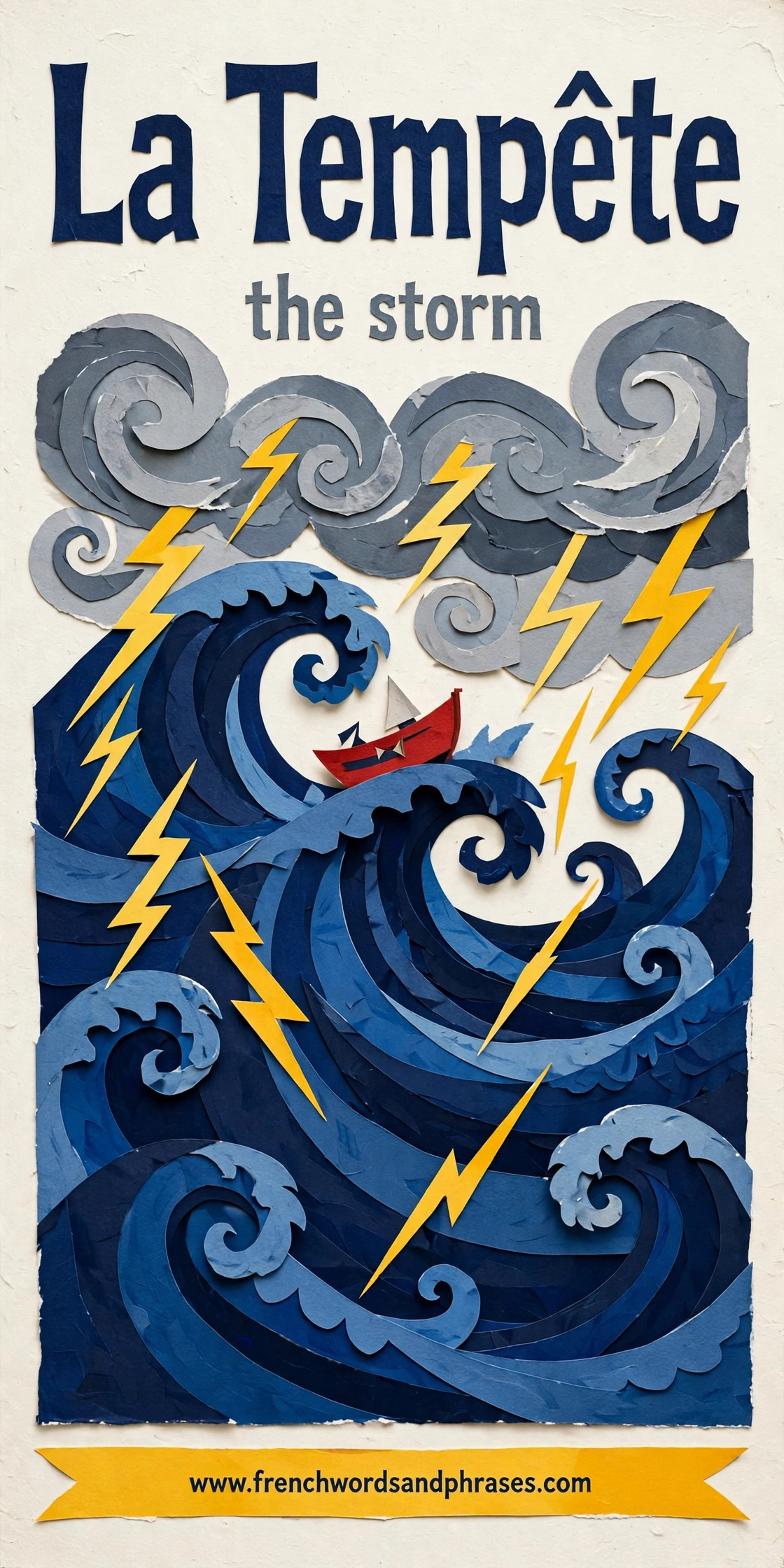
La tempête means the storm.
The shutters bang, the sea turns white, and the radio repeats its warning all morning: « Une violente tempête arrive sur la côte ce soir. » Windows closed, candles ready — la tempête is coming.
In this guide, you’ll learn what tempête means in English, how to use it with its articles, how to form its plural, and how it appears in everyday French. Explore French examples, English translations, and practice quizzes.
Understanding the French Noun Tempête
Tempête is a feminine French noun, learned with its article: la tempête, une tempête. It takes a regular plural: les tempêtes. Do not confuse it with le temps, the weather — tempête is the weather at its most violent.
It means the storm — a violent disturbance of wind and usually rain, snow or sand: une tempête de neige is a snowstorm, une tempête de sable a sandstorm. French also uses it figuratively, for an uproar: une tempête de protestations, a storm of protest — and most famously in the idiom une tempête dans un verre d’eau, a storm in a teacup.
Gender: Feminine — la tempête, une tempête
Plural: les tempêtes
Kinds of storm: tempête de neige (snowstorm), tempête de sable (sandstorm), tempête tropicale (tropical storm)
Not the same as: le temps — the weather in general, or time
At sea: essuyer une tempête — to ride out a storm
English equivalents: The storm, the tempest.
One famous usage detail: French names its great storms like hurricanes — the devastating winter storm of 1999 is still remembered simply as la tempête de 1999, or by its name, Lothar. When a French speaker says la tempête with a date after it, everyone knows exactly which one is meant.
Experience the Word
Tempête is nature with its voice raised. It is the night the tiles rattle, the harbour empties, and the whole village listens to the wind testing every shutter and every tree.
Imagine the morning after: branches in the road, the sea still grey and magnificent, neighbours in the street comparing damage and luck — the strange calm that only follows a storm.
You have not just survived bad weather. You have come through the tempête — and the calm feels earned.
How to Use Tempête in French: Complete Guide
Let’s explore how tempête works in French, beginning with its articles — a feminine noun for the wildest weather of all.
Tempête with the Definite Article (La, Les)
Used for a particular storm — the one on the news, the one last night.
| Form | French |
|---|---|
| Feminine singular | la tempête |
| Plural | les tempêtes |
Example
La tempête a arraché des toits dans tout le village.
The storm tore roofs off all over the village.
Tempête with the Indefinite Article (Une, Des)
Used for a storm in general — une tempête is coming, des tempêtes are forecast.
| Form | French |
|---|---|
| Feminine singular | une tempête |
| Plural | des tempêtes |
Example
Une tempête de neige arrive sur la région ce soir.
A snowstorm is arriving over the region this evening.
Tempête with Quantities (Une série de…)
Storms are events, so French counts and sequences them rather than taking « some » of them.
| Quantity | French |
|---|---|
| some storms | des tempêtes |
| a series of storms | une série de tempêtes |
| storm after storm | tempête sur tempête |
| many storms | beaucoup de tempêtes |
| the worst of the storm | le plus fort de la tempête |
Example
Cet hiver, une série de tempêtes a frappé la côte atlantique.
This winter, a series of storms hit the Atlantic coast.
Quick Quiz 1
Complete the sentence:
______ tempête de sable a couvert la ville de poussière. (A)
Reveal the answer
Une
Une tempête de sable a couvert la ville de poussière.
A sandstorm covered the town in dust — tempête is feminine, so une.
The Plural of Tempête
Tempête adds an -s in the plural — les tempêtes, the storms of a hard winter.
| Number | French |
|---|---|
| Singular | la tempête |
| Plural | les tempêtes |
Example
Les tempêtes de cet hiver ont fait beaucoup de dégâts.
This winter’s storms caused a lot of damage.
Tempête with Possessive Adjectives (Ma, Ta, Sa…)
Possessives agree with the noun — tempête is feminine, so it takes ma, ta, sa.
| Owner | French |
|---|---|
| my | ma tempête |
| your (tu) | ta tempête |
| his / her | sa tempête |
| our | notre tempête |
| your (vous) | votre tempête |
| their | leur tempête |
Example
Chaque région a sa tempête que personne n’oublie.
Every region has its storm that nobody forgets.
Quick Quiz 2
Complete the sentence:
______ tempêtes arrivent souvent en automne sur cette côte. (Our)
Reveal the answer
Nos
Nos tempêtes arrivent souvent en automne sur cette côte.
Our storms often arrive in autumn on this coast.
Tempête with Demonstrative Adjectives (Cette, Ces)
Used to point: cette tempête, this storm — the one everyone is talking about.
| Form | French |
|---|---|
| Feminine singular | cette tempête |
| Plural | ces tempêtes |
Example
Cette tempête est la plus forte depuis vingt ans.
This storm is the strongest for twenty years.
Tempête with Adjectives
Adjectives agree with tempête — feminine, and mostly placed after the noun.
| Adjective | With Tempête |
|---|---|
| violente (violent) | une tempête violente |
| forte (strong) | une tempête forte |
| terrible (terrible) | une tempête terrible |
| tropicale (tropical) | une tempête tropicale |
| soudaine (sudden) | une tempête soudaine |
Example
Une tempête violente a balayé la côte pendant la nuit.
A violent storm swept the coast during the night.
Quick Quiz 3
Complete the sentence:
La tempête était vraiment ______. (terrible)
Reveal the answer
terrible
La tempête était vraiment terrible.
The storm was truly terrible — terrible has the same form for masculine and feminine.
Everyday Expressions with Tempête
Teacups, protests and rough seas — the tempête phrases of daily life.
| Expression | In English |
|---|---|
| une tempête dans un verre d’eau | a storm in a teacup |
| une tempête de neige | a snowstorm |
| une tempête de protestations | a storm of protest |
| essuyer une tempête | to ride out a storm (at sea) |
| le calme avant la tempête | the calm before the storm |
| tempêter contre quelqu’un | to rage and storm at someone (the verb) |
Example
Ne t’inquiète pas, c’est une tempête dans un verre d’eau.
Don’t worry — it’s a storm in a teacup.
Words from the Same Family as Tempête
Wind, thunder and rough weather — the words that travel with tempête.
| French | In English |
|---|---|
| tempétueux | stormy, tempestuous |
| le vent | the wind |
| l’orage | the thunderstorm |
| la pluie | the rain |
| la rafale | the gust of wind |
| le naufrage | the shipwreck |
Example
Après la tempête, un vent tempétueux souffle encore sur le port.
After the storm, a tempestuous wind is still blowing over the harbour.
Quick Quiz 4
What is « une tempête dans un verre d’eau »?
Reveal the answer
A storm in a teacup — a huge fuss about something tiny.
Toute cette colère pour un retard de dix minutes : une tempête dans un verre d’eau !
All this anger over a ten-minute delay: a storm in a teacup!
Tempête in Everyday French: Real-Life Examples
Now that you know the word, let’s see how tempête appears in everyday French.
Example 1 — A weather warning
La météo annonce une tempête pour cette nuit.
The forecast is announcing a storm for tonight.
Example 2 — At the harbour
Les bateaux restent au port à cause de la tempête.
The boats are staying in harbour because of the storm.
Example 3 — The morning after
Après la tempête, les rues sont couvertes de branches.
After the storm, the streets are covered in branches.
Example 4 — A snowstorm
Une tempête de neige a bloqué les routes de montagne.
A snowstorm blocked the mountain roads.
Example 5 — Much ado
Cette dispute est une tempête dans un verre d’eau.
This quarrel is a storm in a teacup.
Example 6 — At sea
Le vieux marin a essuyé bien des tempêtes.
The old sailor has ridden out many a storm.
Beyond Translation: The Meaning of Tempête
Tempête descends from the Latin word for time and weather — the same root as le temps — as if a storm were weather with the volume turned all the way up. France keeps its great tempêtes in the national memory the way other countries keep battles: the storm of December 1999, which flattened forests from Brittany to Alsace in a single night, is still called simply la tempête du siècle, the storm of the century.
To say tempête is to hear the shutters bang and the sea stand up.
It evokes wind and wreckage, but also the morning after — neighbours in the street, chainsaws singing, and the deep French pleasure of rebuilding together.
How to Remember the French Noun Tempête
Remember it this way: Tempête is the storm — feminine, la tempête, and it lives inside the most useful idiom for overreactions: une tempête dans un verre d’eau.
- You see one coming — la tempête, une tempête violente.
- You see a fuss about nothing — une tempête dans un verre d’eau.
- You see snow flying sideways — une tempête de neige.
The key idea is la tempête — weather at its loudest.
Test Your Knowledge of Tempête
Let’s see how much you’ve learned. Try answering these questions before revealing the answers.
Question 1
Is tempête masculine or feminine?
Reveal the answer
Feminine — la tempête, une tempête.
Question 2
How do you say a snowstorm?
Reveal the answer
Une tempête de neige.
Question 3
Translate: The storm tore off the roof.
Reveal the answer
La tempête a arraché le toit.
Question 4
What is the difference between le temps and la tempête?
Reveal the answer
Le temps is the weather (or time) in general; la tempête is a violent storm — weather at its most extreme.
Question 5
Complete the sentence:
______ tempête a duré toute la nuit. (This)
Reveal the answer
Cette
Cette tempête a duré toute la nuit.
This storm lasted all night.
Your Final Challenge
Can You Use It?
How would you say this in French?
“A violent storm is arriving this evening.”
Reveal the answer
Une tempête violente arrive ce soir.
A violent storm is arriving this evening.
A little French. A little curiosity. A richer everyday life.
LEARN FRENCH ONE WORD AT A TIME