A French Word to Live By
Translate Radis to English
/ʁa.di/
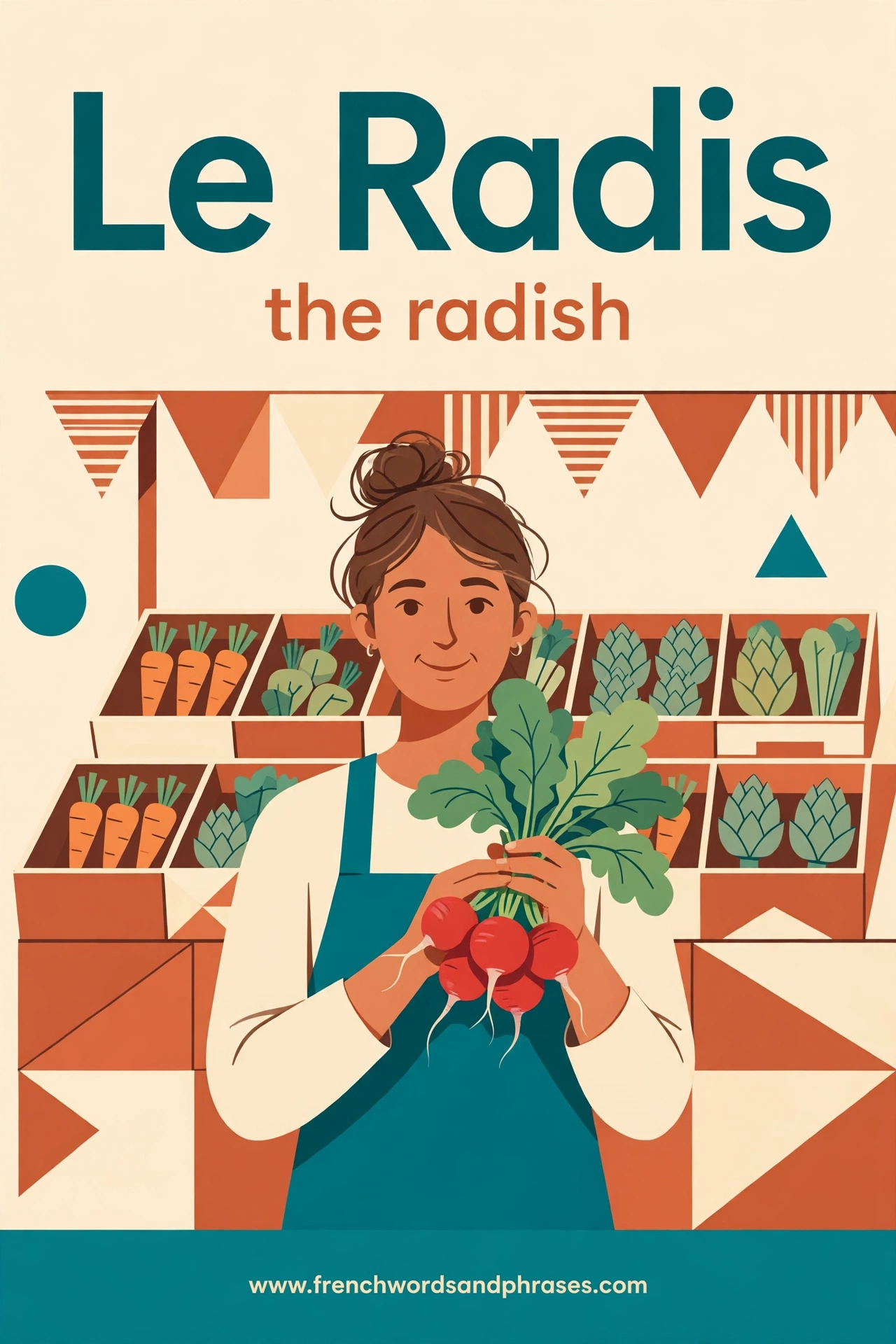
Le radis means the radish.
At the market stall, the greengrocer lifts a bunch of red-and-white roots, still damp from the morning: « Des radis tout frais, croquants, parfaits avec un peu de beurre ! » Crisp, peppery and bright — le radis.
In this guide, you’ll learn what radis means in English, how to use it with its articles, how to form its plural, and how it appears in everyday French. Explore French examples, English translations, and practice quizzes.
Understanding the French Noun Radis
Radis is a masculine French noun, learned with its article: le radis, un radis. Its final -s is part of the word itself and is never heard — and, unusually, the plural is spelled exactly the same: les radis.
It means the radish — the small, crunchy root vegetable, usually red outside and white inside, eaten raw with salt and butter or sliced into salads. The classic French spring radish is long and pink-tipped, le radis rose; its bigger, fiercer cousin is le radis noir, the black radish.
Gender: Masculine — le radis, un radis
Plural: les radis — the spelling never changes (the word already ends in -s)
Sold in: une botte de radis — a bunch of radishes
Varieties: le radis rose (the pink radish), le radis noir (the black radish)
In the kitchen: Eaten raw, with butter and salt, or sliced into salads
English equivalents: The radish.
One delightful usage detail: in familiar French, un radis can mean a tiny coin — so ne pas avoir un radis means to be completely broke, not to have a penny to your name. The same little vegetable gives you a crunchy snack and an empty wallet.
Experience the Word
Radis is the taste of a French spring morning. A bunch of radis on the kitchen table means the market was good, the season has turned, and lunch will start with something that crunches.
Imagine the ritual: the radish split with a knife, a curl of cold butter, a pinch of salt — nothing cooked, nothing complicated, just freshness itself, eaten standing up before the real meal begins.
You have not just eaten a vegetable. You have taken the first bite of spring — le printemps, the radis way.
How to Use Radis in French: Complete Guide
Let’s explore how radis works in French, beginning with its articles — and notice the plural that refuses to change its spelling.
Radis with the Definite Article (Le, Les)
Used for the radish in front of you, or radishes in general.
| Form | French |
|---|---|
| Masculine singular | le radis |
| Plural | les radis |
Example
Le radis est croquant et un peu piquant.
The radish is crunchy and a little peppery.
Radis with the Indefinite Article (Un, Des)
Used for a radish, or some radishes you have just bought.
| Form | French |
|---|---|
| Masculine singular | un radis |
| Plural | des radis |
Example
Elle coupe un radis en fines rondelles pour la salade.
She is slicing a radish into thin rounds for the salad.
Radis with Quantities (Une botte de…)
Radishes are countable and sold in bunches, so French counts and bundles them rather than taking « some » of them.
| Quantity | French |
|---|---|
| some radishes | des radis |
| a bunch of radishes | une botte de radis |
| a plate of radishes | une assiette de radis |
| many radishes | beaucoup de radis |
| not a single radish | pas un radis |
Example
Au marché, j’ai acheté une botte de radis roses.
At the market, I bought a bunch of pink radishes.
Quick Quiz 1
Complete the sentence:
Je n’ai plus ______ radis, le frigo est vide. (any, after the negative)
Reveal the answer
de
Je n’ai plus de radis, le frigo est vide.
After a negative, des becomes de: no radishes left at all.
The Plural of Radis
Radis already ends in -s, so the plural is spelled the same — only the article changes.
| Number | French |
|---|---|
| Singular | le radis |
| Plural | les radis |
Example
Les radis du jardin sont déjà prêts à cueillir.
The radishes from the garden are already ready to pick.
Radis with Possessive Adjectives (Mon, Ton, Son…)
Possessives agree with the noun — radis is masculine, so it takes mon, ton, son.
| Owner | French |
|---|---|
| my | mon radis |
| your (tu) | ton radis |
| his / her | son radis |
| our | notre radis |
| your (vous) | votre radis |
| their | leur radis |
Example
Il garde son radis pour la fin, c’est son préféré.
He is keeping his radish for last; it is his favourite.
Quick Quiz 2
Complete the sentence:
______ radis sont sur la table, avec le beurre et le sel. (Our)
Reveal the answer
Nos
Nos radis sont sur la table, avec le beurre et le sel.
Our radishes are on the table, with the butter and salt.
Radis with Demonstrative Adjectives (Ce, Ces)
Used to point at the radish you mean: ce radis, this radish here.
| Form | French |
|---|---|
| Masculine singular | ce radis |
| Plural | ces radis |
Example
Ce radis est énorme, il pèse presque cent grammes !
This radish is enormous; it weighs almost a hundred grams!
Radis with Adjectives
Adjectives agree with radis — masculine, and mostly placed after the noun.
| Adjective | With Radis |
|---|---|
| croquant (crunchy) | un radis croquant |
| frais (fresh) | un radis frais |
| piquant (peppery, hot) | un radis piquant |
| rose (pink) | un radis rose |
| gros (big) | un gros radis |
Example
Un radis frais et croquant, c’est le printemps dans l’assiette.
A fresh, crunchy radish is springtime on a plate.
Quick Quiz 3
Complete the sentence:
Ces radis sont très ______. (fresh)
Reveal the answer
frais
Ces radis sont très frais.
These radishes are very fresh — frais keeps the same spelling in the masculine plural.
Everyday Expressions with Radis
Bunches, butter and empty pockets — the radis phrases of daily life.
| Expression | In English |
|---|---|
| une botte de radis | a bunch of radishes |
| des radis beurre | radishes with butter (the classic starter) |
| ne pas avoir un radis | to be broke, not to have a penny |
| le radis noir | the black radish |
| croquer un radis | to crunch into a radish |
| un radis creux | a hollow radish (disappointing, all promise) |
Example
Après les réparations de la voiture, il n’a plus un radis.
After the car repairs, he hasn’t got a penny left.
Words from the Same Family as Radis
Roots and root vegetables — the words that travel with radis.
| French | In English |
|---|---|
| la racine | the root |
| le radis noir | the black radish |
| la botte | the bunch (of vegetables or flowers) |
| le navet | the turnip |
| la carotte | the carrot |
| croquant | crunchy |
Example
Le radis est une racine, comme la carotte et le navet.
The radish is a root, like the carrot and the turnip.
Quick Quiz 4
What does « ne pas avoir un radis » mean?
Reveal the answer
To be broke — not to have a penny. In familiar French, a radis is a tiny coin.
Je n’ai pas un radis pour prendre le bus.
I haven’t got a penny for the bus.
Radis in Everyday French: Real-Life Examples
Now that you know the word, let’s see how radis appears in everyday French.
Example 1 — At the market
Je prends une botte de radis roses, s’il vous plaît.
I’ll take a bunch of pink radishes, please.
Example 2 — A spring starter
On commence le repas avec des radis et du beurre demi-sel.
We’re starting the meal with radishes and salted butter.
Example 3 — In the garden
Les enfants ont semé des radis au printemps.
The children sowed radishes in the spring.
Example 4 — In a salad
Elle ajoute quelques radis coupés en rondelles à la salade.
She adds a few sliced radishes to the salad.
Example 5 — Empty pockets
Ne me demande pas d’argent, je n’ai pas un radis !
Don’t ask me for money — I haven’t got a penny!
Example 6 — A taste test
Ce radis est trop piquant pour moi.
This radish is too hot for me.
Beyond Translation: The Meaning of Radis
The radis carries its history in its name: it comes from the Latin radix, the root — the same ancestor as racine and the English word radical, what goes to the root of things. In France the radish is a small ceremony of spring: the radis beurre, eaten raw with butter and salt, opens meals from Paris bistros to village kitchens, a starter that costs almost nothing and tastes of the season itself.
To say radis is to crunch into the first day of spring.
It evokes market mornings and garden rows, the red skin and the white heart — and, in the slang of empty pockets, the smallest coin a person could fail to have.
How to Remember the French Noun Radis
Remember it this way: Radis is the radish — masculine, and its plural is written exactly like its singular: le radis, les radis.
- You see one — le radis, un radis croquant.
- You see a bunch — les radis, same spelling, only the article moves.
- You have no money — je n’ai pas un radis, not a penny.
The key idea is le radis, les radis — the -s is already there.
Test Your Knowledge of Radis
Let’s see how much you’ve learned. Try answering these questions before revealing the answers.
Question 1
Is radis masculine or feminine?
Reveal the answer
Masculine — le radis, un radis.
Question 2
What is the plural of radis?
Reveal the answer
Les radis — the spelling does not change, because the word already ends in -s.
Question 3
Translate: I bought a bunch of radishes.
Reveal the answer
J’ai acheté une botte de radis.
Question 4
What is le radis noir?
Reveal the answer
The black radish — a large, dark-skinned, stronger-tasting cousin of the little pink radish.
Question 5
Complete the sentence:
Il n’a plus ______ radis après ses achats. (money sense aside — use the partitive after the negative)
Reveal the answer
de
Il n’a plus de radis après ses achats.
He has no radishes left after his shopping — after a negative, des becomes de.
Your Final Challenge
Can You Use It?
How would you say this in French?
“The radishes are fresh and crunchy.”
Reveal the answer
Les radis sont frais et croquants.
The radishes are fresh and crunchy.
A little French. A little curiosity. A richer everyday life.
LEARN FRENCH ONE WORD AT A TIME