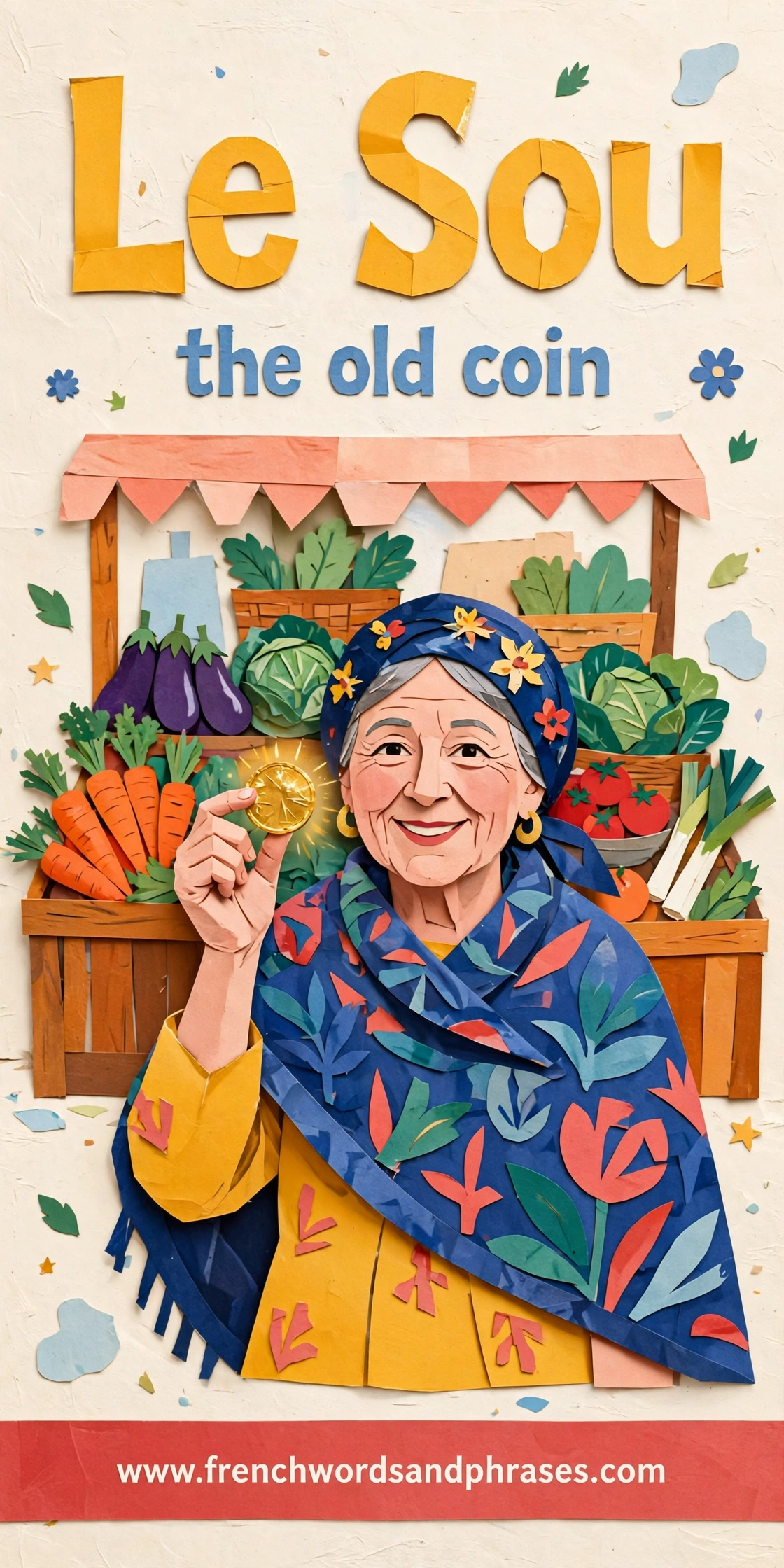
A French Word to Live By
Translate Sou to English
/su/
Le Sou means the old coin.
In grandfather’s drawer there is a tin box of coins nobody can spend: big copper pieces with a hole in the middle, worn smooth by a century of pockets. Each one is un sou — worth almost nothing, and rich in stories.
In this guide, you’ll learn what sou means in English, how to use it with its articles, how to form its plural, and how it appears in everyday French. Explore French examples, English translations, and practice quizzes.
Understanding the French Noun Sou
Sou is a masculine French noun. It is learned together with its article: le sou, un sou. It began as the name of a real coin — in the old system, twenty sous made a franc — and it survives today mostly in the plural, les sous, as an everyday word for money.
It means the sou — an old, small French coin of very little value, and by extension a penny, a cent, the smallest money there is. Its real life is in expressions: sans le sou, penniless; pas un sou, not a penny; and in the plural, les sous is simply money — gagner des sous, to earn money.
Gender: Masculine
Definite article: le — le sou (the old coin)
Indefinite article: un — un sou (a sou, a penny)
Plural: les sous — the everyday word for money
History: Twenty sous once made one franc; the coin is long gone, the word remains
English equivalents: The sou; a penny, a cent (in expressions).
One important usage detail: in modern French, les sous (always plural) is a cheerful, familiar word for money in general — il a des sous, he’s got money. The singular sou belongs to expressions of emptiness: sans sou ni maille, without a penny to one’s name.
Experience the Word
Sou is more than a dead coin. It is the smell of the copper piece in a child’s fist at the market, the smallest unit of saving, spending and being broke.
Imagine the old kitchen scene: the week’s sous counted on the table, sou par sou, coin by coin, into little piles for bread, rent and candles.
You have not just counted money. You have watched a family budget in copper.
How to Use Sou in French: Complete Guide
Let’s explore how sou works in French, beginning with its articles — a masculine noun whose plural has a whole second life as the word for money.
Sou with the Definite Article (Le, Les)
Le sou for the coin itself; les sous, far more common, for money in general.
| Form | French |
|---|---|
| Masculine singular | le sou |
| Plural | les sous |
Example
Les sous manquent à la fin du mois.
Money is short at the end of the month.
Sou with the Indefinite Article (Un, Des)
Un sou is the smallest coin imaginable — usually met in negative sentences about having none.
| Form | French |
|---|---|
| Masculine singular | un sou |
| Plural | des sous |
Example
Il n’a pas un sou en poche.
He hasn’t a penny in his pocket.
Counting and Measuring Sou: Quantities
Sous are counted one by one — sou par sou — and gathered into little fortunes.
| French | In English |
|---|---|
| un sou | one sou, one penny |
| sou par sou | penny by penny |
| quelques sous | a few pennies, a bit of money |
| pas un sou | not a penny |
| cent sous | a hundred sous (a small fortune, in the old days) |
| tous ses sous | all his money |
Example
Elle a économisé sou par sou pour s’offrir ce vélo.
She saved penny by penny to buy herself that bike.
Quick Quiz 1
Complete the sentence:
Après les travaux, il est complètement sans le ______.
Reveal the answer
sou
Après les travaux, il est complètement sans le sou.
After the building work, he is completely penniless — sans le sou is the set expression.
The Plural of Sou
Sou simply adds an -s — les sous — but the plural has a meaning of its own: money.
| Number | French |
|---|---|
| Singular | le sou / un sou |
| Plural | les sous / des sous |
Example
Gagner des sous n’est pas toujours facile.
Earning money is not always easy.
Sou with Possessive Adjectives (Mon, Ton, Son…)
Possessives agree with the noun — sou is masculine, so it takes mon, ton, son in the singular.
| Owner | French |
|---|---|
| my | mon sou |
| your (tu) | ton sou |
| his / her | son sou |
| our | notre sou |
| your (vous) | votre sou |
| their | leur sou |
Example
Il a dépensé son dernier sou pour un café.
He spent his last penny on a coffee.
Quick Quiz 2
Complete the sentence:
Elle garde ______ sous dans une vieille boîte en fer. (her)
Reveal the answer
ses
Elle garde ses sous dans une vieille boîte en fer.
She keeps her money in an old tin box — with the plural sous, her becomes ses.
Sou with Demonstrative Adjectives (Ce, Ces)
Used to point: ce sou, this old coin here in the palm of the hand.
| Form | French |
|---|---|
| Masculine singular | ce sou |
| Plural | ces sous |
Example
Ce sou percé date de la guerre, garde-le précieusement.
This pierced sou dates from the war; keep it safe.
Sou with Adjectives
Adjectives agree with sou — masculine forms, with the -s of the plural.
| Adjective | With Sou |
|---|---|
| vieux (old) | un vieux sou / de vieux sous |
| petit (small) | un petit sou / de petits sous |
| dernier (last) | le dernier sou / les derniers sous |
| faux (false, counterfeit) | un faux sou / de faux sous |
| précieux (precious) | un sou précieux / des sous précieux |
Example
Ce vieux sou vaut plus que sa valeur pour les collectionneurs.
This old sou is worth more than its face value to collectors.
Quick Quiz 3
Complete the sentence:
Il n’a plus un ______ sou en poche. (single — the word is « seul »; place it correctly)
Reveal the answer
seul
Il n’a plus un seul sou en poche.
He no longer has a single penny in his pocket — seul goes before the noun here: un seul sou.
Everyday Expressions with Sou
Penniless or saving — the sou phrases of daily life are all about empty and full pockets.
| Expression | In English |
|---|---|
| sans le sou | penniless, broke |
| sans sou ni maille | without a penny to one’s name |
| pas un sou | not a penny, not a cent |
| gagner des sous | to earn money |
| sou par sou | penny by penny |
| une affaire de gros sous | a big-money business |
Example
Jeune, il est arrivé à Paris sans sou ni maille.
As a young man, he arrived in Paris without a penny to his name.
Words from the Same Family as Sou
Coins, saving and small change — the words that travel with sou.
| French | In English |
|---|---|
| la pièce | the coin (the modern word) |
| le centime | the centime, the cent |
| la monnaie | change, coins; money in general |
| économiser | to save (money) |
| la tirelire | the money box, the piggy bank |
| le porte-monnaie | the purse, the wallet for coins |
Example
L’enfant met ses sous dans sa tirelire.
The child puts his coins in his money box.
Quick Quiz 4
What does sans sou ni maille mean?
Reveal the answer
Without a penny to one’s name — completely broke; sou and maille were the two smallest coins of old France.
Il a tout perdu: le voilà sans sou ni maille.
He lost everything: here he is without a penny to his name.
Sou in Everyday French: Real-Life Examples
Now that you know the word, let’s see how sou appears in everyday French.
Example 1 — Being broke
Ce mois-ci, je suis sans le sou, je ne sors pas.
This month I’m broke; I’m not going out.
Example 2 — Saving
Elle met ses sous de côté pour les vacances.
She is putting her money aside for the holidays.
Example 3 — An old coin
Mon grand-père collectionne les vieux sous percés.
My grandfather collects old pierced sous.
Example 4 — Earning
À seize ans, il gagnait déjà ses premiers sous.
At sixteen, he was already earning his first money.
Example 5 — Not a penny
La voiture est en panne et je n’ai pas un sou pour la réparer.
The car has broken down and I haven’t a penny to fix it.
Example 6 — Penny by penny
Sou par sou, ils ont remboursé toutes leurs dettes.
Penny by penny, they paid off all their debts.
Beyond Translation: The Meaning of Sou
The sou is a ghost coin: abolished generations ago, yet still rattling in the language every day. French speakers who have never seen one still arrive sans le sou, still save sou par sou, still call money des sous. Few dead coins anywhere have enjoyed such a busy afterlife — the sou is the penny of the French imagination.
To say sou is to count money at its most human scale.
It evokes the market stall and the tin box of savings, the holed copper piece kept for luck — and the dignity of small sums carefully earned.
How to Remember the French Noun Sou
Remember it this way: Sou is the old penny — masculine, le sou, and its plural les sous is still the everyday word for money.
- You empty the pocket — sans le sou, pas un sou en poche.
- You fill the tin — sou par sou, jusqu’au dernier.
- You say money itself — les sous, toujours au pluriel.
The key idea is le sou, les sous — the dead coin that still means money.
Test Your Knowledge of Sou
Let’s see how much you’ve learned. Try answering these questions before revealing the answers.
Question 1
Is sou masculine or feminine?
Reveal the answer
Masculine — le sou, un sou.
Question 2
What do les sous mean in modern French?
Reveal the answer
Money — in the plural, sous is the familiar everyday word: gagner des sous, to earn money.
Question 3
Translate: He hasn’t a penny.
Reveal the answer
Il n’a pas un sou. (Or: Il est sans le sou.)
Question 4
How many sous once made a franc?
Reveal the answer
Twenty — in the old system, twenty sous made one franc.
Question 5
Complete the sentence:
Elle économise ______ par sou pour son voyage. (penny)
Reveal the answer
sou
Elle économise sou par sou pour son voyage.
She is saving penny by penny for her trip.
Your Final Challenge
Can You Use It?
How would you say this in French?
“He saved his money penny by penny.”
Reveal the answer
Il a économisé ses sous sou par sou.
He saved his money penny by penny.
A little French. A little curiosity. A richer everyday life.
LEARN FRENCH ONE WORD AT A TIME