A French Word to Live By
Translate Gond to English
/ɡɔ̃/
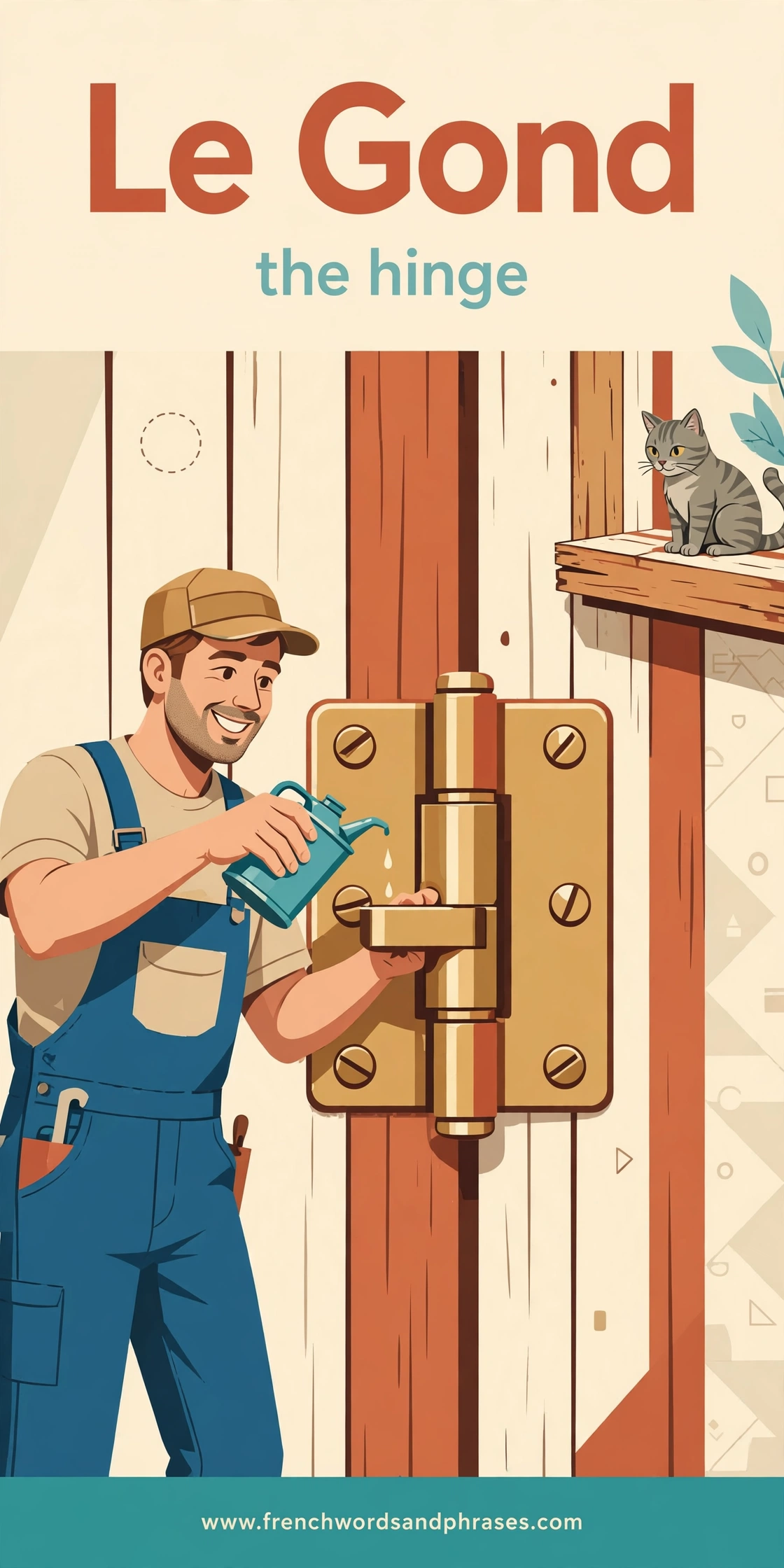
Le Gond means the hinge.
The old door has creaked for years, and this morning it finally jumps its hinges and leans against the wall. Grandfather shakes his head: the door is not the only thing that can fly off its hinges — sortir de ses gonds is what grandfather himself does when he loses his temper.
In this guide, you’ll learn what gond means in English, how to use it with its articles, how to form its plural, and how it appears in everyday French. Explore French examples, English translations, and practice quizzes.
Understanding the French Noun Gond
Gond is a masculine French noun. It is learned together with its article: le gond, un gond. Mind the ending: the d is silent, so gond sounds like « gon ». It names the metal pin-and-eye hinge a door swings on.
It means the hinge — more precisely, the sturdy metal hinge pin fixed to the door frame, on which the door hangs and swings. A door usually has two: les gonds. From that hardware comes the expression sortir de ses gonds, to come off one’s hinges — to fly into a rage.
Gender: Masculine
Definite article: le — le gond (the hinge)
Indefinite article: un — un gond (a hinge)
Plural: les gonds
Sound note: The final d is silent — gond is pronounced /ɡɔ̃/
English equivalents: The hinge; the hinge pin.
One important usage detail: you will meet gond most often inside its expression — sortir de ses gonds, to fly off the handle. For a modern door’s flat folding hinge, French also uses la charnière; the gond is the heavy pin of old doors, shutters and gates.
Experience the Word
Gond is more than hardware. It is the small iron pivot on which the whole door — and, in the expression, the whole temper — turns.
Imagine the farmhouse door: two black iron gonds, a century of openings and closings, and that one morning when the door lifts clean off them.
You have not just seen a hinge. You have found the exact point where patience comes off its mountings.
How to Use Gond in French: Complete Guide
Let’s explore how gond works in French, beginning with its articles — a regular masculine noun with a silent d and a famous temper.
Gond with the Definite Article (Le, Les)
Used for a specific hinge — le gond that creaks every time the door moves.
| Form | French |
|---|---|
| Masculine singular | le gond |
| Plural | les gonds |
Example
Le gond de la porte grince depuis des semaines.
The door’s hinge has been creaking for weeks.
Gond with the Indefinite Article (Un, Des)
Used for a hinge in general — un gond, one piece of ironmongery among others.
| Form | French |
|---|---|
| Masculine singular | un gond |
| Plural | des gonds |
Example
Il faut un gond neuf pour réparer le portail.
We need a new hinge to repair the gate.
Counting and Measuring Gond: Quantities
Hinges are countable, and doors are greedy — they almost always take them in pairs.
| French | In English |
|---|---|
| un gond | one hinge |
| une paire de gonds | a pair of hinges |
| les deux gonds | both hinges, the two hinges |
| un gond de porte | a door hinge |
| des gonds rouillés | rusty hinges |
| huiler les gonds | to oil the hinges |
Example
Une paire de gonds suffit pour cette petite porte.
A pair of hinges is enough for this little door.
Quick Quiz 1
Complete the expression:
Quand il a vu la facture, il est sorti de ses ______.
Reveal the answer
gonds
Quand il a vu la facture, il est sorti de ses gonds.
When he saw the bill, he flew off the handle — literally, he came off his hinges.
The Plural of Gond
Gond adds an -s in the plural, but the d stays silent — les gonds still sounds like « les gons ».
| Number | French |
|---|---|
| Singular | le gond / un gond |
| Plural | les gonds / des gonds |
Example
Les gonds du vieux portail sont couverts de rouille.
The hinges of the old gate are covered in rust.
Gond with Possessive Adjectives (Mon, Ton, Son…)
Possessives agree with the noun — gond is masculine, so it takes mon, ton, son in the singular, and ses in the famous expression.
| Owner | French |
|---|---|
| my | mon gond |
| your (tu) | ton gond |
| his / her | son gond |
| our | notre gond |
| your (vous) | votre gond |
| their | leur gond |
Example
La porte est sortie de son gond pendant la tempête.
The door came off its hinge during the storm.
Quick Quiz 2
Complete the sentence:
Il a huilé ______ gonds de la grange. (his)
Reveal the answer
ses
Il a huilé ses gonds de la grange.
He oiled his barn hinges — with the plural, his becomes ses.
Gond with Demonstrative Adjectives (Ce, Ces)
Used to point at a particular hinge: ce gond, this hinge here.
| Form | French |
|---|---|
| Masculine singular | ce gond |
| Plural | ces gonds |
Example
Ce gond est tordu, la porte ne ferme plus.
This hinge is bent; the door no longer closes.
Gond with Adjectives
Adjectives agree with gond — masculine forms, with the -s of the plural.
| Adjective | With Gond |
|---|---|
| rouillé (rusty) | un gond rouillé / des gonds rouillés |
| vieux (old) | un vieux gond / de vieux gonds |
| solide (solid, sturdy) | un gond solide / des gonds solides |
| neuf (new) | un gond neuf / des gonds neufs |
| tordu (bent) | un gond tordu / des gonds tordus |
Example
Un vieux gond rouillé grince à chaque coup de vent.
An old rusty hinge creaks with every gust of wind.
Quick Quiz 3
Complete the sentence:
La porte tient par un gond très ______. (solid)
Reveal the answer
solide
La porte tient par un gond très solide.
The door hangs on a very solid hinge — solide stays masculine singular with gond.
Everyday Expressions with Gond
Tempers and old doors — the gond phrases of daily life.
| Expression | In English |
|---|---|
| sortir de ses gonds | to fly off the handle, to lose one’s temper |
| faire sortir quelqu’un de ses gonds | to drive someone up the wall, to make someone snap |
| mettre une porte sur ses gonds | to hang a door on its hinges |
| huiler les gonds | to oil the hinges |
| un gond de porte | a door hinge |
| la porte sort de ses gonds | the door comes off its hinges |
Example
Cette remarque l’a fait sortir de ses gonds immédiatement.
That remark made him fly off the handle at once.
Words from the Same Family as Gond
Hinges, doors and unhinged tempers — the words that travel with gond.
| French | In English |
|---|---|
| dégonder | to take off its hinges, to unhinge |
| être dégondé | to be off its hinges, unhinged |
| la charnière | the hinge (the modern folding kind) |
| la penture | the hinge strap, the iron band of a door |
| la porte | the door |
| le portail | the gate |
Example
Ils ont dégondé la porte pour la repeindre.
They took the door off its hinges to repaint it.
Quick Quiz 4
What does sortir de ses gonds mean, said of a person?
Reveal the answer
To fly off the handle, to lose your temper completely — like a door jumping off its hinges.
Ne le provoque pas, il va sortir de ses gonds.
Don’t provoke him; he’ll fly off the handle.
Gond in Everyday French: Real-Life Examples
Now that you know the word, let’s see how gond appears in everyday French.
Example 1 — A repair
Le gond du portail est cassé, il faut le changer.
The gate’s hinge is broken; it needs changing.
Example 2 — Losing patience
À la troisième question, le professeur est sorti de ses gonds.
At the third question, the teacher flew off the handle.
Example 3 — Oiling
Mets un peu d’huile sur les gonds, la porte grince.
Put a little oil on the hinges; the door is creaking.
Example 4 — A storm
Pendant la nuit, la porte de la grange est sortie de ses gonds.
During the night, the barn door came off its hinges.
Example 5 — Driving someone mad
Ce bruit de perceuse va me faire sortir de mes gonds !
That drill noise is going to drive me up the wall!
Example 6 — At the hardware shop
Je cherche des gonds pour une porte lourde en chêne.
I’m looking for hinges for a heavy oak door.
Beyond Translation: The Meaning of Gond
Every language needs a picture for the moment patience snaps, and French chose the door hinge: a door on its gonds is calm, useful, under control — a door off them is chaos against the wall. The image is centuries old and still perfectly alive, because everyone has heard that creak and felt that moment coming.
To say gond is to name the small pin that holds both doors and tempers in place.
It evokes black iron and oak doors, the farmyard gate in the wind — and the warning every family knows: push him a little further, and il va sortir de ses gonds.
How to Remember the French Noun Gond
Remember it this way: Gond is the hinge — masculine, le gond, its d is silent, and a person who snaps sort de ses gonds.
- You hear the silence of the d — gond se prononce « gon ».
- You see the door — deux gonds, un en haut, un en bas.
- You feel the temper — sortir de ses gonds, exploser de colère.
The key idea is le gond — the hinge that tempers jump off.
Test Your Knowledge of Gond
Let’s see how much you’ve learned. Try answering these questions before revealing the answers.
Question 1
Is gond masculine or feminine?
Reveal the answer
Masculine — le gond, un gond.
Question 2
Is the final d of gond pronounced?
Reveal the answer
No — gond is pronounced /ɡɔ̃/, like « gon ».
Question 3
Translate: The door came off its hinges.
Reveal the answer
La porte est sortie de ses gonds.
Question 4
What is la charnière?
Reveal the answer
The modern folding hinge — the other hinge word; the gond is the heavy pin of old doors and gates.
Question 5
Complete the sentence:
Il faut huiler ______ gonds de la porte. (the)
Reveal the answer
les
Il faut huiler les gonds de la porte.
The door’s hinges need oiling.
Your Final Challenge
Can You Use It?
How would you say this in French?
“The old door comes off its hinges.”
Reveal the answer
La vieille porte sort de ses gonds.
The old door comes off its hinges.
A little French. A little curiosity. A richer everyday life.
LEARN FRENCH ONE WORD AT A TIME