A French Word to Live By
Translate Seul to English
/sœl/
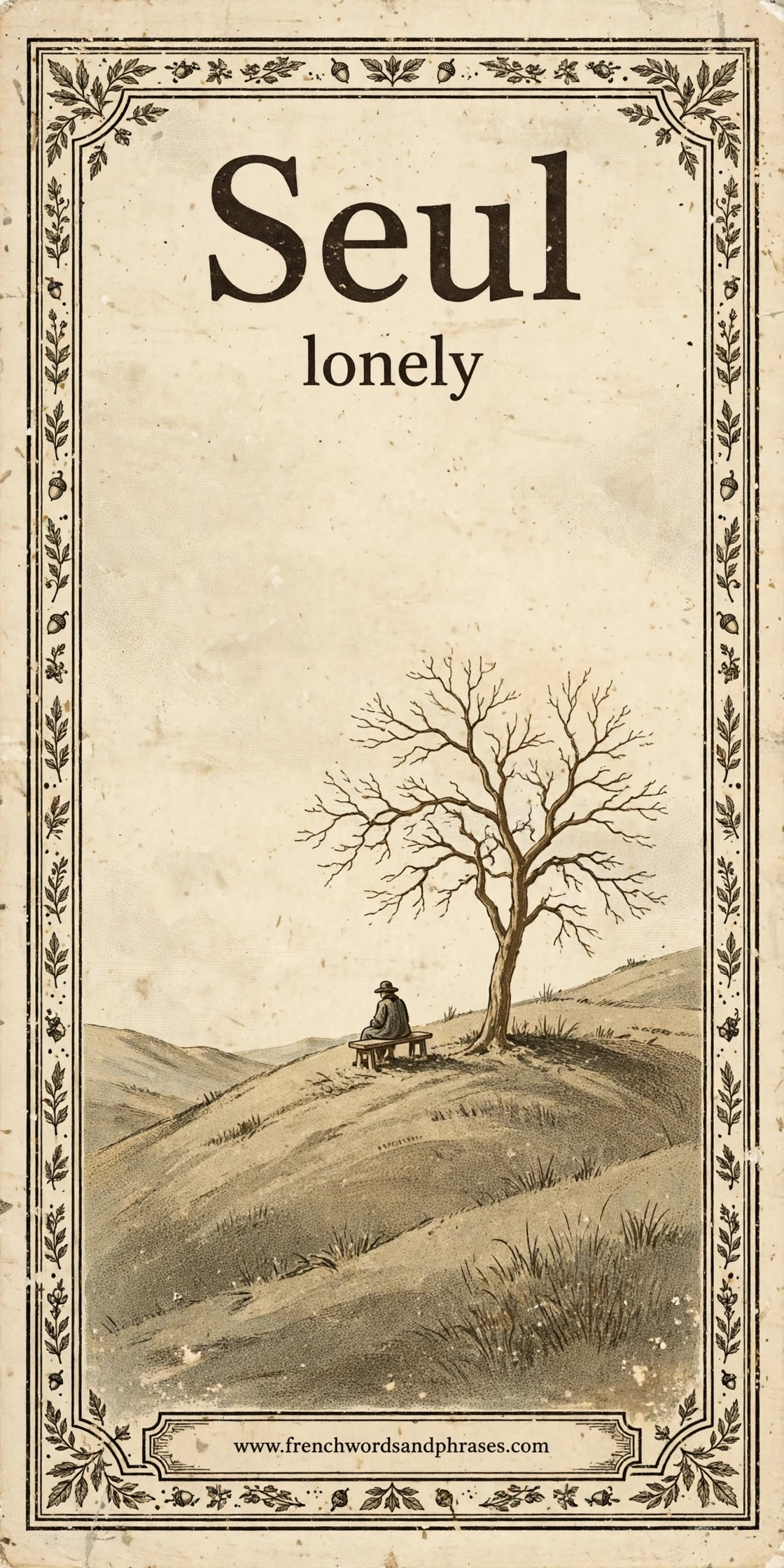
Seul means lonely.
A small flat on the fifth floor, a table set for one, and a lamp lit early against the winter evening. The phone has not rung since lunch, and the radio is the only voice in the room. She is not frightened, and she is not bored — she simply wishes someone were there. She is seule.
In this guide, you’ll learn what seul means in English, how its feminine changes the sound as well as the spelling, and the famous rule that makes one word mean two different things: before the noun it means only, after the noun it means alone. Explore French examples, English translations, and practice quizzes.
Understanding the French Adjective Seul
Seul is a French adjective of quality — the adjective of being alone — and one of the rare words whose position changes its meaning entirely. It agrees in the regular way: seul, seule, seuls, seules. After the noun it means alone or lonely; before the noun it means only.
It means lonely — feeling alone, or simply being alone without company. It describes people left by themselves (elle est seule, she is alone), houses at the end of a lane (une maison seule, a solitary house) and moments with no one to share them (un dimanche seul, a lonely Sunday). Seul is the word of solitude: sometimes chosen, sometimes endured, always felt.
Type: Adjective of quality — feelings and solitude
Answers the question: What is he or she like? — alone / lonely
Changes form: Yes — seul, seule, seuls, seules
Feminine: seule
English equivalents: Alone; lonely; solitary; (before the noun) only.
One important usage detail: seul is the famous position word. BEFORE the noun it means only — la seule maison du village, the only house in the village. AFTER the noun it means alone — une maison seule, a solitary house. And with tout, it does a useful second job: tout seul means all by yourself, toute seule for a woman.
Experience the Word
Seul is the adjective of the table set for one — the feeling and the fact of solitude wearing the same word, and telling you apart only by where it stands.
Imagine a lighthouse keeper on a rock in the Atlantic, waving at the supply boat as it turns back for the mainland. He is seul for a month, and he chose the month — solitude can be a job, a holiday, or a grief, and French gives them all the same word.
You have not just described an empty room. You have described a person who notices the emptiness.
How to Use Seul in French: Complete Guide
Let’s explore how seul works in French, beginning with the whole word on one card.
Seul at a Glance
Before the details, here is the whole word on one card.
The Whole Word on One Card
Meaning, type, position and forms — seul in four lines.
| Point | Seul |
|---|---|
| Meaning | lonely, alone |
| Type | adjective of quality — feelings and solitude |
| Usual position | after the noun for alone — un homme seul; before it for only — le seul homme |
| Form | seul / seule / seuls / seules |
Example
Elle est seule ce soir.
She is alone this evening.
The Four Forms of Seul
Seul agrees with the noun it describes, and the feminine changes the sound too: the silent l of seul wakes up and becomes a clear /l/ in seule.
| Form | Seul | Example |
|---|---|---|
| Masculine singular | seul | un homme seul — a man alone |
| Feminine singular | seule | une femme seule — a woman alone |
| Masculine plural | seuls | des hommes seuls — men alone |
| Feminine plural | seules | des femmes seules — women alone |
Example
Il est seul et elle est seule ce week-end.
He is alone and she is alone this weekend.
Quick Quiz 1
Which form of seul goes with femme (feminine)?
Reveal the answer
seule
Une femme seule.
A woman alone.
Seule: The Feminine Wakes the L
The feminine of seul is formed by adding an e — and this time the e does more than change the spelling: the final l, silent in seul, is pronounced in seule.
| Situation | Example |
|---|---|
| The rule | just add -e — seul → seule |
| The sound | seul is /sœl/ with a silent l; seule is /sœl/ with the l heard |
| Masculine plural | seuls — des garçons seuls |
| Feminine plural | seules — des filles seules |
Example
Elle se sent seule dans cette grande ville.
She feels lonely in this big city.
Where Seul Goes: Before Means Only, After Means Alone
Seul is one of the few adjectives whose position changes the meaning. Put it before the noun and it counts; put it after and it describes solitude.
| Pattern | Example |
|---|---|
| Before the noun = only | la seule maison — the only house |
| After the noun = alone | une maison seule — a solitary house |
| After être | je suis seul — I am alone |
| With tout | tout seul — all by yourself; toute seule — all by herself |
Example
C’est la seule maison du village.
It’s the only house in the village.
Quick Quiz 2
What is the difference between la seule maison and une maison seule?
Reveal the answer
Only vs alone
La seule maison = the only house; une maison seule = a solitary house.
Position changes the meaning.
More Alone: Comparing with Seul
Solitude compares like any feeling, with plus, moins and aussi — though très seul and plus seul que jamais do most of the everyday work.
| Degree | Example |
|---|---|
| As alone as | aussi seul que — as alone as |
| More alone | plus seul — more alone |
| Less alone | moins seul — less alone |
| The most alone (masc.) | le plus seul — le plus seul des villageois |
| The most alone (fem.) | la plus seule — la plus seule des villageoises |
Example
Elle se sent plus seule que jamais.
She feels more lonely than ever.
Everyday Expressions with Seul
Seul is the word of solitude in every register — the lighthouse, the traveller, the survivor, and the kitchen table.
| Expression | In English |
|---|---|
| tout seul | all by yourself, on your own (masc.) |
| toute seule | all by herself, on her own (fem.) |
| se sentir seul | to feel lonely |
| laissé seul | left alone |
| vivre seul | to live alone |
| le seul et unique | the one and only |
Example
Il a construit cette maison tout seul.
He built this house all by himself.
Quick Quiz 3
How do you say ‘all by herself’ in French?
Reveal the answer
toute seule
Elle l’a fait toute seule.
She did it all by herself.
Seul and Its Neighbours
Seul shares its solitary field with solitaire and isolé; accompagné and entouré are the crowded opposites, and ensemble is the warmest of them all.
| French | In English |
|---|---|
| solitaire | solitary — by nature, like a solitary life |
| isolé | isolated — alone and cut off |
| abandonné | abandoned — alone and left behind |
| triste | sad — often the companion of seul |
| accompagné | accompanied — the opposite |
| entouré | surrounded, with people around you — the warm opposite |
Example
Il n’est pas triste, il est seul et heureux.
He isn’t sad, he’s alone and happy.
Watch Out: The Traps Around Seul
The traps here are the position rule itself, and the difference between solitude chosen and solitude felt.
| Trap | The truth |
|---|---|
| The position rule | before the noun = only; after = alone — un seul ami is one friend only, un ami seul is a lonely friend |
| Alone vs lonely | être seul is the fact; se sentir seul is the feeling — French can say one without the other |
| The silent l | seul ends in a silent l; seule pronounces it — /sœl/ both ways, but the l is heard in seule |
| Le seul ami | le seul ami = the only friend — the most common use of the word in real French |
Example
C’est mon seul ami dans cette ville.
He’s my only friend in this city.
Quick Quiz 4
What does un seul ami mean?
Reveal the answer
One friend only
Before the noun, seul means only.
Un seul ami — a single, only friend.
Seul in Everyday French: Real-Life Examples
Now that you know the word, let’s see how seul appears in everyday French.
Example 1 — Evening
Elle est seule ce soir, son mari voyage.
She is alone this evening, her husband is travelling.
Example 2 — A city
Je me sens seul dans cette grande ville.
I feel lonely in this big city.
Example 3 — A house
La maison est seule au bout du chemin.
The house stands alone at the end of the path.
Example 4 — Doing it alone
Il a réparé la voiture tout seul.
He repaired the car all by himself.
Example 5 — Only friend
C’est mon seul ami ici.
He’s my only friend here.
Example 6 — A Sunday
Un dimanche seul est toujours un peu long.
A lonely Sunday is always a bit long.
Beyond Translation: The Meaning of Seul
English says lonely for the meaning of seul — but French, unlike English, gives the fact and the feeling the same word, and lets its position decide which one you mean.
Seul is the word that counts and the word that aches, in one spelling.
Un seul ami is the only friend you have; un ami seul is the lonely friend you visit. French trusts its speakers to hear the difference in where the word stands — a small, daily piece of poetry hidden inside the grammar of position.
How to Remember the French Adjective Seul
Remember it this way: Seul is the lonely adjective — one word, two meanings, decided by its position, and a feminine that wakes up the silent l.
- You put it before for only — le seul ami, the only friend.
- You put it after for alone — un ami seul, a lonely friend.
- You hear the l in the feminine — seule pronounces the letter that seul hides.
The key idea is seul before the noun means only, after it means alone, and seule pronounces the silent l.
Test Your Knowledge of Seul
Let’s see how much you’ve learned. Try answering these questions before revealing the answers.
Question 1
What does seul mean?
Reveal the answer
Lonely, alone — after the noun; before it, only.
Question 2
What is the feminine of seul?
Reveal the answer
seule — add an e, and the silent l is pronounced.
Question 3
Translate: the only house in the village.
Reveal the answer
La seule maison du village.
Question 4
Complete the sentence:
Elle se sent ______ dans cette ville.
Reveal the answer
seule
Elle se sent seule dans cette ville.
She feels lonely in this city.
Question 5
What does tout seul mean?
Reveal the answer
All by yourself — on your own, without help.
Your Final Challenge
Can You Use It?
How would you say this in French?
“She feels lonely in this big city, but tomorrow her friend arrives.”
Reveal the answer
Elle se sent seule dans cette grande ville, mais demain son amie arrive.
She feels lonely in this big city, but tomorrow her friend arrives.
A little French. A little curiosity. A richer everyday life.
LEARN FRENCH ONE WORD AT A TIME