A French Word to Live By
How to Conjugate Sembler in French
Pronunciation: /sɑ̃.ble/
Sembler means “to seem,” “to appear,” or “to give the impression” in French. It is a regular first-group verb ending in -er, and it is especially useful when describing how someone or something appears, feels, or is perceived.
Sometimes appearances tell us everything. A beautiful afternoon may seem perfect, a conversation may appear difficult, and a familiar face may look different after many years. In French, the verb sembler helps us express these impressions with elegance and precision.
In this guide, you’ll learn how to conjugate sembler in every major French tense and mood. We’ll explore its grammar, discover useful expressions, and practice with examples and quizzes along the way.
Understanding the French Verb Sembler
Sembler is a regular first-group French verb ending in -er. It follows the standard conjugation pattern used by verbs such as parler, aimer, and trouver.
- Infinitive: sembler
- Meaning: to seem, to appear, to look like
- Verb group: First group (regular -er verb)
- Auxiliary verb: avoir
- Past participle: semblé
- Present participle: semblant
How Sembler Is Conjugated
Sembler follows the regular -er conjugation pattern. Its stem is sembl-, and the usual endings are added depending on the tense and subject.
For example, in the present tense:
- je semble
- tu sembles
- il / elle semble
- nous semblons
- vous semblez
- ils / elles semblent
Unlike irregular verbs such as être or avoir, sembler does not require complicated stem changes. Once you know the regular -er pattern, most of its forms are straightforward.
How to Use Sembler
Sembler is commonly used to describe an impression, an appearance, or an opinion about a situation.
- sembler heureux — to seem happy
- sembler difficile — to seem difficult
- sembler intéressant — to seem interesting
- sembler fatigué — to appear tired
- sembler être — to seem to be
- il me semble que — it seems to me that
- il semble que — it seems that
For example:
Elle semble heureuse aujourd’hui.
She seems happy today.
Ce livre semble très intéressant.
This book seems very interesting.
The Expression Il Me Semble Que
One of the most useful expressions with sembler is il me semble que, which means “it seems to me that” or “I think that.”
Il me semble que nous sommes en retard.
It seems to me that we are late.
When this expression introduces an affirmative statement, it is generally followed by the indicative mood because the speaker presents the idea as an impression or belief.
However, a negative or interrogative construction can express doubt or uncertainty and may call for the subjunctive.
Il ne me semble pas qu’il soit prêt.
It doesn’t seem to me that he is ready.
Notice the subjunctive form soit of être in this example.
Sembler and Its Past Participle
The past participle of sembler is semblé. It is used with the auxiliary verb avoir to form compound tenses.
Cette idée m’a semblé excellente.
This idea seemed excellent to me.
Because sembler uses avoir, its past participle does not normally agree with the subject. The form remains semblé in ordinary compound-tense constructions.
Experience the Word
Imagine arriving in a charming French village on a sunny afternoon. The streets seem peaceful, the cafés look inviting, and everyone appears to be enjoying the moment.
Sembler is the perfect verb for describing these impressions.
Tout semble calme et les habitants semblent heureux.
Everything seems peaceful, and the residents seem happy.
It is a simple word, but one that allows you to describe the world around you with nuance and personality.
How to Conjugate Sembler: Complete French Conjugation Guide
Indicatif
The indicative mood is used to describe facts, observations, opinions, and events presented as real. Sembler follows the regular -er pattern throughout its indicative conjugations.
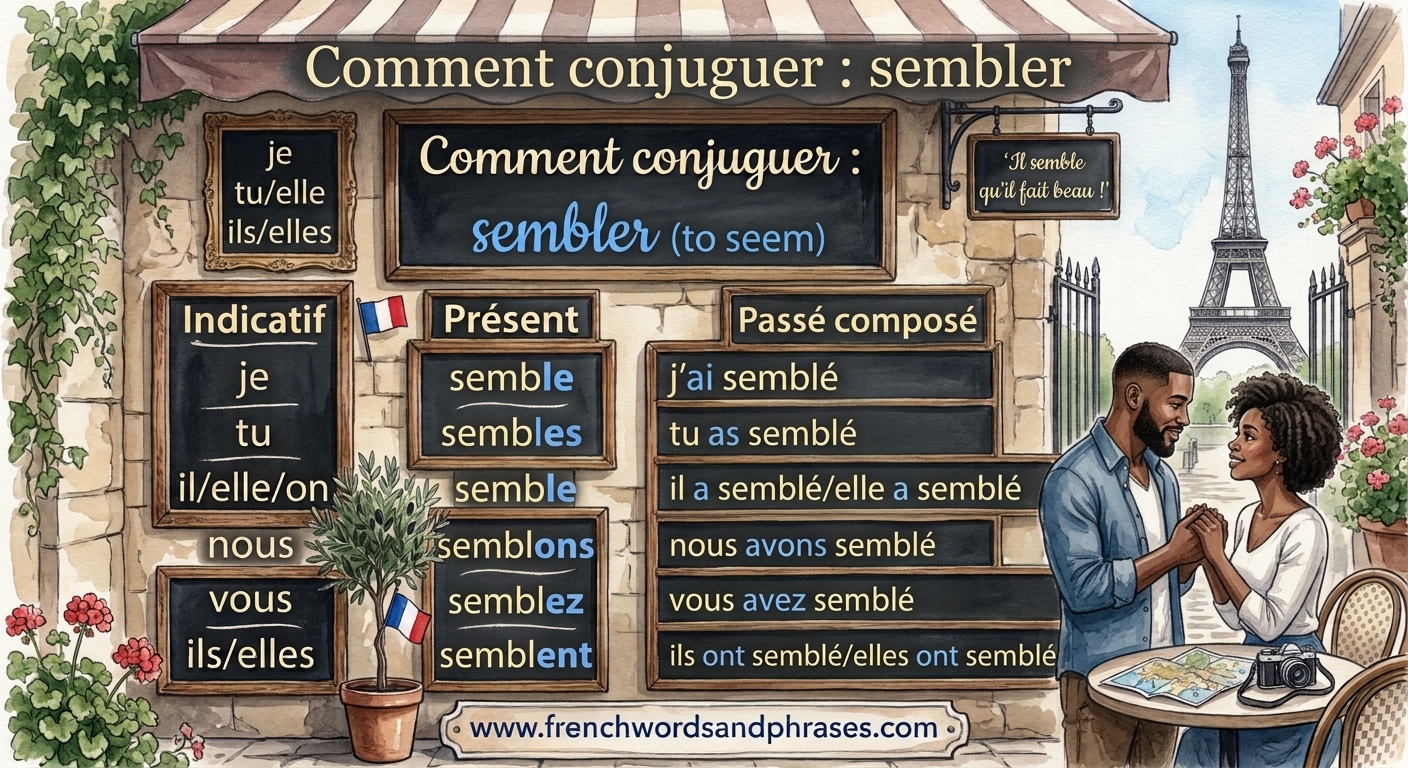
How to Conjugate Sembler in the Présent (Present Tense)
The present tense describes what seems true now, current impressions, and general observations.
| Subject | Conjugation |
|---|---|
| je | semble |
| tu | sembles |
| il / elle | semble |
| nous | semblons |
| vous | semblez |
| ils / elles | semblent |
Tu sembles très heureux aujourd’hui.
You seem very happy today.
Remember that the final -ent in semblent is silent. The pronunciation of the third-person plural is the same as the singular form semble.
Quick Quiz: Sembler in the Present
How do you say “We seem tired” in French?
Show the answer
Nous semblons fatigués.
The correct present-tense form for nous is semblons.
How to Conjugate Sembler in the Passé Composé (Compound Past Tense)
The passé composé describes completed actions or impressions in the past. It is formed with the present tense of avoir followed by the past participle semblé.
| Subject | Conjugation |
|---|---|
| j’ | ai semblé |
| tu | as semblé |
| il / elle | a semblé |
| nous | avons semblé |
| vous | avez semblé |
| ils / elles | ont semblé |
Cette maison m’a semblé magnifique.
This house seemed magnificent to me.
The auxiliary is always avoir. The past participle semblé does not agree with the subject.
How to Conjugate Sembler in the Imparfait (Imperfect Tense)
The imparfait describes impressions, appearances, and situations that continued over time in the past. It is also useful for describing how something used to seem.
| Subject | Conjugation |
|---|---|
| je | semblais |
| tu | semblais |
| il / elle | semblait |
| nous | semblions |
| vous | sembliez |
| ils / elles | semblaient |
Quand j’étais jeune, cette ville me semblait immense.
When I was young, this city seemed enormous to me.
The imperfect stem is sembl-, with the standard imperfect endings.
Quick Quiz: Sembler in the Imparfait
Complete the sentence: “They seemed worried.”
Show the answer
Ils semblaient inquiets.
The imperfect form for ils and elles is semblaient.
How to Conjugate Sembler in the Plus-que-parfait (Pluperfect Tense)
The plus-que-parfait describes an impression or situation that had already occurred before another past event. It is formed with the imperfect tense of avoir and the past participle semblé.
| Subject | Conjugation |
|---|---|
| j’ | avais semblé |
| tu | avais semblé |
| il / elle | avait semblé |
| nous | avions semblé |
| vous | aviez semblé |
| ils / elles | avaient semblé |
Le projet avait semblé impossible au début.
The project had seemed impossible at first.
The plus-que-parfait is useful when explaining how an earlier impression changed over time.
How to Conjugate Sembler in the Passé Simple (Simple Past Tense)
The passé simple is mainly used in literature, historical accounts, and formal narratives. It describes completed actions or impressions in the past and is rarely heard in everyday conversation.
| Subject | Conjugation |
|---|---|
| je | semblai |
| tu | semblas |
| il / elle | sembla |
| nous | semblâmes |
| vous | semblâtes |
| ils / elles | semblèrent |
À ses yeux, tout sembla soudain différent.
In his eyes, everything suddenly seemed different.
Although you are unlikely to use this tense in everyday conversation, recognizing it will help you understand French novels and historical writing.
How to Conjugate Sembler in the Passé Antérieur (Past Anterior Tense)
The passé antérieur is a literary tense used to describe an action completed immediately before another past action. It is formed with the passé simple of avoir and the past participle semblé.
| Subject | Conjugation |
|---|---|
| j’ | eus semblé |
| tu | eus semblé |
| il / elle | eut semblé |
| nous | eûmes semblé |
| vous | eûtes semblé |
| ils / elles | eurent semblé |
Dès qu’il eut semblé convaincant, le projet fut accepté.
As soon as it had seemed convincing, the project was accepted.
This tense is mainly encountered in formal and literary French.
How to Conjugate Sembler in the Futur Simple (Simple Future Tense)
The futur simple describes what will seem or appear to be true in the future. To form it, add the standard future endings to the infinitive sembler.
| Subject | Conjugation |
|---|---|
| je | semblerai |
| tu | sembleras |
| il / elle | semblera |
| nous | semblerons |
| vous | semblerez |
| ils / elles | sembleront |
Avec le temps, cette décision semblera plus raisonnable.
With time, this decision will seem more reasonable.
Because sembler is regular, its future stem remains the full infinitive sembler.
Quick Quiz: Sembler in the Future
How would you say “The journey will seem shorter”?
Show the answer
Le voyage semblera plus court.
The future form for il or elle is semblera.
How to Conjugate Sembler in the Futur Antérieur (Future Perfect Tense)
The futur antérieur describes an impression or action that will have been completed before a particular point in the future. It is formed with the future tense of avoir and the past participle semblé.
| Subject | Conjugation |
|---|---|
| j’ | aurai semblé |
| tu | auras semblé |
| il / elle | aura semblé |
| nous | aurons semblé |
| vous | aurez semblé |
| ils / elles | auront semblé |
Après quelques jours, cette solution aura semblé évidente.
After a few days, this solution will have seemed obvious.
The futur antérieur is useful when looking back from a future point in time.
How to Conjugate Sembler in the Futur Proche (Near Future Tense)
The futur proche describes something that is going to seem or appear a certain way. It is formed with the present tense of aller followed by the infinitive sembler.
| Subject | Conjugation |
|---|---|
| je | vais sembler |
| tu | vas sembler |
| il / elle | va sembler |
| nous | allons sembler |
| vous | allez sembler |
| ils / elles | vont sembler |
Cette tâche va sembler difficile au début.
This task is going to seem difficult at first.
The futur proche is especially common in spoken French and is often used for immediate expectations or predictions.
Conditionnel
The conditional mood expresses what would happen under certain circumstances. It is also used to describe hypothetical impressions, possibilities, and situations that depend on something else.
How to Conjugate Sembler in the Conditionnel Présent (Present Conditional)
The present conditional uses the infinitive sembler followed by the imperfect endings.
| Subject | Conjugation |
|---|---|
| je | semblerais |
| tu | semblerais |
| il / elle | semblerait |
| nous | semblerions |
| vous | sembleriez |
| ils / elles | sembleraient |
Cette idée semblerait meilleure avec quelques modifications.
This idea would seem better with a few changes.
The conditional is useful when expressing a hypothetical opinion or a possibility rather than a certainty.
How to Conjugate Sembler in the Conditionnel Passé (Past Conditional)
The past conditional describes what would have seemed or appeared to be true under different circumstances. It is formed with the conditional present of avoir and the past participle semblé.
| Subject | Conjugation |
|---|---|
| j’ | aurais semblé |
| tu | aurais semblé |
| il / elle | aurait semblé |
| nous | aurions semblé |
| vous | auriez semblé |
| ils / elles | auraient semblé |
Sans cette explication, la situation aurait semblé étrange.
Without this explanation, the situation would have seemed strange.
How to Conjugate Sembler in the Conditionnel Passé – Alternative Form
This literary alternative uses the imperfect subjunctive of avoir followed by the past participle semblé. It is rare in modern spoken French but may appear in older literature and formal writing.
| Subject | Conjugation |
|---|---|
| j’ | eusse semblé |
| tu | eusses semblé |
| il / elle | eût semblé |
| nous | eussions semblé |
| vous | eussiez semblé |
| ils / elles | eussent semblé |
Cette décision eût semblé raisonnable dans d’autres circonstances.
This decision would have seemed reasonable under different circumstances.
Subjonctif
The subjunctive mood expresses doubt, uncertainty, emotion, necessity, and subjective judgment. With sembler, it is particularly useful in expressions that suggest uncertainty or question whether something is true.
How to Conjugate Sembler in the Subjonctif Présent (Present Subjunctive)
The present subjunctive is used when the speaker expresses doubt, uncertainty, or a subjective reaction. Sembler follows its regular present subjunctive pattern.
| Subject | Conjugation |
|---|---|
| que je | semble |
| que tu | sembles |
| qu’il / qu’elle | semble |
| que nous | semblions |
| que vous | sembliez |
| qu’ils / qu’elles | semblent |
Il ne semble pas que cette solution soit la meilleure.
It doesn’t seem that this solution is the best.
Notice that the subjunctive in this example appears in soit, the form of être following il ne semble pas que. The verb sembler itself is in the indicative.
How to Conjugate Sembler in the Subjonctif Imparfait (Imperfect Subjunctive)
The imperfect subjunctive is a literary tense that is rarely used in modern everyday French. It is mainly encountered in older novels and formal writing.
| Subject | Conjugation |
|---|---|
| que je | semblasse |
| que tu | semblasses |
| qu’il / qu’elle | semblât |
| que nous | semblassions |
| que vous | semblassiez |
| qu’ils / qu’elles | semblassent |
Il fallait que cette réponse semblât convaincante.
It was necessary for this answer to seem convincing.
How to Conjugate Sembler in the Subjonctif Plus-que-parfait (Pluperfect Subjunctive)
The pluperfect subjunctive is a literary tense describing an action or impression that had been completed before another past event in a context requiring the subjunctive.
| Subject | Conjugation |
|---|---|
| que j’ | eusse semblé |
| que tu | eusses semblé |
| qu’il / qu’elle | eût semblé |
| que nous | eussions semblé |
| que vous | eussiez semblé |
| qu’ils / qu’elles | eussent semblé |
Il regrettait que cette décision eût semblé injuste.
He regretted that this decision had seemed unfair.
How to Conjugate Sembler in the Subjonctif Passé (Past Subjunctive)
The past subjunctive describes a completed action or impression in a context requiring the subjunctive. It is formed with the present subjunctive of avoir and the past participle semblé.
| Subject | Conjugation |
|---|---|
| que j’ | aie semblé |
| que tu | aies semblé |
| qu’il / qu’elle | ait semblé |
| que nous | ayons semblé |
| que vous | ayez semblé |
| qu’ils / qu’elles | aient semblé |
Je suis surpris que cette tâche ait semblé si facile.
I’m surprised that this task seemed so easy.
Impératif
The imperative mood is used to give commands, instructions, advice, or encouragement. Sembler has three imperative forms: tu, nous, and vous. The subject pronoun is omitted.
How to Conjugate Sembler in the Impératif Présent (Present Imperative)
| Subject | Conjugation |
|---|---|
| (tu) | semble |
| (nous) | semblons |
| (vous) | semblez |
The imperative of sembler is grammatically possible, although it is less common in everyday conversation than the imperative of many other verbs. It may be used in literary, rhetorical, or special contexts.
Semblons confiants et avançons ensemble.
Let’s appear confident and move forward together.
Quick Quiz: Sembler in the Imperative
What is the correct imperative form when addressing several people formally?
Show the answer
Semblez.
The vous form of the present imperative is semblez.
French Participles: Sembler
Participles are important verb forms used in compound tenses and other grammatical constructions. Sembler has a regular present participle and past participle.
Present Participle
The present participle of sembler is semblant. It can describe an action or impression in progress and is also used in certain grammatical constructions.
Tout en semblant calme, il était très inquiet.
While seeming calm, he was very worried.
Past Participle
The past participle of sembler is semblé. It is used with avoir to form compound tenses.
- semblé — past participle
Le résultat a semblé satisfaisant.
The result seemed satisfactory.
Remember that sembler uses avoir, so its past participle does not normally agree with the subject.
Sembler in Everyday French: Six Useful Examples
Here are six examples showing how sembler works in different tenses and moods.
1. Present — Describing an impression
Cette journée semble parfaite.
This day seems perfect.
2. Passé composé — A past impression
Le film m’a semblé très long.
The film seemed very long to me.
3. Imparfait — A past appearance
La maison semblait abandonnée.
The house seemed abandoned.
4. Futur simple — A future impression
Tout semblera plus facile demain.
Everything will seem easier tomorrow.
5. Conditionnel présent — A hypothetical impression
Cette option semblerait plus intéressante.
This option would seem more interesting.
6. Subjonctif présent — Expressing doubt
Il ne semble pas que nous soyons prêts.
It doesn’t seem that we are ready.
Beyond Translation: The Many Uses of Sembler
Sembler is a particularly useful verb because it allows you to describe impressions without presenting them as absolute facts. It is often used when you want to express what something looks like, how someone appears, or what you think about a situation.
Sembler + Adjective
One of the most common constructions is sembler followed by an adjective. The adjective describes the person or thing being discussed.
Ce restaurant semble excellent.
This restaurant seems excellent.
Ils semblent contents de leur décision.
They seem happy with their decision.
Sembler + Infinitive
Sembler can also be followed by an infinitive to describe what someone or something appears to be doing or what seems to happen.
Elle semble comprendre la situation.
She seems to understand the situation.
Il semble connaître tout le monde.
He seems to know everyone.
Sembler Être
The expression sembler être means “to seem to be.” In many sentences, however, French speakers simply use sembler followed by an adjective or noun phrase.
Il semble être un homme honnête.
He seems to be an honest man.
Il semble honnête.
He seems honest.
Sembler vs. Paraître
Sembler and paraître are often translated as “to seem” or “to appear.” They are frequently interchangeable, although the choice can depend on context and style.
Sembler often emphasizes an impression or judgment.
Cette idée semble intéressante.
This idea seems interesting.
Paraître can emphasize appearance or how something presents itself to an observer.
Elle paraît fatiguée.
She looks tired.
Both verbs are useful when describing appearances, and learning them together will help you express yourself more naturally.
Il Semble Que and Il Me Semble Que
These two expressions are especially common in French:
- Il semble que… — It seems that…
- Il me semble que… — It seems to me that…
In affirmative statements, they are generally followed by the indicative:
Il me semble que tu as raison.
It seems to me that you are right.
When the expression is negative or expresses genuine uncertainty, the subjunctive is often used:
Il ne semble pas qu’elle comprenne.
It doesn’t seem that she understands.
How to Remember the Conjugation of Sembler
The good news is that sembler is a regular -er verb. Once you know the conjugation pattern of a verb such as parler or aimer, you already know most of what you need to conjugate sembler.
- Present: sembl- + e, es, e, ons, ez, ent
- Imperfect: sembl- + ais, ais, ait, ions, iez, aient
- Future: sembler- + ai, as, a, ons, ez, ont
- Conditional: sembler- + ais, ais, ait, ions, iez, aient
- Past participle: semblé
- Present participle: semblant
Pay particular attention to the compound tenses. They all use the auxiliary verb avoir followed by semblé.
For everyday practice, try using simple expressions such as:
- Il semble heureux. — He seems happy.
- Elle semble fatiguée. — She seems tired.
- Tout semble possible. — Everything seems possible.
- Il me semble que oui. — It seems to me that yes.
Short, practical sentences are an excellent way to make a new French verb part of your vocabulary.
Test Your Knowledge: Sembler
Let’s see how well you have learned to conjugate sembler. Try answering each question before revealing the answer.
Question 1
What is the correct present-tense form for nous?
Show the answer
Nous semblons.
Question 2
What is the past participle of sembler?
Show the answer
Semblé.
Question 3
Complete the sentence: “They will seem happy.”
Show the answer
Ils sembleront heureux.
Question 4
Which auxiliary verb is used to form the passé composé of sembler?
Show the answer
Avoir. For example: j’ai semblé.
Question 5
How do you say “She would seem tired” in French?
Show the answer
Elle semblerait fatiguée.
Your Final Challenge
Translate this sentence into French:
“It seems to me that this is a good idea.”
Reveal the translation
Il me semble que c’est une bonne idée.
It seems to me that this is a good idea.
Remember the useful expression il me semble que, which is commonly followed by the indicative in an affirmative statement.
A little French. A little curiosity. A richer everyday life.
LEARN FRENCH ONE WORD AT A TIME