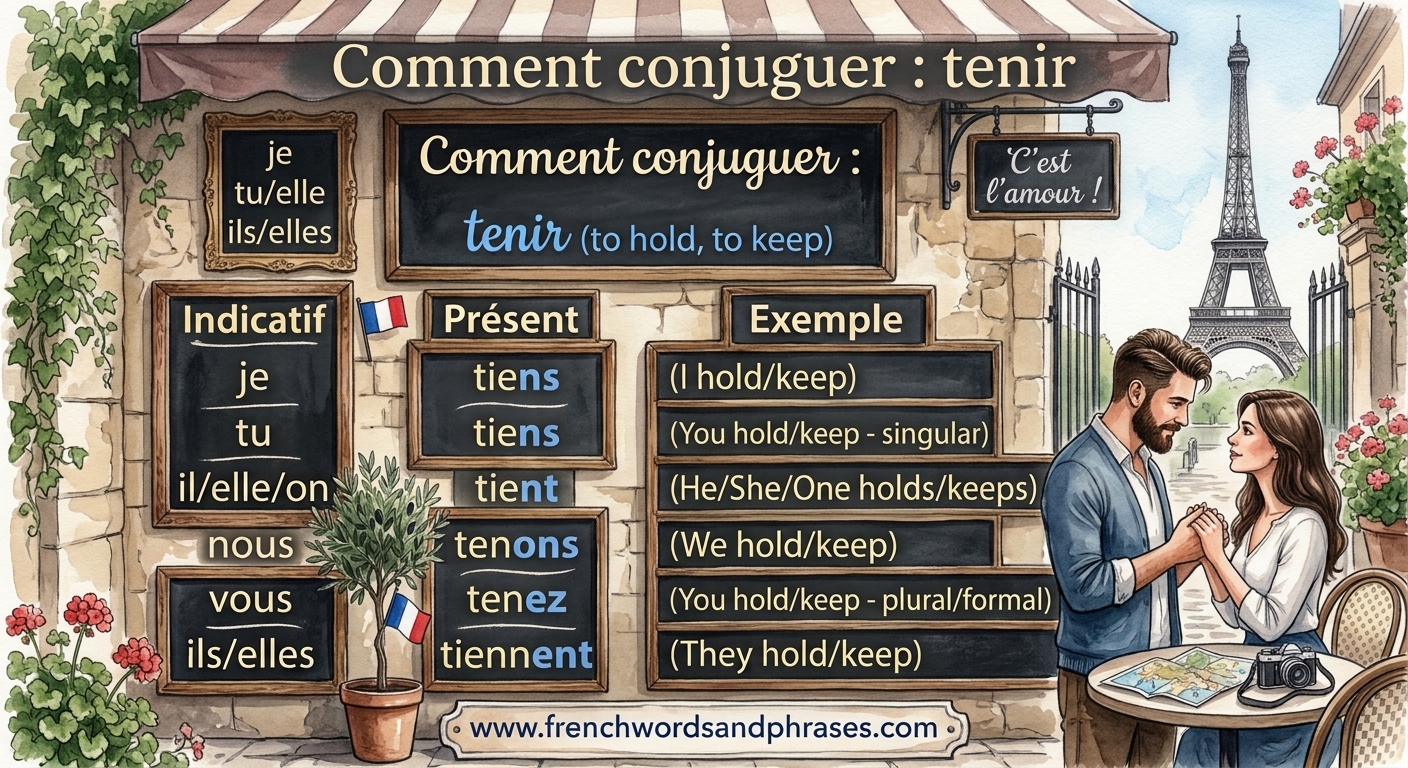
A French Word to Live By
How to Conjugate Tenir in French
Pronunciation: /tə.niʁ/
Tenir means “to hold,” “to keep,” “to maintain,” or “to last” in French. It is an irregular third-group verb used in countless everyday expressions, from holding someone’s hand to keeping a promise or running a business.
Some words simply have a way of staying with us. Tenir is one of them. It can describe the simple act of holding something in your hands, the determination to keep going, or the importance of keeping your word. It is a wonderfully versatile verb that appears in conversations, literature, and everyday French life.
In this guide, you’ll discover how to conjugate tenir in every major French tense and mood. We’ll explore its irregular patterns, examine practical examples, and give you opportunities to test your knowledge along the way.
Understanding the French Verb Tenir
Tenir is an irregular third-group French verb ending in -ir. Although its infinitive ends in -ir, it does not follow the regular conjugation pattern of verbs such as finir or choisir.
- Infinitive: tenir
- Meaning: to hold, to keep, to maintain, to last
- Verb group: Third group (irregular -ir verb)
- Auxiliary verb: avoir
- Past participle: tenu
- Present participle: tenant
Why Is Tenir Irregular?
Tenir uses several different stems depending on the tense and subject. Recognizing these changes is the key to mastering its conjugation.
- tien-: used in the singular present indicative and parts of the present subjunctive.
- ten-: used in the nous and vous forms of the present indicative and subjunctive, and throughout the imperfect tense.
- tienn-: used in the third-person plural present indicative and parts of the present subjunctive.
- tiendr-: used in the future and conditional tenses.
- tenu: the past participle used in compound tenses.
Tenir also belongs to a family of related verbs, including retenir (to retain or remember), maintenir (to maintain), obtenir (to obtain), and soutenir (to support). These verbs share many of tenir’s irregular conjugation patterns.
How to Use Tenir
Tenir has several meanings depending on the context. Here are some of its most common uses:
- tenir quelque chose — to hold something
- tenir la main de quelqu’un — to hold someone’s hand
- tenir une promesse — to keep a promise
- tenir un journal — to keep a diary
- tenir une entreprise — to run a business
- tenir bon — to hold on, to stand firm
- tenir à quelque chose — to care about something, to be attached to something
- tenir compte de — to take into account
- tenir de quelqu’un — to take after someone
For example:
Je tiens beaucoup à ma famille.
My family means a great deal to me.
Elle tient la main de son enfant.
She is holding her child’s hand.
Tenir and Its Past Participle
The past participle of tenir is tenu. It is used with the auxiliary verb avoir to form compound tenses.
J’ai tenu ma promesse.
I kept my promise.
Because tenir uses avoir, its past participle does not normally agree with the subject. However, it agrees with a preceding direct object when grammar requires it.
Les promesses que j’ai tenues.
The promises that I kept.
Here, tenues agrees with the feminine plural direct object les promesses, which appears before the verb.
Experience the Word
Imagine walking through a charming village in the south of France. You stop at a small market, hold a basket in one hand, and ask a shopkeeper about a local product. Later, you promise a friend that you will return for dinner.
Tenir can describe both moments: holding the basket and keeping your promise.
Je tiens mon panier et je tiens toujours mes promesses.
I am holding my basket, and I always keep my promises.
One verb, several meanings, and countless opportunities to use it. That is the beauty of tenir.
How to Conjugate Tenir: Complete French Conjugation Guide
Indicatif
The indicative mood is used to describe facts, actions, habits, and events presented as real. Tenir has several irregular stems, but once you recognize the patterns, its conjugation becomes easier to remember.
How to Conjugate Tenir in the Présent (Present Tense)
The present tense describes actions happening now, regular habits, and general facts. Notice the change from tien- in the singular forms to ten- with nous and vous, and tienn- with ils and elles.
| Subject | Conjugation |
|---|---|
| je | tiens |
| tu | tiens |
| il / elle | tient |
| nous | tenons |
| vous | tenez |
| ils / elles | tiennent |
Je tiens toujours mon téléphone dans ma main gauche.
I always hold my phone in my left hand.
Remember the three important present-tense patterns: tiens, tenons, and tiennent.
Quick Quiz: Tenir in the Present
How do you say “We keep our promises” in French?
Show the answer
Nous tenons nos promesses.
The correct present-tense form for nous is tenons.
How to Conjugate Tenir in the Passé Composé (Compound Past Tense)
The passé composé describes completed actions in the past. It is formed with the present tense of avoir followed by the past participle tenu.
| Subject | Conjugation |
|---|---|
| j’ | ai tenu |
| tu | as tenu |
| il / elle | a tenu |
| nous | avons tenu |
| vous | avez tenu |
| ils / elles | ont tenu |
Elle a tenu sa promesse.
She kept her promise.
Remember that tenir uses avoir in the passé composé. Its past participle is always tenu unless agreement with a preceding direct object is required.
How to Conjugate Tenir in the Imparfait (Imperfect Tense)
The imparfait describes ongoing or repeated actions in the past. It is commonly used for habits, background details, and situations that continued over time.
| Subject | Conjugation |
|---|---|
| je | tenais |
| tu | tenais |
| il / elle | tenait |
| nous | tenions |
| vous | teniez |
| ils / elles | tenaient |
Quand j’étais petit, je tenais toujours la main de ma mère dans la rue.
When I was little, I always held my mother’s hand in the street.
Notice that the imperfect uses the stem ten- throughout all six forms.
Quick Quiz: Tenir in the Imparfait
Complete the sentence: “They used to keep a diary.”
Show the answer
Ils tenaient un journal.
The imperfect form for ils and elles is tenaient.
How to Conjugate Tenir in the Plus-que-parfait (Pluperfect Tense)
The plus-que-parfait describes an action that had already happened before another past action. It is formed with the imperfect tense of avoir and the past participle tenu.
| Subject | Conjugation |
|---|---|
| j’ | avais tenu |
| tu | avais tenu |
| il / elle | avait tenu |
| nous | avions tenu |
| vous | aviez tenu |
| ils / elles | avaient tenu |
J’avais tenu cette boîte pendant plusieurs minutes avant de la poser.
I had held this box for several minutes before putting it down.
The plus-que-parfait helps establish the order of events when describing the past.
How to Conjugate Tenir in the Passé Simple (Simple Past Tense)
The passé simple is primarily used in literature, historical writing, and formal narratives. It describes completed actions in the past and is rarely heard in everyday conversation.
| Subject | Conjugation |
|---|---|
| je | tins |
| tu | tins |
| il / elle | tint |
| nous | tînmes |
| vous | tîntes |
| ils / elles | tinrent |
Il tint sa promesse malgré les difficultés.
He kept his promise despite the difficulties.
Although you are unlikely to use this tense in ordinary conversation, recognizing it will help you understand French novels and stories.
How to Conjugate Tenir in the Passé Antérieur (Past Anterior Tense)
The passé antérieur is a literary tense used to describe an action completed immediately before another past action. It is formed with the passé simple of avoir and the past participle tenu.
| Subject | Conjugation |
|---|---|
| j’ | eus tenu |
| tu | eus tenu |
| il / elle | eut tenu |
| nous | eûmes tenu |
| vous | eûtes tenu |
| ils / elles | eurent tenu |
Lorsqu’il eut tenu sa promesse, il partit tranquillement.
When he had kept his promise, he left peacefully.
This tense is mainly encountered in formal and literary French.
How to Conjugate Tenir in the Futur Simple (Simple Future Tense)
The futur simple describes actions that will happen in the future. Tenir has an irregular future stem: tiendr-. The standard future endings are added to this stem.
| Subject | Conjugation |
|---|---|
| je | tiendrai |
| tu | tiendras |
| il / elle | tiendra |
| nous | tiendrons |
| vous | tiendrez |
| ils / elles | tiendront |
Je tiendrai ma promesse et je reviendrai demain.
I will keep my promise and come back tomorrow.
Pay special attention to the future stem tiendr-. It is shared by the related verb venir, which uses the future stem viendr-.
Quick Quiz: Tenir in the Future
How would you say “She will hold the door open”?
Show the answer
Elle tiendra la porte ouverte.
The future form for elle is tiendra.
How to Conjugate Tenir in the Futur Antérieur (Future Perfect Tense)
The futur antérieur describes an action that will have been completed before a particular point in the future. It is formed with the future tense of avoir and the past participle tenu.
| Subject | Conjugation |
|---|---|
| j’ | aurai tenu |
| tu | auras tenu |
| il / elle | aura tenu |
| nous | aurons tenu |
| vous | aurez tenu |
| ils / elles | auront tenu |
À la fin de l’année, nous aurons tenu toutes nos promesses.
By the end of the year, we will have kept all our promises.
The futur antérieur emphasizes that the action will be completed before a future deadline or event.
How to Conjugate Tenir in the Futur Proche (Near Future Tense)
The futur proche describes something that is going to happen soon or is already planned. It is formed with the present tense of aller followed by the infinitive tenir.
| Subject | Conjugation |
|---|---|
| je | vais tenir |
| tu | vas tenir |
| il / elle | va tenir |
| nous | allons tenir |
| vous | allez tenir |
| ils / elles | vont tenir |
Je vais tenir la porte pour vous.
I am going to hold the door for you.
The futur proche is especially common in spoken French and is a convenient way to talk about immediate plans.
Conditionnel
The conditional mood expresses what would happen under certain circumstances. It is also used to make polite requests, express wishes, and discuss hypothetical situations.
How to Conjugate Tenir in the Conditionnel Présent (Present Conditional)
The present conditional uses the same irregular stem as the future tense, tiendr-, followed by the imperfect endings.
| Subject | Conjugation |
|---|---|
| je | tiendrais |
| tu | tiendrais |
| il / elle | tiendrait |
| nous | tiendrions |
| vous | tiendriez |
| ils / elles | tiendraient |
Je tiendrais volontiers votre sac pendant que vous cherchez vos clés.
I would gladly hold your bag while you look for your keys.
The conditional is also useful in polite expressions:
Je tiendrais à vous remercier personnellement.
I would like to thank you personally.
How to Conjugate Tenir in the Conditionnel Passé (Past Conditional)
The past conditional describes what would have happened under different circumstances. It is formed with the conditional present of avoir and the past participle tenu.
| Subject | Conjugation |
|---|---|
| j’ | aurais tenu |
| tu | aurais tenu |
| il / elle | aurait tenu |
| nous | aurions tenu |
| vous | auriez tenu |
| ils / elles | auraient tenu |
J’aurais tenu ma promesse si j’en avais eu la possibilité.
I would have kept my promise if I had had the opportunity.
How to Conjugate Tenir in the Conditionnel Passé – Alternative Form
This literary alternative uses the imperfect subjunctive of avoir followed by the past participle tenu. It is rare in modern spoken French but may appear in older literature and formal writing.
| Subject | Conjugation |
|---|---|
| j’ | eusse tenu |
| tu | eusses tenu |
| il / elle | eût tenu |
| nous | eussions tenu |
| vous | eussiez tenu |
| ils / elles | eussent tenu |
Il eût tenu sa parole s’il en avait eu la force.
He would have kept his word if he had had the strength.
Subjonctif
The subjunctive mood expresses wishes, doubts, emotions, necessity, and possibilities. It often follows expressions such as il faut que, je veux que, and bien que.
How to Conjugate Tenir in the Subjonctif Présent (Present Subjunctive)
The present subjunctive is used when an action is uncertain, desired, necessary, or emotionally significant. Notice the changes between tienn- in the singular and third-person plural forms and ten- in the nous and vous forms.
| Subject | Conjugation |
|---|---|
| que je | tienne |
| que tu | tiennes |
| qu’il / qu’elle | tienne |
| que nous | tenions |
| que vous | teniez |
| qu’ils / qu’elles | tiennent |
Il faut que je tienne ma promesse.
I must keep my promise.
The expression il faut que is commonly followed by the subjunctive.
How to Conjugate Tenir in the Subjonctif Imparfait (Imperfect Subjunctive)
The imperfect subjunctive is a literary tense that is rarely used in modern everyday French. You will mainly encounter it in older novels and formal writing.
| Subject | Conjugation |
|---|---|
| que je | tinsse |
| que tu | tinsses |
| qu’il / qu’elle | tînt |
| que nous | tinssions |
| que vous | tinssiez |
| qu’ils / qu’elles | tinssent |
Il souhaitait que je tinsse ma parole.
He wished that I would keep my word.
How to Conjugate Tenir in the Subjonctif Plus-que-parfait (Pluperfect Subjunctive)
The pluperfect subjunctive is a literary tense describing an action that had been completed before another past action in a context requiring the subjunctive.
| Subject | Conjugation |
|---|---|
| que j’ | eusse tenu |
| que tu | eusses tenu |
| qu’il / qu’elle | eût tenu |
| que nous | eussions tenu |
| que vous | eussiez tenu |
| qu’ils / qu’elles | eussent tenu |
Elle regrettait que nous eussions tenu cette réunion sans elle.
She regretted that we had held that meeting without her.
How to Conjugate Tenir in the Subjonctif Passé (Past Subjunctive)
The past subjunctive describes a completed action in a context that calls for the subjunctive. It is formed with the present subjunctive of avoir and the past participle tenu.
| Subject | Conjugation |
|---|---|
| que j’ | aie tenu |
| que tu | aies tenu |
| qu’il / qu’elle | ait tenu |
| que nous | ayons tenu |
| que vous | ayez tenu |
| qu’ils / qu’elles | aient tenu |
Je suis heureux que tu aies tenu ta promesse.
I’m happy that you kept your promise.
Impératif
The imperative mood is used to give commands, instructions, advice, or encouragement. Tenir has three imperative forms: tu, nous, and vous. The subject pronoun is omitted.
How to Conjugate Tenir in the Impératif Présent (Present Imperative)
| Subject | Conjugation |
|---|---|
| (tu) | tiens |
| (nous) | tenons |
| (vous) | tenez |
Tiens bon ! Tout ira bien.
Hang in there! Everything will be fine.
Use tiens when speaking informally to one person, tenons when suggesting that you do something together, and tenez when addressing several people or speaking formally.
Quick Quiz: Tenir in the Imperative
How would you tell a friend to “Hold on” or “Hang in there”?
Show the answer
Tiens bon !
The informal singular imperative is tiens, followed here by bon.
French Participles: Tenir
Participles are important verb forms used in compound tenses and other grammatical constructions. Tenir has an irregular past participle: tenu.
Present Participle
The present participle of tenir is tenant. It can describe an action in progress or appear in certain grammatical constructions.
En tenant la porte ouverte, il a laissé entrer tout le monde.
By holding the door open, he let everyone come in.
Past Participle
The past participle is tenu. It is used with avoir to form compound tenses and can also function as an adjective. Its agreement forms are:
- tenu — masculine singular
- tenus — masculine plural
- tenue — feminine singular
- tenues — feminine plural
Les promesses tenues sont importantes.
Promises kept are important.
When tenir is used with avoir, remember that the past participle generally remains unchanged unless a preceding direct object requires agreement.
Tenir in Everyday French: Six Useful Examples
Here are six examples showing how tenir works in different tenses and everyday situations.
1. Present — Holding something
Je tiens un livre dans mes mains.
I am holding a book in my hands.
2. Passé composé — Keeping a promise
Il a tenu sa parole.
He kept his word.
3. Imparfait — A repeated action in the past
Elle tenait toujours un petit carnet dans son sac.
She always used to keep a small notebook in her bag.
4. Futur simple — A future commitment
Nous tiendrons notre engagement.
We will honor our commitment.
5. Conditionnel présent — A hypothetical situation
Je tiendrais la porte pour vous.
I would hold the door for you.
6. Subjonctif présent — Expressing necessity
Il faut que vous teniez compte de cette information.
You must take this information into account.
Beyond Translation: The Many Uses of Tenir
Learning tenir is about much more than memorizing the translation “to hold.” It appears in many common expressions, and some of these have meanings that are not immediately obvious from the individual words.
- tenir bon — to hold on, to stand firm, to persevere
- tenir sa promesse — to keep one’s promise
- tenir parole — to keep one’s word
- tenir compte de — to take into account
- tenir à quelqu’un — to care about someone
- tenir à quelque chose — to be attached to something
- tenir au courant — to keep informed or up to date
- tenir la route — to make sense, to hold up, to be convincing
- tenir debout — to stand upright
- tenir compagnie à quelqu’un — to keep someone company
- tenir un journal — to keep a diary
- tenir une réunion — to hold a meeting
Tenir vs. Garder
Both tenir and garder can sometimes be translated as “to keep,” but they are not interchangeable in every situation.
Tenir often emphasizes holding, maintaining, or honoring something.
Je tiens ma promesse.
I keep my promise.
Garder often emphasizes keeping something in one’s possession, retaining it, or looking after it.
Je garde cette lettre.
I am keeping this letter.
Learning the distinction will help you choose the more natural verb in everyday French.
Tenir and Its Related Verbs
Tenir is the foundation of a family of useful French verbs. Many of them follow similar irregular conjugation patterns.
- retenir — to retain, remember, or hold back
- maintenir — to maintain or keep in place
- obtenir — to obtain or get
- soutenir — to support or defend
- contenir — to contain
- appartenir — to belong to
For example:
J’obtiens de bons résultats.
I get good results.
Cette boîte contient des livres.
This box contains books.
Recognizing the shared patterns in these verbs can make learning French conjugations considerably easier.
How to Remember the Conjugation of Tenir
Tenir may look complicated at first, but its irregular forms follow recognizable patterns. Focus on the main stems and the rest becomes much easier to remember.
- Present: tiens, tiens, tient / tenons, tenez / tiennent
- Imperfect: ten- + ais, ais, ait, ions, iez, aient
- Future: tiendr- + ai, as, a, ons, ez, ont
- Conditional: tiendr- + ais, ais, ait, ions, iez, aient
- Past participle: tenu
- Present participle: tenant
One helpful trick is to learn tenir alongside venir. Both verbs share important irregular patterns:
- tenir / venir
- je tiens / je viens
- nous tenons / nous venons
- ils tiennent / ils viennent
- je tiendrai / je viendrai
Once you recognize these similarities, you will find it easier to remember both verbs and their related forms.
Most importantly, practice tenir in useful expressions such as tenir bon, tenir sa promesse, and tenir compte de. Learning verbs in context is one of the best ways to make them part of your everyday French.
Test Your Knowledge: Tenir
Let’s see how well you have learned to conjugate tenir. Try answering each question before revealing the answer.
Question 1
What is the correct present-tense form for nous?
Show the answer
Nous tenons.
Question 2
What is the past participle of tenir?
Show the answer
Tenu.
Question 3
Complete the sentence: “She will keep her promise.”
Show the answer
Elle tiendra sa promesse.
Question 4
Which auxiliary verb is used to form the passé composé of tenir?
Show the answer
Avoir. For example: j’ai tenu.
Question 5
How do you say “I would hold” in French?
Show the answer
Je tiendrais.
Your Final Challenge
Translate this sentence into French:
“We have always kept our promises.”
Reveal the translation
Nous avons toujours tenu nos promesses.
We have always kept our promises.
Notice that the passé composé uses avons followed by the past participle tenu.
A little French. A little curiosity. A richer everyday life.
LEARN FRENCH ONE WORD AT A TIME