A French Word to Live By
How to Conjugate Se chancir in French
/sə ʃɑ̃.siʁ/
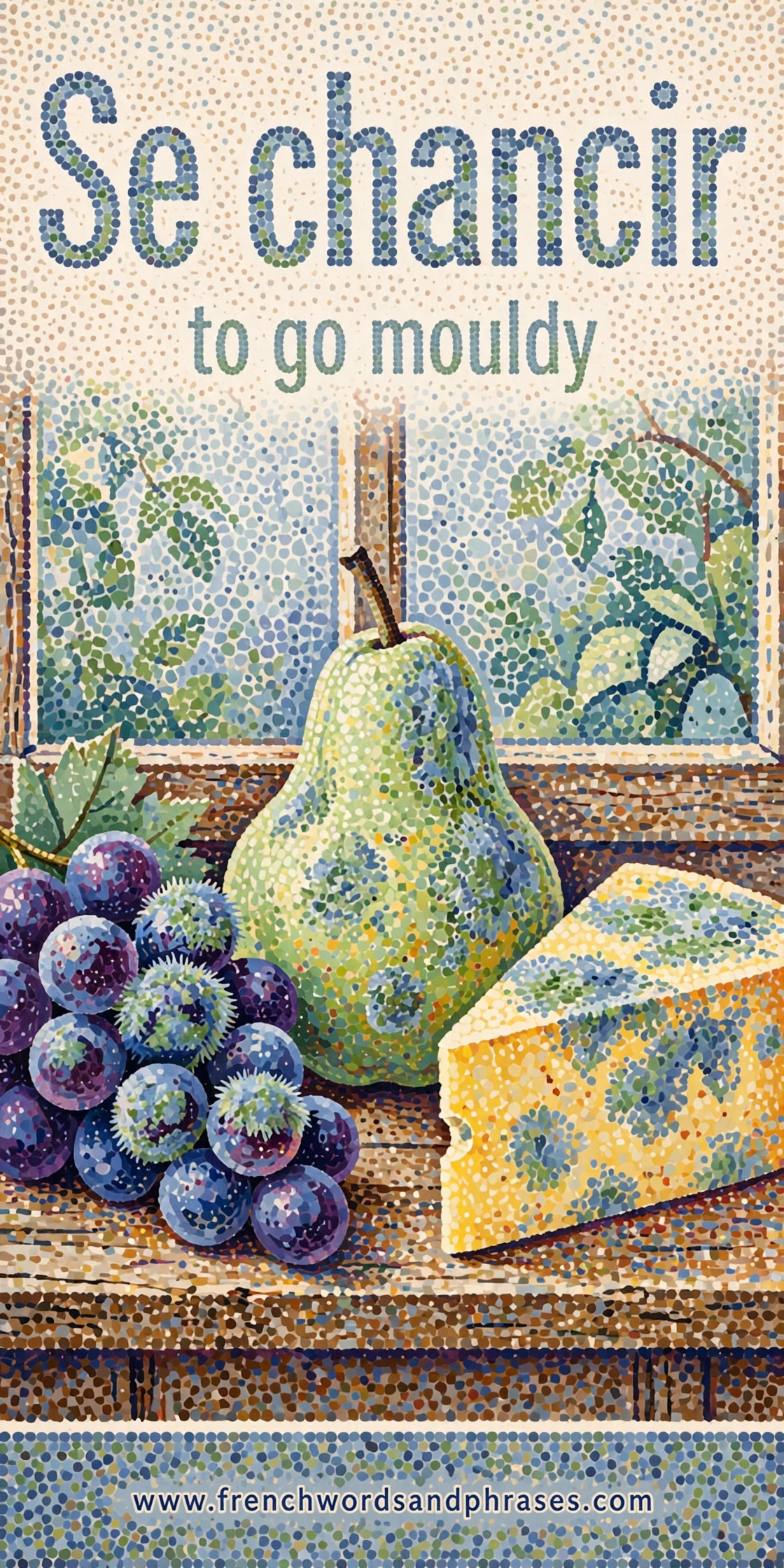
Se chancir means to go mouldy — the everyday pronominal form for wine, bread and preserves quietly spoiling in the damp.
Open the pantry after a wet autumn and there it is: the jam furred green, the cheese blooming, the bread spotted. Se chancir is the form French actually reaches for when food goes mouldy — the spoiling that happens to things left alone with the damp.
In this guide, you’ll learn how to conjugate se chancir in all the major French tenses and moods. Explore complete conjugation tables, French examples, English translations, and practice quizzes.
Understanding the French Verb Se chancir
Se chancir is a regular French verb belonging to the second group of verbs, those ending in -ir.
It means to go mouldy. It is commonly used of stored food — bread, cheese, fruit, jam and wine — spoiling in damp pantries and cellars, and it is the form you will find in cookbooks and hear at markets. Where the plain chancir feels like a cellar-book word, se chancir is simply how French says that something has gone mouldy.
Verb classification: Second group (-ir), reflexive
Auxiliary verb: Être
Past participle: chanci
Present participle: chancissant
English equivalents: To go mouldy, to spoil; le fromage se chancit — the cheese is going mouldy; les pommes se sont chancies — the apples have gone mouldy; se chancir à l’humidité — to go mouldy in the damp.
One important detail: se chancir is the usual form of this verb in modern French — the plain chancir exists, but speakers overwhelmingly say le pain se chancit. Being reflexive, it takes être in every compound tense and the past participle agrees with the subject: les pommes se sont chancies, la confiture s’est chancie. The conjugation is the regular finir pattern underneath: je me chancis, nous nous chancissons, past participle chanci.
Experience the Word
Se chancir is spoiling in the first person — the food itself seems to do it, quietly, behind a closed door.
Imagine the jar of plum jam put up with such pride in September. By December a grey-green bloom has spread under the lid — elle s’est chancie, degree by degree, in the dark of the cellier, and the whole batch follows it within the month.
Nobody touched it. It went mouldy all by itself — s’est chancie, in silence.
How to Conjugate Se chancir: Complete French Conjugation Guide
Let’s explore every major conjugation of se chancir, beginning with the indicative mood.
How to Conjugate Se chancir in the Indicative Mood
The indicative mood is used to express facts, observations, actions, and events.
How to Conjugate Se chancir in the Present Tense (Présent)
Used for actions happening now, habitual actions, and general truths.
| Subject | Conjugation |
|---|---|
| je | me chancis |
| tu | te chancis |
| il / elle | se chancit |
| nous | nous chancissons |
| vous | vous chancissez |
| ils / elles | se chancissent |
Example
Le fromage se chancit dans le garde-manger.
The cheese is going mouldy in the pantry.
Quick Quiz 1
Complete the sentence:
Le pain se ______ vite dans ce cellier humide.
Reveal the answer
chancit
Le pain se chancit vite dans ce cellier humide.
Bread goes mouldy quickly in this damp pantry.
How to Conjugate Se chancir in the Passé Composé
Used for completed actions in the past. Se chancir takes the auxiliary verb être.
| Subject | Conjugation |
|---|---|
| je | me suis chanci / me suis chancie |
| tu | t’es chanci / t’es chancie |
| il / elle | s’est chanci / s’est chancie |
| nous | nous sommes chancis / nous sommes chancies |
| vous | vous êtes chancis / vous êtes chancies / vous êtes chanci / vous êtes chancie |
| ils / elles | se sont chancis / se sont chancies |
Example
Les pommes se sont chancies pendant l’hiver.
The apples went mouldy during the winter.
How to Conjugate Se chancir in the Imparfait (Imperfect Tense)
Used for habitual past actions, descriptions, and ongoing situations in the past.
| Subject | Conjugation |
|---|---|
| je | me chancissais |
| tu | te chancissais |
| il / elle | se chancissait |
| nous | nous chancissions |
| vous | vous chancissiez |
| ils / elles | se chancissaient |
Example
Le pain se chancissait en quelques jours, autrefois.
Bread used to go mouldy within a few days, in the old days.
Quick Quiz 2
Choose the correct form:
The apples went mouldy.
Les pommes ______ pendant l’hiver. (se sont chancies / ont chanci)
Reveal the answer
se sont chancies
Les pommes se sont chancies pendant l’hiver.
Se chancir is reflexive, takes être, and the participle agrees: chancies.
How to Conjugate Se chancir in the Plus-que-parfait
Used to describe an action that had already been completed before another past event.
| Subject | Conjugation |
|---|---|
| je | m’étais chanci / m’étais chancie |
| tu | t’étais chanci / t’étais chancie |
| il / elle | s’était chanci / s’était chancie |
| nous | nous étions chancis / nous étions chancies |
| vous | vous étiez chancis / vous étiez chancies / vous étiez chanci / vous étiez chancie |
| ils / elles | s’étaient chancis / s’étaient chancies |
Example
Le vin s’était chanci avant même les vendanges suivantes.
The wine had gone off even before the following harvest.
How to Conjugate Se chancir in the Passé Simple
Primarily used in formal writing, literature, and historical narratives. It is rarely used in everyday conversation.
| Subject | Conjugation |
|---|---|
| je | me chancis |
| tu | te chancis |
| il / elle | se chancit |
| nous | nous chancîmes |
| vous | vous chancîtes |
| ils / elles | se chancirent |
Example
Le cidre se chancit dans la cave humide.
The cider went off in the damp cellar.
How to Conjugate Se chancir in the Passé Antérieur
A literary tense used to express an action completed immediately before another past action, generally in the passé simple.
| Subject | Conjugation |
|---|---|
| je | me fus chanci / me fus chancie |
| tu | te fus chanci / te fus chancie |
| il / elle | se fut chanci / se fut chancie |
| nous | nous fûmes chancis / nous fûmes chancies |
| vous | vous fûtes chancis / vous fûtes chancies / vous fûtes chanci / vous fûtes chancie |
| ils / elles | se furent chancis / se furent chancies |
Example
Dès que le pain se fut chanci, on le donna aux poules.
As soon as the bread had gone mouldy, it was given to the hens.
How to Conjugate Se chancir in the Future Tense (Futur Simple)
Used to describe actions that will take place in the future.
| Subject | Conjugation |
|---|---|
| je | me chancirai |
| tu | te chanciras |
| il / elle | se chancira |
| nous | nous chancirons |
| vous | vous chancirez |
| ils / elles | se chanciront |
Example
Ces confitures se chanciront si le cellier reste humide.
These jams will go mouldy if the pantry stays damp.
How to Conjugate Se chancir in the Futur Antérieur (Future Perfect)
Used for an action that will have been completed before a particular point in the future.
| Subject | Conjugation |
|---|---|
| je | me serai chanci / me serai chancie |
| tu | te seras chanci / te seras chancie |
| il / elle | se sera chanci / se sera chancie |
| nous | nous serons chancis / nous serons chancies |
| vous | vous serez chancis / vous serez chancies / vous serez chanci / vous serez chancie |
| ils / elles | se seront chancis / se seront chancies |
Example
À Pâques, le fromage se sera chanci depuis longtemps.
By Easter, the cheese will have gone mouldy long ago.
How to Conjugate Se chancir in the Near Future (Futur Proche)
Used to describe something that is going to happen soon. Formed with aller + infinitive.
| Subject | Conjugation |
|---|---|
| je | vais me chancir |
| tu | vas te chancir |
| il / elle | va se chancir |
| nous | allons nous chancir |
| vous | allez vous chancir |
| ils / elles | vont se chancir |
Example
Ce camembert va se chancir si tu l’oublies dans le placard.
This camembert is going to go mouldy if you forget it in the cupboard.
How to Conjugate Se chancir in the Conditional Mood
The conditional mood expresses what would happen under certain circumstances. It is also frequently used to make polite requests or express wishes.
How to Conjugate Se chancir in the Present Conditional
| Subject | Conjugation |
|---|---|
| je | me chancirais |
| tu | te chancirais |
| il / elle | se chancirait |
| nous | nous chancirions |
| vous | vous chanciriez |
| ils / elles | se chanciraient |
Example
Sans réfrigérateur, tout se chancirait en été.
Without a refrigerator, everything would go mouldy in summer.
How to Conjugate Se chancir in the Past Conditional
| Subject | Conjugation |
|---|---|
| je | me serais chanci / me serais chancie |
| tu | te serais chanci / te serais chancie |
| il / elle | se serait chanci / se serait chancie |
| nous | nous serions chancis / nous serions chancies |
| vous | vous seriez chancis / vous seriez chancies / vous seriez chanci / vous seriez chancie |
| ils / elles | se seraient chancis / se seraient chancies |
Example
Le pain se serait chanci même dans le cellier.
The bread would have gone mouldy even in the pantry.
Se chancir in the Literary Past Conditional Form
This less common literary form uses the imperfect subjunctive of être.
| Subject | Conjugation |
|---|---|
| je | me fusse chanci / me fusse chancie |
| tu | te fusses chanci / te fusses chancie |
| il / elle | se fût chanci / se fût chancie |
| nous | nous fussions chancis / nous fussions chancies |
| vous | vous fussiez chancis / vous fussiez chancies / vous fussiez chanci / vous fussiez chancie |
| ils / elles | se fussent chancis / se fussent chancies |
Example
Le vin se fût chanci dans cette cave malsaine.
The wine would have gone off in that unhealthy cellar.
How to Conjugate Se chancir in the Subjunctive Mood
The subjunctive is used to express wishes, emotions, doubts, necessity, and uncertainty. It frequently follows expressions such as il faut que (it is necessary that) or bien que (although).
How to Conjugate Se chancir in the Present Subjunctive
| Subject | Conjugation |
|---|---|
| que je | me chancisse |
| que tu | te chancisses |
| qu’il / qu’elle | se chancisse |
| que nous | nous chancissions |
| que vous | vous chancissiez |
| qu’ils / qu’elles | se chancissent |
Example
Je doute que le fromage se chancisse si vite.
I doubt the cheese will go mouldy so quickly.
Quick Quiz 3
Complete the sentence using the subjunctive:
Je doute que les confitures se ______ dans ce cellier sec.
Reveal the answer
chancissent
Je doute que les confitures se chancissent dans ce cellier sec.
I doubt the jams will go mouldy in this dry pantry.
How to Conjugate Se chancir in the Imperfect Subjunctive
A literary tense, rarely encountered in modern spoken French.
| Subject | Conjugation |
|---|---|
| que je | me chancisse |
| que tu | te chancisses |
| qu’il / qu’elle | se chancît |
| que nous | nous chancissions |
| que vous | vous chancissiez |
| qu’ils / qu’elles | se chancissent |
Example
On craignait que les provisions se chancissent pendant le siège.
People feared the provisions might go mouldy during the siege.
How to Conjugate Se chancir in the Pluperfect Subjunctive
A literary construction used to express an action completed before another past action.
| Subject | Conjugation |
|---|---|
| que je | me fusse chanci / me fusse chancie |
| que tu | te fusses chanci / te fusses chancie |
| qu’il / qu’elle | se fût chanci / se fût chancie |
| que nous | nous fussions chancis / nous fussions chancies |
| que vous | vous fussiez chancis / vous fussiez chancies / vous fussiez chanci / vous fussiez chancie |
| qu’ils / qu’elles | se fussent chancis / se fussent chancies |
Example
On racontait que le vin se fût chanci dans toutes les caves du village.
People said the wine had gone off in every cellar in the village.
How to Conjugate Se chancir in the Past Subjunctive
| Subject | Conjugation |
|---|---|
| que je | me sois chanci / me sois chancie |
| que tu | te sois chanci / te sois chancie |
| qu’il / qu’elle | se soit chanci / se soit chancie |
| que nous | nous soyons chancis / nous soyons chancies |
| que vous | vous soyez chancis / vous soyez chancies / vous soyez chanci / vous soyez chancie |
| qu’ils / qu’elles | se soient chancis / se soient chancies |
Example
Il est dommage que les pommes se soient chancies.
It is a shame the apples went mouldy.
How to Conjugate Se chancir in the Imperative
The imperative is used to give commands, instructions, invitations, or suggestions. Subject pronouns are omitted.
How to Conjugate Se chancir in the Present Imperative
| Person | Conjugation |
|---|---|
| (tu) | chancis-toi |
| (nous) | chancissons-nous |
| (vous) | chancissez-vous |
Example
Ne vous chancissez pas, mes petits fromages, le repas est dimanche !
Don’t go mouldy, my little cheeses, dinner is on Sunday!
Quick Quiz 4
How would you say Don’t go mouldy, little cheese (tu form)?
Reveal the answer
Ne te chancis pas, petit fromage !
French Participles of Se chancir
Participles are verb forms that can be used in compound tenses and other grammatical constructions.
Present Participle of Se chancir
chancissant
En se chancissant, le pain dégage une odeur aigre.
As it goes mouldy, the bread gives off a sour smell.
Past Participle of Se chancir
chanci
Chancie au fond du cellier, la confiture fut jetée.
Gone mouldy at the back of the pantry, the jam was thrown away.
Se chancir in Everyday French: Real-Life Examples
Now that you know the conjugations, let’s see how se chancir appears in everyday French.
Example 1 — Present
Le fromage se chancit dans le garde-manger.
The cheese is going mouldy in the pantry.
Example 2 — Passé composé
Les pommes se sont chancies pendant l’hiver.
The apples went mouldy during the winter.
Example 3 — Imparfait
Le pain se chancissait en quelques jours.
Bread used to go mouldy within a few days.
Example 4 — Future
Ces confitures se chanciront si le cellier reste humide.
These jams will go mouldy if the pantry stays damp.
Example 5 — Conditional
Sans réfrigérateur, tout se chancirait en été.
Without a refrigerator, everything would go mouldy in summer.
Example 6 — Imperative
Ne te chancis pas, petit fromage, pas avant dimanche !
Don’t go mouldy, little cheese, not before Sunday!
Beyond Translation: The Meaning of Se chancir
Why does French bother with the reflexive here? Because se chancir presents the spoiling as something the food does to itself, from the inside — no agent, no blame, just damp and time.
It is the pantry’s version of a middle voice.
Compare le pain a chanci (a cellar-book statement of fact) with le pain s’est chanci (what the cook actually says, with a sigh). Same mould — different voice.
How to Remember the French Verb Se chancir
Remember it this way: Se chancir is about the jam that goes mouldy all by itself in the dark pantry.
- The usual form: le pain se chancit — everyday French chooses the reflexive for this verb.
- Être in compound tenses, and the participle agrees: les pommes se sont chancies.
- Finir pattern underneath: je me chancis, nous nous chancissons, past participle chanci.
The key idea is the jam that goes mouldy all by itself in the dark pantry.
Test Your Knowledge of Se chancir
Let’s see how much you’ve learned. Try answering these questions before revealing the answers.
Question 1
Which auxiliary does se chancir use, and why?
Reveal the answer
Être — it is a reflexive verb: les pommes se sont chancies.
Question 2
How do you say The apples went mouldy during the winter in French?
Reveal the answer
Les pommes se sont chancies pendant l’hiver.
Question 3
Translate: The cheese is going mouldy in the pantry.
Reveal the answer
Le fromage se chancit dans le garde-manger.
Question 4
What is the past participle of se chancir?
Reveal the answer
Chanci — agreeing: chancie, chancis, chancies.
Question 5
Complete the sentence:
Je doute que le fromage se ______ si vite.
Reveal the answer
chancisse
Je doute que le fromage se chancisse si vite.
I doubt the cheese will go mouldy so quickly.
Your Final Challenge
Can You Use It?
How would you say this in French?
The apples went mouldy in the cellar, and winter won one more little battle.
Reveal the answer
Les pommes se sont chancies au cellier, et l’hiver a gagné une petite bataille de plus.
The apples went mouldy in the cellar, and winter won one more little battle.
A little French. A little curiosity. A richer everyday life.
LEARN FRENCH ONE WORD AT A TIME