
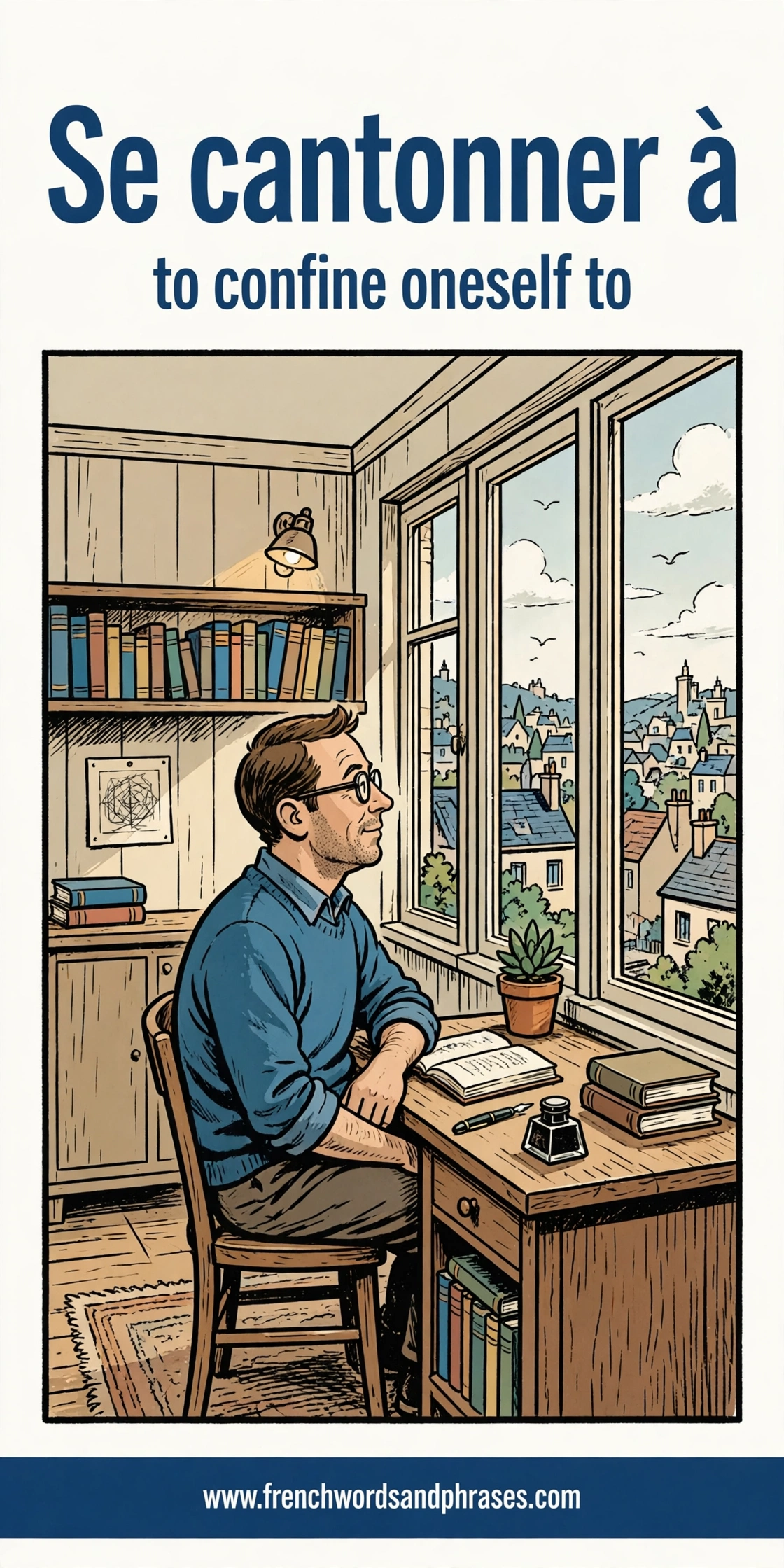
A French Word to Live By
How to Conjugate Se cantonner à in French
/sə kɑ̃.tɔ.ne a/
Se cantonner à means to confine oneself to — to settle into one narrow corner of a subject, a job or a role, and refuse to step outside it.
A historian who will only study one small century, an actor trapped for ever in the same comic role — se cantonner à is the reflexive of the self-made boundary: the soldier’s billet of cantonner, shrunk to the size of one person’s comfort zone.
In this guide, you’ll learn how to conjugate se cantonner à in all the major French tenses and moods. Explore complete conjugation tables, French examples, English translations, and practice quizzes.
Understanding the French Verb Se cantonner à
Se cantonner à is a regular French verb belonging to the first group of verbs, those ending in-er.
It means to confine oneself to. It is almost always a gentle criticism: the scholar, artist or official who se cantonne à one small territory is being accused of playing safe. Journalists and critics love it — un acteur cantonné aux rôles comiques — and the negative form is a compliment: un esprit qui ne se cantonne à rien, a mind that confines itself to nothing.
Verb classification: First group (-er), reflexive
Auxiliary verb: Être
Past participle: cantonné
Present participle: cantonnant
English equivalents: To confine oneself to, to limit oneself to, to stick to; se cantonner à un sujet — to confine oneself to one subject; se cantonner à son rôle — to stick to one’s role; se cantonner à observer — to confine oneself to watching; ne pas se cantonner à — to refuse to limit oneself to.
One important detail: se cantonner à is the reflexive of cantonner, to quarter troops — the soldier is assigned his canton, his corner, and here the person assigns the corner to himself. The construction never changes: se cantonner à + a noun or an infinitive — elle se cantonne à son sujet, il s’est cantonné à observer. Being reflexive, it takes être in every compound tense and the past participle agrees with the subject: elles se sont cantonnées à leurs recherches. The tu imperative tucks the pronoun behind the verb: ne te cantonne pas à ce rôle !
Experience the Word
Se cantonner à is the verb of the comfort zone drawn as a map — one small canton, thoroughly known, and nothing beyond its borders.
Imagine a brilliant historian at a Paris university. Forty years ago she wrote a famous book about one small Breton port; since then, every article, every lecture, every student has been sent back to the same harbour — elle s’est cantonnée à son port, and the whole ocean of history waits outside, unexplored.
Nobody has imprisoned her there. She has confined herself — cantonnée à, by her own choice, in her own corner.
How to Conjugate Se cantonner à: Complete French Conjugation Guide
Let’s explore every major conjugation of se cantonner à, beginning with the indicative mood.
How to Conjugate Se cantonner à in the Indicative Mood
The indicative mood is used to express facts, observations, actions, and events.
How to Conjugate Se cantonner à in the Present Tense (Présent)
Used for actions happening now, habitual actions, and general truths.
| Subject | Conjugation |
|---|---|
| je | me cantonne |
| tu | te cantonnes |
| il / elle | se cantonne |
| nous | nous cantonnons |
| vous | vous cantonnez |
| ils / elles | se cantonnent |
Example
Cet acteur se cantonne aux rôles comiques depuis dix ans.
This actor has confined himself to comic roles for ten years.
Quick Quiz 1
Complete the sentence:
Nous ne nous ______ à aucun sujet en particulier.
Reveal the answer
cantonnons
Nous ne nous cantonnons à aucun sujet en particulier.
We do not confine ourselves to any particular subject.
How to Conjugate Se cantonner à in the Passé Composé
Used for completed actions in the past. Se cantonner à takes the auxiliary verb être.
| Subject | Conjugation |
|---|---|
| je | me suis cantonné / me suis cantonnée |
| tu | t’es cantonné / t’es cantonnée |
| il / elle | s’est cantonné / s’est cantonnée |
| nous | nous sommes cantonnés / nous sommes cantonnées |
| vous | vous êtes cantonnés / vous êtes cantonnées / vous êtes cantonné / vous êtes cantonnée |
| ils / elles | se sont cantonnés / se sont cantonnées |
Example
Elle s’est cantonnée à l’histoire de sa région toute sa carrière.
She confined herself to the history of her region for her whole career.
How to Conjugate Se cantonner à in the Imparfait (Imperfect Tense)
Used for habitual past actions, descriptions, and ongoing situations in the past.
| Subject | Conjugation |
|---|---|
| je | me cantonnais |
| tu | te cantonnais |
| il / elle | se cantonnait |
| nous | nous cantonnions |
| vous | vous cantonniez |
| ils / elles | se cantonnaient |
Example
Le vieux professeur se cantonnait à un seul chapitre du programme.
The old professor used to confine himself to a single chapter of the syllabus.
Quick Quiz 2
Choose the correct form:
She confined herself to one role.
Elle ______ à un seul rôle. (s’est cantonnée / a cantonné)
Reveal the answer
s’est cantonnée
Elle s’est cantonnée à un seul rôle.
Se cantonner is reflexive, takes être, and the participle agrees: cantonnée.
How to Conjugate Se cantonner à in the Plus-que-parfait
Used to describe an action that had already been completed before another past event.
| Subject | Conjugation |
|---|---|
| je | m’étais cantonné / m’étais cantonnée |
| tu | t’étais cantonné / t’étais cantonnée |
| il / elle | s’était cantonné / s’était cantonnée |
| nous | nous étions cantonnés / nous étions cantonnées |
| vous | vous étiez cantonnés / vous étiez cantonnées / vous étiez cantonné / vous étiez cantonnée |
| ils / elles | s’étaient cantonnés / s’étaient cantonnées |
Example
Ils s’étaient cantonnés à observer sans jamais intervenir.
They had confined themselves to watching without ever intervening.
How to Conjugate Se cantonner à in the Passé Simple
Primarily used in formal writing, literature, and historical narratives. It is rarely used in everyday conversation.
| je | me cantonnai |
| tu | te cantonnas |
| il / elle | se cantonna |
| nous | nous cantonnâmes |
| vous | vous cantonnâtes |
| ils / elles | se cantonnèrent |
Example
L’écrivain se cantonna à la poésie après son premier roman.
The writer confined himself to poetry after his first novel.
How to Conjugate Se cantonner à in the Passé Antérieur
A literary tense used to express an action completed immediately before another past action, generally in the passé simple.
| Subject | Conjugation |
|---|---|
| je | me fus cantonné / me fus cantonnée |
| tu | te fus cantonné / te fus cantonnée |
| il / elle | se fut cantonné / se fut cantonnée |
| nous | nous fûmes cantonnés / nous fûmes cantonnées |
| vous | vous fûtes cantonnés / vous fûtes cantonnées / vous fûtes cantonné / vous fûtes cantonnée |
| ils / elles | se furent cantonnés / se furent cantonnées |
Example
Dès qu’il se fut cantonné à ce rôle, les metteurs en scène l’oublièrent.
As soon as he had confined himself to that role, the directors forgot him.
How to Conjugate Se cantonner à in the Future Tense (Futur Simple)
Used to describe actions that will take place in the future.
| Subject | Conjugation |
|---|---|
| je | me cantonnerai |
| tu | te cantonneras |
| il / elle | se cantonnera |
| nous | nous cantonnerons |
| vous | vous cantonnerez |
| ils / elles | se cantonneront |
Example
Si tu te cantonnes à un seul sujet, tu t’ennuieras vite.
If you confine yourself to a single subject, you will soon get bored.
How to Conjugate Se cantonner à in the Futur Antérieur (Future Perfect)
Used for an action that will have been completed before a particular point in the future.
| Subject | Conjugation |
|---|---|
| je | me serai cantonné / me serai cantonnée |
| tu | te seras cantonné / te seras cantonnée |
| il / elle | se sera cantonné / se sera cantonnée |
| nous | nous serons cantonnés / nous serons cantonnées |
| vous | vous serez cantonnés / vous serez cantonnées / vous serez cantonné / vous serez cantonnée |
| ils / elles | se seront cantonnés / se seront cantonnées |
Example
À la retraite, il se sera cantonné à son jardin pendant des années.
By retirement, he will have confined himself to his garden for years.
How to Conjugate Se cantonner à in the Near Future (Futur Proche)
Used to describe something that is going to happen soon. Formed with aller + infinitive.
| Subject | Conjugation |
|---|---|
| je | vais me cantonner |
| tu | vas te cantonner |
| il / elle | va se cantonner |
| nous | allons nous cantonner |
| vous | allez vous cantonner |
| ils / elles | vont se cantonner |
Example
Tu ne vas quand même pas te cantonner à ce petit bureau !
You are not really going to confine yourself to this little office!
How to Conjugate Se cantonner à in the Conditional Mood
The conditional mood expresses what would happen under certain circumstances. It is also frequently used to make polite requests or express wishes.
How to Conjugate Se cantonner à in the Present Conditional
| Subject | Conjugation |
|---|---|
| je | me cantonnerais |
| tu | te cantonnerais |
| il / elle | se cantonnerait |
| nous | nous cantonnerions |
| vous | vous cantonneriez |
| ils / elles | se cantonneraient |
Example
Sans sa curiosité, elle se cantonnerait à son village natal.
Without her curiosity, she would confine herself to her native village.
How to Conjugate Se cantonner à in the Past Conditional
| Subject | Conjugation |
|---|---|
| je | me serais cantonné / me serais cantonnée |
| tu | te serais cantonné / te serais cantonnée |
| il / elle | se serait cantonné / se serait cantonnée |
| nous | nous serions cantonnés / nous serions cantonnées |
| vous | vous seriez cantonnés / vous seriez cantonnées / vous seriez cantonné / vous seriez cantonnée |
| ils / elles | se seraient cantonnés / se seraient cantonnées |
Example
Il se serait cantonné à observer si on ne l’avait pas poussé à agir.
He would have confined himself to watching if nobody had pushed him to act.
Se cantonner à in the Literary Past Conditional Form
This less common literary form uses the imperfect subjunctive of être.
| Subject | Conjugation |
|---|---|
| je | me fusse cantonné / me fusse cantonnée |
| tu | te fusses cantonné / te fusses cantonnée |
| il / elle | se fût cantonné / se fût cantonnée |
| nous | nous fussions cantonnés / nous fussions cantonnées |
| vous | vous fussiez cantonnés / vous fussiez cantonnées / vous fussiez cantonné / vous fussiez cantonnée |
| ils / elles | se fussent cantonnés / se fussent cantonnées |
Example
Le sage se fût cantonné à son jardin, comme Candide.
The wise man would have confined himself to his garden, like Candide.
How to Conjugate Se cantonner à in the Subjunctive Mood
The subjunctive is used to express wishes, emotions, doubts, necessity, and uncertainty. It frequently follows expressions such as il faut que (it is necessary that) or bien que (although).
How to Conjugate Se cantonner à in the Present Subjunctive
| Subject | Conjugation |
|---|---|
| que je | me cantonne |
| que tu | te cantonnes |
| qu’il / qu’elle | se cantonne |
| que nous | nous cantonnions |
| que vous | vous cantonniez |
| qu’ils / qu’elles | se cantonnent |
Example
Je regrette qu’il se cantonne à des sujets si étroits.
I regret that he confines himself to such narrow subjects.
Quick Quiz 3
Complete the sentence using the subjunctive:
Je regrette que vous vous ______ à observer.
Reveal the answer
cantonniez
Je regrette que vous vous cantonniez à observer.
I regret that you confine yourselves to watching.
How to Conjugate Se cantonner à in the Imperfect Subjunctive
A literary tense, rarely encountered in modern spoken French.
| Subject | Conjugation |
|---|---|
| que je | me cantonnasse |
| que tu | te cantonnasses |
| qu’il / qu’elle | se cantonnât |
| que nous | nous cantonnassions |
| que vous | vous cantonnassiez |
| qu’ils / qu’elles | se cantonnassent |
Example
On craignait qu’elle se cantonnât à son premier succès.
People feared she might confine herself to her first success.
How to Conjugate Se cantonner à in the Pluperfect Subjunctive
A literary construction used to express an action completed before another past action.
| Subject | Conjugation |
|---|---|
| que j’ | me fusse cantonné / me fusse cantonnée |
| que tu | te fusses cantonné / te fusses cantonnée |
| qu’il / qu’elle | se fût cantonné / se fût cantonnée |
| que nous | nous fussions cantonnés / nous fussions cantonnées |
| que vous | vous fussiez cantonnés / vous fussiez cantonnées / vous fussiez cantonné / vous fussiez cantonnée |
| qu’ils / qu’elles | se fussent cantonnés / se fussent cantonnées |
Example
On racontait qu’il se fût cantonné à traduire les autres.
People said he had confined himself to translating others.
How to Conjugate Se cantonner à in the Past Subjunctive
| Subject | Conjugation |
|---|---|
| que je | me sois cantonné / me sois cantonnée |
| que tu | te sois cantonné / te sois cantonnée |
| qu’il / qu’elle | se soit cantonné / se soit cantonnée |
| que nous | nous soyons cantonnés / nous soyons cantonnées |
| que vous | vous soyez cantonnés / vous soyez cantonnées / vous soyez cantonné / vous soyez cantonnée |
| qu’ils / qu’elles | se soient cantonnés / se soient cantonnées |
Example
Je suis étonné qu’elle se soit cantonnée à un seul rôle.
I am amazed she confined herself to a single role.
How to Conjugate Se cantonner à in the Imperative
The imperative is used to give commands, instructions, invitations, or suggestions. Subject pronouns are omitted.
How to Conjugate Se cantonner à in the Present Imperative
| Person | Conjugation |
|---|---|
| (tu) | cantonne-toi |
| (nous) | cantonnons-nous |
| (vous) | cantonnez-vous |
Example
Ne te cantonne pas à ce que tu sais déjà !
Do not confine yourself to what you already know!
Quick Quiz 4
How would you say Do not confine yourself to this role (tu form)?
Reveal the answer
Ne te cantonne pas à ce rôle !
French Participles of Se cantonner à
Participles are verb forms that can be used in compound tenses and other grammatical constructions.
Present Participle of Se cantonner à
cantonnant
En se cantonnant à son sujet, il en est devenu le meilleur spécialiste.
By confining himself to his subject, he became its leading specialist.
Past Participle of Se cantonner à
cantonné
Cantonnée à la botanique, elle ignorait tout du reste des sciences.
Confined to botany, she knew nothing of the rest of science.
Se cantonner à in Everyday French: Real-Life Examples
Now that you know the conjugations, let’s see how se cantonner à appears in everyday French.
Example 1 — Present
Cet acteur se cantonne aux rôles comiques.
This actor confines himself to comic roles.
Example 2 — Passé composé
Elle s’est cantonnée à l’histoire de sa région.
She confined herself to the history of her region.
Example 3 — Imparfait
Le professeur se cantonnait à un seul chapitre.
The professor used to confine himself to one chapter.
Example 4 — Future
Tu te cantonneras à un sujet si tu n’y prends garde.
You will confine yourself to one subject if you are not careful.
Example 5 — Conditional
Elle se cantonnerait à son village sans sa curiosité.
She would confine herself to her village without her curiosity.
Example 6 — Imperative
Ne te cantonne pas à ce rôle !
Do not confine yourself to this role!
Beyond Translation: The Meaning of Se cantonner à
English to confine oneself to states the fact; French se cantonner à draws the map — le canton, the little district, is inside the verb.
The boundary is always self-drawn.
That is the verb’s quiet sting: the soldier of cantonner was assigned his corner by others, but the scholar who se cantonne has chosen his own billets — and French uses the word to ask, politely, whether the corner has become a cage.
How to Remember the French Verb Se cantonner à
Remember it this way: Se cantonner à is about the scholar who never leaves her one small harbour.
- Always with à: se cantonner à un sujet, à son rôle, à + infinitive — the preposition is part of the verb.
- Always reflexive: être in compound tenses, participle agreeing — elle s’est cantonnée.
- The picture: the soldier’s canton, shrunk to one person’s comfort zone.
The key idea is the scholar who never leaves her one small harbour.
Test Your Knowledge of Se cantonner à
Let’s see how much you’ve learned. Try answering these questions before revealing the answers.
Question 1
Which preposition always follows se cantonner, and why?
Reveal the answer
À — se cantonner à un sujet, à son rôle: the construction is fixed, from cantonner, to quarter troops in a canton.
Question 2
How do you say This actor confines himself to comic roles in French?
Reveal the answer
Cet acteur se cantonne aux rôles comiques.
Question 3
Translate: She confined herself to the history of her region.
Reveal the answer
Elle s’est cantonnée à l’histoire de sa région.
Question 4
What is the past participle of se cantonner?
Reveal the answer
Cantonné — agreeing: cantonnée, cantonnés, cantonnées.
Question 5
Complete the sentence:
Je regrette qu’il se ______ à des sujets si étroits.
Reveal the answer
cantonne
Je regrette qu’il se cantonne à des sujets si étroits.
I regret that he confines himself to such narrow subjects.
Your Final Challenge
Can You Use It?
How would you say this in French?
She refuses to confine herself to a single harbour: her history is the whole ocean.
Reveal the answer
Elle refuse de se cantonner à un seul port : son histoire à elle, c’est l’océan entier.
She refuses to confine herself to a single harbour: her history is the whole ocean.
A little French. A little curiosity. A richer everyday life.
LEARN FRENCH ONE WORD AT A TIME




