
A French Word to Live By
How to Conjugate Se camper in French
/sə kɑ̃.pe/
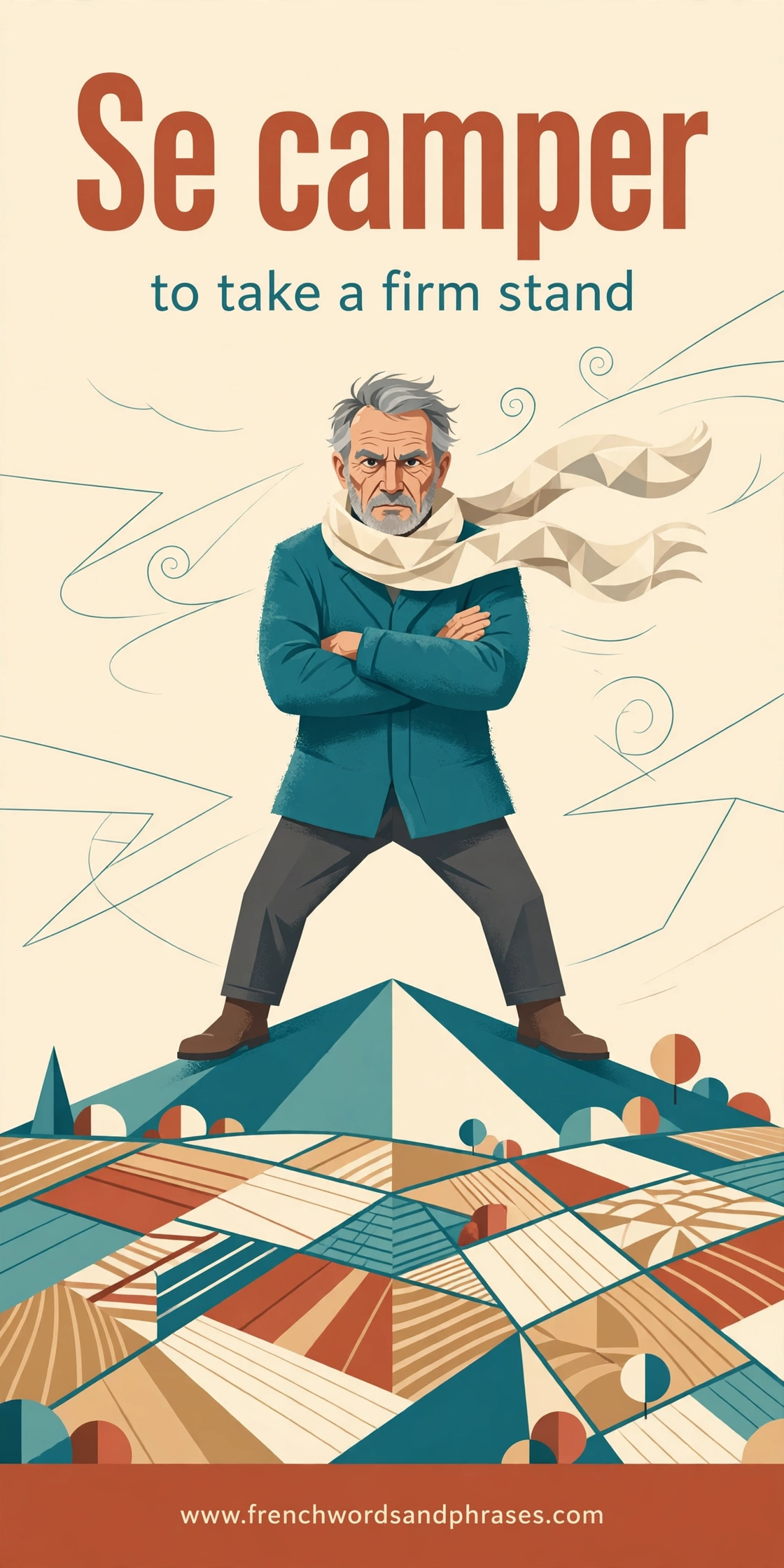
Se camper means to take a firm stand — to plant yourself somewhere solidly, feet apart and unmovable, ready to face whatever comes.
A doorman planted in a doorway, a negotiator settling into his chair for a long night, a toddler rooted to the sweetshop floor — se camper is the reflexive verb of planting yourself somewhere and meaning to stay.
In this guide, you’ll learn how to conjugate se camper in all the major French tenses and moods. Explore complete conjugation tables, French examples, English translations, and practice quizzes.
Understanding the French Verb Se camper
Se camper is a regular French verb belonging to the first group of verbs, those ending in-er.
It means to take a firm stand. Se camper carries two shades of the same posture: physically planting yourself somewhere (devant la porte, dans un fauteuil) and, figuratively, digging in — se camper sur ses positions is the negotiator or debater who will not budge an inch. Both come from the tent peg: once campé, you are not moving.
Verb classification: First group (-er), reflexive
Auxiliary verb: Être
Past participle: campé
Present participle: campant
English equivalents: To plant oneself, to take a firm stand, to settle oneself; se camper devant quelqu’un — to plant oneself in front of someone; se camper sur ses positions — to dig in, to stand firm; se camper dans un fauteuil — to settle oneself into an armchair; il s’est campé devant la porte — he planted himself in front of the door.
One important detail: se camper is the reflexive partner of camper (to camp, to pitch camp) — the camper plants a tent, the person who se campe plants themselves. It is usually followed by the place where you plant yourself: se camper devant, se camper dans un fauteuil, se camper sur ses positions. Being reflexive, it takes être in compound tenses and the past participle agrees: elle s’est campée devant lui, ils se sont campés sur leurs positions.
Experience the Word
Se camper is the verb of the planted feet — the body announcing, before a word is spoken, that it will not be moved.
Imagine the concierge of a Paris building who has decided that the delivery man shall not pass. She takes her broom, steps into the doorway, and se campe — feet apart, arms crossed — a fortress of one woman between the street and her staircase.
The delivery man reads the posture at once. She has planted herself — campée, like a tent peg driven into her own doorway.
How to Conjugate Se camper: Complete French Conjugation Guide
Let’s explore every major conjugation of se camper, beginning with the indicative mood.
How to Conjugate Se camper in the Indicative Mood
The indicative mood is used to express facts, observations, actions, and events.
How to Conjugate Se camper in the Present Tense (Présent)
Used for actions happening now, habitual actions, and general truths.
| Subject | Conjugation |
|---|---|
| je | me campe |
| tu | te campes |
| il / elle | se campe |
| nous | nous campons |
| vous | vous campez |
| ils / elles | se campent |
Example
Le gardien se campe devant la porte chaque matin.
The caretaker plants himself in front of the door every morning.
Quick Quiz 1
Complete the sentence:
Nous nous ______ devant la porte, décidés à attendre.
Reveal the answer
campons
Nous nous campons devant la porte, décidés à attendre.
We are planting ourselves in front of the door, determined to wait.
How to Conjugate Se camper in the Passé Composé
Used for completed actions in the past. Se camper takes the auxiliary verb être.
| Subject | Conjugation |
|---|---|
| je | me suis campé / me suis campée |
| tu | t’es campé / t’es campée |
| il / elle | s’est campé / s’est campée |
| nous | nous sommes campés / nous sommes campées |
| vous | vous êtes campés / vous êtes campées / vous êtes campé / vous êtes campée |
| ils / elles | se sont campés / se sont campées |
Example
Il s’est campé devant moi et a refusé de bouger.
He planted himself in front of me and refused to move.
How to Conjugate Se camper in the Imparfait (Imperfect Tense)
Used for habitual past actions, descriptions, and ongoing situations in the past.
| Subject | Conjugation |
|---|---|
| je | me campais |
| tu | te campais |
| il / elle | se campait |
| nous | nous campions |
| vous | vous campiez |
| ils / elles | se campaient |
Example
Les négociateurs se campaient sur leurs positions.
The negotiators were digging in on their positions.
Quick Quiz 2
Choose the correct form:
She settled herself into the armchair.
Elle ______ dans le fauteuil. (s’est campée / a campé)
Reveal the answer
s’est campée
Elle s’est campée dans le fauteuil.
Se camper is reflexive, takes être, and the participle agrees: campée.
How to Conjugate Se camper in the Plus-que-parfait
Used to describe an action that had already been completed before another past event.
| Subject | Conjugation |
|---|---|
| je | m’étais campé / m’étais campée |
| tu | t’étais campé / t’étais campée |
| il / elle | s’était campé / s’était campée |
| nous | nous étions campés / nous étions campées |
| vous | vous étiez campés / vous étiez campées / vous étiez campé / vous étiez campée |
| ils / elles | s’étaient campés / s’étaient campées |
Example
Elle s’était campée dans le fauteuil avant mon arrivée.
She had settled herself into the armchair before I arrived.
How to Conjugate Se camper in the Passé Simple
Primarily used in formal writing, literature, and historical narratives. It is rarely used in everyday conversation.
| Subject | Conjugation |
|---|---|
| je | me campai |
| tu | te campas |
| il / elle | se campa |
| nous | nous campâmes |
| vous | vous campâtes |
| ils / elles | se campèrent |
Example
Le soldat se campa devant le général et attendit.
The soldier planted himself before the general and waited.
How to Conjugate Se camper in the Passé Antérieur
A literary tense used to express an action completed immediately before another past action, generally in the passé simple.
| Subject | Conjugation |
|---|---|
| je | me fus campé / me fus campée |
| tu | te fus campé / te fus campée |
| il / elle | se fut campé / se fut campée |
| nous | nous fûmes campés / nous fûmes campées |
| vous | vous fûtes campés / vous fûtes campées / vous fûtes campé / vous fûtes campée |
| ils / elles | se furent campés / se furent campées |
Example
Dès qu’il se fut campé dans l’embrasure, personne ne put passer.
As soon as he had planted himself in the doorway, nobody could get past.
How to Conjugate Se camper in the Future Tense (Futur Simple)
Used to describe actions that will take place in the future.
| Subject | Conjugation |
|---|---|
| je | me camperai |
| tu | te camperas |
| il / elle | se campera |
| nous | nous camperons |
| vous | vous camperez |
| ils / elles | se camperont |
Example
Demain, je me camperai devant la mairie jusqu’à ce qu’on m’écoute.
Tomorrow, I shall plant myself in front of the town hall until someone listens to me.
How to Conjugate Se camper in the Futur Antérieur (Future Perfect)
Used for an action that will have been completed before a particular point in the future.
| Subject | Conjugation |
|---|---|
| je | me serai campé / me serai campée |
| tu | te seras campé / te seras campée |
| il / elle | se sera campé / se sera campée |
| nous | nous serons campés / nous serons campées |
| vous | vous serez campés / vous serez campées / vous serez campé / vous serez campée |
| ils / elles | se seront campés / se seront campées |
Example
À la fin de la réunion, chacun se sera campé sur sa position.
By the end of the meeting, everyone will have dug in on their position.
How to Conjugate Se camper in the Near Future (Futur Proche)
Used to describe something that is going to happen soon. Formed with aller + infinitive.
| Subject | Conjugation |
|---|---|
| je | vais me camper |
| tu | vas te camper |
| il / elle | va se camper |
| nous | allons nous camper |
| vous | allez vous camper |
| ils / elles | vont se camper |
Example
Attention, il va se camper devant la porte.
Careful, he is going to plant himself in front of the door.
How to Conjugate Se camper in the Conditional Mood
The conditional mood expresses what would happen under certain circumstances. It is also frequently used to make polite requests or express wishes.
How to Conjugate Se camper in the Present Conditional
| Subject | Conjugation |
|---|---|
| je | me camperais |
| tu | te camperais |
| il / elle | se camperait |
| nous | nous camperions |
| vous | vous camperiez |
| ils / elles | se camperaient |
Example
À ta place, je me camperais et je refuserais de partir.
If I were you, I would take a firm stand and refuse to leave.
How to Conjugate Se camper in the Past Conditional
| Subject | Conjugation |
|---|---|
| je | me serais campé / me serais campée |
| tu | te serais campé / te serais campée |
| il / elle | se serait campé / se serait campée |
| nous | nous serions campés / nous serions campées |
| vous | vous seriez campés / vous seriez campées / vous seriez campé / vous seriez campée |
| ils / elles | se seraient campés / se seraient campées |
Example
Elle se serait campée devant lui si elle avait osé.
She would have planted herself in front of him if she had dared.
Se camper in the Literary Past Conditional Form
This less common literary form uses the imperfect subjunctive of être.
| Subject | Conjugation |
|---|---|
| je | me fusse campé / me fusse campée |
| tu | te fusses campé / te fusses campée |
| il / elle | se fût campé / se fût campée |
| nous | nous fussions campés / nous fussions campées |
| vous | vous fussiez campés / vous fussiez campées / vous fussiez campé / vous fussiez campée |
| ils / elles | se fussent campés / se fussent campées |
Example
Il se fût campé devant le roi pour défendre son ami.
He would have planted himself before the king to defend his friend.
How to Conjugate Se camper in the Subjunctive Mood
The subjunctive is used to express wishes, emotions, doubts, necessity, and uncertainty. It frequently follows expressions such as il faut que (it is necessary that) or bien que (although).
How to Conjugate Se camper in the Present Subjunctive
| Subject | Conjugation |
|---|---|
| que je | me campe |
| que tu | te campes |
| qu’il / qu’elle | se campe |
| que nous | nous campions |
| que vous | vous campiez |
| qu’ils / qu’elles | se campent |
Example
Je ne veux pas que tu te campes devant la porte.
I do not want you planting yourself in front of the door.
Quick Quiz 3
Complete the sentence using the subjunctive:
Je ne veux pas que les enfants se ______ devant l’écran toute la journée.
Reveal the answer
campent
Je ne veux pas que les enfants se campent devant l’écran toute la journée.
I do not want the children parked in front of the screen all day.
How to Conjugate Se camper in the Imperfect Subjunctive
A literary tense, rarely encountered in modern spoken French.
| Subject | Conjugation |
|---|---|
| que je | me campasse |
| que tu | te campasses |
| qu’il / qu’elle | se campât |
| que nous | nous campassions |
| que vous | vous campassiez |
| qu’ils / qu’elles | se campassent |
Example
Il était drôle qu’elle se campât dans le fauteuil du directeur.
It was funny that she settled herself into the boss’s armchair.
How to Conjugate Se camper in the Pluperfect Subjunctive
A literary construction used to express an action completed before another past action.
| Subject | Conjugation |
|---|---|
| que je | me fusse campé / me fusse campée |
| que tu | te fusses campé / te fusses campée |
| qu’il / qu’elle | se fût campé / se fût campée |
| que nous | nous fussions campés / nous fussions campées |
| que vous | vous fussiez campés / vous fussiez campées / vous fussiez campé / vous fussiez campée |
| qu’ils / qu’elles | se fussent campés / se fussent campées |
Example
On racontait qu’il se fût campé devant tout le village.
People said he had taken his stand in front of the whole village.
How to Conjugate Se camper in the Past Subjunctive
| Subject | Conjugation |
|---|---|
| que je | me sois campé / me sois campée |
| que tu | te sois campé / te sois campée |
| qu’il / qu’elle | se soit campé / se soit campée |
| que nous | nous soyons campés / nous soyons campées |
| que vous | vous soyez campés / vous soyez campées / vous soyez campé / vous soyez campée |
| qu’ils / qu’elles | se soient campés / se soient campées |
Example
Je suis surpris qu’il se soit campé sur ses positions si vite.
I am surprised he dug in on his positions so quickly.
How to Conjugate Se camper in the Imperative
The imperative is used to give commands, instructions, invitations, or suggestions. Subject pronouns are omitted.
How to Conjugate Se camper in the Present Imperative
| Person | Conjugation |
|---|---|
| (tu) | campe-toi |
| (nous) | campons-nous |
| (vous) | campez-vous |
Example
Campe-toi devant la porte et ne laisse passer personne !
Plant yourself in front of the door and let nobody through!
Quick Quiz 4
How would you say Plant yourself in front of the door (tu form)?
Reveal the answer
Campe-toi devant la porte !
French Participles of Se camper
Participles are verb forms that can be used in compound tenses and other grammatical constructions.
Present Participle of Se camper
campant
En se campant sur ses positions, le négociateur a bloqué la réunion.
By digging in on his positions, the negotiator blocked the meeting.
Past Participle of Se camper
campé
Campé devant la porte, le gardien surveillait les allées et venues.
Planted in front of the door, the caretaker watched the comings and goings.
Se camper in Everyday French: Real-Life Examples
Now that you know the conjugations, let’s see how se camper appears in everyday French.
Example 1 — Present
Le gardien se campe devant la porte.
The caretaker plants himself in front of the door.
Example 2 — Passé composé
Il s’est campé devant moi.
He planted himself in front of me.
Example 3 — Imparfait
Les négociateurs se campaient sur leurs positions.
The negotiators were digging in on their positions.
Example 4 — Future
Je me camperai devant la mairie.
I shall plant myself in front of the town hall.
Example 5 — Conditional
Je me camperais et je refuserais de partir.
I would take a firm stand and refuse to leave.
Example 6 — Imperative
Campe-toi devant la porte !
Plant yourself in front of the door!
Beyond Translation: The Meaning of Se camper
Plain camper pitches a tent; se camper pitches the person — the tent pegs become two feet, and the campsite becomes a doorway, an armchair or a negotiating position.
The figurative sense is the famous one.
Se camper sur ses positions is the set phrase of French debates and union talks: once a side is campé, everyone knows the night will be long.
How to Remember the French Verb Se camper
Remember it this way: Se camper is about a concierge planted in her doorway like a tent peg.
- Camper plants a tent; se camper plants yourself — feet as tent pegs.
- Followed by the place: se camper devant, dans un fauteuil, sur ses positions.
- Reflexive rules: être auxiliary, participle agrees — elle s’est campée.
The key idea is a concierge planted in her doorway like a tent peg.
Test Your Knowledge of Se camper
Let’s see how much you’ve learned. Try answering these questions before revealing the answers.
Question 1
Which auxiliary does se camper use, and why?
Reveal the answer
Être — it is a reflexive verb: il s’est campé devant la porte.
Question 2
How do you say He planted himself in front of me in French?
Reveal the answer
Il s’est campé devant moi.
Question 3
Translate: The negotiators were digging in on their positions.
Reveal the answer
Les négociateurs se campaient sur leurs positions.
Question 4
What is the past participle of se camper?
Reveal the answer
Campé — agreeing: campée, campés, campées.
Question 5
Complete the sentence:
Je ne veux pas que tu te ______ devant la porte.
Reveal the answer
campes
Je ne veux pas que tu te campes devant la porte.
I do not want you planting yourself in front of the door.
Your Final Challenge
Can You Use It?
How would you say this in French?
Planting herself in front of the town hall door, the old lady announced that she would wait for the mayor, rain or shine.
Reveal the answer
Se campant devant la porte de la mairie, la vieille dame annonça qu’elle attendrait le maire, qu’il pleuve ou qu’il vente.
Planting herself in front of the town hall door, the old lady announced that she would wait for the mayor, rain or shine.
A little French. A little curiosity. A richer everyday life.
LEARN FRENCH ONE WORD AT A TIME




