A French Word to Live By
How to Conjugate Bouchonner in French
/bu.ʃɔ.ne/
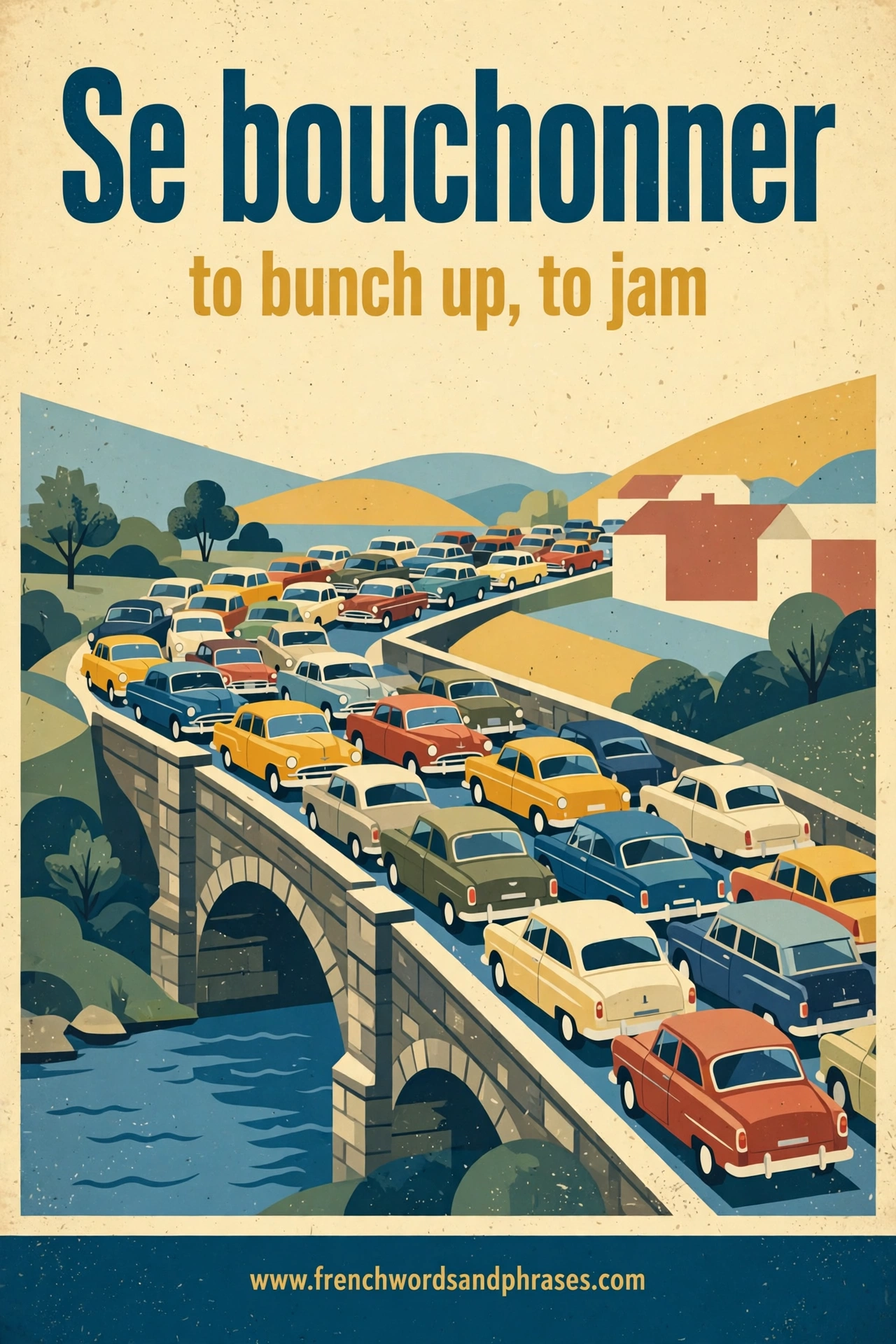
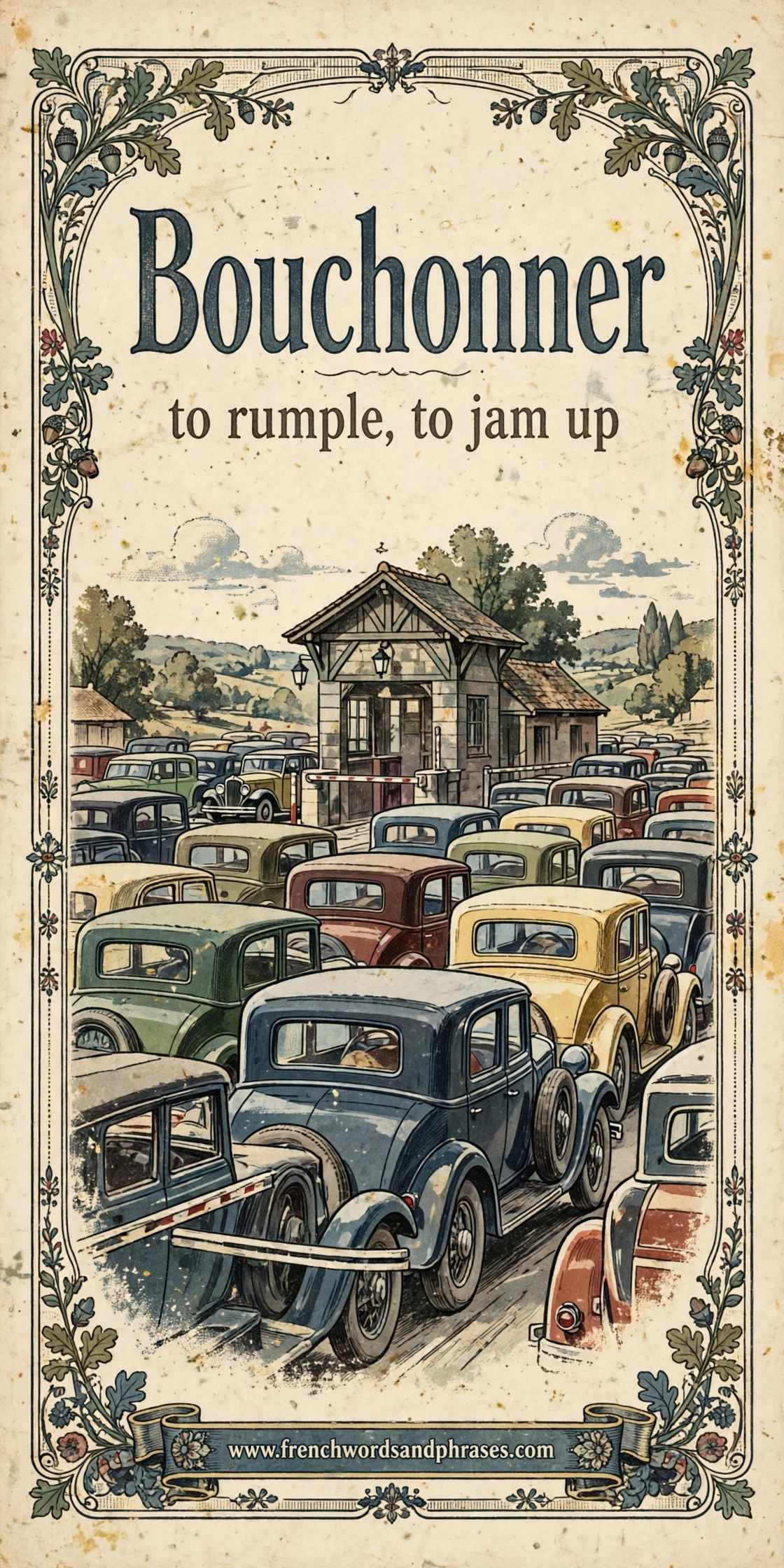
Bouchonner means to rumple into a ball or to jam up — cloth crumpled like a cork-shaped wad, traffic bunching until nothing moves.
A shirt screwed up into a ball at the bottom of a suitcase, a motorway slowing to a crawl at the toll booths, a groom rubbing down a horse with a twist of straw — bouchonner is the verb of the wad and the jam: things squeezed into a bouchon, a stopper of cloth, cars or straw.
In this guide, you’ll learn how to conjugate bouchonner in all the major French tenses and moods. Explore complete conjugation tables, French examples, English translations, and practice quizzes.
Understanding the French Verb Bouchonner
Bouchonner is a regular French verb belonging to the first group of verbs, those ending in-er.
It means to rumple, to jam up. In the stable it is a precise grooming term, with cloth it means careless crumpling (never careful folding), and on the road it is impersonal — ça bouchonne — the standard announcement that the cars ahead have formed a jam.
Verb classification: First group (-er)
Auxiliary verb: Avoir
Past participle: bouchonné
Present participle: bouchonnant
English equivalents: To rumple, to crumple, to rub down; bouchonner un linge — to screw a cloth up into a ball; bouchonner un cheval — to rub a horse down with a wisp of straw; ça bouchonne — traffic is jamming up, there are hold-ups; un bouchon — a cork, a wad, a traffic jam.
One important detail: bouchonner is built on un bouchon, a cork or stopper — anything rolled or pressed into that shape gets bouchonné. It has three lives that share the image: laundry screwed into a ball, a horse rubbed down with a straw wad (un bouchon de paille), and traffic that corks itself solid — ça bouchonne sur le périphérique is what every Paris radio says at rush hour. The verb is a regular -er: je bouchonne, nous bouchonnons, ils bouchonnent.
Experience the Word
Bouchonner is the verb of the wad — cloth, straw or traffic pressed into a cork-shaped lump that will not move.
Imagine the Friday-evening ring road around Paris. Brake lights stretch to the horizon, a motorbike threads between the lanes, and the radio announcer sighs the words every driver dreads: ça bouchonne — the whole city has corked itself into one long, honking stopper.
Nobody crashed, nobody stopped on purpose. The traffic has simply bouchonné — jammed — itself into a cork.
How to Conjugate Bouchonner: Complete French Conjugation Guide
Let’s explore every major conjugation of bouchonner, beginning with the indicative mood.
How to Conjugate Bouchonner in the Indicative Mood
The indicative mood is used to express facts, observations, actions, and events.
How to Conjugate Bouchonner in the Present Tense (Présent)
Used for actions happening now, habitual actions, and general truths.
| Subject | Conjugation |
|---|---|
| je | bouchonne |
| tu | bouchonnes |
| il / elle | bouchonne |
| nous | bouchonnons |
| vous | bouchonnez |
| ils / elles | bouchonnent |
Example
Ça bouchonne sur le périphérique depuis une heure.
Traffic has been jamming up on the ring road for an hour.
Quick Quiz 1
Complete the sentence:
Nous ______ les chevaux après la promenade.
Reveal the answer
bouchonnons
Nous bouchonnons les chevaux après la promenade.
We rub the horses down after the ride.
How to Conjugate Bouchonner in the Passé Composé
Used for completed actions in the past. Bouchonner takes the auxiliary verb avoir.
| Subject | Conjugation |
|---|---|
| j’ | ai bouchonné |
| tu | as bouchonné |
| il / elle | a bouchonné |
| nous | avons bouchonné |
| vous | avez bouchonné |
| ils / elles | ont bouchonné |
Example
Elle a bouchonné sa chemise au fond de la valise.
She screwed her shirt up into a ball at the bottom of the suitcase.
How to Conjugate Bouchonner in the Imparfait (Imperfect Tense)
Used for habitual past actions, descriptions, and ongoing situations in the past.
| Subject | Conjugation |
|---|---|
| je | bouchonnais |
| tu | bouchonnais |
| il / elle | bouchonnait |
| nous | bouchonnions |
| vous | bouchonniez |
| ils / elles | bouchonnaient |
Example
Le palefrenier bouchonnait les chevaux après la course.
The groom used to rub the horses down after the race.
Quick Quiz 2
Choose the correct form:
The traffic jammed up this morning.
Ça ______ ce matin. (a bouchonné / est bouchonné)
Reveal the answer
a bouchonné
Ça a bouchonné ce matin.
Bouchonner takes avoir.
How to Conjugate Bouchonner in the Plus-que-parfait
Used to describe an action that had already been completed before another past event.
| Subject | Conjugation |
|---|---|
| j’ | avais bouchonné |
| tu | avais bouchonné |
| il / elle | avait bouchonné |
| nous | avions bouchonné |
| vous | aviez bouchonné |
| ils / elles | avaient bouchonné |
Example
Le linge avait bouchonné les autres vêtements dans le tiroir.
The laundry had crumpled the other clothes in the drawer.
How to Conjugate Bouchonner in the Passé Simple
Primarily used in formal writing, literature, and historical narratives. It is rarely used in everyday conversation.
| Subject | Conjugation |
|---|---|
| je | bouchonnai |
| tu | bouchonnas |
| il / elle | bouchonna |
| nous | bouchonnâmes |
| vous | bouchonnâtes |
| ils / elles | bouchonnèrent |
Example
La foule bouchonna l’entrée du stade en quelques minutes.
The crowd jammed the stadium entrance within minutes.
How to Conjugate Bouchonner in the Passé Antérieur
A literary tense used to express an action completed immediately before another past action, generally in the passé simple.
| Subject | Conjugation |
|---|---|
| j’ | eus bouchonné |
| tu | eus bouchonné |
| il / elle | eut bouchonné |
| nous | eûmes bouchonné |
| vous | eûtes bouchonné |
| ils / elles | eurent bouchonné |
Example
Quand la neige eut bouchonné les cols, les vallées furent isolées.
When the snow had blocked the passes, the valleys were cut off.
How to Conjugate Bouchonner in the Future Tense (Futur Simple)
Used to describe actions that will take place in the future.
| Subject | Conjugation |
|---|---|
| je | bouchonnerai |
| tu | bouchonneras |
| il / elle | bouchonnera |
| nous | bouchonnerons |
| vous | bouchonnerez |
| ils / elles | bouchonneront |
Example
Demain, ça bouchonnera dès sept heures aux péages.
Tomorrow, traffic will jam up from seven o’clock at the tolls.
How to Conjugate Bouchonner in the Futur Antérieur (Future Perfect)
Used for an action that will have been completed before a particular point in the future.
| Subject | Conjugation |
|---|---|
| j’ | aurai bouchonné |
| tu | auras bouchonné |
| il / elle | aura bouchonné |
| nous | aurons bouchonné |
| vous | aurez bouchonné |
| ils / elles | auront bouchonné |
Example
À midi, la circulation aura bouchonné tout le centre-ville.
By noon, the traffic will have jammed the whole town centre.
How to Conjugate Bouchonner in the Near Future (Futur Proche)
Used to describe something that is going to happen soon. Formed with aller + infinitive.
| Subject | Conjugation |
|---|---|
| je | vais bouchonner |
| tu | vas bouchonner |
| il / elle | va bouchonner |
| nous | allons bouchonner |
| vous | allez bouchonner |
| ils / elles | vont bouchonner |
Example
Pars maintenant, ça va bouchonner sur l’autoroute.
Leave now, traffic is going to jam up on the motorway.
How to Conjugate Bouchonner in the Conditional Mood
The conditional mood expresses what would happen under certain circumstances. It is also frequently used to make polite requests or express wishes.
How to Conjugate Bouchonner in the Present Conditional
| Subject | Conjugation |
|---|---|
| je | bouchonnerais |
| tu | bouchonnerais |
| il / elle | bouchonnerait |
| nous | bouchonnerions |
| vous | bouchonneriez |
| ils / elles | bouchonneraient |
Example
Sans les travaux, ça bouchonnerait beaucoup moins.
Without the roadworks, there would be far fewer hold-ups.
How to Conjugate Bouchonner in the Past Conditional
| Subject | Conjugation |
|---|---|
| j’ | aurais bouchonné |
| tu | aurais bouchonné |
| il / elle | aurait bouchonné |
| nous | aurions bouchonné |
| vous | auriez bouchonné |
| ils / elles | auraient bouchonné |
Example
Il aurait bouchonné le cheval avec plus de soin autrefois.
He would have rubbed the horse down more carefully in the old days.
Bouchonner in the Literary Past Conditional Form
This less common literary form uses the imperfect subjunctive of avoir.
| Subject | Conjugation |
|---|---|
| j’ | eusse bouchonné |
| tu | eusses bouchonné |
| il / elle | eût bouchonné |
| nous | eussions bouchonné |
| vous | eussiez bouchonné |
| ils / elles | eussent bouchonné |
Example
La foule eût bouchonné la place sans les barrières.
The crowd would have jammed the square without the barriers.
How to Conjugate Bouchonner in the Subjunctive Mood
The subjunctive is used to express wishes, emotions, doubts, necessity, and uncertainty. It frequently follows expressions such as il faut que (it is necessary that) or bien que (although).
How to Conjugate Bouchonner in the Present Subjunctive
| Subject | Conjugation |
|---|---|
| que je | bouchonne |
| que tu | bouchonnes |
| qu’il / qu’elle | bouchonne |
| que nous | bouchonnions |
| que vous | bouchonniez |
| qu’ils / qu’elles | bouchonnent |
Example
Je déteste que le linge bouchonne tout dans la machine.
I hate it when the laundry crumples everything in the machine.
Quick Quiz 3
Complete the sentence using the subjunctive:
On craint que la foule ne ______ l’entrée du stade.
Reveal the answer
bouchonne
On craint que la foule ne bouchonne l’entrée du stade.
People fear the crowd will jam the stadium entrance.
How to Conjugate Bouchonner in the Imperfect Subjunctive
A literary tense, rarely encountered in modern spoken French.
| Subject | Conjugation |
|---|---|
| que je | bouchonnasse |
| que tu | bouchonnasses |
| qu’il / qu’elle | bouchonnât |
| que nous | bouchonnassions |
| que vous | bouchonnassiez |
| qu’ils / qu’elles | bouchonnassent |
Example
On craignait que la neige bouchonnât les routes de montagne.
People feared the snow might block the mountain roads.
How to Conjugate Bouchonner in the Pluperfect Subjunctive
A literary construction used to express an action completed before another past action.
| Subject | Conjugation |
|---|---|
| que j’ | eusse bouchonné |
| que tu | eusses bouchonné |
| qu’il / qu’elle | eût bouchonné |
| que nous | eussions bouchonné |
| que vous | eussiez bouchonné |
| qu’ils / qu’elles | eussent bouchonné |
Example
On disait que la foule eût bouchonné les abords du stade.
People said the crowd had jammed the approaches to the stadium.
How to Conjugate Bouchonner in the Past Subjunctive
| Subject | Conjugation |
|---|---|
| que j’ | aie bouchonné |
| que tu | aies bouchonné |
| qu’il / qu’elle | ait bouchonné |
| que nous | ayons bouchonné |
| que vous | ayez bouchonné |
| qu’ils / qu’elles | aient bouchonné |
Example
Je suis étonné que ça ait bouchonné si tôt ce matin.
I am surprised the traffic jammed up so early this morning.
How to Conjugate Bouchonner in the Imperative
The imperative is used to give commands, instructions, invitations, or suggestions. Subject pronouns are omitted.
How to Conjugate Bouchonner in the Present Imperative
| Person | Conjugation |
|---|---|
| (tu) | bouchonne |
| (nous) | bouchonnons |
| (vous) | bouchonnez |
Example
Bouchonne bien le cheval avant de le rentrer !
Rub the horse down well before bringing him in!
Quick Quiz 4
How would you say Rub the horse down well (tu form)?
Reveal the answer
Bouchonne bien le cheval !
French Participles of Bouchonner
Participles are verb forms that can be used in compound tenses and other grammatical constructions.
Present Participle of Bouchonner
bouchonnant
En bouchonnant sa chemise, il l’a rendue importable.
By screwing up his shirt into a ball, he made it unwearable.
Past Participle of Bouchonner
bouchonné
Bouchonnée au fond du sac, la nappe était pleine de plis.
Crumpled at the bottom of the bag, the tablecloth was full of creases.
Bouchonner in Everyday French: Real-Life Examples
Now that you know the conjugations, let’s see how bouchonner appears in everyday French.
Example 1 — Present
Ça bouchonne sur le périphérique depuis une heure.
Traffic has been jamming up on the ring road for an hour.
Example 2 — Passé composé
Elle a bouchonné sa chemise au fond de la valise.
She screwed her shirt up into a ball at the bottom of the suitcase.
Example 3 — Imparfait
Le palefrenier bouchonnait les chevaux après la course.
The groom used to rub the horses down after the race.
Example 4 — Future
Demain, ça bouchonnera dès sept heures.
Tomorrow, traffic will jam up from seven o’clock.
Example 5 — Conditional
Sans les travaux, ça bouchonnerait beaucoup moins.
Without the roadworks, there would be far fewer hold-ups.
Example 6 — Imperative
Bouchonne bien le cheval avant de le rentrer !
Rub the horse down well before bringing him in!
Beyond Translation: The Meaning of Bouchonner
The cork explains everything: un bouchon stops a bottle, so whatever is pressed into a cork’s shape — a shirt, a straw wisp, a thousand cars — gets bouchonné.
French traffic reports run on this word.
Between ça roule (it’s flowing) and un bouchon de dix kilomètres (a ten-kilometre jam), the little verb bouchonner announces every slow, corked-up morning in France.
How to Remember the French Verb Bouchonner
Remember it this way: Bouchonner is about crumpled cloth and traffic corked into a jam.
- Un bouchon is a cork: bouchonner presses things into a cork-shaped wad.
- On the road it is impersonal — ça bouchonne = traffic is jamming up.
- Regular -er: je bouchonne, nous bouchonnons, past participle bouchonné.
The key idea is crumpled cloth and traffic corked into a jam.
Test Your Knowledge of Bouchonner
Let’s see how much you’ve learned. Try answering these questions before revealing the answers.
Question 1
What does ça bouchonne mean on a traffic report?
Reveal the answer
Traffic is jamming up — the cars have formed a bouchon, a cork of traffic.
Question 2
How do you say Traffic has been jamming up on the ring road in French?
Reveal the answer
Ça bouchonne sur le périphérique.
Question 3
Translate: She screwed her shirt up into a ball at the bottom of the suitcase.
Reveal the answer
Elle a bouchonné sa chemise au fond de la valise.
Question 4
What is the past participle of bouchonner?
Reveal the answer
Bouchonné.
Question 5
Complete the sentence:
Je déteste que le linge ______ tout dans la machine.
Reveal the answer
bouchonne
Je déteste que le linge bouchonne tout dans la machine.
I hate it when the laundry crumples everything in the machine.
Your Final Challenge
Can You Use It?
How would you say this in French?
Every Friday, traffic jams up at the gates of Paris, and the radio sings it like an old song.
Reveal the answer
Chaque vendredi, ça bouchonne aux portes de Paris, et la radio le chante comme une vieille chanson.
Every Friday, traffic jams up at the gates of Paris, and the radio sings it like an old song.
A little French. A little curiosity. A richer everyday life.
LEARN FRENCH ONE WORD AT A TIME