A French Word to Live By
How to Conjugate Se blesser in French
/sə blɛ.se/
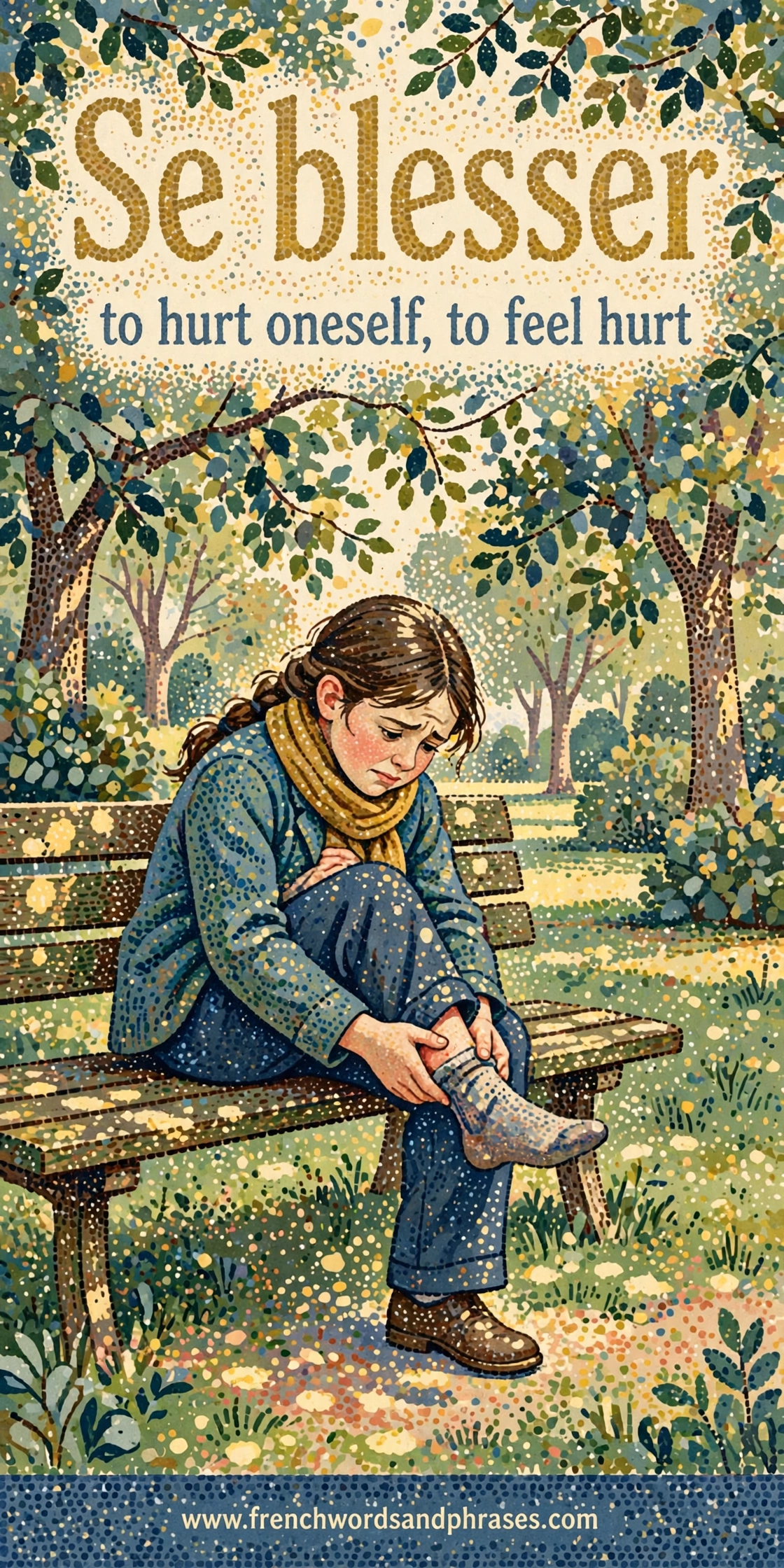
Se blesser means to hurt oneself, to feel hurt — to come away from an accident with an injury, or from a conversation with a wounded heart.
A skier twisting her knee on the last run of the day, a cook catching a finger on the knife, a friend quietly taking offence at a joke that was not aimed at her — se blesser is the verb of hurting yourself, in the body or in the feelings, and French lets the context decide which.
In this guide, you’ll learn how to conjugate se blesser in all the major French tenses and moods. Explore complete conjugation tables, French examples, English translations, and practice quizzes.
Understanding the French Verb Se blesser
Se blesser is a regular French verb belonging to the first group of verbs, those ending in-er.
It means to hurt oneself, to feel hurt. On sports pages and in accident reports it is the everyday verb of self-injury: un joueur s’est blessé à l’entraînement. In conversation, its second life is just as common — se blesser d’une plaisanterie is to take offence at a joke, and someone easily offended est vite blessé.
Verb classification: First group (-er), reflexive
Auxiliary verb: Être
Past participle: blessé
Present participle: blessant
English equivalents: To hurt oneself, to injure oneself, to take offence; se blesser au genou — to hurt one’s knee; se blesser en tombant — to hurt oneself falling; se blesser d’une remarque — to feel hurt by a remark; être blessé — to be injured, to be hurt.
One important detail: se blesser is reflexive, so it takes être in every compound tense and the past participle agrees with the subject: elle s’est blessée au genou, ils se sont blessés en tombant. The tu imperative tucks the pronoun behind the verb: ne te blesse pas ! Two constructions carry the two senses: the physical injury names the body part with à — se blesser à la cheville — while the wounded feeling takes de or par: elle s’est blessée de ta remarque, il s’est senti blessé par ce silence. The plain verb blesser hurts someone else; the reflexive turns the harm back on the subject.
Experience the Word
Se blesser is the verb of harm that comes home — the accident you do to yourself, and the offence you take away with you.
Imagine the last ski run of a February afternoon. The light is flat, the snow is chopped up, and halfway down the piste a young woman catches an edge and falls badly. She sits up slowly, holding her knee: elle s’est blessée, and the holiday changes its plans around her.
No one pushed her and nothing attacked her. She has hurt herself — elle s’est blessée — and the verb needs no culprit.
How to Conjugate Se blesser: Complete French Conjugation Guide
Let’s explore every major conjugation of se blesser, beginning with the indicative mood.
How to Conjugate Se blesser in the Indicative Mood
The indicative mood is used to express facts, observations, actions, and events.
How to Conjugate Se blesser in the Present Tense (Présent)
Used for actions happening now, habitual actions, and general truths.
| Subject | Conjugation |
|---|---|
| je | me blesse |
| tu | te blesses |
| il / elle | se blesse |
| nous | nous blessons |
| vous | vous blessez |
| ils / elles | se blessent |
Example
Les enfants se blessent souvent en jouant au football.
Children often hurt themselves playing football.
Quick Quiz 1
Complete the sentence:
Nous nous ______ souvent en jouant au rugby.
Reveal the answer
blessons
Nous nous blessons souvent en jouant au rugby.
We often hurt ourselves playing rugby.
How to Conjugate Se blesser in the Passé Composé
Used for completed actions in the past. Se blesser takes the auxiliary verb être.
| Subject | Conjugation |
|---|---|
| je | me suis blessé / me suis blessée |
| tu | t’es blessé / t’es blessée |
| il / elle | s’est blessé / s’est blessée |
| nous | nous sommes blessés / nous sommes blessées |
| vous | vous êtes blessés / vous êtes blessées / vous êtes blessé / vous êtes blessée |
| ils / elles | se sont blessés / se sont blessées |
Example
Elle s’est blessée au genou en skiant.
She hurt her knee skiing.
How to Conjugate Se blesser in the Imparfait (Imperfect Tense)
Used for habitual past actions, descriptions, and ongoing situations in the past.
| Subject | Conjugation |
|---|---|
| je | me blessais |
| tu | te blessais |
| il / elle | se blessait |
| nous | nous blessions |
| vous | vous blessiez |
| ils / elles | se blessaient |
Example
Il se blessait chaque été en bricolant dans son atelier.
He used to hurt himself every summer doing DIY in his workshop.
Quick Quiz 2
Choose the correct form:
She hurt her knee.
Elle ______ au genou. (s’est blessée / a blessé)
Reveal the answer
s’est blessée
Elle s’est blessée au genou.
Se blesser is reflexive, takes être, and the participle agrees: blessée.
How to Conjugate Se blesser in the Plus-que-parfait
Used to describe an action that had already been completed before another past event.
| Subject | Conjugation |
|---|---|
| je | m’étais blessé / m’étais blessée |
| tu | t’étais blessé / t’étais blessée |
| il / elle | s’était blessé / s’était blessée |
| nous | nous étions blessés / nous étions blessées |
| vous | vous étiez blessés / vous étiez blessées / vous étiez blessé / vous étiez blessée |
| ils / elles | s’étaient blessés / s’étaient blessées |
Example
Elle s’était blessée à la cheville avant le marathon.
She had injured her ankle before the marathon.
How to Conjugate Se blesser in the Passé Simple
Primarily used in formal writing, literature, and historical narratives. It is rarely used in everyday conversation.
| Subject | Conjugation |
|---|---|
| je | me blessai |
| tu | te blessas |
| il / elle | se blessa |
| nous | nous blessâmes |
| vous | vous blessâtes |
| ils / elles | se blessèrent |
Example
Le soldat se blessa légèrement à la main.
The soldier wounded himself slightly in the hand.
How to Conjugate Se blesser in the Passé Antérieur
A literary tense used to express an action completed immediately before another past action, generally in the passé simple.
| Subject | Conjugation |
|---|---|
| je | me fus blessé / me fus blessée |
| tu | te fus blessé / te fus blessée |
| il / elle | se fut blessé / se fut blessée |
| nous | nous fûmes blessés / nous fûmes blessées |
| vous | vous fûtes blessés / vous fûtes blessées / vous fûtes blessé / vous fûtes blessée |
| ils / elles | se furent blessés / se furent blessées |
Example
Dès qu’il se fut blessé, on l’emmena à l’infirmerie.
As soon as he had hurt himself, they took him to the infirmary.
How to Conjugate Se blesser in the Future Tense (Futur Simple)
Used to describe actions that will take place in the future.
| Subject | Conjugation |
|---|---|
| je | me blesserai |
| tu | te blesseras |
| il / elle | se blessera |
| nous | nous blesserons |
| vous | vous blesserez |
| ils / elles | se blesseront |
Example
Si tu ne fais pas attention, tu te blesseras.
If you are not careful, you will hurt yourself.
How to Conjugate Se blesser in the Futur Antérieur (Future Perfect)
Used for an action that will have been completed before a particular point in the future.
| Subject | Conjugation |
|---|---|
| je | me serai blessé / me serai blessée |
| tu | te seras blessé / te seras blessée |
| il / elle | se sera blessé / se sera blessée |
| nous | nous serons blessés / nous serons blessées |
| vous | vous serez blessés / vous serez blessées / vous serez blessé / vous serez blessée |
| ils / elles | se seront blessés / se seront blessées |
Example
À ce rythme, il se sera blessé avant la fin de la saison.
At this rate, he will have injured himself before the end of the season.
How to Conjugate Se blesser in the Near Future (Futur Proche)
Used to describe something that is going to happen soon. Formed with aller + infinitive.
| Subject | Conjugation |
|---|---|
| je | vais me blesser |
| tu | vas te blesser |
| il / elle | va se blesser |
| nous | allons nous blesser |
| vous | allez vous blesser |
| ils / elles | vont se blesser |
Example
Descends de là, tu vas te blesser !
Get down from there, you are going to hurt yourself!
How to Conjugate Se blesser in the Conditional Mood
The conditional mood expresses what would happen under certain circumstances. It is also frequently used to make polite requests or express wishes.
How to Conjugate Se blesser in the Present Conditional
| Subject | Conjugation |
|---|---|
| je | me blesserais |
| tu | te blesserais |
| il / elle | se blesserait |
| nous | nous blesserions |
| vous | vous blesseriez |
| ils / elles | se blesseraient |
Example
Sans échauffement, vous vous blesseriez facilement.
Without warming up, you would injure yourselves easily.
How to Conjugate Se blesser in the Past Conditional
| Subject | Conjugation |
|---|---|
| je | me serais blessé / me serais blessée |
| tu | te serais blessé / te serais blessée |
| il / elle | se serait blessé / se serait blessée |
| nous | nous serions blessés / nous serions blessées |
| vous | vous seriez blessés / vous seriez blessées / vous seriez blessé / vous seriez blessée |
| ils / elles | se seraient blessés / se seraient blessées |
Example
Elle se serait blessée si elle était tombée de l’échelle.
She would have hurt herself if she had fallen off the ladder.
Se blesser in the Literary Past Conditional Form
This less common literary form uses the imperfect subjunctive of être.
| Subject | Conjugation |
|---|---|
| je | me fusse blessé / me fusse blessée |
| tu | te fusses blessé / te fusses blessée |
| il / elle | se fût blessé / se fût blessée |
| nous | nous fussions blessés / nous fussions blessées |
| vous | vous fussiez blessés / vous fussiez blessées / vous fussiez blessé / vous fussiez blessée |
| ils / elles | se fussent blessés / se fussent blessées |
Example
Il se fût blessé gravement sans son casque.
He would have injured himself seriously without his helmet.
How to Conjugate Se blesser in the Subjunctive Mood
The subjunctive is used to express wishes, emotions, doubts, necessity, and uncertainty. It frequently follows expressions such as il faut que (it is necessary that) or bien que (although).
How to Conjugate Se blesser in the Present Subjunctive
| Subject | Conjugation |
|---|---|
| que je | me blesse |
| que tu | te blesses |
| qu’il / qu’elle | se blesse |
| que nous | nous blessions |
| que vous | vous blessiez |
| qu’ils / qu’elles | se blessent |
Example
Je ne veux pas que tu te blesses avec ce couteau.
I do not want you to hurt yourself with that knife.
Quick Quiz 3
Complete the sentence using the subjunctive:
Elle craint que son fils se ______ en grimpant.
Reveal the answer
blesse
Elle craint que son fils se blesse en grimpant.
She fears her son may hurt himself climbing.
How to Conjugate Se blesser in the Imperfect Subjunctive
A literary tense, rarely encountered in modern spoken French.
| Subject | Conjugation |
|---|---|
| que je | me blessasse |
| que tu | te blessasses |
| qu’il / qu’elle | se blessât |
| que nous | nous blessassions |
| que vous | vous blessassiez |
| qu’ils / qu’elles | se blessassent |
Example
Elle craignait que son fils se blessât en grimpant aux arbres.
She feared her son might hurt himself climbing trees.
How to Conjugate Se blesser in the Pluperfect Subjunctive
A literary construction used to express an action completed before another past action.
| Subject | Conjugation |
|---|---|
| que je | me fusse blessé / me fusse blessée |
| que tu | te fusses blessé / te fusses blessée |
| qu’il / qu’elle | se fût blessé / se fût blessée |
| que nous | nous fussions blessés / nous fussions blessées |
| que vous | vous fussiez blessés / vous fussiez blessées / vous fussiez blessé / vous fussiez blessée |
| qu’ils / qu’elles | se fussent blessés / se fussent blessées |
Example
On disait qu’il se fût blessé à l’entraînement.
People said he had injured himself in training.
How to Conjugate Se blesser in the Past Subjunctive
| Subject | Conjugation |
|---|---|
| que je | me sois blessé / me sois blessée |
| que tu | te sois blessé / te sois blessée |
| qu’il / qu’elle | se soit blessé / se soit blessée |
| que nous | nous soyons blessés / nous soyons blessées |
| que vous | vous soyez blessés / vous soyez blessées / vous soyez blessé / vous soyez blessée |
| qu’ils / qu’elles | se soient blessés / se soient blessées |
Example
Je suis triste qu’elle se soit blessée de ta remarque.
I am sorry she felt hurt by your remark.
How to Conjugate Se blesser in the Imperative
The imperative is used to give commands, instructions, invitations, or suggestions. Subject pronouns are omitted.
How to Conjugate Se blesser in the Present Imperative
| Person | Conjugation |
|---|---|
| (tu) | blesse-toi |
| (nous) | blessons-nous |
| (vous) | blessez-vous |
Example
Ne te blesse pas avec ces ciseaux !
Do not hurt yourself with those scissors!
Quick Quiz 4
How would you say Do not hurt yourself (tu form)?
Reveal the answer
Ne te blesse pas !
French Participles of Se blesser
Participles are verb forms that can be used in compound tenses and other grammatical constructions.
Present Participle of Se blesser
blessant
En se blessant au doigt, elle a laissé tomber le vase.
Hurting her finger, she dropped the vase.
Past Participle of Se blesser
blessé
Blessée dans son orgueil, elle a quitté la pièce sans un mot.
Hurt in her pride, she left the room without a word.
Se blesser in Everyday French: Real-Life Examples
Now that you know the conjugations, let’s see how se blesser appears in everyday French.
Example 1 — Present
Il se blesse souvent en bricolant.
He often hurts himself doing DIY.
Example 2 — Passé composé
Elle s’est blessée au genou.
She hurt her knee.
Example 3 — Imparfait
Enfant, je me blessais à chaque vacances.
As a child, I hurt myself every holiday.
Example 4 — Future
Tu te blesseras si tu continues ainsi.
You will hurt yourself if you go on like that.
Example 5 — Conditional
Sans casque, il se blesserait gravement.
Without a helmet, he would injure himself seriously.
Example 6 — Imperative
Ne te blesse pas avec ce couteau !
Do not hurt yourself with that knife!
Beyond Translation: The Meaning of Se blesser
English needs two different phrases — to hurt oneself and to take offence — where French se blesser calmly covers both, because both are harms the subject carries away.
The reflexive pronoun is the whole story.
Blesser quelqu’un sends the harm outward; se blesser brings it home. And French is honest about the second sense: to feel hurt by a remark is, grammatically, something you do to yourself — elle s’est blessée de ta plaisanterie, she wounded herself on your joke.
How to Remember the French Verb Se blesser
Remember it this way: Se blesser is about the skier holding her knee on the last run of the day.
- Always reflexive: je me blesse, elle s’est blessée — être, and the participle agrees.
- Body part with à: se blesser au genou, à la cheville; hurt feelings with de or par: blessée de ta remarque.
- Regular -er underneath: je me blesse, nous nous blessons, past participle blessé.
The key idea is the skier holding her knee on the last run of the day.
Test Your Knowledge of Se blesser
Let’s see how much you’ve learned. Try answering these questions before revealing the answers.
Question 1
Which auxiliary does se blesser use, and why?
Reveal the answer
Être — it is a reflexive verb: elle s’est blessée au genou.
Question 2
How do you say She hurt her knee skiing in French?
Reveal the answer
Elle s’est blessée au genou en skiant.
Question 3
Translate: He often hurts himself doing DIY.
Reveal the answer
Il se blesse souvent en bricolant.
Question 4
What is the past participle of se blesser?
Reveal the answer
Blessé — agreeing: blessée, blessés, blessées.
Question 5
Complete the sentence:
Je ne veux pas que tu te ______ avec ce couteau.
Reveal the answer
blesses
Je ne veux pas que tu te blesses avec ce couteau.
I do not want you to hurt yourself with that knife.
Your Final Challenge
Can You Use It?
How would you say this in French?
She hurt her knee skiing, but it is her brother’s remark that still hurts her.
Reveal the answer
Elle s’est blessée au genou en skiant, mais c’est la remarque de son frère qui lui fait encore mal.
She hurt her knee skiing, but it is her brother’s remark that still hurts her.
A little French. A little curiosity. A richer everyday life.
LEARN FRENCH ONE WORD AT A TIME