A French Word to Live By
How to Conjugate Se amuser in French
/sə a.my.ze/
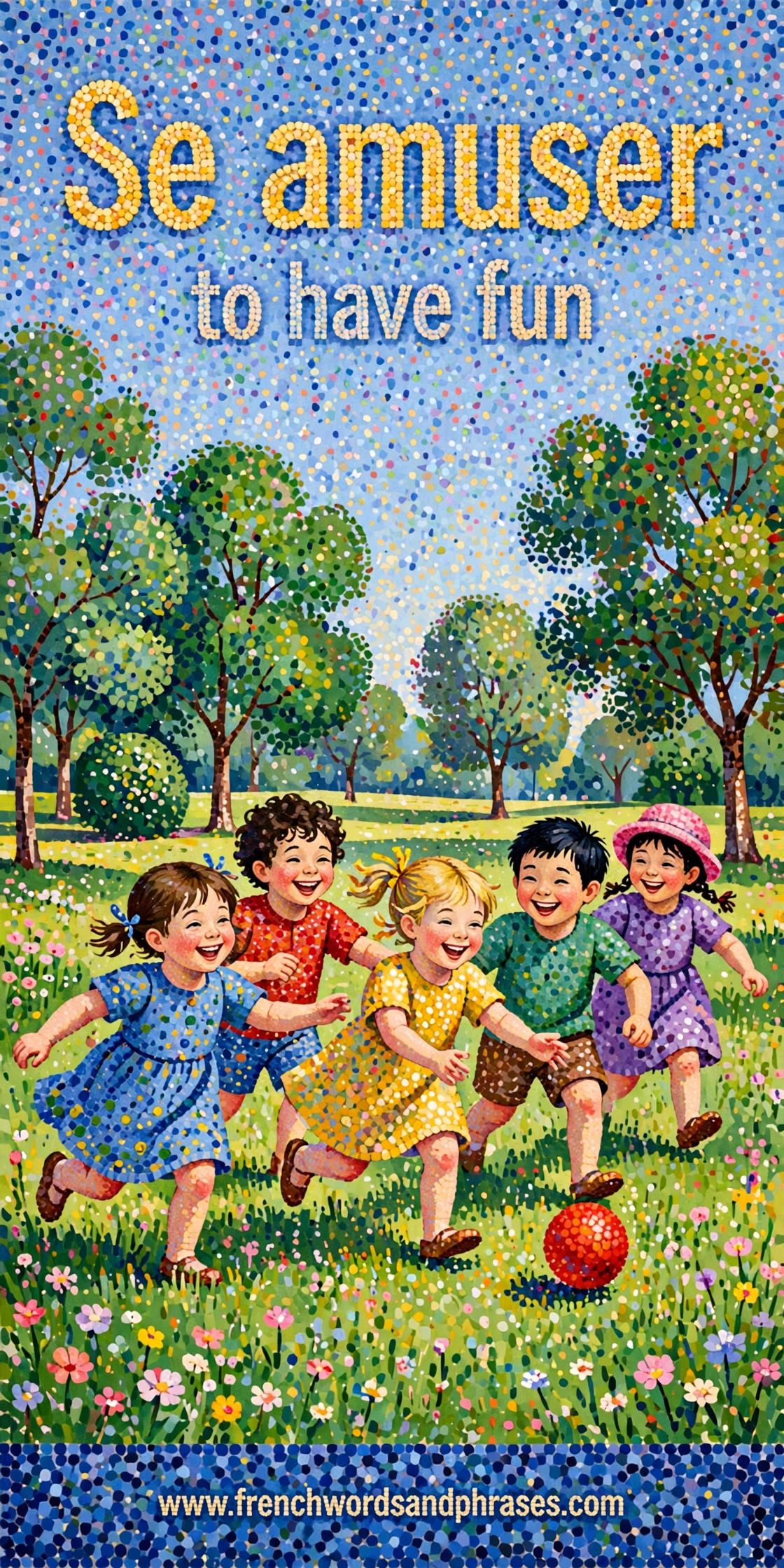
Se amuser means to have fun — to enjoy yourself, to play, to pass the time in delight.
Children building a dam across a stream, friends doubled over a board game at midnight, a grandfather flying a kite he bought « for the grandchildren » — s’amuser is the verb of fun itself: time enjoyed so completely that it disappears.
In this guide, you’ll learn how to conjugate se amuser in all the major French tenses and moods. Explore complete conjugation tables, French examples, English translations, and practice quizzes.
Understanding the French Verb Se amuser
Se amuser is a regular French verb belonging to the first group of verbs, those ending in-er.
It means to have fun. It is the standard answer to « Vous avez passé de bonnes vacances ? » — on s’est bien amusés ! — and the verb of children’s play, parties, games and holidays. « Amusez-vous bien ! » is the natural French way to say Have fun! to a group, and s’amuser comme un petit fou is to have the time of your life.
Verb classification: First group (-er), reflexive
Auxiliary verb: Être
Past participle: amusé
Present participle: amusant
English equivalents: To have fun, to enjoy oneself, to play; s’amuser à faire quelque chose — to amuse oneself doing something; s’amuser comme un fou — to have a whale of a time; amuser quelqu’un — to amuse someone, to entertain someone.
One important detail: the reflexive pronoun is the whole point of s’amuser. The plain verb amuser entertains somebody else — le clown amuse les enfants — while s’amuser is to have fun yourself: les enfants s’amusent. Being reflexive, it takes être in every compound tense and the participle agrees: elle s’est amusée, ils se sont amusés. The tu imperative tucks the pronoun behind the verb: amuse-toi ! Followed by another verb, it takes à: ils s’amusent à construire une cabane.
Experience the Word
Se amuser is the verb of time well lost — hours spent playing that never feel wasted for a second.
Imagine a garden on a summer evening, a kite, and a grandfather who bought it « for the children ». Ten minutes later the children are sitting in the grass watching him run, laughing, across the lawn: c’est lui qui s’amuse — and everyone agrees he has earned it.
The kite was never really for the children. He is having fun — amusé, completely, like a boy again.
How to Conjugate Se amuser: Complete French Conjugation Guide
Let’s explore every major conjugation of se amuser, beginning with the indicative mood.
How to Conjugate Se amuser in the Indicative Mood
The indicative mood is used to express facts, observations, actions, and events.
How to Conjugate Se amuser in the Present Tense (Présent)
Used for actions happening now, habitual actions, and general truths.
| Subject | Conjugation |
|---|---|
| je | m’amuse |
| tu | t’amuses |
| il / elle | s’amuse |
| nous | nous amusons |
| vous | vous amusez |
| ils / elles | s’amusent |
Example
Les enfants s’amusent dans le jardin.
The children are having fun in the garden.
Quick Quiz 1
Complete the sentence:
Nous ______ dans le jardin.
Reveal the answer
nous amusons
Nous nous amusons dans le jardin.
We are having fun in the garden.
How to Conjugate Se amuser in the Passé Composé
Used for completed actions in the past. Se amuser takes the auxiliary verb être.
| Subject | Conjugation |
|---|---|
| je | me suis amusé / me suis amusée |
| tu | t’es amusé / t’es amusée |
| il / elle | s’est amusé / s’est amusée |
| nous | nous sommes amusés / nous sommes amusées |
| vous | vous êtes amusés / vous êtes amusées / vous êtes amusé / vous êtes amusée |
| ils / elles | se sont amusés / se sont amusées |
Example
Elle s’est bien amusée à la fête.
She had a great time at the party.
How to Conjugate Se amuser in the Imparfait (Imperfect Tense)
Used for habitual past actions, descriptions, and ongoing situations in the past.
| Subject | Conjugation |
|---|---|
| je | m’amusais |
| tu | t’amusais |
| il / elle | s’amusait |
| nous | nous amusions |
| vous | vous amusiez |
| ils / elles | s’amusaient |
Example
Nous nous amusions comme des fous.
We used to have a whale of a time.
Quick Quiz 2
Choose the correct form:
She had a great time.
Elle ______ à la fête. (s’est amusée / a amusé)
Reveal the answer
s’est amusée
Elle s’est amusée à la fête.
S’amuser is reflexive, takes être, and the participle agrees: amusée.
How to Conjugate Se amuser in the Plus-que-parfait
Used to describe an action that had already been completed before another past event.
| Subject | Conjugation |
|---|---|
| je | m’étais amusé / m’étais amusée |
| tu | t’étais amusé / t’étais amusée |
| il / elle | s’était amusé / s’était amusée |
| nous | nous étions amusés / nous étions amusées |
| vous | vous étiez amusés / vous étiez amusées / vous étiez amusé / vous étiez amusée |
| ils / elles | s’étaient amusés / s’étaient amusées |
Example
Ils s’étaient amusés jusqu’à minuit.
They had had fun until midnight.
How to Conjugate Se amuser in the Passé Simple
Primarily used in formal writing, literature, and historical narratives. It is rarely used in everyday conversation.
| Subject | Conjugation |
|---|---|
| je | m’amusai |
| tu | t’amusas |
| il / elle | s’amusa |
| nous | nous amusâmes |
| vous | vous amusâtes |
| ils / elles | s’amusèrent |
Example
Les invités s’amusèrent toute la soirée.
The guests enjoyed themselves all evening.
How to Conjugate Se amuser in the Passé Antérieur
A literary tense used to express an action completed immediately before another past action, generally in the passé simple.
| Subject | Conjugation |
|---|---|
| je | me fus amusé / me fus amusée |
| tu | te fus amusé / te fus amusée |
| il / elle | se fut amusé / se fut amusée |
| nous | nous fûmes amusés / nous fûmes amusées |
| vous | vous fûtes amusés / vous fûtes amusées / vous fûtes amusé / vous fûtes amusée |
| ils / elles | se furent amusés / se furent amusées |
Example
Dès qu’ils se furent amusés un moment, les enfants réclamèrent le gâteau.
As soon as they had played for a while, the children demanded the cake.
How to Conjugate Se amuser in the Future Tense (Futur Simple)
Used to describe actions that will take place in the future.
| Subject | Conjugation |
|---|---|
| je | m’amuserai |
| tu | t’amuseras |
| il / elle | s’amusera |
| nous | nous amuserons |
| vous | vous amuserez |
| ils / elles | s’amuseront |
Example
Vous vous amuserez bien demain, j’en suis sûr.
You will have a great time tomorrow, I am sure of it.
How to Conjugate Se amuser in the Futur Antérieur (Future Perfect)
Used for an action that will have been completed before a particular point in the future.
| Subject | Conjugation |
|---|---|
| je | me serai amusé / me serai amusée |
| tu | te seras amusé / te seras amusée |
| il / elle | se sera amusé / se sera amusée |
| nous | nous serons amusés / nous serons amusées |
| vous | vous serez amusés / vous serez amusées / vous serez amusé / vous serez amusée |
| ils / elles | se seront amusés / se seront amusées |
Example
À la fin des vacances, les enfants se seront amusés comme jamais.
By the end of the holidays, the children will have had more fun than ever.
How to Conjugate Se amuser in the Near Future (Futur Proche)
Used to describe something that is going to happen soon. Formed with aller + infinitive.
| Subject | Conjugation |
|---|---|
| je | vais m’amuser |
| tu | vas t’amuser |
| il / elle | va s’amuser |
| nous | allons nous amuser |
| vous | allez vous amuser |
| ils / elles | vont s’amuser |
Example
Allez, on va bien s’amuser ce soir !
Come on, we are going to have a great time tonight!
How to Conjugate Se amuser in the Conditional Mood
The conditional mood expresses what would happen under certain circumstances. It is also frequently used to make polite requests or express wishes.
How to Conjugate Se amuser in the Present Conditional
| Subject | Conjugation |
|---|---|
| je | m’amuserais |
| tu | t’amuserais |
| il / elle | s’amuserait |
| nous | nous amuserions |
| vous | vous amuseriez |
| ils / elles | s’amuseraient |
Example
Sans la pluie, nous nous amuserions davantage dehors.
Without the rain, we would have more fun outside.
How to Conjugate Se amuser in the Past Conditional
| Subject | Conjugation |
|---|---|
| je | me serais amusé / me serais amusée |
| tu | te serais amusé / te serais amusée |
| il / elle | se serait amusé / se serait amusée |
| nous | nous serions amusés / nous serions amusées |
| vous | vous seriez amusés / vous seriez amusées / vous seriez amusé / vous seriez amusée |
| ils / elles | se seraient amusés / se seraient amusées |
Example
Elle se serait amusée si elle était venue avec nous.
She would have had fun if she had come with us.
Se amuser in the Literary Past Conditional Form
This less common literary form uses the imperfect subjunctive of être.
| Subject | Conjugation |
|---|---|
| je | me fusse amusé / me fusse amusée |
| tu | te fusses amusé / te fusses amusée |
| il / elle | se fût amusé / se fût amusée |
| nous | nous fussions amusés / nous fussions amusées |
| vous | vous fussiez amusés / vous fussiez amusées / vous fussiez amusé / vous fussiez amusée |
| ils / elles | se fussent amusés / se fussent amusées |
Example
Il se fût amusé sans cette mauvaise nouvelle.
He would have had fun without that bad news.
How to Conjugate Se amuser in the Subjunctive Mood
The subjunctive is used to express wishes, emotions, doubts, necessity, and uncertainty. It frequently follows expressions such as il faut que (it is necessary that) or bien que (although).
How to Conjugate Se amuser in the Present Subjunctive
| Subject | Conjugation |
|---|---|
| que je | m’amuse |
| que tu | t’amuses |
| qu’il / qu’elle | s’amuse |
| que nous | nous amusions |
| que vous | vous amusiez |
| qu’ils / qu’elles | s’amusent |
Example
Je veux que tu t’amuses pendant les vacances.
I want you to have fun during the holidays.
Quick Quiz 3
Complete the sentence using the subjunctive:
Je veux que vous ______ pendant les vacances.
Reveal the answer
vous amusiez
Je veux que vous vous amusiez pendant les vacances.
I want you to have fun during the holidays.
How to Conjugate Se amuser in the Imperfect Subjunctive
A literary tense, rarely encountered in modern spoken French.
| Subject | Conjugation |
|---|---|
| que je | m’amusasse |
| que tu | t’amusasses |
| qu’il / qu’elle | s’amusât |
| que nous | nous amusassions |
| que vous | vous amusassiez |
| qu’ils / qu’elles | s’amusassent |
Example
Elle espérait que les enfants s’amusassent un peu.
She hoped the children would enjoy themselves a little.
How to Conjugate Se amuser in the Pluperfect Subjunctive
A literary construction used to express an action completed before another past action.
| Subject | Conjugation |
|---|---|
| que je | me fusse amusé / me fusse amusée |
| que tu | te fusses amusé / te fusses amusée |
| qu’il / qu’elle | se fût amusé / se fût amusée |
| que nous | nous fussions amusés / nous fussions amusées |
| que vous | vous fussiez amusés / vous fussiez amusées / vous fussiez amusé / vous fussiez amusée |
| qu’ils / qu’elles | se fussent amusés / se fussent amusées |
Example
On racontait qu’ils se fussent amusés toute la nuit.
People said they had had fun all night.
How to Conjugate Se amuser in the Past Subjunctive
| Subject | Conjugation |
|---|---|
| que je | me sois amusé / me sois amusée |
| que tu | te sois amusé / te sois amusée |
| qu’il / qu’elle | se soit amusé / se soit amusée |
| que nous | nous soyons amusés / nous soyons amusées |
| que vous | vous soyez amusés / vous soyez amusées / vous soyez amusé / vous soyez amusée |
| qu’ils / qu’elles | se soient amusés / se soient amusées |
Example
Je suis ravi qu’elle se soit amusée à la fête.
I am delighted she had fun at the party.
How to Conjugate Se amuser in the Imperative
The imperative is used to give commands, instructions, invitations, or suggestions. Subject pronouns are omitted.
How to Conjugate Se amuser in the Present Imperative
| Person | Conjugation |
|---|---|
| (tu) | amuse-toi |
| (nous) | amusons-nous |
| (vous) | amusez-vous |
Example
Amuse-toi bien, mais rentre avant minuit !
Have fun, but be home before midnight!
Quick Quiz 4
How would you say Have fun (tu form)?
Reveal the answer
Amuse-toi bien !
French Participles of Se amuser
Participles are verb forms that can be used in compound tenses and other grammatical constructions.
Present Participle of Se amuser
amusant
En s’amusant, les enfants apprennent sans s’en rendre compte.
By having fun, children learn without realising it.
Past Participle of Se amuser
amusé
Bien amusés, les invités sont partis en chantant.
Well entertained, the guests left singing.
Se amuser in Everyday French: Real-Life Examples
Now that you know the conjugations, let’s see how se amuser appears in everyday French.
Example 1 — Present
Les enfants s’amusent dans le jardin.
The children are having fun in the garden.
Example 2 — Passé composé
Elle s’est bien amusée.
She had a great time.
Example 3 — Imparfait
Nous nous amusions comme des fous.
We used to have a whale of a time.
Example 4 — Future
Vous vous amuserez bien demain.
You will have a great time tomorrow.
Example 5 — Conditional
Elle se serait amusée en venant.
She would have had fun by coming.
Example 6 — Imperative
Amuse-toi bien !
Have fun!
Beyond Translation: The Meaning of Se amuser
English amuse has shrunk to a mild smile — « mildly amused » — but French s’amuser kept the full playground.
It is the verb French reaches for at every party.
Its root is the Muse herself, the goddess of play and art: to s’amuser is, etymologically, to spend time with the Muses — which is why an afternoon of pure fun can still feel, in French, like a small work of art.
How to Remember the French Verb Se amuser
Remember it this way: Se amuser is about the grandfather flying the kite he bought « for the children » — and having all the fun.
- Amuser quelqu’un entertains someone else; s’amuser is to have fun yourself — the pronoun changes everything.
- Reflexive, so être and agreement: elle s’est amusée, ils se sont amusés.
- Before another verb it takes à: s’amuser à construire une cabane; and « Amuse-toi bien ! » is Have fun!
The key idea is the grandfather flying the kite he bought « for the children » — and having all the fun.
Test Your Knowledge of Se amuser
Let’s see how much you’ve learned. Try answering these questions before revealing the answers.
Question 1
What changes between amuser and s’amuser?
Reveal the answer
The direction of the fun — amuser quelqu’un entertains someone else; s’amuser is to have fun yourself.
Question 2
How do you say The children are having fun in the garden in French?
Reveal the answer
Les enfants s’amusent dans le jardin.
Question 3
Translate: She had a great time at the party.
Reveal the answer
Elle s’est bien amusée à la fête.
Question 4
What is the past participle of s’amuser?
Reveal the answer
Amusé — agreeing: amusée, amusés, amusées.
Question 5
Complete the sentence:
Je veux que tu ______ pendant les vacances.
Reveal the answer
t’amuses
Je veux que tu t’amuses pendant les vacances.
I want you to have fun during the holidays.
Your Final Challenge
Can You Use It?
How would you say this in French?
The children have fun in the puddles, and the rain becomes a game.
Reveal the answer
Les enfants s’amusent dans les flaques, et la pluie devient un jeu.
The children have fun in the puddles, and the rain becomes a game.
A little French. A little curiosity. A richer everyday life.
LEARN FRENCH ONE WORD AT A TIME