A French Word to Live By
How to Conjugate Se affiner in French
/sa.fi.ne/
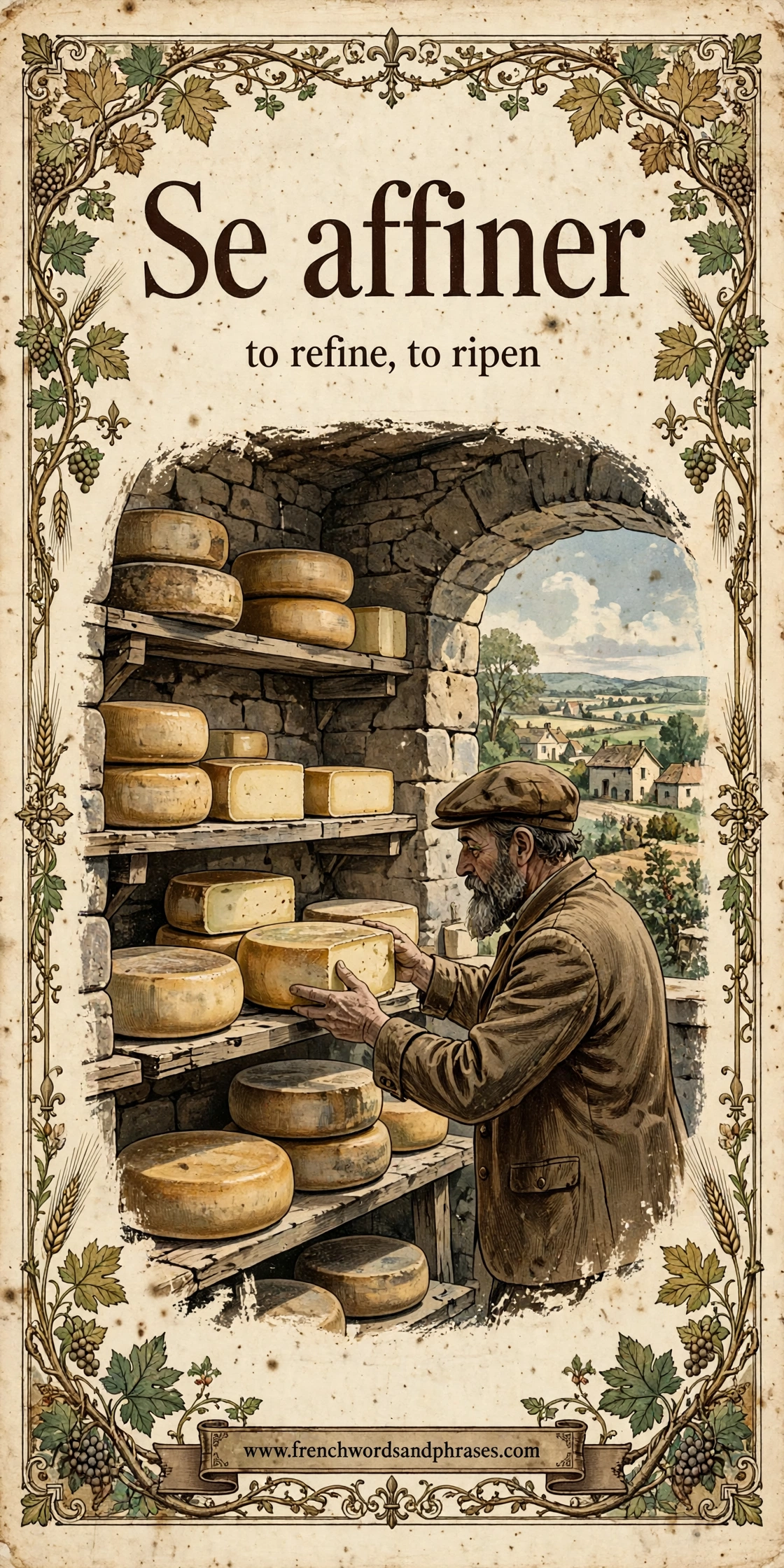
Se affiner means to refine, to ripen — to grow finer by itself with time, as a cheese ripens in the cellar and a palate sharpens with the years.
Rows of cheeses resting on wooden boards in a cool, dark cave, each one slowly becoming itself; a young taster whose palate sharpens vintage by vintage — se affiner is the verb of slow self-improvement: nothing is added, time does the work, and what was rough comes out fine.
In this guide, you’ll learn how to conjugate se affiner in all the major French tenses and moods. Explore complete conjugation tables, French examples, English translations, and practice quizzes.
Understanding the French Verb Se affiner
Se affiner is a regular French verb belonging to the first group of verbs, those ending in-er.
It means to refine, to ripen. It is commonly used of cheeses ripening under the affineur’s care, of wines and spirits mellowing, and figuratively of bodies growing slimmer and more elegant and of tastes, ears and judgements sharpening with experience. Nothing forces the change: se affiner is improvement at the speed of seasons, not of workshops.
Verb classification: First group (-er), reflexive
Auxiliary verb: Être
Past participle: affiné
Present participle: affinant
English equivalents: To refine itself, to ripen, to become finer; un fromage qui s’affine — a cheese that is ripening; la taille s’affine — the waist grows slimmer; le goût s’affine — the taste sharpens; l’affinage — the ripening of cheese.
One important detail: se affiner watches the thing itself grow finer, where its parent affiner needs a craftsman doing the refining. Its kingdom is the cheese cellar — l’affinage is the whole art of ripening cheese, and the specialist is l’affineur — but the verb also describes a silhouette slimming (sa taille s’affine) and senses sharpening (son palais s’affine). Being reflexive, it takes être in every compound tense and the participle agrees: le fromage s’est affiné, ses traits se sont affinés. The tu imperative tucks the pronoun behind the verb: affine-toi !
Experience the Word
Se affiner is the verb of becoming — the slow, quiet process by which time turns the coarse into the delicate.
Imagine a cave d’affinage in the mountains. On spruce boards, two hundred young cheeses rest in the cool dark. The affineur turns them, brushes them, salts them — but the real work is theirs: semaine après semaine, ils s’affinent, their rinds bloom, their paste softens, their flavour deepens from milk to mountain.
Nobody made them better. They have ripened — affinés, matured, become themselves.
How to Conjugate Se affiner: Complete French Conjugation Guide
Let’s explore every major conjugation of se affiner, beginning with the indicative mood.
How to Conjugate Se affiner in the Indicative Mood
The indicative mood is used to express facts, observations, actions, and events.
How to Conjugate Se affiner in the Present Tense (Présent)
Used for actions happening now, habitual actions, and general truths.
| Subject | Conjugation |
|---|---|
| je | m’affine |
| tu | t’affines |
| il / elle | s’affine |
| nous | nous affinons |
| vous | vous affinez |
| ils / elles | s’affinent |
Example
Ce fromage s’affine lentement dans la cave.
This cheese is ripening slowly in the cellar.
Quick Quiz 1
Complete the sentence:
Les fromages ______ dans la cave.
Reveal the answer
s’affinent
Les fromages s’affinent dans la cave.
The cheeses are ripening in the cellar.
How to Conjugate Se affiner in the Passé Composé
Used for completed actions in the past. Se affiner takes the auxiliary verb être.
| Subject | Conjugation |
|---|---|
| je | me suis affiné / me suis affinée |
| tu | t’es affiné / t’es affinée |
| il / elle | s’est affiné / s’est affinée |
| nous | nous sommes affinés / nous sommes affinées |
| vous | vous êtes affinés / vous êtes affinées / vous êtes affiné / vous êtes affinée |
| ils / elles | se sont affinés / se sont affinées |
Example
Son goût s’est affiné avec les années.
His taste has sharpened with the years.
How to Conjugate Se affiner in the Imparfait (Imperfect Tense)
Used for habitual past actions, descriptions, and ongoing situations in the past.
| Subject | Conjugation |
|---|---|
| je | m’affinais |
| tu | t’affinais |
| il / elle | s’affinait |
| nous | nous affinions |
| vous | vous affiniez |
| ils / elles | s’affinaient |
Example
Les fromages s’affinaient sur des planches d’épicéa.
The cheeses would ripen on spruce boards.
Quick Quiz 2
Choose the correct form:
His taste has sharpened.
Son goût ______. (s’est affiné / a affiné)
Reveal the answer
s’est affiné
Son goût s’est affiné.
Se affiner is reflexive and takes être.
How to Conjugate Se affiner in the Plus-que-parfait
Used to describe an action that had already been completed before another past event.
| Subject | Conjugation |
|---|---|
| je | m’étais affiné / m’étais affinée |
| tu | t’étais affiné / t’étais affinée |
| il / elle | s’était affiné / s’était affinée |
| nous | nous étions affinés / nous étions affinées |
| vous | vous étiez affinés / vous étiez affinées / vous étiez affiné / vous étiez affinée |
| ils / elles | s’étaient affinés / s’étaient affinées |
Example
Sa taille s’était affinée depuis le printemps.
Her waist had grown slimmer since the spring.
How to Conjugate Se affiner in the Passé Simple
Primarily used in formal writing, literature, and historical narratives. It is rarely used in everyday conversation.
| Subject | Conjugation |
|---|---|
| je | m’affinai |
| tu | t’affinas |
| il / elle | s’affina |
| nous | nous affinâmes |
| vous | vous affinâtes |
| ils / elles | s’affinèrent |
Example
Le vin s’affina pendant dix ans dans les fûts.
The wine matured for ten years in the casks.
How to Conjugate Se affiner in the Passé Antérieur
A literary tense used to express an action completed immediately before another past action, generally in the passé simple.
| Subject | Conjugation |
|---|---|
| je | me fus affiné / me fus affinée |
| tu | te fus affiné / te fus affinée |
| il / elle | se fut affiné / se fut affinée |
| nous | nous fûmes affinés / nous fûmes affinées |
| vous | vous fûtes affinés / vous fûtes affinées / vous fûtes affiné / vous fûtes affinée |
| ils / elles | se furent affinés / se furent affinées |
Example
Quand le fromage se fut affiné, on le mit en vente.
When the cheese had ripened, it was put on sale.
How to Conjugate Se affiner in the Future Tense (Futur Simple)
Used to describe actions that will take place in the future.
| Subject | Conjugation |
|---|---|
| je | m’affinerai |
| tu | t’affineras |
| il / elle | s’affinera |
| nous | nous affinerons |
| vous | vous affinerez |
| ils / elles | s’affineront |
Example
Avec le temps, ton palais s’affinera.
With time, your palate will sharpen.
How to Conjugate Se affiner in the Futur Antérieur (Future Perfect)
Used for an action that will have been completed before a particular point in the future.
| Subject | Conjugation |
|---|---|
| je | me serai affiné / me serai affinée |
| tu | te seras affiné / te seras affinée |
| il / elle | se sera affiné / se sera affinée |
| nous | nous serons affinés / nous serons affinées |
| vous | vous serez affinés / vous serez affinées / vous serez affiné / vous serez affinée |
| ils / elles | se seront affinés / se seront affinées |
Example
À Noël, les fromages se seront affinés à point.
By Christmas, the cheeses will have ripened to perfection.
How to Conjugate Se affiner in the Near Future (Futur Proche)
Used to describe something that is going to happen soon. Formed with aller + infinitive.
| Subject | Conjugation |
|---|---|
| je | vais m’affiner |
| tu | vas t’affiner |
| il / elle | va s’affiner |
| nous | allons nous affiner |
| vous | allez vous affiner |
| ils / elles | vont s’affiner |
Example
Ce comté va encore s’affiner quelques mois.
This Comté is going to ripen for a few more months.
How to Conjugate Se affiner in the Conditional Mood
The conditional mood expresses what would happen under certain circumstances. It is also frequently used to make polite requests or express wishes.
How to Conjugate Se affiner in the Present Conditional
| Subject | Conjugation |
|---|---|
| je | m’affinerais |
| tu | t’affinerais |
| il / elle | s’affinerait |
| nous | nous affinerions |
| vous | vous affineriez |
| ils / elles | s’affineraient |
Example
Sans humidité, le fromage ne s’affinerait pas.
Without humidity, the cheese would not ripen.
How to Conjugate Se affiner in the Past Conditional
| Subject | Conjugation |
|---|---|
| je | me serais affiné / me serais affinée |
| tu | te serais affiné / te serais affinée |
| il / elle | se serait affiné / se serait affinée |
| nous | nous serions affinés / nous serions affinées |
| vous | vous seriez affinés / vous seriez affinées / vous seriez affiné / vous seriez affinée |
| ils / elles | se seraient affinés / se seraient affinées |
Example
Son style se serait affiné avec plus de pratique.
His style would have grown finer with more practice.
Se affiner in the Literary Past Conditional Form
This less common literary form uses the imperfect subjunctive of être.
| Subject | Conjugation |
|---|---|
| je | me fusse affiné / me fusse affinée |
| tu | te fusses affiné / te fusses affinée |
| il / elle | se fût affiné / se fût affinée |
| nous | nous fussions affinés / nous fussions affinées |
| vous | vous fussiez affinés / vous fussiez affinées / vous fussiez affiné / vous fussiez affinée |
| ils / elles | se fussent affinés / se fussent affinées |
Example
Le vin se fût affiné davantage dans une meilleure cave.
The wine would have matured further in a better cellar.
How to Conjugate Se affiner in the Subjunctive Mood
The subjunctive is used to express wishes, emotions, doubts, necessity, and uncertainty. It frequently follows expressions such as il faut que (it is necessary that) or bien que (although).
How to Conjugate Se affiner in the Present Subjunctive
| Subject | Conjugation |
|---|---|
| que je | m’affine |
| que tu | t’affines |
| qu’il / qu’elle | s’affine |
| que nous | nous affinions |
| que vous | vous affiniez |
| qu’ils / qu’elles | s’affinent |
Example
Il faut que le fromage s’affine encore un mois.
The cheese must ripen for another month.
Quick Quiz 3
Complete the sentence using the subjunctive:
Il faut que ce vin ______ encore un an.
Reveal the answer
s’affine
Il faut que ce vin s’affine encore un an.
This wine must mature for another year.
How to Conjugate Se affiner in the Imperfect Subjunctive
A literary tense, rarely encountered in modern spoken French.
| Subject | Conjugation |
|---|---|
| que je | m’affinasse |
| que tu | t’affinasses |
| qu’il / qu’elle | s’affinât |
| que nous | nous affinassions |
| que vous | vous affinassiez |
| qu’ils / qu’elles | s’affinassent |
Example
On attendait que les fromages s’affinassent lentement.
They waited for the cheeses to ripen slowly.
How to Conjugate Se affiner in the Pluperfect Subjunctive
A literary construction used to express an action completed before another past action.
| Subject | Conjugation |
|---|---|
| que je | me fusse affiné / me fusse affinée |
| que tu | te fusses affiné / te fusses affinée |
| qu’il / qu’elle | se fût affiné / se fût affinée |
| que nous | nous fussions affinés / nous fussions affinées |
| que vous | vous fussiez affinés / vous fussiez affinées / vous fussiez affiné / vous fussiez affinée |
| qu’ils / qu’elles | se fussent affinés / se fussent affinées |
Example
On racontait que son goût se fût affiné en Italie.
People said his taste had been refined in Italy.
How to Conjugate Se affiner in the Past Subjunctive
| Subject | Conjugation |
|---|---|
| que je | me sois affiné / me sois affinée |
| que tu | te sois affiné / te sois affinée |
| qu’il / qu’elle | se soit affiné / se soit affinée |
| que nous | nous soyons affinés / nous soyons affinées |
| que vous | vous soyez affinés / vous soyez affinées / vous soyez affiné / vous soyez affinée |
| qu’ils / qu’elles | se soient affinés / se soient affinées |
Example
Je suis ravi que ton oreille se soit affinée.
I am delighted your ear has sharpened.
How to Conjugate Se affiner in the Imperative
The imperative is used to give commands, instructions, invitations, or suggestions. Subject pronouns are omitted.
How to Conjugate Se affiner in the Present Imperative
| Person | Conjugation |
|---|---|
| (tu) | affine-toi |
| (nous) | affinons-nous |
| (vous) | affinez-vous |
Example
Affine-toi au contact des grands vins !
Refine yourself in the company of great wines!
Quick Quiz 4
How would you say Refine yourself in the company of great wines (tu form)?
Reveal the answer
Affine-toi au contact des grands vins !
French Participles of Se affiner
Participles are verb forms that can be used in compound tenses and other grammatical constructions.
Present Participle of Se affiner
affinant
En s’affinant, le fromage développe ses arômes.
As it ripens, the cheese develops its aromas.
Past Participle of Se affiner
affiné
Affinés dix-huit mois, ces comtés sont exceptionnels.
Ripened for eighteen months, these Comtés are exceptional.
Se affiner in Everyday French: Real-Life Examples
Now that you know the conjugations, let’s see how se affiner appears in everyday French.
Example 1 — Present
Le fromage s’affine dans la cave.
The cheese is ripening in the cellar.
Example 2 — Passé composé
Son goût s’est affiné avec les années.
His taste has sharpened with the years.
Example 3 — Imparfait
Les fromages s’affinaient sur des planches.
The cheeses would ripen on boards.
Example 4 — Future
Ton palais s’affinera avec le temps.
Your palate will sharpen with time.
Example 5 — Conditional
Le fromage ne s’affinerait pas sans humidité.
The cheese would not ripen without humidity.
Example 6 — Imperative
Affine-toi au contact des grands vins !
Refine yourself in the company of great wines!
Beyond Translation: The Meaning of Se affiner
English ripen covers the cheese, but French se affiner covers the whole journey from coarse to fine — cheese, wine, waistlines and taste alike.
L’affinage is a French institution.
The affineur, who ripens cheeses made by other hands, holds an official title of honour in France — proof that this small reflexive verb names a national art: knowing how to wait, and what waiting creates.
How to Remember the French Verb Se affiner
Remember it this way: Se affiner is about cheeses on spruce boards, ripening in the dark.
- The cheese-cellar verb: un fromage s’affine, and the art of it is l’affinage.
- The thing improves by itself: son goût s’affine, sa taille s’affine — no craftsman needed.
- Always reflexive: être in compound tenses, participle agreeing — le fromage s’est affiné.
The key idea is cheeses on spruce boards, ripening in the dark.
Test Your Knowledge of Se affiner
Let’s see how much you’ve learned. Try answering these questions before revealing the answers.
Question 1
What is l’affinage?
Reveal the answer
The ripening of cheese — the art and period during which a cheese s’affine in the cellar, watched over by the affineur.
Question 2
How do you say This cheese is ripening slowly in the cellar in French?
Reveal the answer
Ce fromage s’affine lentement dans la cave.
Question 3
Translate: His taste has sharpened with the years.
Reveal the answer
Son goût s’est affiné avec les années.
Question 4
What is the past participle of se affiner, and how does it agree?
Reveal the answer
Affiné — agreeing with the subject: affinée, affinés, affinées.
Question 5
Complete the sentence:
Il faut que le fromage ______ encore un mois.
Reveal the answer
s’affine
Il faut que le fromage s’affine encore un mois.
The cheese must ripen for another month.
Your Final Challenge
Can You Use It?
How would you say this in French?
The cheese ripens in the silence of the cellar, and time becomes an ingredient.
Reveal the answer
Le fromage s’affine dans le silence de la cave, et le temps devient un ingrédient.
The cheese ripens in the silence of the cellar, and time becomes an ingredient.
A little French. A little curiosity. A richer everyday life.
LEARN FRENCH ONE WORD AT A TIME