A French Word to Live By
How to Conjugate Affiner in French
/a.fi.ne/
Affiner means to refine, to improve — to take something good and make it finer: purer metal, sharper taste, better work.
A goldsmith drawing impurities out of molten metal, a cellist polishing one phrase for the hundredth time, a cook tasting and adjusting — affiner is the verb of patient improvement: nothing new is created, everything present is made finer.
In this guide, you’ll learn how to conjugate affiner in all the major French tenses and moods. Explore complete conjugation tables, French examples, English translations, and practice quizzes.
Understanding the French Verb Affiner
Affiner is a regular French verb belonging to the first group of verbs, those ending in-er.
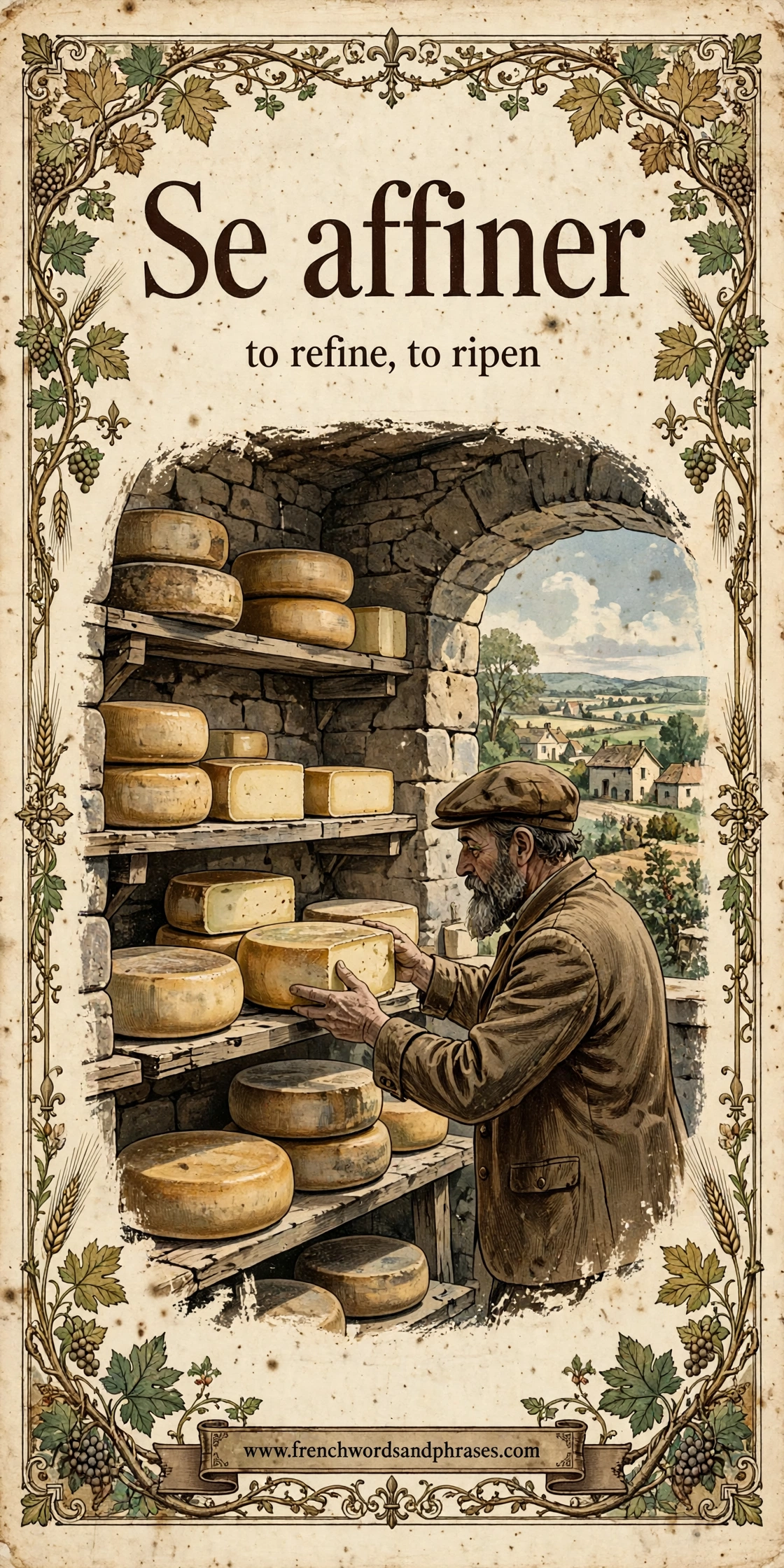
It means to refine, to improve. It is commonly used in metallurgy and food for purifying gold, silver, sugar and spirits, and everywhere else for the slow perfecting of skills and senses: affiner son oreille, affiner son jugement, affiner une recette. Its reflexive twin se affiner follows the thing itself as it grows finer — above all, cheese ripening in the cellar.
Verb classification: First group (-er)
Auxiliary verb: Avoir
Past participle: affiné
Present participle: affinant
English equivalents: To refine, to improve, to perfect; affiner un métal — to refine a metal; affiner le sucre — to refine sugar; affiner son style — to refine one’s style; affiner une technique — to perfect a technique; affiner son goût — to refine one’s taste.
One important detail: affiner is the craftsman of the pair fin / affiner — to make fin, fine. Its work is always improvement of something that already exists: one affine un métal, un style, un goût, une méthode. Do not confuse it with raffiner, which refines oil and sugar on the industrial scale (une raffinerie) and also means to be over-subtle; affiner keeps the human scale of the workshop and the kitchen. The verb is perfectly regular: j’affine, nous affinons, ils affinent.
Experience the Word
Affiner is the verb of the second draft of everything — the patient pass that turns the rough into the fine.
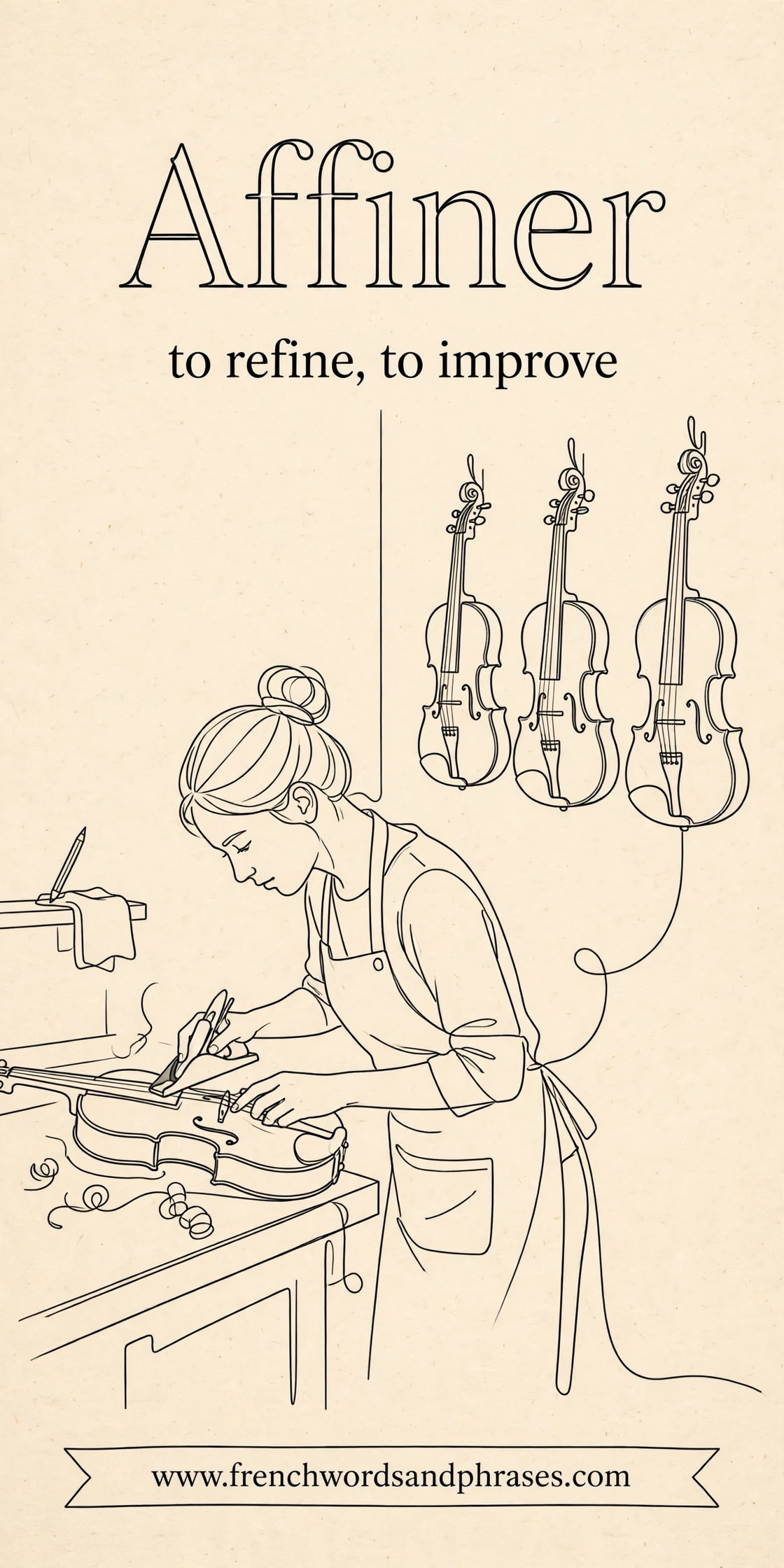
Imagine a young violin maker with a finished instrument on the bench. It plays; it is good; it is not yet right. For three days he affine — a shaving of varnish here, a hair’s breadth off the bridge there — until one morning the note blooms like a struck bell and he puts his tools down.
He has made nothing new. He has refined — affiné, improved, coaxed the good into the excellent.
How to Conjugate Affiner: Complete French Conjugation Guide
Let’s explore every major conjugation of affiner, beginning with the indicative mood.
How to Conjugate Affiner in the Indicative Mood
The indicative mood is used to express facts, observations, actions, and events.
How to Conjugate Affiner in the Present Tense (Présent)
Used for actions happening now, habitual actions, and general truths.
| Subject | Conjugation |
|---|---|
| je | affine |
| tu | affines |
| il / elle | affine |
| nous | affinons |
| vous | affinez |
| ils / elles | affinent |
Example
Le joaillier affine l’or avant de le travailler.
The jeweller refines the gold before working it.
Quick Quiz 1
Complete the sentence:
Nous ______ notre technique chaque semaine.
Reveal the answer
affinons
Nous affinons notre technique chaque semaine.
We refine our technique every week.
How to Conjugate Affiner in the Passé Composé
Used for completed actions in the past. Affiner takes the auxiliary verb avoir.
| Subject | Conjugation |
|---|---|
| j’ | ai affiné |
| tu | as affiné |
| il / elle | a affiné |
| nous | avons affiné |
| vous | avez affiné |
| ils / elles | ont affiné |
Example
Elle a affiné sa technique pendant des années.
She refined her technique over the years.
How to Conjugate Affiner in the Imparfait (Imperfect Tense)
Used for habitual past actions, descriptions, and ongoing situations in the past.
| Subject | Conjugation |
|---|---|
| je | affinais |
| tu | affinais |
| il / elle | affinait |
| nous | affinions |
| vous | affiniez |
| ils / elles | affinaient |
Example
Le maître affinait chaque phrase de la sonate.
The master would polish every phrase of the sonata.
Quick Quiz 2
Choose the correct form:
They perfected the recipe.
Ils ______ la recette. (ont affiné / sont affinés)
Reveal the answer
ont affiné
Ils ont affiné la recette.
Affiner takes avoir.
How to Conjugate Affiner in the Plus-que-parfait
Used to describe an action that had already been completed before another past event.
| Subject | Conjugation |
|---|---|
| j’ | avais affiné |
| tu | avais affiné |
| il / elle | avait affiné |
| nous | avions affiné |
| vous | aviez affiné |
| ils / elles | avaient affiné |
Example
Ils avaient affiné la recette au fil des générations.
They had perfected the recipe over the generations.
How to Conjugate Affiner in the Passé Simple
Primarily used in formal writing, literature, and historical narratives. It is rarely used in everyday conversation.
| Subject | Conjugation |
|---|---|
| je | affinai |
| tu | affinas |
| il / elle | affina |
| nous | affinâmes |
| vous | affinâtes |
| ils / elles | affinèrent |
Example
L’atelier affina le métal jusqu’à le rendre pur.
The workshop refined the metal until it was pure.
How to Conjugate Affiner in the Passé Antérieur
A literary tense used to express an action completed immediately before another past action, generally in the passé simple.
| Subject | Conjugation |
|---|---|
| j’ | eus affiné |
| tu | eus affiné |
| il / elle | eut affiné |
| nous | eûmes affiné |
| vous | eûtes affiné |
| ils / elles | eurent affiné |
Example
Quand elle eut affiné son jeu, elle enregistra le disque.
When she had perfected her playing, she recorded the disc.
How to Conjugate Affiner in the Future Tense (Futur Simple)
Used to describe actions that will take place in the future.
| Subject | Conjugation |
|---|---|
| je | affinerai |
| tu | affineras |
| il / elle | affinera |
| nous | affinerons |
| vous | affinerez |
| ils / elles | affineront |
Example
Avec le temps, tu affineras ton goût.
With time, you will refine your taste.
How to Conjugate Affiner in the Futur Antérieur (Future Perfect)
Used for an action that will have been completed before a particular point in the future.
| Subject | Conjugation |
|---|---|
| j’ | aurai affiné |
| tu | auras affiné |
| il / elle | aura affiné |
| nous | aurons affiné |
| vous | aurez affiné |
| ils / elles | auront affiné |
Example
À la fin du stage, ils auront affiné leur technique.
By the end of the course, they will have refined their technique.
How to Conjugate Affiner in the Near Future (Futur Proche)
Used to describe something that is going to happen soon. Formed with aller + infinitive.
| Subject | Conjugation |
|---|---|
| je | vais affiner |
| tu | vas affiner |
| il / elle | va affiner |
| nous | allons affiner |
| vous | allez affiner |
| ils / elles | vont affiner |
Example
Ce soir, nous allons affiner les derniers détails.
This evening, we are going to polish the final details.
How to Conjugate Affiner in the Conditional Mood
The conditional mood expresses what would happen under certain circumstances. It is also frequently used to make polite requests or express wishes.
How to Conjugate Affiner in the Present Conditional
| Subject | Conjugation |
|---|---|
| je | affinerais |
| tu | affinerais |
| il / elle | affinerait |
| nous | affinerions |
| vous | affineriez |
| ils / elles | affineraient |
Example
Un bon professeur affinerait l’oreille de ses élèves.
A good teacher would refine his pupils’ ear.
How to Conjugate Affiner in the Past Conditional
| Subject | Conjugation |
|---|---|
| j’ | aurais affiné |
| tu | aurais affiné |
| il / elle | aurait affiné |
| nous | aurions affiné |
| vous | auriez affiné |
| ils / elles | auraient affiné |
Example
Elle aurait affiné son style avec plus de lectures.
She would have refined her style with more reading.
Affiner in the Literary Past Conditional Form
This less common literary form uses the imperfect subjunctive of avoir.
| Subject | Conjugation |
|---|---|
| j’ | eusse affiné |
| tu | eusses affiné |
| il / elle | eût affiné |
| nous | eussions affiné |
| vous | eussiez affiné |
| ils / elles | eussent affiné |
Example
Le maître eût affiné l’ouvrage avant de le signer.
The master would have perfected the work before signing it.
How to Conjugate Affiner in the Subjunctive Mood
The subjunctive is used to express wishes, emotions, doubts, necessity, and uncertainty. It frequently follows expressions such as il faut que (it is necessary that) or bien que (although).
How to Conjugate Affiner in the Present Subjunctive
| Subject | Conjugation |
|---|---|
| que je | affine |
| que tu | affines |
| qu’il / qu’elle | affine |
| que nous | affinions |
| que vous | affiniez |
| qu’ils / qu’elles | affinent |
Example
Il faut que tu affines ce passage avant le concert.
You must polish this passage before the concert.
Quick Quiz 3
Complete the sentence using the subjunctive:
Il faut que vous ______ votre jeu avant le concert.
Reveal the answer
affiniez
Il faut que vous affiniez votre jeu avant le concert.
You must refine your playing before the concert.
How to Conjugate Affiner in the Imperfect Subjunctive
A literary tense, rarely encountered in modern spoken French.
| Subject | Conjugation |
|---|---|
| que je | affinasse |
| que tu | affinasses |
| qu’il / qu’elle | affinât |
| que nous | affinassions |
| que vous | affinassiez |
| qu’ils / qu’elles | affinassent |
Example
On demandait qu’il affinât le métal une seconde fois.
They asked him to refine the metal a second time.
How to Conjugate Affiner in the Pluperfect Subjunctive
A literary construction used to express an action completed before another past action.
| Subject | Conjugation |
|---|---|
| que j’ | eusse affiné |
| que tu | eusses affiné |
| qu’il / qu’elle | eût affiné |
| que nous | eussions affiné |
| que vous | eussiez affiné |
| qu’ils / qu’elles | eussent affiné |
Example
On admirait qu’elle eût affiné son art à ce point.
People admired that she had refined her art to this degree.
How to Conjugate Affiner in the Past Subjunctive
| Subject | Conjugation |
|---|---|
| que j’ | aie affiné |
| que tu | aies affiné |
| qu’il / qu’elle | ait affiné |
| que nous | ayons affiné |
| que vous | ayez affiné |
| qu’ils / elles | aient affiné |
Example
Je suis heureux qu’ils aient affiné la recette.
I am happy they perfected the recipe.
How to Conjugate Affiner in the Imperative
The imperative is used to give commands, instructions, invitations, or suggestions. Subject pronouns are omitted.
How to Conjugate Affiner in the Present Imperative
| Person | Conjugation |
|---|---|
| (tu) | affine |
| (nous) | affinons |
| (vous) | affinez |
Example
Affine ton jeu, écoute chaque note !
Refine your playing, listen to every note!
Quick Quiz 4
How would you say Polish the final details (tu form)?
Reveal the answer
Affine les derniers détails !
French Participles of Affiner
Participles are verb forms that can be used in compound tenses and other grammatical constructions.
Present Participle of Affiner
affinant
En affinant son style, l’écrivain a trouvé sa voix.
By refining his style, the writer found his voice.
Past Participle of Affiner
affiné
Affiné par des années de pratique, son goût ne le trompe plus.
Refined by years of practice, his taste no longer deceives him.
Affiner in Everyday French: Real-Life Examples
Now that you know the conjugations, let’s see how affiner appears in everyday French.
Example 1 — Present
Le joaillier affine l’or.
The jeweller refines the gold.
Example 2 — Passé composé
Elle a affiné sa technique.
She refined her technique.
Example 3 — Imparfait
Le maître affinait chaque phrase.
The master would polish every phrase.
Example 4 — Future
Tu affineras ton goût avec le temps.
You will refine your taste with time.
Example 5 — Conditional
Un bon professeur affinerait ton oreille.
A good teacher would refine your ear.
Example 6 — Imperative
Affine les derniers détails !
Polish the final details!
Beyond Translation: The Meaning of Affiner
English refine and French affiner are cousins — both grow out of fin, fine, the end-point of purity.
Affiner is improvement without replacement.
The metal stays metal, the musician stays the same musician; what changes is the fineness. French even keeps the idea in the cheese cellar, where the affineur is the specialist who ripens cheeses to perfection — refining you can eat.
How to Remember the French Verb Affiner
Remember it this way: Affiner is about the goldsmith and the violin maker, polishing the good into the excellent.
- Affiner = to make fin: finer metal, finer taste, finer work — improvement, never replacement.
- Its workshop partners: affiner un métal, son style, son goût, une technique.
- Regular -er: j’affine, nous affinons, past participle affiné.
The key idea is the goldsmith and the violin maker, polishing the good into the excellent.
Test Your Knowledge of Affiner
Let’s see how much you’ve learned. Try answering these questions before revealing the answers.
Question 1
What single idea stands behind every use of affiner?
Reveal the answer
Making finer — from fin: purer metal, sharper taste, better technique, without replacing the thing itself.
Question 2
How do you say She refined her technique over the years in French?
Reveal the answer
Elle a affiné sa technique pendant des années.
Question 3
Translate: The jeweller refines the gold before working it.
Reveal the answer
Le joaillier affine l’or avant de le travailler.
Question 4
What is the past participle of affiner?
Reveal the answer
Affiné.
Question 5
Complete the sentence:
Il faut que tu ______ ce passage avant le concert.
Reveal the answer
affines
Il faut que tu affines ce passage avant le concert.
You must polish this passage before the concert.
Your Final Challenge
Can You Use It?
How would you say this in French?
Refining takes time: it is the opposite of haste, and the secret of beautiful things.
Reveal the answer
Affiner demande du temps : c’est le contraire de la hâte, et le secret des belles choses.
Refining takes time: it is the opposite of haste, and the secret of beautiful things.
A little French. A little curiosity. A richer everyday life.
LEARN FRENCH ONE WORD AT A TIME