A French Word to Live By
Translate Blanc to English
/blɑ̃/
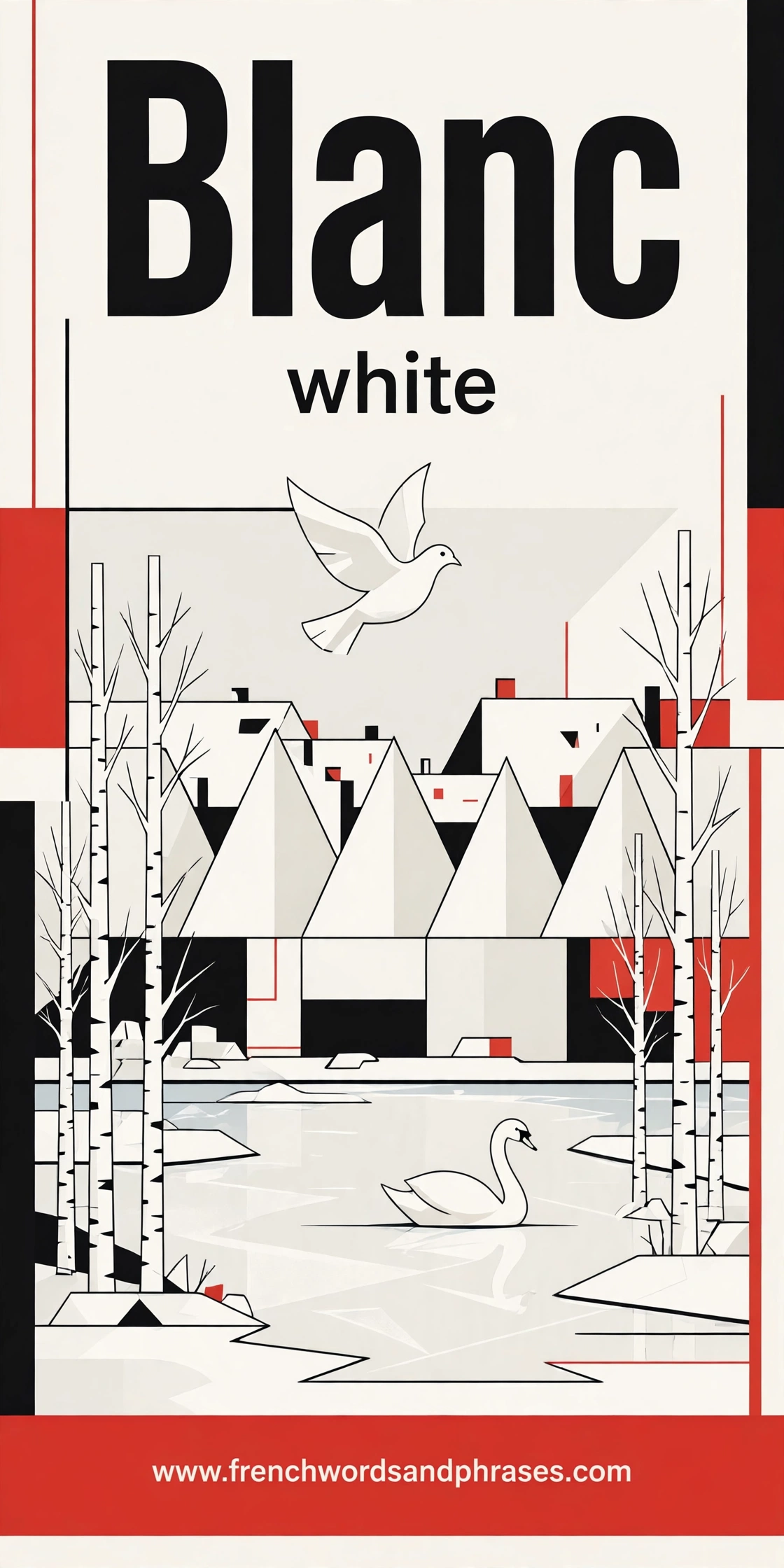
Blanc means white.
A January morning in a mountain village: the roofs, the pine trees, the little road to the bakery — everything has vanished under the same soft blanket, and the first footprints of the day are being written in it like ink on a page. French looks at that colour, the colour of snow and milk and fresh paper, and calls it blanc.
In this guide, you’ll learn what blanc means in English, why its feminine is blanche and not what you would guess, where it stands in the sentence, and how French uses it for everything from weddings to sleepless nights. Explore French examples, English translations, and practice quizzes.
Understanding the French Adjective Blanc
Blanc is a French colour adjective — the colour of snow, milk and fresh linen. It agrees with the noun it describes, but its feminine is irregular: blanc becomes blanche. The four forms are blanc, blanche, blancs, blanches. Like most colour adjectives, it stands after the noun.
It means white. It describes things (une chemise blanche, a white shirt), places (une plage de sable blanc, a white-sand beach) and light itself (une lumière blanche, a white light). Beyond colour, French uses blanc for anything blank, empty or untouched: une page blanche is a blank page, and un examen blanc is a mock exam.
Type: Colour adjective
Answers the question: What colour is it? — white
Changes form: Yes — blanc / blanche / blancs / blanches; the feminine blanche is irregular
English equivalents: White.
One important usage detail: the feminine of blanc is blanche — never ‘blance’. The c becomes ch before the e: blanc, blanche. Blanc stands AFTER the noun — une maison blanche, un mur blanc — and compound shades like blanc cassé (off-white) do not agree at all.
Experience the Word
Blanc is the adjective of first snow and clean sheets — the colour French reaches for when something is new, pure or simply empty, waiting to be filled.
Imagine a painter standing before a canvas she has prepared for weeks, gessoed and sanded until it glows. Everything she will ever put on it is still possible, because at this moment it is perfectly, hopefully blanc.
You have not just named a colour. You have named the colour of beginnings.
How to Use Blanc in French: Complete Guide
Let’s explore how blanc works in French, beginning with the whole word on one card.
Blanc at a Glance
Before the details, here is the whole word on one card.
The Whole Word on One Card
Meaning, type, position and forms — blanc in four lines.
| Point | Blanc |
|---|---|
| Meaning | white |
| Type | colour adjective |
| Usual position | after the noun — une chemise blanche |
| Form | blanc / blanche / blancs / blanches |
Example
Elle porte une chemise blanche.
She is wearing a white shirt.
The Four Forms of Blanc
Blanc agrees with the noun it describes — and its feminine is the famous irregular one: blanc becomes blanche, with a ch where the c used to be.
| Form | Blanc | Example |
|---|---|---|
| Masculine singular | blanc | un mur blanc — a white wall |
| Feminine singular | blanche | une maison blanche — a white house |
| Masculine plural | blancs | des murs blancs — white walls |
| Feminine plural | blanches | des maisons blanches — white houses |
Example
Le mur est blanc et la porte est blanche.
The wall is white and the door is white.
Quick Quiz 1
What is the feminine of blanc?
Reveal the answer
blanche
Une maison blanche.
A white house.
Blanche: The Feminine Changes the C to CH
Most adjectives simply add an e for the feminine. Blanc does something older and more interesting: its c softens into ch, giving blanche — and the sound changes too, from /blɑ̃/ to /blɑ̃ʃ/.
| Situation | Example |
|---|---|
| The rule | blanc → blanche — the c becomes ch before the e |
| The sound | blanc /blɑ̃/ but blanche /blɑ̃ʃ/ — the end is pronounced |
| Masculine plural | blancs — des draps blancs, white sheets |
| Feminine plural | blanches — des pages blanches, blank pages |
Example
Elle a les cheveux blancs et une robe blanche.
She has white hair and a white dress.
Where Blanc Goes: After the Noun
Colour adjectives follow the noun in French, and blanc is no exception. It also lives happily after être, and shade words like cassé or crème can follow it.
| Pattern | Example |
|---|---|
| After the noun | une chemise blanche — a white shirt |
| After être | la neige est blanche — the snow is white |
| With a shade | un blanc cassé — an off-white |
| Before the noun | une blanche chemise — poetic only, not everyday French |
Example
La neige est blanche ce matin.
The snow is white this morning.
Quick Quiz 2
How do you say ‘a white house’ — une blanche maison or une maison blanche?
Reveal the answer
une maison blanche
Colour adjectives stand after the noun, and blanc becomes blanche.
A white house.
Whiter: Comparing with Blanc
Blanc compares the regular way, with plus, moins and aussi — and the superlative agrees as usual: le plus blanc, la plus blanche.
| Degree | Example |
|---|---|
| As white as | aussi blanc que — blanc comme neige, white as snow |
| More white | plus blanc — plus blanc que le lait |
| Less white | moins blanc — moins blanc qu’avant |
| The whitest (masc.) | le plus blanc — le plus blanc des sommets |
| The whitest (fem.) | la plus blanche — la plus blanche des plages |
Example
Ce sommet est plus blanc que l’autre.
This peak is whiter than the other one.
Everyday Expressions with Blanc
Blanc works far beyond colour: French uses it for blank pages, sleepless nights and weddings that exist only on paper.
| Expression | In English |
|---|---|
| une page blanche | a blank page |
| une nuit blanche | a sleepless night |
| un examen blanc | a mock exam, a practice test |
| un mariage blanc | a sham marriage, a marriage of convenience |
| le blanc de l’œuf | the white of the egg |
| à blanc | heated to white heat; also ‘blank’ for a cartridge (à blanc) |
Example
J’ai passé une nuit blanche avant l’examen.
I had a sleepless night before the exam.
Quick Quiz 3
What does une nuit blanche mean?
Reveal the answer
A sleepless night
Elle a passé une nuit blanche.
She had a sleepless night.
Blanc and Its Neighbours
Around blanc gather the pale shades of French — and noir, its eternal opposite, at the far end of the scale.
| French | In English |
|---|---|
| blanc cassé | off-white, broken white |
| crème | cream — a warm near-white |
| ivoire | ivory |
| pâle | pale — of any colour, or of a face |
| clair | light, pale — le bleu clair, light blue |
| noir | black — the opposite |
Example
Elle préfère le blanc cassé au blanc pur.
She prefers off-white to pure white.
Watch Out: The Traps Around Blanc
The traps here are the feminine that isn’t ‘blance’, and the compound shades that refuse to agree.
| Trap | The truth |
|---|---|
| The feminine | blanche, never ‘blance’ — the c becomes ch |
| Compound shades | blanc cassé never changes — des murs blanc cassé |
| un blanc | as a noun, un blanc is a blank space or a white (of an egg, of wine) |
| Hair | white hair is les cheveux blancs — French says ‘white’, not ‘grey’, for a full head |
Example
Laisse un blanc entre les deux paragraphes.
Leave a blank space between the two paragraphs.
Quick Quiz 4
How do you say ‘white walls’ (masculine plural)?
Reveal the answer
des murs blancs
The masculine plural just adds an s.
White walls.
Blanc in Everyday French: Real-Life Examples
Now that you know the word, let’s see how blanc appears in everyday French.
Example 1 — At home
Nous avons peint le salon en blanc.
We painted the living room white.
Example 2 — Clothes
Elle porte une robe blanche pour la fête.
She is wearing a white dress for the party.
Example 3 — Winter
Les toits sont blancs ce matin, il a neigé.
The roofs are white this morning, it has snowed.
Example 4 — At school
Le professeur écrit sur le tableau blanc.
The teacher writes on the whiteboard.
Example 5 — Cooking
Sépare le blanc du jaune de l’œuf.
Separate the white from the yolk of the egg.
Example 6 — Paper
Donne-moi une feuille blanche, s’il te plaît.
Give me a blank sheet of paper, please.
Beyond Translation: The Meaning of Blanc
English says white for the meaning of blanc — but French lets the word wander much further from colour than English does: a page can be blanche when it is simply empty, a night can be blanche when nobody slept, and a marriage can be blanc when it exists only for the paperwork.
In French, blanc is the colour of everything untouched, unwritten and undone.
And its feminine keeps a small fossil of history: the ch of blanche is the sound the c made a thousand years ago, preserved every time someone describes a white house.
How to Remember the French Adjective Blanc
Remember it this way: Blanc is the snow-white adjective — after the noun, with a famous feminine where the c turns into ch.
- You change the c to ch for a woman or a feminine thing — une maison blanche.
- You keep it simple for men and masculine things — un mur blanc, des murs blancs.
- You let it mean ‘blank’ too — une page blanche, une nuit blanche.
The key idea is blanc becomes blanche in the feminine — the c turns into ch.
Test Your Knowledge of Blanc
Let’s see how much you’ve learned. Try answering these questions before revealing the answers.
Question 1
What does blanc mean?
Reveal the answer
White — the colour of snow and milk.
Question 2
What is the feminine of blanc?
Reveal the answer
blanche — the c becomes ch: blanc, blanche.
Question 3
Translate: a white shirt (chemise is feminine).
Reveal the answer
Une chemise blanche.
Question 4
Complete the sentence:
La neige est ______ .
Reveal the answer
blanche
La neige est blanche.
The snow is white.
Question 5
What does ‘une nuit blanche’ mean?
Reveal the answer
A sleepless night — a night spent awake.
Your Final Challenge
Can You Use It?
How would you say this in French?
“The house is white and the door is white too.”
Reveal the answer
La maison est blanche et la porte est blanche aussi.
The house is white and the door is white too.
A little French. A little curiosity. A richer everyday life.
LEARN FRENCH ONE WORD AT A TIME