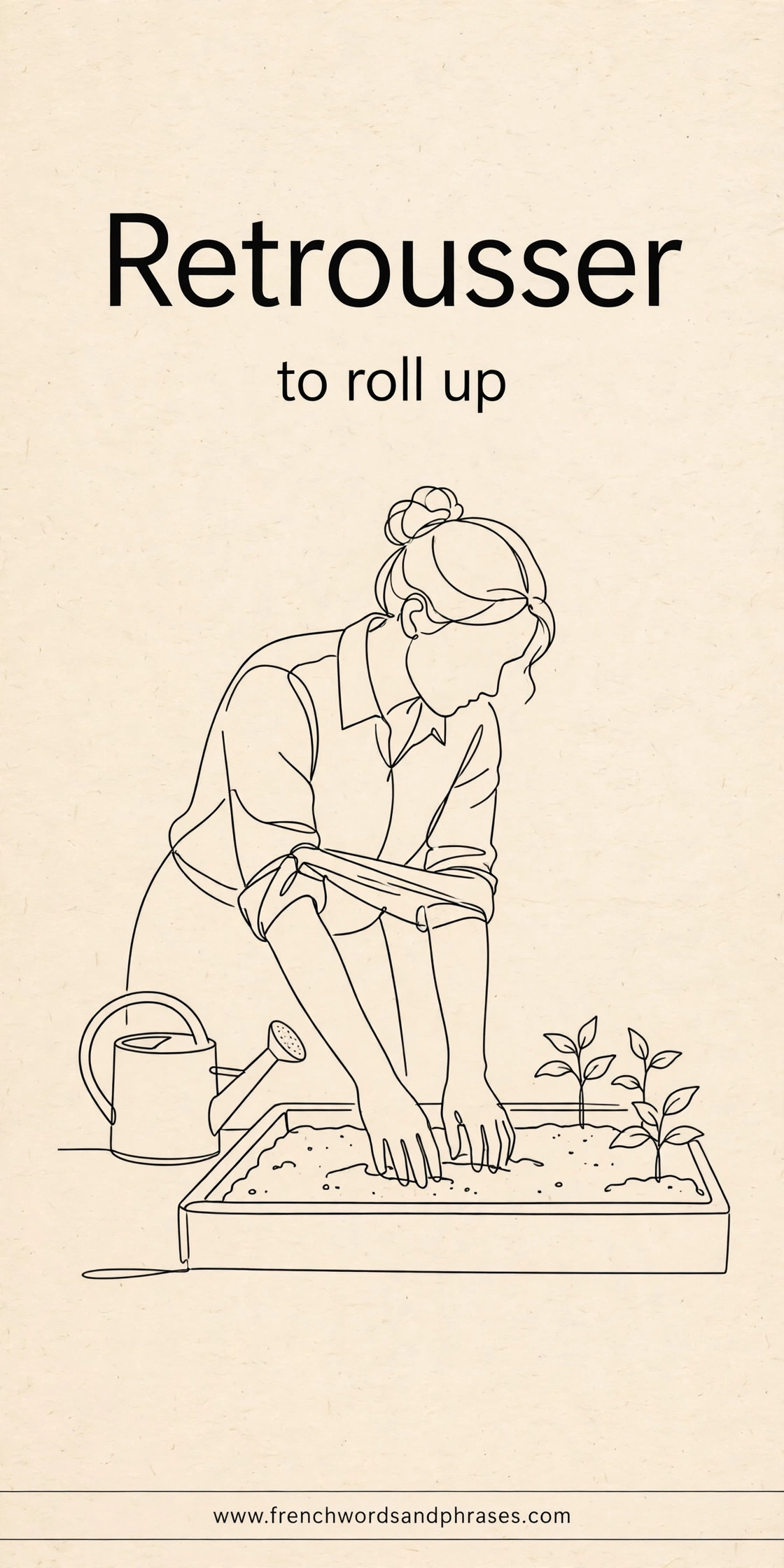
A French Word to Live By
How to Conjugate Retourner in French
/ʁə.tuʁ.ne/
Retourner means to turn over; to go back — to flip a thing onto its other side, or to travel back to the place you came from.
A cook flipping a crêpe with one flick of the wrist, a gardener turning dark soil to the light, a traveller at the station window asking for the train home — retourner lives two lives at once: it turns things over, and it takes people back.
In this guide, you’ll learn how to conjugate retourner in all the major French tenses and moods. Explore complete conjugation tables, French examples, English translations, and practice quizzes.
Understanding the French Verb Retourner
Retourner is a regular French verb belonging to the first group of verbs, those ending in-er.
It means to turn over; to go back. The two lives meet in a family of vivid phrases: retourner sa veste is to change sides overnight, retourner une situation is to turn a situation around, and cela me retourne l’estomac is it turns my stomach. The noun un retour is the return journey — the ticket home.
Verb classification: First group (-er)
Auxiliary verb: Avoir
Past participle: retourné
Present participle: retournant
English equivalents: To turn over, to turn back, to return, to go back; retourner une crêpe — to flip a pancake; retourner la terre — to turn over the soil; retourner à Paris — to go back to Paris; retourner sur ses pas — to retrace one’s steps; retourner sa veste — to change sides, to turn one’s coat.
One important detail: retourner changes its auxiliary with its meaning. Transitive — turning something over — it takes avoir: j’ai retourné le matelas. Intransitive — going back somewhere — it takes être, like all verbs of coming and going: elle est retournée au village, ils sont retournés à Paris, and the participle agrees. Ask yourself what is moving: a thing being flipped (avoir), or a person travelling back (être).
Experience the Word
Retourner is the verb of the other side — of the crêpe, of the soil, and of the road home.
Imagine a Breton crêperie at the height of summer. The cook’s wrist never rests: flick, catch, flick, catch — elle retourne les crêpes one after another, each landing golden-side up. And at the corner table sits a sailor home after ten years at sea, watching her, thinking that he too has retourné — back to the very port he swore he would never see again.
The crêpe shows its other side; the sailor shows his face at home. Both have turned — retourné — each in their own direction.
How to Conjugate Retourner: Complete French Conjugation Guide
Let’s explore every major conjugation of retourner, beginning with the indicative mood.
How to Conjugate Retourner in the Indicative Mood
The indicative mood is used to express facts, observations, actions, and events.
How to Conjugate Retourner in the Present Tense (Présent)
Used for actions happening now, habitual actions, and general truths.
| Subject | Conjugation |
|---|---|
| je | retourne |
| tu | retournes |
| il / elle | retourne |
| nous | retournons |
| vous | retournez |
| ils / elles | retournent |
Example
Chaque été, elle retourne dans le village de son enfance.
Every summer, she goes back to the village of her childhood.
Quick Quiz 1
Complete the sentence:
Nous ______ les matelas chaque printemps.
Reveal the answer
retournons
Nous retournons les matelas chaque printemps.
We turn the mattresses over every spring.
How to Conjugate Retourner in the Passé Composé
Used for completed actions in the past. Retourner takes the auxiliary verb avoir.
| Subject | Conjugation |
|---|---|
| j’ | ai retourné |
| tu | as retourné |
| il / elle | a retourné |
| nous | avons retourné |
| vous | avez retourné |
| ils / elles | ont retourné |
Example
Il a retourné la crêpe d’un geste sûr.
He flipped the pancake with a sure gesture.
How to Conjugate Retourner in the Imparfait (Imperfect Tense)
Used for habitual past actions, descriptions, and ongoing situations in the past.
| Subject | Conjugation |
|---|---|
| je | retournais |
| tu | retournais |
| il / elle | retournait |
| nous | retournions |
| vous | retourniez |
| ils / elles | retournaient |
Example
Nous retournions toujours par le même chemin.
We always used to go back by the same path.
Quick Quiz 2
Choose the correct form:
She went back to Paris.
Elle ______ à Paris. (est retournée / a retourné)
Reveal the answer
est retournée
Elle est retournée à Paris.
Retourner meaning to go back takes être, and the participle agrees.
How to Conjugate Retourner in the Plus-que-parfait
Used to describe an action that had already been completed before another past event.
| Subject | Conjugation |
|---|---|
| j’ | avais retourné |
| tu | avais retourné |
| il / elle | avait retourné |
| nous | avions retourné |
| vous | aviez retourné |
| ils / elles | avaient retourné |
Example
Elle avait retourné tout le jardin avant l’hiver.
She had turned over the whole garden before winter.
How to Conjugate Retourner in the Passé Simple
Primarily used in formal writing, literature, and historical narratives. It is rarely used in everyday conversation.
| Subject | Conjugation |
|---|---|
| je | retournai |
| tu | retournas |
| il / elle | retourna |
| nous | retournâmes |
| vous | retournâtes |
| ils / elles | retournèrent |
Example
Le voyageur retourna chez lui après dix ans d’absence.
The traveller returned home after ten years away.
How to Conjugate Retourner in the Passé Antérieur
A literary tense used to express an action completed immediately before another past action, generally in the passé simple.
| Subject | Conjugation |
|---|---|
| j’ | eus retourné |
| tu | eus retourné |
| il / elle | eut retourné |
| nous | eûmes retourné |
| vous | eûtes retourné |
| ils / elles | eurent retourné |
Example
Quand il eut retourné la dernière page, il ferma le livre.
When he had turned the last page, he closed the book.
How to Conjugate Retourner in the Future Tense (Futur Simple)
Used to describe actions that will take place in the future.
| Subject | Conjugation |
|---|---|
| je | retournerai |
| tu | retourneras |
| il / elle | retournera |
| nous | retournerons |
| vous | retournerez |
| ils / elles | retourneront |
Example
Nous retournerons à la mer l’été prochain.
We will go back to the seaside next summer.
How to Conjugate Retourner in the Futur Antérieur (Future Perfect)
Used for an action that will have been completed before a particular point in the future.
| Subject | Conjugation |
|---|---|
| j’ | aurai retourné |
| tu | auras retourné |
| il / elle | aura retourné |
| nous | aurons retourné |
| vous | aurez retourné |
| ils / elles | auront retourné |
Example
À Noël, ils auront retourné toute la terre du potager.
By Christmas, they will have turned over all the soil in the vegetable garden.
How to Conjugate Retourner in the Near Future (Futur Proche)
Used to describe something that is going to happen soon. Formed with aller + infinitive.
| Subject | Conjugation |
|---|---|
| je | vais retourner |
| tu | vas retourner |
| il / elle | va retourner |
| nous | allons retourner |
| vous | allez retourner |
| ils / elles | vont retourner |
Example
Tu vas retourner ce steak, il brûle !
You are going to turn that steak over, it is burning!
How to Conjugate Retourner in the Conditional Mood
The conditional mood expresses what would happen under certain circumstances. It is also frequently used to make polite requests or express wishes.
How to Conjugate Retourner in the Present Conditional
| Subject | Conjugation |
|---|---|
| je | retournerais |
| tu | retournerais |
| il / elle | retournerait |
| nous | retournerions |
| vous | retourneriez |
| ils / elles | retourneraient |
Example
Je retournerais bien vivre à la campagne.
I would gladly go back and live in the country.
How to Conjugate Retourner in the Past Conditional
| Subject | Conjugation |
|---|---|
| j’ | aurais retourné |
| tu | aurais retourné |
| il / elle | aurait retourné |
| nous | aurions retourné |
| vous | auriez retourné |
| ils / elles | auraient retourné |
Example
Sans la pluie, nous aurions retourné la terre hier.
Without the rain, we would have turned over the soil yesterday.
Retourner in the Literary Past Conditional Form
This less common literary form uses the imperfect subjunctive of avoir.
| Subject | Conjugation |
|---|---|
| j’ | eusse retourné |
| tu | eusses retourné |
| il / elle | eût retourné |
| nous | eussions retourné |
| vous | eussiez retourné |
| ils / elles | eussent retourné |
Example
Elle fût retournée chez elle sans l’orage.
She would have gone back home without the storm.
How to Conjugate Retourner in the Subjunctive Mood
The subjunctive is used to express wishes, emotions, doubts, necessity, and uncertainty. It frequently follows expressions such as il faut que (it is necessary that) or bien que (although).
How to Conjugate Retourner in the Present Subjunctive
| Subject | Conjugation |
|---|---|
| que je | retourne |
| que tu | retournes |
| qu’il / qu’elle | retourne |
| que nous | retournions |
| que vous | retourniez |
| qu’ils / qu’elles | retournent |
Example
Il faut que tu retournes ce tapis pour le nettoyer.
You must turn this rug over to clean it.
Quick Quiz 3
Complete the sentence using the subjunctive:
Il faut que vous ______ la terre avant l’hiver.
Reveal the answer
retourniez
Il faut que vous retourniez la terre avant l’hiver.
You must turn over the soil before winter.
How to Conjugate Retourner in the Imperfect Subjunctive
A literary tense, rarely encountered in modern spoken French.
| Subject | Conjugation |
|---|---|
| que je | retournasse |
| que tu | retournasses |
| qu’il / qu’elle | retournât |
| que nous | retournassions |
| que vous | retournassiez |
| qu’ils / qu’elles | retournassent |
Example
Elle ne pensait pas qu’il retournât un jour au pays.
She did not think he would ever return to his home country.
How to Conjugate Retourner in the Pluperfect Subjunctive
A literary construction used to express an action completed before another past action.
| Subject | Conjugation |
|---|---|
| que j’ | eusse retourné |
| que tu | eusses retourné |
| qu’il / qu’elle | eût retourné |
| que nous | eussions retourné |
| que vous | eussiez retourné |
| qu’ils / qu’elles | eussent retourné |
Example
On racontait qu’elle fût retournée vivre au village.
People said she had gone back to live in the village.
How to Conjugate Retourner in the Past Subjunctive
| Subject | Conjugation |
|---|---|
| que j’ | aie retourné |
| que tu | aies retourné |
| qu’il / qu’elle | ait retourné |
| que nous | ayons retourné |
| que vous | ayez retourné |
| qu’ils / qu’elles | aient retourné |
Example
Je suis content que tu aies retourné la situation.
I am glad you turned the situation around.
How to Conjugate Retourner in the Imperative
The imperative is used to give commands, instructions, invitations, or suggestions. Subject pronouns are omitted.
How to Conjugate Retourner in the Present Imperative
| Person | Conjugation |
|---|---|
| (tu) | retourne |
| (nous) | retournons |
| (vous) | retournez |
Example
Retourne la crêpe, vite, elle va brûler !
Flip the pancake, quick, it is going to burn!
Quick Quiz 4
How would you say Turn the steak over (tu form)?
Reveal the answer
Retourne le steak !
French Participles of Retourner
Participles are verb forms that can be used in compound tenses and other grammatical constructions.
Present Participle of Retourner
retournant
En retournant la pierre, il a trouvé un fossile.
By turning over the stone, he found a fossil.
Past Participle of Retourner
retourné
Retournée par le vent, la barque flottait à l’envers.
Turned over by the wind, the boat floated upside down.
Retourner in Everyday French: Real-Life Examples
Now that you know the conjugations, let’s see how retourner appears in everyday French.
Example 1 — Present
Elle retourne la crêpe d’un geste sûr.
She flips the pancake with a sure gesture.
Example 2 — Passé composé
Il a retourné le matelas ce matin.
He turned the mattress over this morning.
Example 3 — Imparfait
Nous retournions par le même chemin.
We used to go back by the same path.
Example 4 — Future
Nous retournerons à la mer l’été prochain.
We will go back to the seaside next summer.
Example 5 — Conditional
Je retournerais vivre à la campagne.
I would go back and live in the country.
Example 6 — Imperative
Retourne ce steak, il brûle !
Turn that steak over, it is burning!
Beyond Translation: The Meaning of Retourner
Retourner is tourner (to turn) with the prefix re-, back again: to turn back, to turn over, to turn homeward.
French keeps the journey in the verb.
English splits the idea between flip, turn over and go back; French holds all three in one word, because in each case something — a pancake, a mattress, a traveller — ends up facing the way it came from.
How to Remember the French Verb Retourner
Remember it this way: Retourner is about the cook’s flicking wrist — and the sailor walking back into his home port.
- Two lives, two auxiliaries: j’ai retourné le matelas (a thing flipped), elle est retournée à Paris (a person gone back).
- Retourner sa veste — to change sides; retourner sur ses pas — to retrace one’s steps.
- Regular -er forms throughout: je retourne, nous retournons, past participle retourné.
The key idea is the cook’s flicking wrist — and the sailor walking back into his home port.
Test Your Knowledge of Retourner
Let’s see how much you’ve learned. Try answering these questions before revealing the answers.
Question 1
Which auxiliary does retourner take in Elle est retournée à Paris, and why?
Reveal the answer
Être — retourner meaning to go back is a verb of movement: elle est retournée, ils sont retournés. Turning a thing over takes avoir: j’ai retourné le matelas.
Question 2
How do you say He flipped the pancake in French?
Reveal the answer
Il a retourné la crêpe.
Question 3
Translate: We will go back to the seaside next summer.
Reveal the answer
Nous retournerons à la mer l’été prochain.
Question 4
What is the past participle of retourner?
Reveal the answer
Retourné — agreeing with être: retournée, retournés, retournées.
Question 5
Complete the sentence:
Il faut que tu ______ ce tapis pour le nettoyer.
Reveal the answer
retournes
Il faut que tu retournes ce tapis pour le nettoyer.
You must turn this rug over to clean it.
Your Final Challenge
Can You Use It?
How would you say this in French?
She flips the pancake, looks at the sea, and decides to come back and live here.
Reveal the answer
Elle retourne la crêpe, regarde la mer, et décide de retourner vivre ici.
She flips the pancake, looks at the sea, and decides to come back and live here.
A little French. A little curiosity. A richer everyday life.
LEARN FRENCH ONE WORD AT A TIME