A French Word to Live By
Translate Récolte to English
/ʁe.kɔlt/
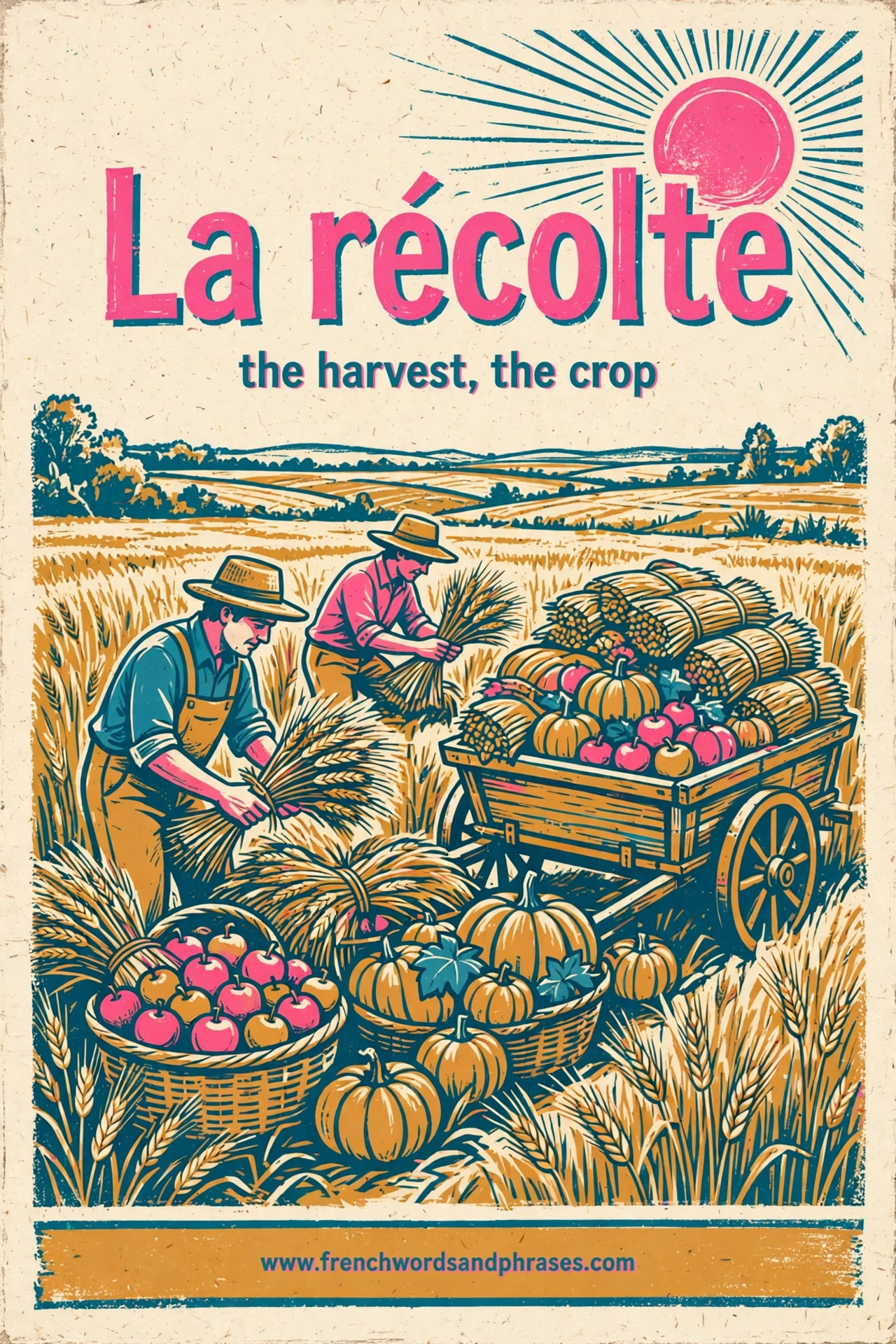
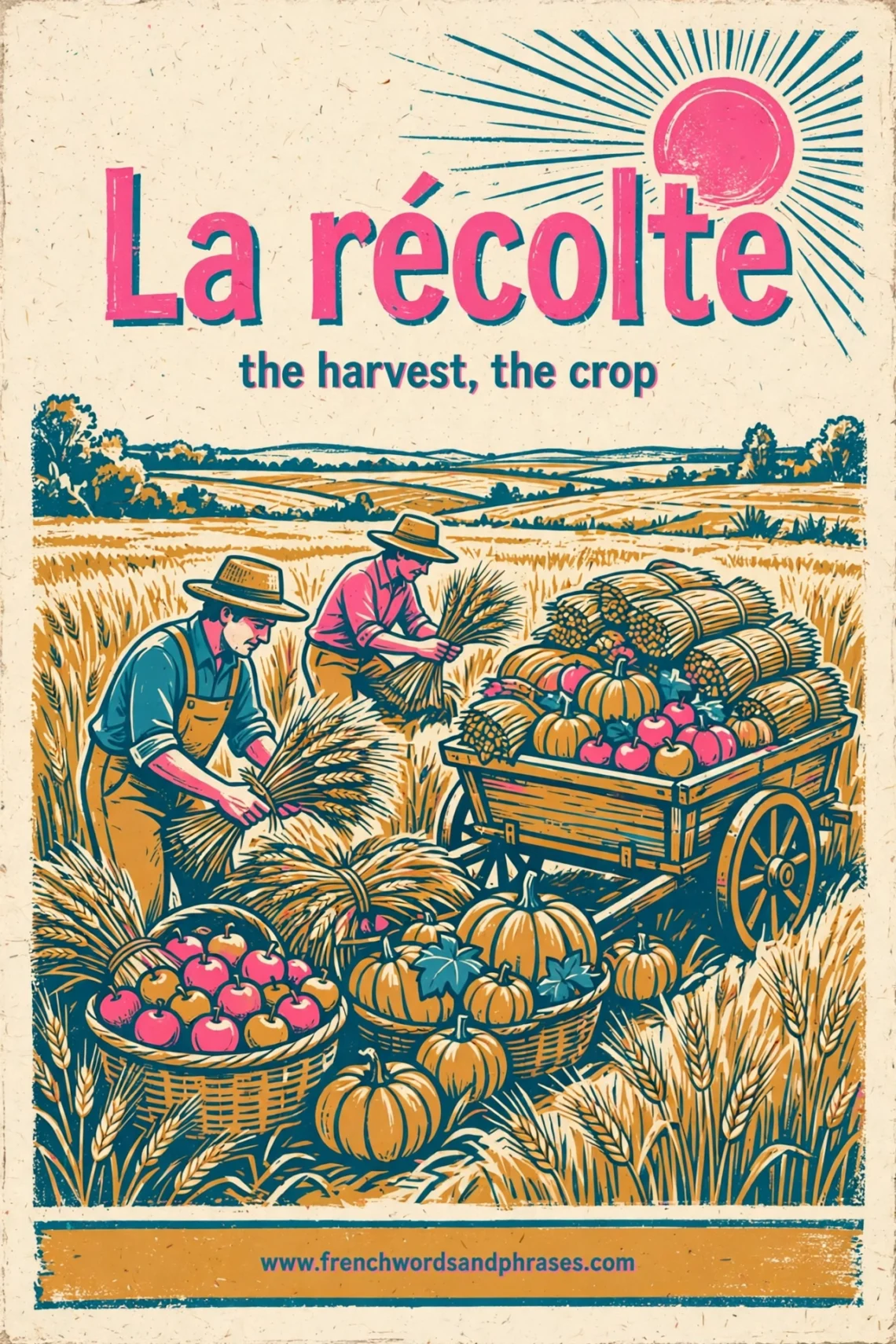
La récolte means the harvest, the crop.
Baskets filling in the orchard, the combine rolling gold through the wheat, the cellar door closing on a year’s jars: la récolte, the harvest, the crop — the season’s work gathered into the barn at last.
In this guide, you’ll learn what récolte means in English, how to use it with its articles, how to form its plural, and how it appears in everyday French. Explore French examples, English translations, and practice quizzes.
Understanding the French Noun Récolte
Récolte is a feminine French noun, learned with its article: la récolte, une récolte. It names both the gathering and what is gathered: la récolte du blé, the wheat harvest; une bonne récolte, a good crop. Its verb is récolter, to harvest, to reap — and, figuratively, to collect what one has sown.
It means the harvest, the crop — the produce gathered from fields, gardens and trees: la récolte des pommes, the apple harvest, la récolte de miel, the honey harvest, une récolte abondante, an abundant crop. The season itself is le temps des récoltes, harvest time. Figuratively, effort is harvested like wheat: la récolte de signatures, the gathering of signatures, and the old warning, on récolte ce qu’on a semé — you reap what you sow.
Gender: Feminine — la récolte
Definite article: la — la récolte (the harvest)
Indefinite article: une — une récolte (a harvest, a crop)
Plural: les récoltes — regular, with a simple -s
Spelling note: two é’s frame the word: ré-col-te — the first syllable always carries its accent
The double sense: the gathering itself, and the crop that is gathered
English equivalents: The harvest, the crop.
The crop is named with de: la récolte de pommes de terre, the potato harvest; the year judges it with adjectives: une bonne récolte, une mauvaise récolte. The verb récolter serves both field and figure — récolter des fonds, to raise funds; récolter des ennuis, to reap trouble. And the proverb governs all of it: on récolte ce qu’on a semé.
Experience the Word
Récolte is the noun of the full basket — the moment a year of weather, work and waiting becomes something you can carry home.
Imagine the vineyard at dawn in late September: pickers already between the rows, buckets filling, the trailer groaning toward the pressoir. La récolte ne attend pas — the harvest does not wait — and the whole village, from grandmothers to schoolchildren, is in the vines before the sun is.
You have not just named a crop. You have named the year’s answer — la récolte, the harvest, good or bad, of fields and of lives.
How to Use Récolte in French: Complete Guide
Let’s explore how récolte works in French, beginning with its articles — la récolte, une récolte, une bonne récolte.
Récolte with the Definite Article (La, Les)
Used for the harvest in question — this year’s, the village’s, the orchard’s.
| Form | French |
|---|---|
| Feminine singular | la récolte |
| Plural | les récoltes |
Example
La récolte commence la semaine prochaine.
The harvest begins next week.
Récolte with the Indefinite Article (Une, Des)
Used for a crop as a result — good, bad, abundant, lost.
| Form | French |
|---|---|
| Feminine singular | une récolte |
| Plural | des récoltes |
Example
Cette année, nous aurons une récolte magnifique.
This year, we will have a magnificent harvest.
Récolte with Its Crops (Pommes, Blé, Miel…)
Each crop names its harvest with de — orchards, fields and hives alike.
| Crop | French |
|---|---|
| the apple harvest | la récolte des pommes |
| the wheat harvest | la récolte du blé |
| the grape harvest | la récolte des raisins |
| the honey harvest | la récolte de miel |
| the potato harvest | la récolte des pommes de terre |
Example
La récolte des raisins demande beaucoup de bras.
The grape harvest needs many hands.
Quick Quiz 1
Complete the sentence:
______ récolte de cette année est excellente. (the)
Reveal the answer
La
La récolte de cette année est excellente.
This year’s harvest is excellent — récolte is feminine, so la.
The Plural of Récolte
Récolte takes a regular plural in -s — harvests counted year by year, field by field.
| Number | French |
|---|---|
| Singular | la récolte |
| Plural | les récoltes |
Example
Les récoltes des trois dernières années ont été bonnes.
The last three years’ harvests have been good.
Récolte with Possessive Adjectives (Ma, Ta, Sa…)
Possessives agree with the noun: récolte is feminine, so ma, ta, sa in the singular.
| Owner | French |
|---|---|
| my | ma récolte |
| your (tu) | ta récolte |
| his / her | sa récolte |
| our | notre récolte |
| your (vous) | votre récolte |
| their | leur récolte |
Example
Le jardinier est fier de sa récolte de tomates.
The gardener is proud of his tomato harvest.
Quick Quiz 2
Complete the sentence:
Elle vend ______ récolte au marché du village. (her)
Reveal the answer
sa
Elle vend sa récolte au marché du village.
She sells her harvest at the village market — sa, because récolte is feminine.
Récolte with Demonstrative Adjectives (Cette, Ces)
Used to point: cette récolte, this harvest — the one in the barn, the one in the photograph.
| Form | French |
|---|---|
| Feminine singular | cette récolte |
| Plural | ces récoltes |
Example
Cette récolte suffira pour tout l’hiver.
This harvest will be enough for the whole winter.
Récolte with Adjectives
Adjectives agree with récolte — feminine singular: une bonne récolte, une récolte abondante.
| Adjective | With Récolte |
|---|---|
| bonne (good) | une bonne récolte |
| mauvaise (bad) | une mauvaise récolte |
| abondante (abundant) | une récolte abondante |
| première (first) | la première récolte |
| riche (rich) | une récolte riche |
Example
Après la pluie de mai, la récolte sera abondante.
After the May rain, the harvest will be abundant.
Quick Quiz 3
Complete the sentence:
Ce fut une récolte ______ grâce au beau temps. (abundant)
Reveal the answer
abondante
Ce fut une récolte abondante grâce au beau temps.
It was an abundant harvest thanks to the good weather — abondante, feminine, to agree with récolte.
Everyday Expressions with Récolte
Vineyards, gardens and proverbs — the récolte phrases of daily life.
| Expression | In English |
|---|---|
| le temps des récoltes | harvest time |
| une bonne / mauvaise récolte | a good / bad harvest |
| on récolte ce qu’on a semé | you reap what you sow (proverb) |
| la récolte de signatures | the gathering of signatures |
| faire la récolte | to bring in the harvest |
Example
Au temps des récoltes, tout le village aide aux champs.
At harvest time, the whole village helps in the fields.
Words from the Same Family as Récolte
Sowing and gathering — the words that travel with récolte.
| French | In English |
|---|---|
| récolter | to harvest, to reap (the verb) |
| semer | to sow — the other half of the proverb |
| les vendanges | the grape harvest — its own famous word |
| une grange | a barn |
| le blé | wheat, corn |
Example
On sème au printemps et on récolte à l’automne.
You sow in spring and harvest in autumn.
Quick Quiz 4
Complete the proverb: on récolte ce qu’on a…
Reveal the answer
semé — you reap what you sow, in the field and in life.
On récolte ce qu’on a semé.
You reap what you sow.
Récolte in Everyday French: Real-Life Examples
Now that you know the word, let’s see how récolte appears in everyday French.
Example 1 — The vineyard
La récolte des raisins commence à l’aube.
The grape harvest begins at dawn.
Example 2 — The garden
Ma récolte de tomates est superbe cette année.
My tomato harvest is superb this year.
Example 3 — The year
Une mauvaise récolte inquiète tout le village.
A bad harvest worries the whole village.
Example 4 — Honey
La récolte de miel a lieu à la fin de l’été.
The honey harvest takes place at the end of summer.
Example 5 — Signatures
La récolte de signatures continue devant la mairie.
The gathering of signatures continues in front of the town hall.
Example 6 — The proverb
Il a récolté ce qu’il avait semé : des ennuis.
He reaped what he had sown: trouble.
Beyond Translation: The Meaning of Récolte
Récolte is built from récolter, itself from a Latin word for gathering back — re-colligere, to collect again: the harvest is the year’s loan repaid, gathered back into the barn. French keeps the moral inside the farming: the same verb reaps wheat and consequences, and the proverb on récolte ce qu’on a semé has governed consciences as long as it has governed fields.
To say récolte is to close the year’s account — what was sown, now weighed and carried home.
It evokes the dawn vineyard, the groaning trailer and the cellar shelves filling — work, answered.
How to Remember the French Noun Récolte
Remember it this way: Récolte is the harvest — feminine: la récolte, une bonne récolte, and the year’s crop in one word.
- Always feminine — la récolte, une récolte, sa récolte.
- The judgement — une bonne récolte, une mauvaise récolte.
- The proverb — on récolte ce qu’on a semé, you reap what you sow.
The key idea is la récolte — the harvest, the crop, feminine; on récolte ce qu’on a semé.
Test Your Knowledge of Récolte
Let’s see how much you’ve learned. Try answering these questions before revealing the answers.
Question 1
Is récolte masculine or feminine?
Reveal the answer
Feminine — la récolte, une récolte.
Question 2
How do you say a good harvest?
Reveal the answer
Une bonne récolte.
Question 3
Translate: The grape harvest begins at dawn.
Reveal the answer
La récolte des raisins commence à l’aube.
Question 4
What is the verb of the same family as récolte?
Reveal the answer
Récolter — to harvest, to reap.
Question 5
Complete the sentence:
______ récoltes des dernières années ont été bonnes. (the)
Reveal the answer
Les
Les récoltes des dernières années ont été bonnes.
The last years’ harvests have been good.
Your Final Challenge
Can You Use It?
How would you say this in French?
“You reap what you sow.”
Reveal the answer
On récolte ce qu’on a semé.
You reap what you sow.
A little French. A little curiosity. A richer everyday life.
LEARN FRENCH ONE WORD AT A TIME