A French Word to Live By
How to Conjugate Protéger in French
/pʁɔ.te.ʒe/
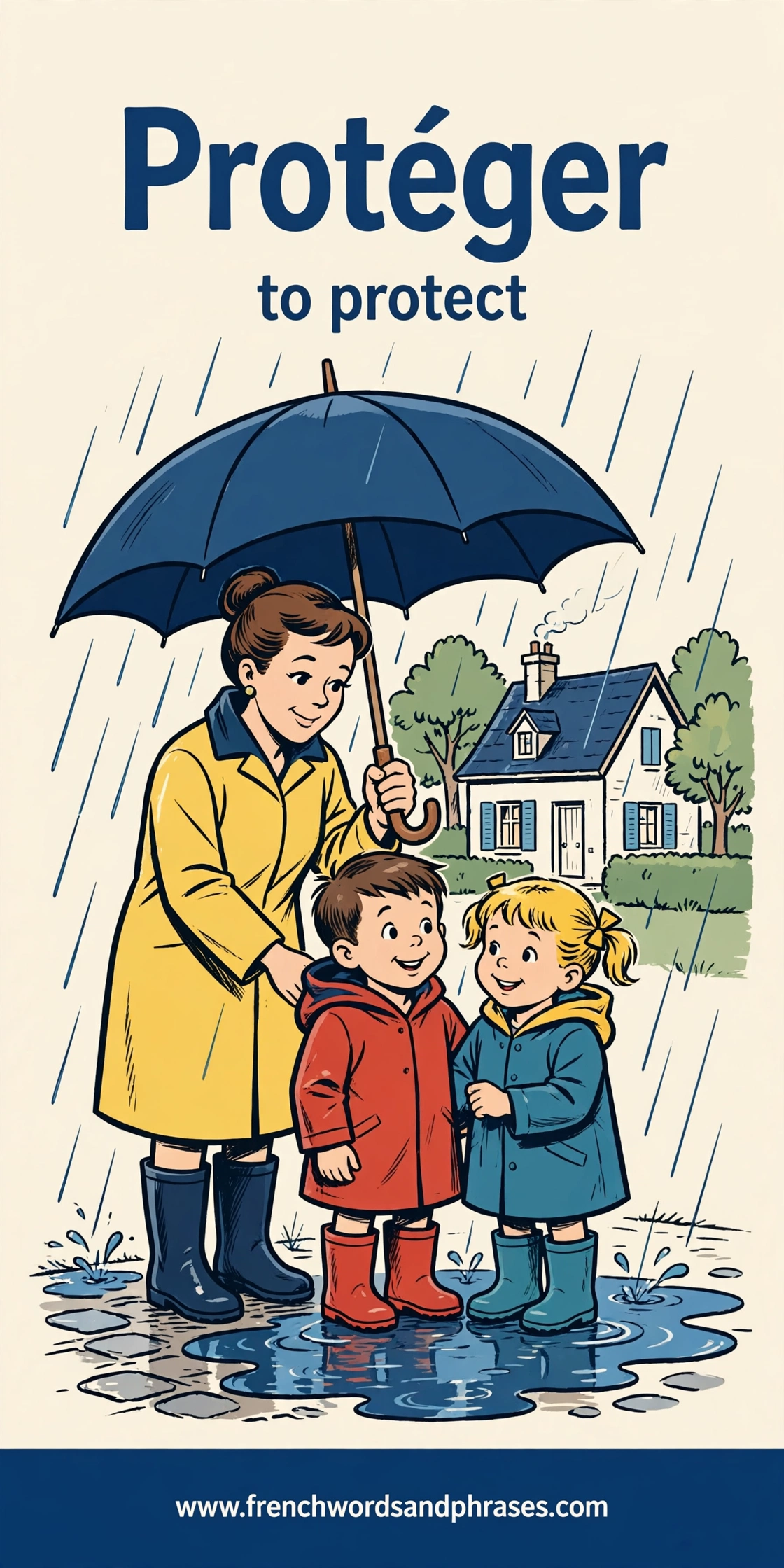
Protéger means to protect — to shield someone or something from harm: children from the cold, skin from the sun, a house from the storm, a secret from the curious.
A mother adjusting a scarf at the school gate, a helmet lowered before the ride, a law written for the weakest — protéger is the verb of the shield, of everything French places between what it loves and what could harm it.
In this guide, you’ll learn how to conjugate protéger in all the major French tenses and moods. Explore complete conjugation tables, French examples, English translations, and practice quizzes.
Understanding the French Verb Protéger
Protéger is a regular French verb belonging to the first group of verbs, those ending in-er.
It means to protect. Protéger takes its enemy with contre or de: protéger contre le vent, to protect against the wind; protéger du soleil, to protect from the sun. The reflexive se protéger is the language of health and prudence — se protéger du soleil, se protéger contre les maladies. And French law and nature share the adjective: une espèce protégée, un site protégé, a protected species, a protected site.
Verb classification: First group (-er)
Auxiliary verb: Avoir
Past participle: protégé
Present participle: protégeant
English equivalents: To protect, to shield, to guard; protéger quelqu’un — to protect someone; protéger contre le froid — to protect against the cold; protéger du soleil — to protect from the sun; se protéger — to protect oneself; une espèce protégée — a protected species.
One important detail: protéger is an espérer-type verb with a -ger twist — the é of the stem opens to è in the present singular and third plural, in the subjunctive singular and third plural, and in the tu imperative: je protège, tu protèges, il protège, ils protègent. But the future and conditional keep é: je protégerai, je protégerais. And because of the g, the nous form keeps a protective e: nous protégeons, while the sounded endings keep é: nous protégeons, vous protégez, je protégeais.
Experience the Word
Protéger is the verb of the outstretched arm — the gesture older than language, placing a body between danger and what it loves.
Imagine the shepherd in the high pasture as the storm builds over the ridge: he counts the flock, closes the fold, and sets his own back to the wind at the gate. Il protège ses bêtes — the verb needs no speech; the whole mountain understands it.
Children, flocks, forests, secrets — all shelter under the same arm. That is protéger — the shield, held steady.
How to Conjugate Protéger: Complete French Conjugation Guide
Let’s explore every major conjugation of protéger, beginning with the indicative mood.
How to Conjugate Protéger in the Indicative Mood
The indicative mood is used to express facts, observations, actions, and events.
How to Conjugate Protéger in the Present Tense (Présent)
Used for actions happening now, habitual actions, and general truths.
| Subject | Conjugation |
|---|---|
| je | protège |
| tu | protèges |
| il / elle | protège |
| nous | protégeons |
| vous | protégez |
| ils / elles | protègent |
Example
Cette crème protège la peau du soleil.
This cream protects the skin from the sun.
Quick Quiz 1
Complete the sentence:
Nous ______ les enfants du froid.
Reveal the answer
protégeons
Nous protégeons les enfants du froid.
We protect the children from the cold — the -ger verb keeps its e: protégeons.
How to Conjugate Protéger in the Passé Composé
Used for completed actions in the past. Protéger takes the auxiliary verb avoir.
| Subject | Conjugation |
|---|---|
| j’ | ai protégé |
| tu | as protégé |
| il / elle | a protégé |
| nous | avons protégé |
| vous | avez protégé |
| ils / elles | ont protégé |
Example
Le mur a protégé le jardin du vent.
The wall protected the garden from the wind.
How to Conjugate Protéger in the Imparfait (Imperfect Tense)
Used for habitual past actions, descriptions, and ongoing situations in the past.
| Subject | Conjugation |
|---|---|
| je | protégeais |
| tu | protégeais |
| il / elle | protégeait |
| nous | protégions |
| vous | protégiez |
| ils / elles | protégeaient |
Example
Le grand chien protégeait les enfants de la maison.
The big dog used to protect the children of the house.
Quick Quiz 2
Choose the correct form:
Tomorrow, I will protect my family.
Demain, je ______ ma famille. (protégerai / protègerai)
Reveal the answer
protégerai
Demain, je protégerai ma famille.
The future keeps the é of the stem: protégerai, protégerons.
How to Conjugate Protéger in the Plus-que-parfait
Used to describe an action that had already been completed before another past event.
| Subject | Conjugation |
|---|---|
| j’ | avais protégé |
| tu | avais protégé |
| il / elle | avait protégé |
| nous | avions protégé |
| vous | aviez protégé |
| ils / elles | avaient protégé |
Example
Elle avait protégé ses frères pendant toute la guerre.
She had protected her brothers throughout the war.
How to Conjugate Protéger in the Passé Simple
Primarily used in formal writing, literature, and historical narratives. It is rarely used in everyday conversation.
| Subject | Conjugation |
|---|---|
| je | protégeai |
| tu | protégeas |
| il / elle | protégea |
| nous | protégeâmes |
| vous | protégeâtes |
| ils / elles | protégeèrent |
Example
Le rempart protégea la ville pendant des siècles.
The rampart protected the town for centuries.
How to Conjugate Protéger in the Passé Antérieur
A literary tense used to express an action completed immediately before another past action, generally in the passé simple.
| Subject | Conjugation |
|---|---|
| j’ | eus protégé |
| tu | eus protégé |
| il / elle | eut protégé |
| nous | eûmes protégé |
| vous | eûtes protégé |
| ils / elles | eurent protégé |
Example
Quand la loi eut protégé la forêt, les bûcherons partirent.
When the law had protected the forest, the woodcutters left.
How to Conjugate Protéger in the Future Tense (Futur Simple)
Used to describe actions that will take place in the future.
| Subject | Conjugation |
|---|---|
| je | protégerai |
| tu | protégeras |
| il / elle | protégera |
| nous | protégerons |
| vous | protégerez |
| ils / elles | protégeront |
Example
Je protégerai toujours ma famille.
I will always protect my family.
How to Conjugate Protéger in the Futur Antérieur (Future Perfect)
Used for an action that will have been completed before a particular point in the future.
| Subject | Conjugation |
|---|---|
| j’ | aurai protégé |
| tu | auras protégé |
| il / elle | aura protégé |
| nous | aurons protégé |
| vous | aurez protégé |
| ils / elles | auront protégé |
Example
À la fin de l’hiver, ce toit aura protégé la maison de dix tempêtes.
By the end of winter, this roof will have protected the house from ten storms.
How to Conjugate Protéger in the Near Future (Futur Proche)
Used to describe something that is going to happen soon. Formed with aller + infinitive.
| Subject | Conjugation |
|---|---|
| je | vais protéger |
| tu | vas protéger |
| il / elle | va protéger |
| nous | allons protéger |
| vous | allez protéger |
| ils / elles | vont protéger |
Example
Ce casque va protéger ta tête, mets-le.
This helmet is going to protect your head, put it on.
How to Conjugate Protéger in the Conditional Mood
The conditional mood expresses what would happen under certain circumstances. It is also frequently used to make polite requests or express wishes.
How to Conjugate Protéger in the Present Conditional
| Subject | Conjugation |
|---|---|
| je | protégerais |
| tu | protégerais |
| il / elle | protégerait |
| nous | protégerions |
| vous | protégeriez |
| ils / elles | protégeraient |
Example
Un bon manteau te protégerait mieux du froid.
A good coat would protect you better from the cold.
How to Conjugate Protéger in the Past Conditional
| Subject | Conjugation |
|---|---|
| j’ | aurais protégé |
| tu | aurais protégé |
| il / elle | aurait protégé |
| nous | aurions protégé |
| vous | auriez protégé |
| ils / elles | auraient protégé |
Example
Le vaccin l’aurait protégé contre la maladie.
The vaccine would have protected him against the illness.
Protéger in the Literary Past Conditional Form
This less common literary form uses the imperfect subjunctive of avoir.
| Subject | Conjugation |
|---|---|
| j’ | eusse protégé |
| tu | eusses protégé |
| il / elle | eût protégé |
| nous | eussions protégé |
| vous | eussiez protégé |
| ils / elles | eussent protégé |
Example
Le roi eût protégé la ville, si ses murs eussent tenu.
The king would have protected the town, had its walls held.
How to Conjugate Protéger in the Subjunctive Mood
The subjunctive is used to express wishes, emotions, doubts, necessity, and uncertainty. It frequently follows expressions such as il faut que (it is necessary that) or bien que (although).
How to Conjugate Protéger in the Present Subjunctive
| Subject | Conjugation |
|---|---|
| que je | protège |
| que tu | protèges |
| qu’il / qu’elle | protège |
| que nous | protégions |
| que vous | protégiez |
| qu’ils / qu’elles | protègent |
Example
Il faut que ce casque protège bien la tête.
This helmet must protect the head well.
Quick Quiz 3
Complete the sentence using the subjunctive:
Il faut que vous ______ les plus faibles.
Reveal the answer
protégiez
Il faut que vous protégiez les plus faibles.
You must protect the weakest.
How to Conjugate Protéger in the Imperfect Subjunctive
A literary tense, rarely encountered in modern spoken French.
| Subject | Conjugation |
|---|---|
| que je | protégasse |
| que tu | protégasses |
| qu’il / qu’elle | protégât |
| que nous | protégassions |
| que vous | protégassiez |
| qu’ils / qu’elles | protégassent |
Example
Je voulais qu’elle protégeât les plus faibles.
I wanted her to protect the weakest.
How to Conjugate Protéger in the Pluperfect Subjunctive
A literary construction used to express an action completed before another past action.
| Subject | Conjugation |
|---|---|
| que j’ | eusse protégé |
| que tu | eusses protégé |
| qu’il / qu’elle | eût protégé |
| que nous | eussions protégé |
| que vous | eussiez protégé |
| qu’ils / qu’elles | eussent protégé |
Example
On admirait qu’il eût protégé les siens sans jamais se plaindre.
People admired that he had protected his own without ever complaining.
How to Conjugate Protéger in the Past Subjunctive
| Subject | Conjugation |
|---|---|
| que j’ | aie protégé |
| que tu | aies protégé |
| qu’il / qu’elle | ait protégé |
| que nous | ayons protégé |
| que vous | ayez protégé |
| qu’ils / qu’elles | aient protégé |
Example
Je suis fier que tu aies protégé ton petit frère.
I am proud that you protected your little brother.
How to Conjugate Protéger in the Imperative
The imperative is used to give commands, instructions, invitations, or suggestions. Subject pronouns are omitted.
How to Conjugate Protéger in the Present Imperative
| Person | Conjugation |
|---|---|
| (tu) | protège |
| (nous) | protégeons |
| (vous) | protégez |
Example
Protège tes yeux du soleil !
Protect your eyes from the sun!
Quick Quiz 4
How would you say Protect your eyes (tu form)?
Reveal the answer
Protège tes yeux !
French Participles of Protéger
Participles are verb forms that can be used in compound tenses and other grammatical constructions.
Present Participle of Protéger
protégeant
En protégeant la forêt, on protège aussi la rivière.
By protecting the forest, we also protect the river.
Past Participle of Protéger
protégé
Protégés par la loi, ces oiseaux reviennent chaque année.
Protected by law, these birds return every year.
Protéger in Everyday French: Real-Life Examples
Now that you know the conjugations, let’s see how protéger appears in everyday French.
Example 1 — Present
Cette crème protège la peau.
This cream protects the skin.
Example 2 — Passé composé
Le mur a protégé le jardin.
The wall protected the garden.
Example 3 — Imparfait
Le chien protégeait les enfants.
The dog used to protect the children.
Example 4 — Future
Je protégerai ma famille.
I will protect my family.
Example 5 — Conditional
Un manteau te protégerait du froid.
A coat would protect you from the cold.
Example 6 — Imperative
Protège tes yeux du soleil !
Protect your eyes from the sun!
Beyond Translation: The Meaning of Protéger
Protéger comes from the Latin protegere — pro, in front, plus tegere, to cover: to cover in front, to stand as a roof between the sky and what is sheltered. The picture survives in every use: the cream covers the skin, the wall covers the garden, the law covers the species.
The grave accent is the verb’s small weather-vane — è where the stem is stressed and open (je protège), é where the ending carries the sound (je protégerai), a spelling that follows the ear across a thousand years.
Between the scarf at the school gate and the protected species of the national park, protéger covers France, literally, from harm.
How to Remember the French Verb Protéger
Remember it this way: Protéger is about the shepherd with his back to the wind — je protège, je protégerai.
- Espérer-type: je protège with è, but je protégerai with é — the future keeps the acute accent.
- The -ger e: nous protégeons keeps its e so the g stays soft.
- The enemy takes contre or de: protéger contre le vent, protéger du soleil.
The key idea is the shepherd with his back to the wind — je protège, je protégerai.
Test Your Knowledge of Protéger
Let’s see how much you’ve learned. Try answering these questions before revealing the answers.
Question 1
Why does je protège have a grave accent but je protégerai an acute one?
Reveal the answer
The espérer-type rule — é becomes è in the present and subjunctive stems, but the future and conditional keep é: je protégerai.
Question 2
How do you say This cream protects the skin in French?
Reveal the answer
Cette crème protège la peau.
Question 3
Translate: The wall protected the garden from the wind.
Reveal the answer
Le mur a protégé le jardin du vent.
Question 4
What is the past participle of protéger?
Reveal the answer
Protégé.
Question 5
Complete the sentence:
Il faut que tu ______ tes yeux du soleil.
Reveal the answer
protèges
Il faut que tu protèges tes yeux du soleil.
You must protect your eyes from the sun.
Your Final Challenge
Can You Use It?
How would you say this in French?
The shepherd protects his flock from the storm, his back to the wind and his eyes on the mountain.
Reveal the answer
Le berger protège son troupeau de la tempête, le dos au vent et les yeux sur la montagne.
The shepherd protects his flock from the storm, his back to the wind and his eyes on the mountain.
A little French. A little curiosity. A richer everyday life.
LEARN FRENCH ONE WORD AT A TIME