A French Word to Live By
Translate Ravi to English
/ʁavi/
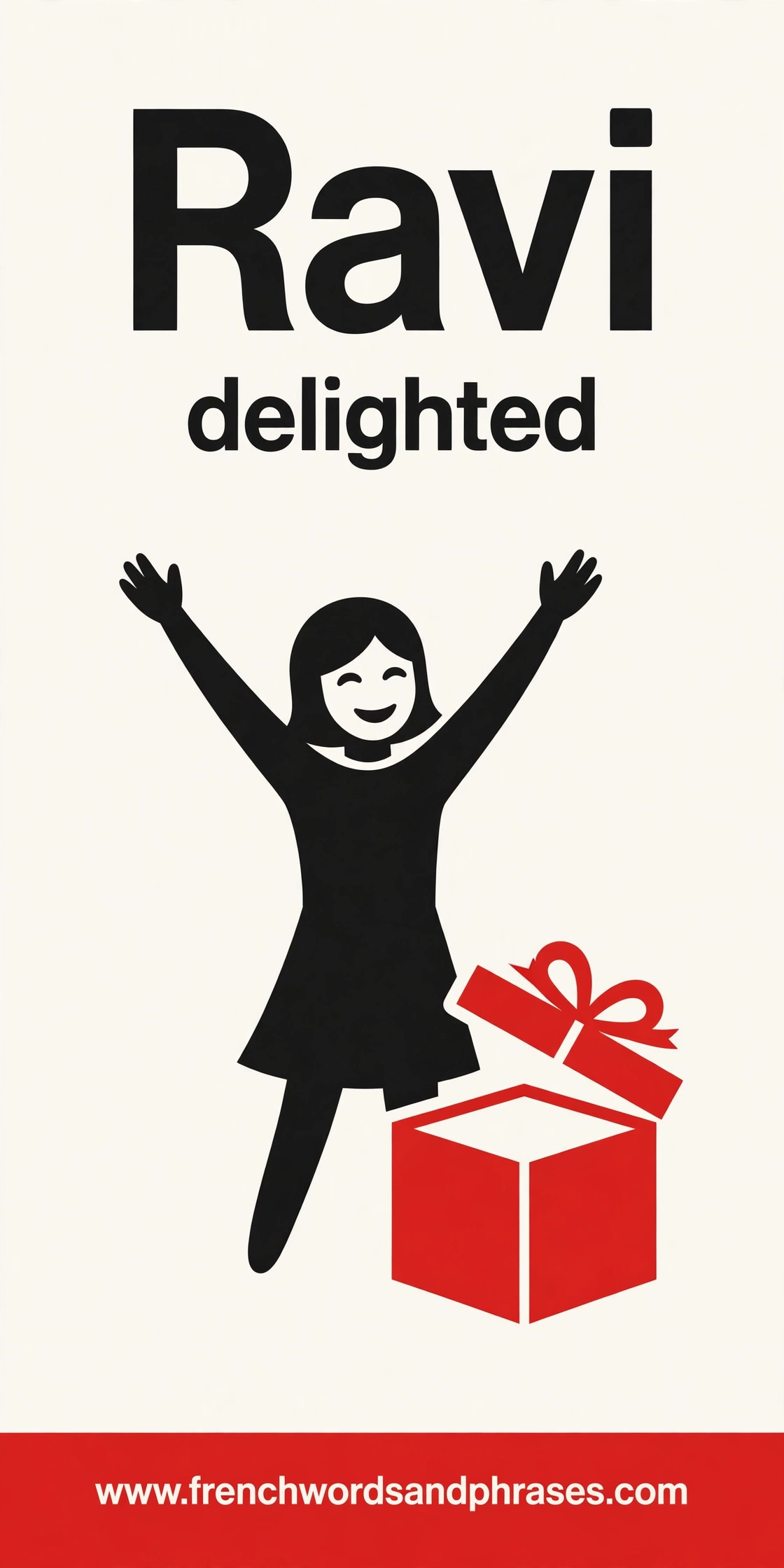
Ravi means delighted.
A railway platform, an evening train pulling in, and a young woman scanning the windows with a bunch of flowers already wilting in her hand. Then a door opens, a suitcase drops, and her whole face changes — she is not just pleased, she is lit up. The French word for that light is ravi.
In this guide, you’ll learn what ravi means in English, how its feminine simply adds an e, why it is almost always followed by de, and how it powers the politest sentence in French — ravi de faire votre connaissance. Explore French examples, English translations, and practice quizzes.
Understanding the French Adjective Ravi
Ravi is a French adjective of quality — the adjective of delight, one step above pleased. It agrees in the regular way: ravi, ravie, ravis, ravies. It is the past participle of ravir, to carry away — a ravi person has been carried away by good news.
It means delighted — very pleased, thrilled by something that has happened or is about to. It describes people hearing good news (ravi de la nouvelle, delighted by the news) and meeting people (ravi de te voir, delighted to see you). It is stronger and warmer than content, and it almost always travels with de, which names the cause of the delight.
Type: Adjective of quality — feelings and delight
Answers the question: What is he or she like? — delighted
Changes form: Yes — ravi, ravie, ravis, ravies
Feminine: ravie
English equivalents: Delighted; thrilled; overjoyed.
One important usage detail: ravi is almost always followed by de — ravi de te voir (delighted to see you), ravie de la nouvelle (delighted by the news). And it opens the most courteous door in French: Ravi de faire votre connaissance — delighted to meet you, said at first introductions.
Experience the Word
Ravi is the adjective of the platform reunion and the opened envelope — the moment good news lands and the face answers before the mouth can.
Imagine a student refreshing a results page at midnight, then reading her name, then reading it again, then waking the whole house. She is not calmly satisfied. She is ravi, and the neighbours know it.
You have not just described pleasure. You have described delight that cannot sit still.
How to Use Ravi in French: Complete Guide
Let’s explore how ravi works in French, beginning with the whole word on one card.
Ravi at a Glance
Before the details, here is the whole word on one card.
The Whole Word on One Card
Meaning, type, position and forms — ravi in four lines.
| Point | Ravi |
|---|---|
| Meaning | delighted |
| Type | adjective of quality — feelings and delight |
| Usual position | after être — je suis ravi de te voir |
| Form | ravi / ravie / ravis / ravies |
Example
Je suis ravi de te voir.
I’m delighted to see you.
The Four Forms of Ravi
Ravi agrees with the person who is delighted, following the regular pattern: the feminine adds an e, the plurals add an s — and none of it changes the sound.
| Form | Ravi | Example |
|---|---|---|
| Masculine singular | ravi | un père ravi — a delighted father |
| Feminine singular | ravie | une mère ravie — a delighted mother |
| Masculine plural | ravis | des parents ravis — delighted parents |
| Feminine plural | ravies | des sœurs ravies — delighted sisters |
Example
Il est ravi et elle est ravie de la nouvelle.
He is delighted and she is delighted by the news.
Quick Quiz 1
Which form of ravi goes with mère (feminine)?
Reveal the answer
ravie
Une mère ravie.
A delighted mother.
Ravie: The Regular Feminine in -ie
The feminine of ravi is formed by adding a single e. Ravi and ravie sound exactly alike — only the spelling, and the agreement it shows, changes.
| Situation | Example |
|---|---|
| The rule | just add -e — ravi → ravie |
| The sound | ravi and ravie sound exactly the same: /ʁavi/ |
| Masculine plural | ravis — des enfants ravis |
| Feminine plural | ravies — des étudiantes ravies |
Example
Elle est ravie de son cadeau.
She is delighted with her present.
Where Ravi Goes: After Être, Followed by De
Ravi lives after être and its cousins, and it almost always brings de with it — de plus an infinitive for actions, de plus a noun for causes.
| Pattern | Example |
|---|---|
| After être + de + infinitive | je suis ravi de partir — I’m delighted to be leaving |
| After être + de + noun | elle est ravie de la surprise — she’s delighted by the surprise |
| After sembler | ils semblent ravis — they seem delighted |
| Before the noun | un ravi homme — not in everyday French |
Example
Nous sommes ravis de vous accueillir.
We are delighted to welcome you.
Quick Quiz 2
Which little word almost always follows ravi?
Reveal the answer
de
Ravi de te voir, ravie de la nouvelle.
Delighted to see you, delighted by the news.
More Delighted: Comparing with Ravi
Delight is hard to measure, but French still compares it the regular way, with plus, moins and aussi — très ravi does most of the everyday work.
| Degree | Example |
|---|---|
| As delighted as | aussi ravi que — as delighted as |
| More delighted | plus ravi — more delighted |
| Less delighted | moins ravi — less delighted |
| The most delighted (masc.) | le plus ravi — le plus ravi des invités |
| The most delighted (fem.) | la plus ravie — la plus ravie des invitées |
Example
Elle est plus ravie que lui de cette nouvelle.
She is more delighted than him by this news.
Everyday Expressions with Ravi
Ravi is the word of welcomes, announcements and first meetings — wherever French wants delight to sound warm and sincere.
| Expression | In English |
|---|---|
| ravi de te voir | delighted to see you |
| ravi de faire votre connaissance | delighted to meet you (formal, first introduction) |
| ravi de la nouvelle | delighted by the news |
| ravi de vous accueillir | delighted to welcome you |
| être ravi de + infinitive | to be delighted to do something |
| un sourire ravi | a delighted smile |
Example
Ravi de faire votre connaissance, madame.
Delighted to meet you, madam.
Quick Quiz 3
What does ravi de faire votre connaissance mean?
Reveal the answer
Delighted to meet you
It is the courteous formula for a first introduction.
Delighted to make your acquaintance.
Ravi and Its Neighbours
Ravi sits at the top of the pleasure scale, above content and heureux; enchanté is its close cousin at introductions, and déçu is its opposite.
| French | In English |
|---|---|
| enchanté | delighted — the other great word of introductions |
| content | pleased, glad — a step below ravi |
| heureux | happy — broader and deeper |
| comblé | fulfilled, overjoyed — delight completely filled |
| aux anges | in heaven, thrilled (literally, with the angels) |
| déçu | disappointed — the opposite |
Example
Elle est comblée, absolument ravie de son nouveau travail.
She is fulfilled, absolutely delighted with her new job.
Watch Out: The Traps Around Ravi
The traps here are the missing de, and the old verb ravir hiding inside the word with a darker past.
| Trap | The truth |
|---|---|
| The missing de | say ravi de te voir — the de is not optional |
| ravir | the verb ravir means to carry off, to snatch — ravi keeps only the ‘carried away’ feeling |
| Agreement | elle est ravie, with an e — the delight agrees with its owner |
| Too strong for small things? | ravi is warm but everyday — French uses it for a good meal as happily as for a wedding |
Example
Les invités sont ravis du repas.
The guests are delighted with the meal.
Quick Quiz 4
How do you say ‘delighted to see you’ to a friend?
Reveal the answer
Ravi de te voir
Ravi if you are a man, ravie if you are a woman.
Delighted to see you.
Ravi in Everyday French: Real-Life Examples
Now that you know the word, let’s see how ravi appears in everyday French.
Example 1 — Reunion
Je suis ravi de te voir après tout ce temps.
I’m delighted to see you after all this time.
Example 2 — Good news
Elle est ravie de la nouvelle : elle a réussi son examen.
She is delighted by the news: she passed her exam.
Example 3 — Introduction
Ravi de faire votre connaissance, monsieur le directeur.
Delighted to meet you, Mr Director.
Example 4 — An invitation
Nous sommes ravis de vous inviter à notre mariage.
We are delighted to invite you to our wedding.
Example 5 — A gift
Les enfants sont ravis de leurs cadeaux.
The children are delighted with their presents.
Example 6 — At work
Il est ravi de travailler avec cette équipe.
He is delighted to work with this team.
Beyond Translation: The Meaning of Ravi
English says delighted for the meaning of ravi — and French hides a small drama inside the word: ravi is the past participle of ravir, to seize and carry away, the verb of rapture and of ravishing beauty.
A ravi person has been carried away — by joy.
The violence of the old verb has melted into pure pleasure, but the movement remains: ravi is not a state you settle into, it is delight arriving like a wave and lifting you with it.
How to Remember the French Adjective Ravi
Remember it this way: Ravi is the delighted adjective — carried away by good news, regular in its forms, and almost never seen without its little companion de.
- You add only an e for the feminine — ravi, ravie, and they sound the same.
- You keep the de — ravi de te voir, ravie de la nouvelle.
- You open introductions with it — Ravi de faire votre connaissance.
The key idea is ravi means delighted, takes de after it, and its feminine ravie sounds identical.
Test Your Knowledge of Ravi
Let’s see how much you’ve learned. Try answering these questions before revealing the answers.
Question 1
What does ravi mean?
Reveal the answer
Delighted — very pleased, thrilled by something.
Question 2
What is the feminine of ravi?
Reveal the answer
ravie — just add an e; the sound does not change.
Question 3
Translate: delighted to meet you (formal).
Reveal the answer
Ravi de faire votre connaissance.
Question 4
Complete the sentence:
Elle est ______ de la surprise.
Reveal the answer
ravie
Elle est ravie de la surprise.
She is delighted by the surprise.
Question 5
Which word follows ravi in ‘delighted to see you’?
Reveal the answer
de — ravi de te voir.
Your Final Challenge
Can You Use It?
How would you say this in French?
“She is delighted by the news and she smiles all day.”
Reveal the answer
Elle est ravie de la nouvelle et elle sourit toute la journée.
She is delighted by the news and she smiles all day.
A little French. A little curiosity. A richer everyday life.
LEARN FRENCH ONE WORD AT A TIME