A French Word to Live By
Translate Joyeux to English
/ʒwajø/
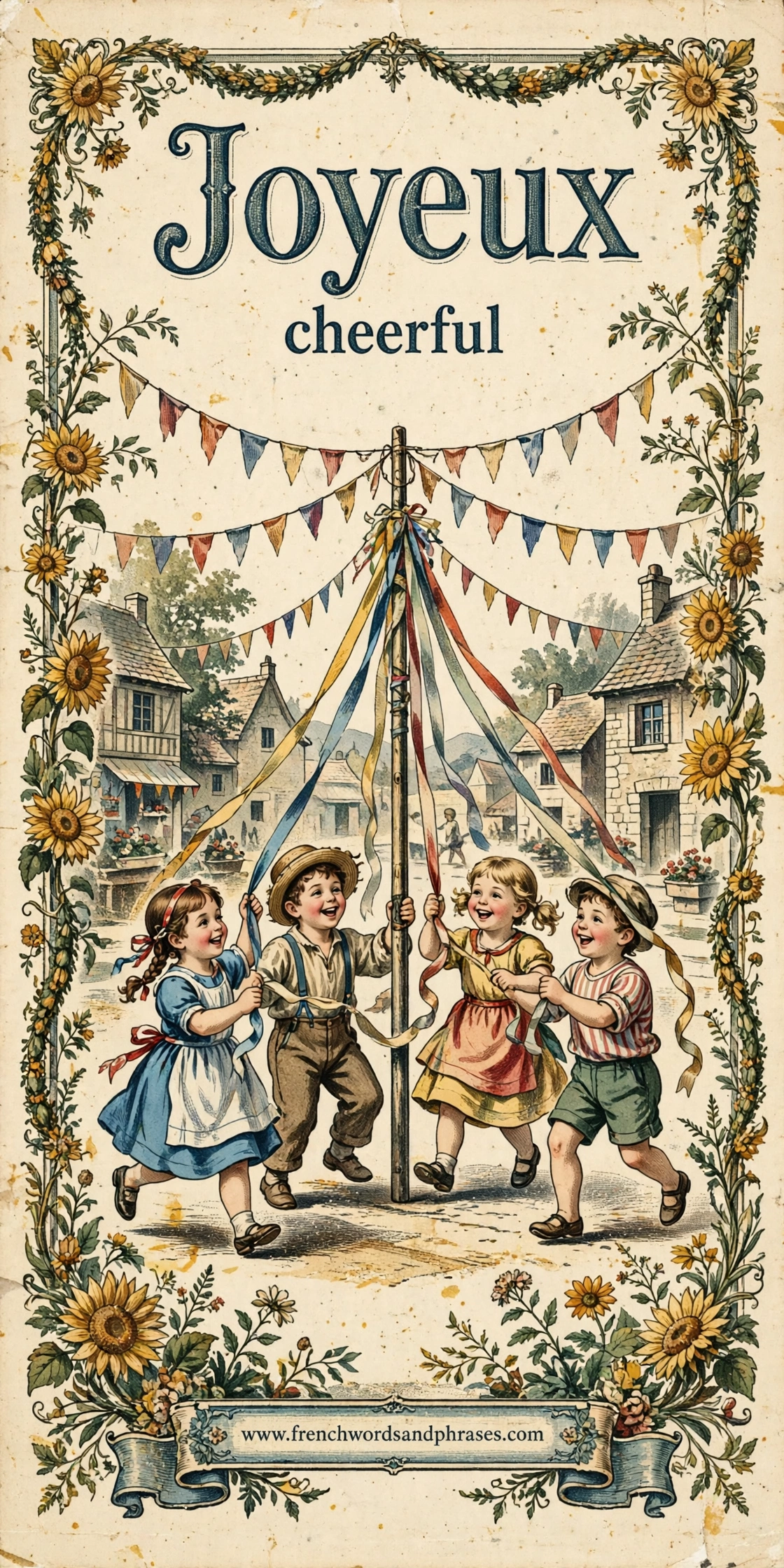
Joyeux means cheerful.
A village square on the first morning of spring: the baker is humming as he stacks his loaves, the café owner is whistling at his shutters, and even the old dog by the fountain seems to be smiling in his sleep. Nobody has won anything. Nothing special has happened. The whole square is simply joyeux.
In this guide, you’ll learn what joyeux means in English, how its feminine turns the x into an s, where it stands in the sentence, and why it steps in front of the noun in the two most famous greetings of the year. Explore French examples, English translations, and practice quizzes.
Understanding the French Adjective Joyeux
Joyeux is a French adjective of quality — the adjective of open, ringing cheerfulness. It agrees in the -eux way: joyeux for the masculine, joyeuse for the feminine, joyeux and joyeuses in the plural — the x gives way to an s whenever the word turns feminine.
It means cheerful — full of joy and visibly so, the kind of happiness that hums, laughs and fills a room. It describes people (un enfant joyeux, a cheerful child), faces and voices (une voix joyeuse, a cheerful voice), and occasions (un joyeux anniversaire, a happy birthday). Where heureux is the deep, settled feeling, joyeux is the feeling with its sleeves rolled up and a song on its lips.
Type: Adjective of quality — mood and cheerfulness
Answers the question: What is he or she like? — cheerful
Changes form: Yes — joyeux, joyeuse, joyeux, joyeuses
Feminine: joyeuse
English equivalents: Cheerful; joyful; merry.
One important usage detail: joyeux usually stands AFTER the noun — un enfant joyeux — but in France’s two most famous greetings it steps proudly in front: Joyeux Noël ! (Merry Christmas) and Joyeux anniversaire ! (Happy birthday). Those two phrases are the exception every learner already knows.
Experience the Word
Joyeux is the adjective of the humming baker and the whistling café owner — happiness that cannot keep quiet and does not try to.
Imagine a grandfather at a family lunch who starts telling a story from his youth and is soon laughing so hard he has to stop, wipe his eyes, and start again — while the whole table laughs with him, without yet knowing the end of the story.
You have not just described someone in a good mood. You have described joy you can hear from the next room.
How to Use Joyeux in French: Complete Guide
Let’s explore how joyeux works in French, beginning with the whole word on one card.
Joyeux at a Glance
Before the details, here is the whole word on one card.
The Whole Word on One Card
Meaning, type, position and forms — joyeux in four lines.
| Point | Joyeux |
|---|---|
| Meaning | cheerful |
| Type | adjective of quality — mood and cheerfulness |
| Usual position | after the noun — un enfant joyeux; before it in Joyeux Noël |
| Form | joyeux / joyeuse / joyeux / joyeuses |
Example
C’est un enfant joyeux.
He’s a cheerful child.
The Four Forms of Joyeux
Joyeux agrees with the noun it describes. The masculine ends in -eux and keeps that same spelling in the plural; the feminine trades the x for an s and adds an e.
| Form | Joyeux | Example |
|---|---|---|
| Masculine singular | joyeux | un garçon joyeux — a cheerful boy |
| Feminine singular | joyeuse | une fille joyeuse — a cheerful girl |
| Masculine plural | joyeux | des garçons joyeux — cheerful boys |
| Feminine plural | joyeuses | des filles joyeuses — cheerful girls |
Example
Mon fils est joyeux et ma fille est joyeuse.
My son is cheerful and my daughter is cheerful.
Quick Quiz 1
Which form of joyeux goes with fille (feminine)?
Reveal the answer
joyeuse
Une fille joyeuse.
A cheerful girl.
Joyeuse: The Feminine in -euse
Adjectives in -eux build their feminine in -euse: the x disappears, an s takes its place, and the word gains a soft buzzing ending, /ʒwajøz/.
| Situation | Example |
|---|---|
| The rule | -eux becomes -euse — joyeux → joyeuse |
| The sound | joyeux is /ʒwajø/, joyeuse is /ʒwajøz/ — you hear the s |
| Masculine plural | joyeux — unchanged, the x does the plural’s work |
| Feminine plural | joyeuses — des voix joyeuses |
Example
Elle a une voix joyeuse qui met tout le monde de bonne humeur.
She has a cheerful voice that puts everyone in a good mood.
Where Joyeux Goes: After the Noun — with Two Famous Exceptions
Joyeux follows the noun it describes, like most adjectives of mood. But the greetings of Christmas and birthdays put it first, and French would not have it any other way.
| Pattern | Example |
|---|---|
| After the noun | un enfant joyeux — a cheerful child |
| After être | elle est joyeuse — she is cheerful |
| Before the noun (greetings) | Joyeux Noël ! — Merry Christmas! |
| Before the noun (greetings) | Joyeux anniversaire ! — Happy birthday! |
Example
Nous avons passé une soirée joyeuse en famille.
We spent a cheerful evening with the family.
Quick Quiz 2
How do you wish someone a merry Christmas in French?
Reveal the answer
Joyeux Noël !
Here joyeux stands before the noun — the famous exception.
Merry Christmas!
More Cheerful: Comparing with Joyeux
Joyeux compares the regular way, with plus, moins and aussi — and the superlative agrees as usual: le plus joyeux, la plus joyeuse.
| Degree | Example |
|---|---|
| As cheerful as | aussi joyeux que — as cheerful as |
| More cheerful | plus joyeux — more cheerful |
| Less cheerful | moins joyeux — less cheerful |
| The most cheerful (masc.) | le plus joyeux — le plus joyeux des enfants |
| The most cheerful (fem.) | la plus joyeuse — la plus joyeuse des sœurs |
Example
Ma sœur est plus joyeuse que moi le matin.
My sister is more cheerful than me in the morning.
Everyday Expressions with Joyeux
Joyeux is the word of greetings and good company — it turns up wherever French wishes somebody well, out loud.
| Expression | In English |
|---|---|
| Joyeux Noël | Merry Christmas |
| Joyeux anniversaire | Happy birthday |
| un joyeux luron | a jolly fellow, a merry soul (old-fashioned and affectionate) |
| une humeur joyeuse | a cheerful mood |
| un joyeux repas | a merry meal, a festive dinner |
| joyeux et léger | cheerful and light-hearted |
Example
Toute la famille te souhaite un joyeux anniversaire.
The whole family wishes you a happy birthday.
Quick Quiz 3
What does une humeur joyeuse mean?
Reveal the answer
A cheerful mood
Il est d’une humeur joyeuse ce matin.
He is in a cheerful mood this morning.
Joyeux and Its Neighbours
Joyeux shares its sunny field with heureux and gai; content is quieter, and triste is the rain on the other side of the window.
| French | In English |
|---|---|
| heureux | happy — the deeper, settled feeling |
| gai | cheerful, light-hearted — close to joyeux |
| content | pleased, glad — a quieter satisfaction |
| radieux | radiant, beaming |
| de bonne humeur | in a good mood |
| triste | sad — the opposite |
Example
Elle est gaie et joyeuse, jamais triste bien longtemps.
She is bright and cheerful, never sad for long.
Watch Out: The Traps Around Joyeux
The traps here are the twin spellings of the plural, and the neighbour heureux, who feels the same joy more quietly.
| Trap | The truth |
|---|---|
| Masculine plural | joyeux keeps its x — des enfants joyeux, never ‘joyeuxs’ |
| heureux | heureux is happy in depth; joyeux is cheerful in sound and movement |
| Position | after the noun normally — but Joyeux Noël and Joyeux anniversaire come first |
| The x and the s | masculine ends in x, feminine in s — joyeux, joyeuse |
Example
Des enfants joyeux chantent dans la cour.
Cheerful children are singing in the courtyard.
Quick Quiz 4
What is the masculine plural of joyeux?
Reveal the answer
joyeux
The form does not change — the x already marks it.
Des garçons joyeux — cheerful boys.
Joyeux in Everyday French: Real-Life Examples
Now that you know the word, let’s see how joyeux appears in everyday French.
Example 1 — Morning
Mon grand-père est toujours joyeux le matin.
My grandfather is always cheerful in the morning.
Example 2 — At school
Les enfants sont joyeux pendant la récréation.
The children are cheerful during break time.
Example 3 — A greeting
Joyeux anniversaire, Marie !
Happy birthday, Marie!
Example 4 — At the café
Le serveur est joyeux et accueille tout le monde avec un sourire.
The waiter is cheerful and greets everyone with a smile.
Example 5 — Family
Elle a une voix joyeuse qui rassure les enfants.
She has a cheerful voice that reassures the children.
Example 6 — Christmas
Nous vous souhaitons un joyeux Noël et une bonne année.
We wish you a merry Christmas and a happy new year.
Beyond Translation: The Meaning of Joyeux
English says cheerful for the meaning of joyeux — but the French word is built on joie, joy itself, and it behaves like it: where heureux sits deep and quiet, joyeux gets up, hums, whistles and wishes you well out loud.
Joyeux is happiness with a voice.
That is why the word owns the greetings — no one whispers Joyeux Noël. It is sung at doors, written in cards and called across squares, the feeling and the sound of the feeling in a single word.
How to Remember the French Adjective Joyeux
Remember it this way: Joyeux is the cheerful adjective — built on joie, feminine in -euse, and standing before the noun in the two greetings everyone knows.
- You trade the x for an s in the feminine — joyeux, joyeuse.
- You leave the masculine plural alone — des enfants joyeux, the x is already there.
- You put it first for the big days — Joyeux Noël, Joyeux anniversaire.
The key idea is joyeux turns into joyeuse in the feminine, and it leads the greetings Joyeux Noël and Joyeux anniversaire.
Test Your Knowledge of Joyeux
Let’s see how much you’ve learned. Try answering these questions before revealing the answers.
Question 1
What does joyeux mean?
Reveal the answer
Cheerful — full of joy, visibly and audibly happy.
Question 2
What is the feminine of joyeux?
Reveal the answer
joyeuse — the -eux ending becomes -euse.
Question 3
Translate: a cheerful child.
Reveal the answer
Un enfant joyeux.
Question 4
Complete the sentence:
______ Noël à toute la famille !
Reveal the answer
Joyeux
Joyeux Noël à toute la famille !
Merry Christmas to the whole family!
Question 5
What is the masculine plural of joyeux?
Reveal the answer
joyeux — unchanged; the x does the work of the plural.
Your Final Challenge
Can You Use It?
How would you say this in French?
“The children are cheerful because today is a holiday.”
Reveal the answer
Les enfants sont joyeux parce qu’aujourd’hui c’est un jour de fête.
The children are cheerful because today is a holiday.
A little French. A little curiosity. A richer everyday life.
LEARN FRENCH ONE WORD AT A TIME