A French Word to Live By
Translate Rail to English
/ʁaj/
Le rail means the rail.
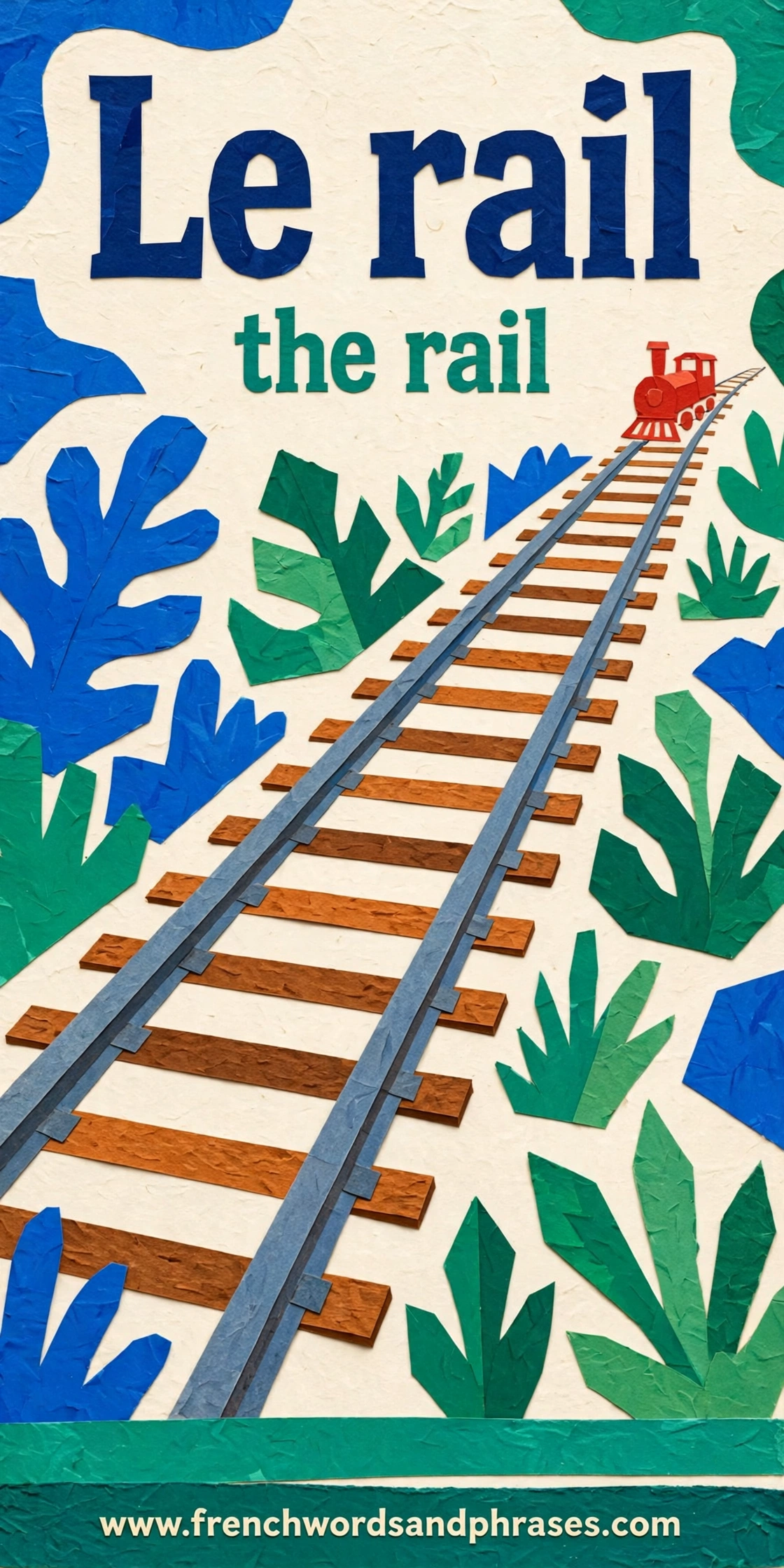
Two ribbons of steel running out of the station into the morning mist, polished bright by a thousand wheels: le rail, the rail — the line a train cannot leave, and by extension the whole world of the railway in a single borrowed word.
In this guide, you’ll learn what rail means in English, how to use it with its articles, how to form its plural, and how it appears in everyday French. Explore French examples, English translations, and practice quizzes.
Understanding the French Noun Rail
Rail is a masculine French noun, learned with its article: le rail, un rail. It is a loanword from English rail, adopted when the railways were built — and French kept it for the steel bar itself and for rail transport as a whole: le rail can mean the track, the train network, travelling by train. The train runs on deux rails joined by des traverses, sleepers.
It means a rail — the steel bar of the track: un rail d’acier, a steel rail, les rails du tramway, the tram rails set into the street. By extension it is the railway world: voyager par le rail, to travel by rail, le transport par rail, rail transport, sortir des rails, to come off the rails — literally, and figuratively for a life or a project going astray. A handrail on stairs is not a rail but une rampe or une main courante; the rail belongs to trains.
Gender: Masculine — le rail
Definite article: le — le rail (the rail)
Indefinite article: un — un rail (a rail)
Plural: les rails — regular, with a simple -s
Spelling note: borrowed from English rail when the railways came — one of industry’s loanwords
Close neighbours: la voie — the track as a whole; une traverse — a sleeper; une rampe — a handrail
English equivalents: The rail; rail transport, the railway.
French thinks of the railway through this word: le rail against la route — rail against road, in every transport debate. The figure of speech is alive: remettre sur les rails, to put back on the rails, to get a project back on track; sortir des rails, to go off the rails. For the track as a numbered platform line, the word is la voie: le train part de la voie trois.
Experience the Word
Rail is the line of no wandering — the train’s whole freedom is to follow it perfectly, and its whole disaster is to leave it.
Imagine the level crossing at dawn: the barriers down, the mist low, and then the express arriving like weather — two bright rails humming a second before the train itself appears.
You have not just named a bar of steel. You have named the discipline of the journey — le rail, the line that decides the way.
How to Use Rail in French: Complete Guide
Let’s explore how rail works in French, beginning with its articles — le rail, un rail, voyager par le rail.
Rail with the Definite Article (Le, Les)
Used for the rail itself, or rail transport in general.
| Form | French |
|---|---|
| Masculine singular | le rail |
| Plural | les rails |
Example
Le rail brille sous le soleil du matin.
The rail shines in the morning sun.
Rail with the Indefinite Article (Un, Des)
Used for one rail among the pair — a bar of steel to lift, check or replace.
| Form | French |
|---|---|
| Masculine singular | un rail |
| Plural | des rails |
Example
Les ouvriers remplacent un rail cassé.
The workers are replacing a broken rail.
Rail with Its Frames (Par le rail, Des rails…)
Rails are travelled by, come off, and are put back on — the frames of the railway.
| Quantity | French |
|---|---|
| by rail | par le rail |
| to come off the rails | sortir des rails |
| to put back on track | remettre sur les rails |
| the tram rails | les rails du tramway |
| a steel rail | un rail d’acier |
Example
Le projet est remis sur les rails après la réunion.
The project is back on track after the meeting.
Quick Quiz 1
Complete the sentence:
______ rail gauche est plus usé que l’autre. (the)
Reveal the answer
Le
Le rail gauche est plus usé que l’autre.
The left rail is more worn than the other — rail is masculine, so le.
The Plural of Rail
Rail takes a regular plural in -s — the pair of steel lines every train needs.
| Number | French |
|---|---|
| Singular | le rail |
| Plural | les rails |
Example
Les rails traversent la plaine jusqu’à l’horizon.
The rails cross the plain to the horizon.
Rail with Possessive Adjectives (Mon, Ton, Son…)
Possessives agree with the noun: rail is masculine, so mon, ton, son in the singular.
| Owner | French |
|---|---|
| my | mon rail |
| your (tu) | ton rail |
| his / her | son rail |
| our | notre rail |
| your (vous) | votre rail |
| their | leur rail |
Example
Le petit train de jardin roule sur son rail de cuivre.
The little garden train runs on its copper rail.
Quick Quiz 2
Complete the sentence:
Le tramway roule sur ______ rails en ville. (its)
Reveal the answer
ses
Le tramway roule sur ses rails en ville.
The tram runs on its rails in town — ses, plural possessive for les rails.
Rail with Demonstrative Adjectives (Ce, Ces)
Used to point: ce rail, this rail — the one being repaired, the one that shines.
| Form | French |
|---|---|
| Masculine singular | ce rail |
| Plural | ces rails |
Example
Ce rail est tordu, il faut le changer.
This rail is bent, it must be replaced.
Rail with Adjectives
Adjectives agree with rail — masculine singular: un rail neuf, un rail rouillé.
| Adjective | With Rail |
|---|---|
| neuf (new) | un rail neuf |
| rouillé (rusty) | un rail rouillé |
| brillant (shining) | un rail brillant |
| cassé (broken) | un rail cassé |
| parallèle (parallel) | des rails parallèles |
Example
Un rail rouillé attend près de la voie abandonnée.
A rusty rail lies waiting by the abandoned track.
Quick Quiz 3
Complete the sentence:
Le train est sorti des ______. (rails)
Reveal the answer
rails
Le train est sorti des rails.
The train came off the rails — rails, plural.
Everyday Expressions with Rail
Stations, projects and derailments — the rail phrases of daily life.
| Expression | In English |
|---|---|
| voyager par le rail | to travel by rail |
| sortir des rails | to come off the rails, to go astray |
| remettre sur les rails | to put back on track |
| le transport par rail | rail transport |
| les rails du tramway | the tram rails |
Example
Après des mois de retard, le projet est remis sur les rails.
After months of delay, the project is back on track.
Words from the Same Family as Rail
The railway world — the words that travel with rail.
| French | In English |
|---|---|
| la voie | the track, the line (voie trois, platform 3) |
| une traverse | a sleeper, a tie |
| un train | a train |
| un chemin de fer | a railway — literally, an iron road |
| un aiguillage | points, a switch |
Example
Le chemin de fer suit la rivière depuis un siècle.
The railway has followed the river for a century.
Quick Quiz 4
What does remettre un projet sur les rails mean?
Reveal the answer
To put a project back on track — the rails guide the train, and the project, back to its course.
La nouvelle équipe a remis le projet sur les rails.
The new team put the project back on track.
Rail in Everyday French: Real-Life Examples
Now that you know the word, let’s see how rail appears in everyday French.
Example 1 — Travel
Nous voyageons par le rail chaque été.
We travel by rail every summer.
Example 2 — The station
Les rails brillent après la pluie.
The rails shine after the rain.
Example 3 — Repairs
Un rail cassé bloque la ligne.
A broken rail is blocking the line.
Example 4 — A project
Le projet est enfin remis sur les rails.
The project is finally back on track.
Example 5 — The tram
Les rails du tramway traversent la place.
The tram rails cross the square.
Example 6 — Warning
Ne marchez jamais sur les rails.
Never walk on the rails.
Beyond Translation: The Meaning of Rail
Rail is English steel naturalised French: when the first chemins de fer were laid, the bar itself kept its English name, and the word grew from the bar to the whole system — le rail against la route in every debate about how France should move.
To say rail is to hear the express coming.
It evokes the humming steel at the level crossing, the project rescued and remis sur les rails, and the bright pair of lines running to the horizon.
How to Remember the French Noun Rail
Remember it this way: Rail is the steel line and the whole railway — masculine: le rail, voyager par le rail.
- Always masculine — le rail, un rail, mon rail.
- The figure of speech — remettre sur les rails, to put back on track; sortir des rails, to go astray.
- Not the handrail — stairs take une rampe; the rail belongs to trains.
The key idea is le rail — the rail, masculine; remettre sur les rails = to put back on track.
Test Your Knowledge of Rail
Let’s see how much you’ve learned. Try answering these questions before revealing the answers.
Question 1
Is rail masculine or feminine?
Reveal the answer
Masculine — le rail, un rail.
Question 2
How do you say to travel by rail?
Reveal the answer
Voyager par le rail.
Question 3
Translate: The project is back on track.
Reveal the answer
Le projet est remis sur les rails.
Question 4
What is la voie at a station?
Reveal the answer
The track or line — le train part de la voie trois, the train leaves from platform 3.
Question 5
Complete the sentence:
______ rails traversent la plaine. (the)
Reveal the answer
Les
Les rails traversent la plaine.
The rails cross the plain.
Your Final Challenge
Can You Use It?
How would you say this in French?
“The project is finally back on track.”
Reveal the answer
Le projet est enfin remis sur les rails.
The project is finally back on track.
A little French. A little curiosity. A richer everyday life.
LEARN FRENCH ONE WORD AT A TIME