
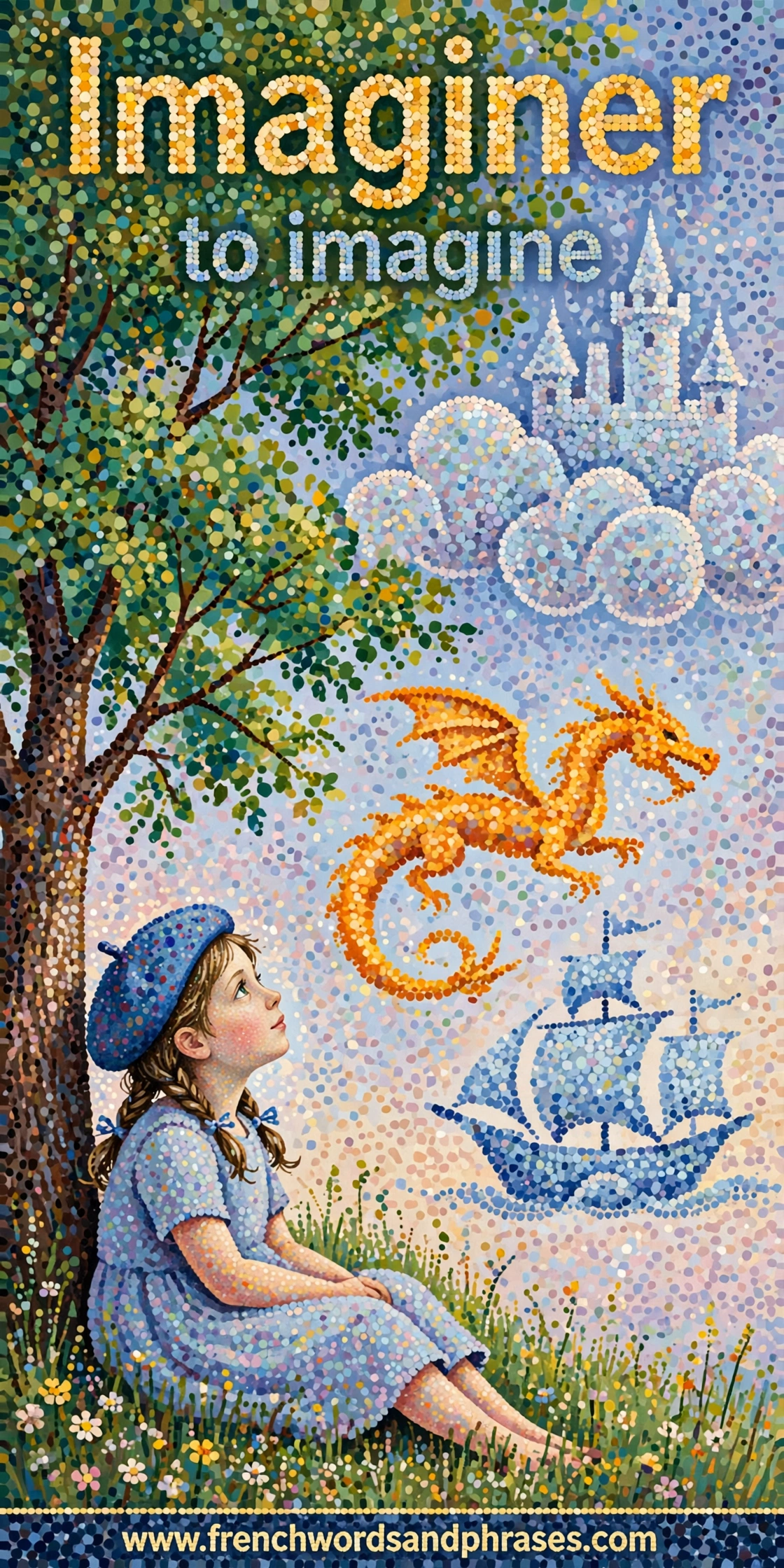
A French Word to Live By
How to Conjugate Imaginer in French
/i.ma.ʒi.ne/
Imaginer means to imagine — to form a picture in the mind of something absent, impossible or not yet real: a face you have never seen, a house you will build, a life you might have lived.
A child turning a cardboard box into a ship, a novelist hearing voices in an empty room, an engineer seeing a bridge across a gorge that is still only wind — imaginer is the verb of the mind’s eye: what it pictures does not exist yet, and sometimes, thanks to it, soon will.
In this guide, you’ll learn how to conjugate imaginer in all the major French tenses and moods. Explore complete conjugation tables, French examples, English translations, and practice quizzes.
Understanding the French Verb Imaginer
Imaginer is a regular French verb belonging to the first group of verbs, those ending in-er.
It means to imagine. Imaginer covers both the creative picture (imaginer une histoire, to make up a story) and the supposition (j’imagine qu’il est fatigué — I imagine he is tired, I suppose so). Its noun is l’imagination, and its adjective imaginable — with the useful negative: ce n’est pas imaginable, it is beyond imagining.
Verb classification: First group (-er)
Auxiliary verb: Avoir
Past participle: imaginé
Present participle: imaginant
English equivalents: To imagine, to picture, to suppose; imaginer un monde — to imagine a world; imagine ! — just imagine!; je n’imagine pas — I can’t imagine; s’imaginer — to imagine oneself, to fancy (often wrongly); imaginer que — to imagine/suppose that.
One important detail: imaginer is a perfectly regular -er verb — j’imagine, nous imaginons, ils imaginent, past participle imaginé. Watch its reflexive twin s’imaginer, which adds a shade of (often mistaken) belief: il s’imagine que tout le monde l’écoute — he imagines (fancies) that everyone listens to him. And the everyday cry of wonder is the imperative: imagine ! or imaginez ! — just imagine!
Experience the Word
Imaginer is the verb of the inner cinema — the one faculty that lets a person live in two worlds at once.
Imagine the architect’s empty office at midnight, the gorge still bridgeless on the map. She closes her eyes and imagine le pont: the arc, the cables, the first car crossing at dawn. The drawing begins the next morning; the imagining began it months before.
The bridge was real first where nobody could see it. Imaginé — pictured in the mind, then built in the world.
How to Conjugate Imaginer: Complete French Conjugation Guide
Let’s explore every major conjugation of imaginer, beginning with the indicative mood.
How to Conjugate Imaginer in the Indicative Mood
The indicative mood is used to express facts, observations, actions, and events.
How to Conjugate Imaginer in the Present Tense (Présent)
Used for actions happening now, habitual actions, and general truths.
| Subject | Conjugation |
|---|---|
| je | imagine |
| tu | imagines |
| il / elle | imagine |
| nous | imaginons |
| vous | imaginez |
| ils / elles | imaginent |
Example
Les enfants imaginent un château dans le jardin.
The children are imagining a castle in the garden.
Quick Quiz 1
Complete the sentence:
Nous ______ une maison près de la mer.
Reveal the answer
imaginons
Nous imaginons une maison près de la mer.
We are imagining a house by the sea.
How to Conjugate Imaginer in the Passé Composé
Used for completed actions in the past. Imaginer takes the auxiliary verb avoir.
| Subject | Conjugation |
|---|---|
| j’ | ai imaginé |
| tu | as imaginé |
| il / elle | a imaginé |
| nous | avons imaginé |
| vous | avez imaginé |
| ils / elles | ont imaginé |
Example
Elle a imaginé toute l’histoire en une nuit.
She imagined the whole story in one night.
How to Conjugate Imaginer in the Imparfait (Imperfect Tense)
Used for habitual past actions, descriptions, and ongoing situations in the past.
| Subject | Conjugation |
|---|---|
| je | imaginais |
| tu | imaginais |
| il / elle | imaginait |
| nous | imaginions |
| vous | imaginiez |
| ils / elles | imaginaient |
Example
Enfant, il imaginait des dragons derrière chaque porte.
As a child, he used to imagine dragons behind every door.
Quick Quiz 2
Choose the correct form:
She imagined the whole story.
Elle ______ toute l’histoire. (a imaginé / est imaginée)
Reveal the answer
a imaginé
Elle a imaginé toute l’histoire.
Imaginer takes avoir.
How to Conjugate Imaginer in the Plus-que-parfait
Used to describe an action that had already been completed before another past event.
| Subject | Conjugation |
|---|---|
| j’ | avais imaginé |
| tu | avais imaginé |
| il / elle | avait imaginé |
| nous | avions imaginé |
| vous | aviez imaginé |
| ils / elles | avaient imaginé |
Example
Nous avions imaginé une maison plus grande et plus claire.
We had imagined a bigger, brighter house.
How to Conjugate Imaginer in the Passé Simple
Primarily used in formal writing, literature, and historical narratives. It is rarely used in everyday conversation.
| Subject | Conjugation |
|---|---|
| je | imaginai |
| tu | imaginas |
| il / elle | imagina |
| nous | imaginâmes |
| vous | imaginâtes |
| ils / elles | imaginèrent |
Example
Le poète imagina un monde sans frontières.
The poet imagined a world without borders.
How to Conjugate Imaginer in the Passé Antérieur
A literary tense used to express an action completed immediately before another past action, generally in the passé simple.
| Subject | Conjugation |
|---|---|
| j’ | eus imaginé |
| tu | eus imaginé |
| il / elle | eut imaginé |
| nous | eûmes imaginé |
| vous | eûtes imaginé |
| ils / elles | eurent imaginé |
Example
Quand il eut imaginé le pont, il se mit au dessin.
When he had imagined the bridge, he set to drawing.
How to Conjugate Imaginer in the Future Tense (Futur Simple)
Used to describe actions that will take place in the future.
| Subject | Conjugation |
|---|---|
| je | imaginerai |
| tu | imagineras |
| il / elle | imaginera |
| nous | imaginerons |
| vous | imaginerez |
| ils / elles | imagineront |
Example
Tu imagineras la fin de l’histoire toi-même.
You will imagine the end of the story yourself.
How to Conjugate Imaginer in the Futur Antérieur (Future Perfect)
Used for an action that will have been completed before a particular point in the future.
| Subject | Conjugation |
|---|---|
| j’ | aurai imaginé |
| tu | auras imaginé |
| il / elle | aura imaginé |
| nous | aurons imaginé |
| vous | aurez imaginé |
| ils / elles | auront imaginé |
Example
À Noël, les enfants auront imaginé mille jouets.
By Christmas, the children will have imagined a thousand toys.
How to Conjugate Imaginer in the Near Future (Futur Proche)
Used to describe something that is going to happen soon. Formed with aller + infinitive.
| Subject | Conjugation |
|---|---|
| je | vais imaginer |
| tu | vas imaginer |
| il / elle | va imaginer |
| nous | allons imaginer |
| vous | allez imaginer |
| ils / elles | vont imaginer |
Example
Je vais imaginer la scène avant de l’écrire.
I am going to imagine the scene before writing it.
How to Conjugate Imaginer in the Conditional Mood
The conditional mood expresses what would happen under certain circumstances. It is also frequently used to make polite requests or express wishes.
How to Conjugate Imaginer in the Present Conditional
| Subject | Conjugation |
|---|---|
| je | imaginerais |
| tu | imaginerais |
| il / elle | imaginerait |
| nous | imaginerions |
| vous | imagineriez |
| ils / elles | imagineraient |
Example
J’imaginerais volontiers une vie à la campagne.
I would gladly imagine a life in the countryside.
How to Conjugate Imaginer in the Past Conditional
| Subject | Conjugation |
|---|---|
| j’ | aurais imaginé |
| tu | aurais imaginé |
| il / elle | aurait imaginé |
| nous | aurions imaginé |
| vous | auriez imaginé |
| ils / elles | auraient imaginé |
Example
Nous aurions imaginé un meilleur plan avec plus de temps.
We would have imagined a better plan with more time.
Imaginer in the Literary Past Conditional Form
This less common literary form uses the imperfect subjunctive of avoir.
| Subject | Conjugation |
|---|---|
| j’ | eusse imaginé |
| tu | eusses imaginé |
| il / elle | eût imaginé |
| nous | eussions imaginé |
| vous | eussiez imaginé |
| ils / elles | eussent imaginé |
Example
Le romancier eût imaginé une autre fin sans son éditeur.
The novelist would have imagined another ending, had it not been for his publisher.
How to Conjugate Imaginer in the Subjunctive Mood
The subjunctive is used to express wishes, emotions, doubts, necessity, and uncertainty. It frequently follows expressions such as il faut que (it is necessary that) or bien que (although).
How to Conjugate Imaginer in the Present Subjunctive
| Subject | Conjugation |
|---|---|
| que je | imagine |
| que tu | imagines |
| qu’il / qu’elle | imagine |
| que nous | imaginions |
| que vous | imaginiez |
| qu’ils / qu’elles | imaginent |
Example
Il faut que tu imagines la scène en détail.
You must imagine the scene in detail.
Quick Quiz 3
Complete the sentence using the subjunctive:
Je suis étonné qu’elle ______ tout cela seule.
Reveal the answer
ait imaginé
Je suis étonné qu’elle ait imaginé tout cela seule.
I am amazed she imagined all that alone.
How to Conjugate Imaginer in the Imperfect Subjunctive
A literary tense, rarely encountered in modern spoken French.
| Subject | Conjugation |
|---|---|
| que je | imaginasse |
| que tu | imaginasses |
| qu’il / qu’elle | imaginât |
| que nous | imaginassions |
| que vous | imaginassiez |
| qu’ils / qu’elles | imaginassent |
Example
On ne pensait pas qu’il imaginât de telles choses.
Nobody thought he imagined such things.
How to Conjugate Imaginer in the Pluperfect Subjunctive
A literary construction used to express an action completed before another past action.
| Subject | Conjugation |
|---|---|
| que j’ | eusse imaginé |
| que tu | eusses imaginé |
| qu’il / qu’elle | eût imaginé |
| que nous | eussions imaginé |
| que vous | eussiez imaginé |
| qu’ils / qu’elles | eussent imaginé |
Example
On racontait que l’inventeur eût imaginé la machine en rêve.
People said the inventor had imagined the machine in a dream.
How to Conjugate Imaginer in the Past Subjunctive
| Subject | Conjugation |
|---|---|
| que j’ | aie imaginé |
| que tu | aies imaginé |
| qu’il / qu’elle | ait imaginé |
| que nous | ayons imaginé |
| que vous | ayez imaginé |
| qu’ils / qu’elles | aient imaginé |
Example
Je suis étonné qu’elle ait imaginé tout cela seule.
I am amazed she imagined all that on her own.
How to Conjugate Imaginer in the Imperative
The imperative is used to give commands, instructions, invitations, or suggestions. Subject pronouns are omitted.
How to Conjugate Imaginer in the Present Imperative
| Person | Conjugation |
|---|---|
| (tu) | imagine |
| (nous) | imaginons |
| (vous) | imaginez |
Example
Imagine un monde sans voitures, juste une minute !
Imagine a world without cars, just for a minute!
Quick Quiz 4
How would you say Imagine a castle (tu form)?
Reveal the answer
Imagine un château !
French Participles of Imaginer
Participles are verb forms that can be used in compound tenses and other grammatical constructions.
Present Participle of Imaginer
imaginant
En imaginant le pire, il a préparé le meilleur.
By imagining the worst, he prepared for the best.
Past Participle of Imaginer
imaginé
Imaginée par un enfant, la machine vole et parle.
Imagined by a child, the machine flies and talks.
Imaginer in Everyday French: Real-Life Examples
Now that you know the conjugations, let’s see how imaginer appears in everyday French.
Example 1 — Present
Les enfants imaginent un château.
The children are imagining a castle.
Example 2 — Passé composé
Elle a imaginé toute l’histoire.
She imagined the whole story.
Example 3 — Imparfait
Il imaginait des dragons partout.
He used to imagine dragons everywhere.
Example 4 — Future
Tu imagineras la fin toi-même.
You will imagine the ending yourself.
Example 5 — Conditional
J’imaginerais une vie à la campagne.
I would imagine a life in the countryside.
Example 6 — Imperative
Imagine un monde sans voitures !
Imagine a world without cars!
Beyond Translation: The Meaning of Imaginer
English imagine and French imaginer are the same Latin image-making verb — but French keeps the reflexive shadow s’imaginer, where the imagining turns inward and becomes a flattering error: he imagines himself admired, indispensable, understood.
One verb for the dream, one letter more for the delusion.
Between the architect’s bridge and the child’s dragon, imaginer is the verb that builds everything twice: once in the mind, once in the world.
How to Remember the French Verb Imaginer
Remember it this way: Imaginer is about the bridge pictured at midnight, months before the first drawing.
- Regular -er: j’imagine, nous imaginons, imaginé — no traps in the forms.
- Imagine ! is the everyday cry — just imagine!
- S’imaginer means to fancy oneself — often a polite way of saying someone is wrong.
The key idea is the bridge pictured at midnight, months before the first drawing.
Test Your Knowledge of Imaginer
Let’s see how much you’ve learned. Try answering these questions before revealing the answers.
Question 1
How do you say Just imagine! in French (tu form)?
Reveal the answer
Imagine ! — the imperative of imaginer.
Question 2
How do you say She imagined the whole story in one night in French?
Reveal the answer
Elle a imaginé toute l’histoire en une nuit.
Question 3
Translate: As a child, he used to imagine dragons behind every door.
Reveal the answer
Enfant, il imaginait des dragons derrière chaque porte.
Question 4
What is the past participle of imaginer?
Reveal the answer
Imaginé.
Question 5
Complete the sentence:
Il faut que tu ______ la scène en détail.
Reveal the answer
imagines
Il faut que tu imagines la scène en détail.
You must imagine the scene in detail.
Your Final Challenge
Can You Use It?
How would you say this in French?
Imagine a bridge where there is only wind: that is how every building begins.
Reveal the answer
Imagine un pont là où il n’y a que du vent : c’est ainsi que commencent toutes les constructions.
Imagine a bridge where there is only wind: that is how every building begins.
A little French. A little curiosity. A richer everyday life.
LEARN FRENCH ONE WORD AT A TIME




