
A French Word to Live By
How to Conjugate Raconter in French
/ʁa.kɔ̃.te/
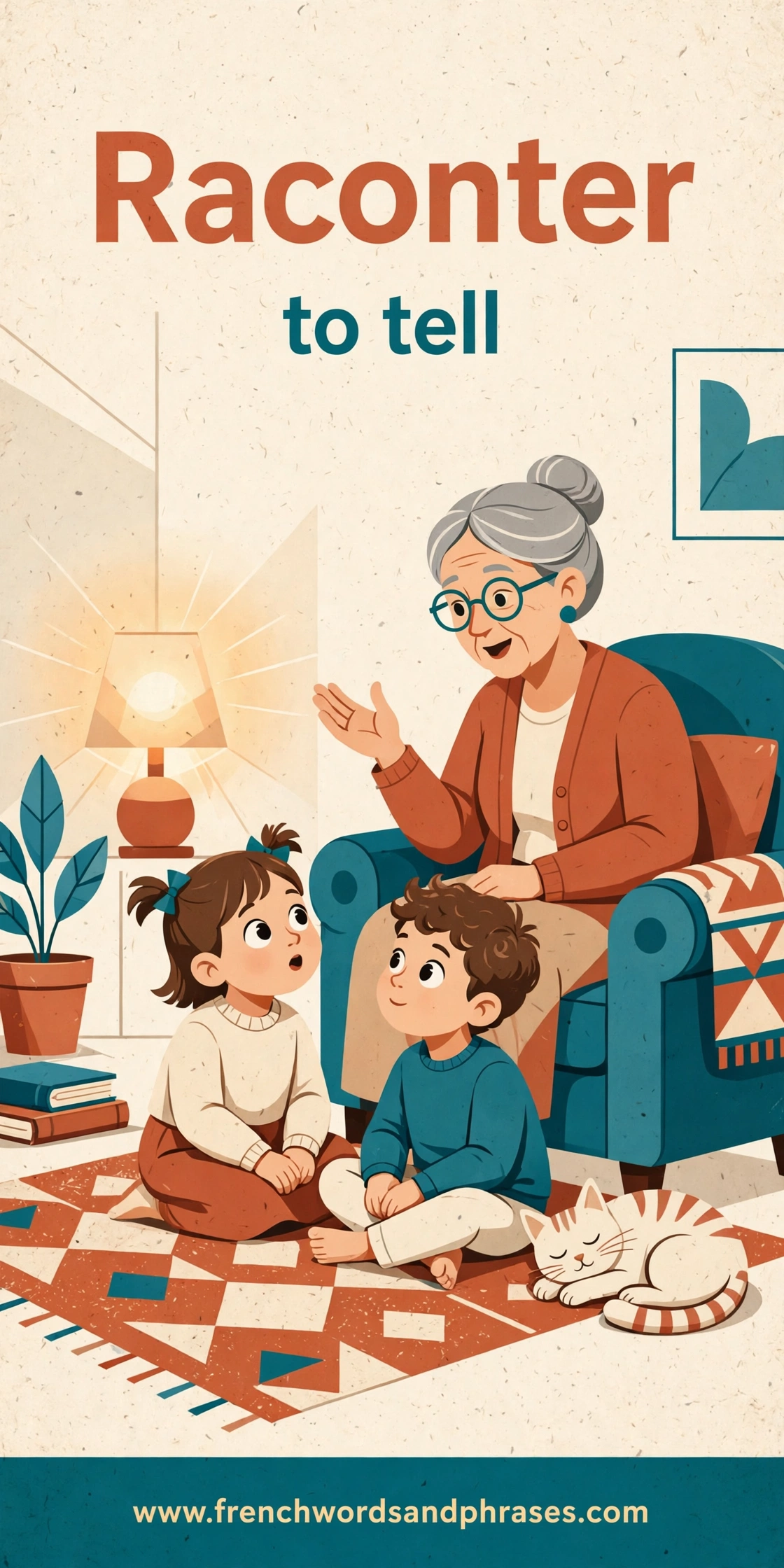
Raconter means to tell.
A grandfather with a child on each knee, a traveller back from the desert, a friend who keeps you past midnight with one more story — raconter is the verb of telling: tales, days, lives, and occasionally cheerful nonsense.
In this guide, you’ll learn how to conjugate raconter in all the major French tenses and moods. Explore complete conjugation tables, French examples, English translations, and practice quizzes.
Understanding the French Verb Raconter
Raconter is a regular French verb belonging to the first group of verbs, those ending in -er.
It means to tell. It is commonly used for telling stories and anecdotes, for recounting your day, a trip or an adventure, for grandparents’ tales and bedtime stories, and — with a smile — for fibs and nonsense: ne raconte pas d’histoires !, don’t tell tales!
Verb classification: First group (-er)
Auxiliary verb: Avoir
Past participle: raconté
Present participle: racontant
English equivalents: To tell, to recount, to relate; raconter des histoires — to tell stories (or fibs); se raconter des histoires — to kid oneself.
One important detail: raconter tells stories, while dire says things — raconte-moi ta journée asks for the tale, not the headline. The verb has a mischievous side: raconter n’importe quoi is to talk nonsense, raconter des salades is to spin yarns, and qu’est-ce que tu me racontes là ? means what on earth are you telling me? The reflexive se raconter turns the telling inward or between friends: ils se racontent leurs vacances, they tell each other about their holidays; il se raconte des histoires, he is kidding himself.
Experience the Word
Raconter is the verb of the held audience — the room goes quiet, the teller warms up, and time stretches.
Imagine a winter evening in a farmhouse kitchen. The grandfather begins the story of the wolf and the frozen river, the same story as last year, word for word — and nobody, not even the teenagers, would dream of asking him to change a line.
Nothing has simply been said. It has been told — unfolded, paced, savoured.
How to Conjugate Raconter: Complete French Conjugation Guide
Let’s explore every major conjugation of raconter, beginning with the indicative mood.
How to Conjugate Raconter in the Indicative Mood
The indicative mood is used to express facts, observations, actions, and events.
How to Conjugate Raconter in the Present Tense (Présent)
Used for actions happening now, habitual actions, and general truths.
| Subject | Conjugation |
|---|---|
| je | raconte |
| tu | racontes |
| il / elle | raconte |
| nous | racontons |
| vous | racontez |
| ils / elles | racontent |
Example
Mon grand-père raconte toujours la même histoire de loup.
My grandfather always tells the same wolf story.
Quick Quiz 1
Complete the sentence:
Nous ______ nos vacances aux voisins.
Reveal the answer
racontons
Nous racontons nos vacances aux voisins.
We tell the neighbours about our holidays.
How to Conjugate Raconter in the Passé Composé
Used for completed actions in the past. Raconter takes the auxiliary verb avoir.
| Subject | Conjugation |
|---|---|
| j’ | ai raconté |
| tu | as raconté |
| il / elle | a raconté |
| nous | avons raconté |
| vous | avez raconté |
| ils / elles | ont raconté |
Example
Elle nous a raconté son voyage au Canada.
She told us about her trip to Canada.
How to Conjugate Raconter in the Imparfait (Imperfect Tense)
Used for habitual past actions, descriptions, and ongoing situations in the past.
| Subject | Conjugation |
|---|---|
| je | racontais |
| tu | racontais |
| il / elle | racontait |
| nous | racontions |
| vous | racontiez |
| ils / elles | racontaient |
Example
Le soir, ma mère racontait des contes avant le coucher.
In the evening, my mother used to tell tales before bedtime.
Quick Quiz 2
Choose the correct form:
She told the truth.
Elle ______ la vérité. (a raconté / est racontée)
Reveal the answer
a raconté
Elle a raconté la vérité.
Raconter takes avoir.
How to Conjugate Raconter in the Plus-que-parfait
Used to describe an action that had already been completed before another past event.
| Subject | Conjugation |
|---|---|
| j’ | avais raconté |
| tu | avais raconté |
| il / elle | avait raconté |
| nous | avions raconté |
| vous | aviez raconté |
| ils / elles | avaient raconté |
Example
Il avait raconté cette anecdote cent fois.
He had told that anecdote a hundred times.
How to Conjugate Raconter in the Passé Simple
Primarily used in formal writing, literature, and historical narratives. It is rarely used in everyday conversation.
| Subject | Conjugation |
|---|---|
| je | racontai |
| tu | racontas |
| il / elle | raconta |
| nous | racontâmes |
| vous | racontâtes |
| ils / elles | racontèrent |
Example
Le voyageur raconta son aventure au village entier.
The traveller recounted his adventure to the whole village.
How to Conjugate Raconter in the Passé Antérieur
A literary tense used to express an action completed immediately before another past action, generally in the passé simple.
| Subject | Conjugation |
|---|---|
| j’ | eus raconté |
| tu | eus raconté |
| il / elle | eut raconté |
| nous | eûmes raconté |
| vous | eûtes raconté |
| ils / elles | eurent raconté |
Example
Quand elle eut raconté la fin, les enfants applaudirent.
When she had told the ending, the children applauded.
How to Conjugate Raconter in the Future Tense (Futur Simple)
Used to describe actions that will take place in the future.
| Subject | Conjugation |
|---|---|
| je | raconterai |
| tu | raconteras |
| il / elle | racontera |
| nous | raconterons |
| vous | raconterez |
| ils / elles | raconteront |
Example
Ce soir, je raconterai l’histoire du phare et de la tempête.
This evening, I will tell the story of the lighthouse and the storm.
How to Conjugate Raconter in the Futur Antérieur (Future Perfect)
Used for an action that will have been completed before a particular point in the future.
| Subject | Conjugation |
|---|---|
| j’ | aurai raconté |
| tu | auras raconté |
| il / elle | aura raconté |
| nous | aurons raconté |
| vous | aurez raconté |
| ils / elles | auront raconté |
Example
À la fin de la soirée, il aura raconté toutes ses aventures.
By the end of the evening, he will have told all his adventures.
How to Conjugate Raconter in the Near Future (Futur Proche)
Used to describe something that is going to happen soon. Formed with aller + infinitive.
| Subject | Conjugation |
|---|---|
| je | vais raconter |
| tu | vas raconter |
| il / elle | va raconter |
| nous | allons raconter |
| vous | allez raconter |
| ils / elles | vont raconter |
Example
Assieds-toi, je vais te raconter quelque chose d’incroyable.
Sit down, I am going to tell you something incredible.
How to Conjugate Raconter in the Conditional Mood
The conditional mood expresses what would happen under certain circumstances. It is also frequently used to make polite requests or express wishes.
How to Conjugate Raconter in the Present Conditional
| Subject | Conjugation |
|---|---|
| je | raconterais |
| tu | raconterais |
| il / elle | raconterait |
| nous | raconterions |
| vous | raconteriez |
| ils / elles | raconteraient |
Example
Avec un public pareil, je raconterais des histoires toute la nuit.
With an audience like this, I would tell stories all night.
How to Conjugate Raconter in the Past Conditional
| Subject | Conjugation |
|---|---|
| j’ | aurais raconté |
| tu | aurais raconté |
| il / elle | aurait raconté |
| nous | aurions raconté |
| vous | auriez raconté |
| ils / elles | auraient raconté |
Example
Elle aurait raconté la vérité si on le lui avait demandé.
She would have told the truth if she had been asked.
Raconter in the Literary Past Conditional Form
This less common literary form uses the imperfect subjunctive of avoir.
| Subject | Conjugation |
|---|---|
| j’ | eusse raconté |
| tu | eusses raconté |
| il / elle | eût raconté |
| nous | eussions raconté |
| vous | eussiez raconté |
| ils / elles | eussent raconté |
Example
Le conteur eût raconté mille histoires pour un repas chaud.
The storyteller would have told a thousand tales for a hot meal.
How to Conjugate Raconter in the Subjunctive Mood
The subjunctive is used to express wishes, emotions, doubts, necessity, and uncertainty. It frequently follows expressions such as il faut que (it is necessary that) or bien que (although).
How to Conjugate Raconter in the Present Subjunctive
| Subject | Conjugation |
|---|---|
| que je | raconte |
| que tu | racontes |
| qu’il / qu’elle | raconte |
| que nous | racontions |
| que vous | racontiez |
| qu’ils / qu’elles | racontent |
Example
Les enfants veulent que je raconte encore une histoire.
The children want me to tell one more story.
Quick Quiz 3
Complete the sentence using the subjunctive:
Les enfants veulent que vous ______ une histoire.
Reveal the answer
racontiez
Les enfants veulent que vous racontiez une histoire.
The children want you to tell a story.
How to Conjugate Raconter in the Imperfect Subjunctive
A literary tense, rarely encountered in modern spoken French.
| Subject | Conjugation |
|---|---|
| que je | racontasse |
| que tu | racontasses |
| qu’il / qu’elle | racontât |
| que nous | racontassions |
| que vous | racontassiez |
| qu’ils / qu’elles | racontassent |
Example
Il fallait qu’elle racontât son voyage à toute la famille.
She had to tell the whole family about her trip.
How to Conjugate Raconter in the Pluperfect Subjunctive
A literary construction used to express an action completed before another past action.
| Subject | Conjugation |
|---|---|
| que j’ | eusse raconté |
| que tu | eusses raconté |
| qu’il / qu’elle | eût raconté |
| que nous | eussions raconté |
| que vous | eussiez raconté |
| qu’ils / qu’elles | eussent raconté |
Example
On riait de ce qu’il eût raconté des salades pareilles.
People laughed that he had spun such yarns.
How to Conjugate Raconter in the Past Subjunctive
| Subject | Conjugation |
|---|---|
| que j’ | aie raconté |
| que tu | aies raconté |
| qu’il / qu’elle | ait raconté |
| que nous | ayons raconté |
| que vous | ayez raconté |
| qu’ils / qu’elles | aient raconté |
Example
Je suis ravi que tu aies raconté cette histoire aux enfants.
I am delighted you told that story to the children.
How to Conjugate Raconter in the Imperative
The imperative is used to give commands, instructions, invitations, or suggestions. Subject pronouns are omitted.
How to Conjugate Raconter in the Present Imperative
| Person | Conjugation |
|---|---|
| (tu) | raconte |
| (nous) | racontons |
| (vous) | racontez |
Example
Raconte-nous ton premier jour à Paris !
Tell us about your first day in Paris!
Quick Quiz 4
How would you say Tell me a story (tu form)?
Reveal the answer
Raconte-moi une histoire !
French Participles of Raconter
Participles are verb forms that can be used in compound tenses and other grammatical constructions.
Present Participle of Raconter
racontant
En racontant son accident, il riait encore de peur.
While recounting his accident, he was still laughing with fright.
Past Participle of Raconter
raconté
Racontée par mon grand-père, l’histoire devenait un film.
Told by my grandfather, the story became a film.
Raconter in Everyday French: Real-Life Examples
Now that you know the conjugations, let’s see how raconter appears in everyday French.
Example 1 — Present
Elle raconte très bien les histoires.
She tells stories very well.
Example 2 — Passé composé
Tu m’as déjà raconté cette blague !
You have already told me that joke!
Example 3 — Imparfait
Grand-père racontait ses souvenirs de guerre.
Grandfather used to recount his war memories.
Example 4 — Future
Je te raconterai tout demain.
I will tell you everything tomorrow.
Example 5 — Conditional
Il raconterait n’importe quoi pour nous faire rire.
He would talk any nonsense to make us laugh.
Example 6 — Imperative
Ne raconte pas d’histoires, dis la vérité !
Do not tell tales, tell the truth!
Beyond Translation: The Meaning of Raconter
English tell covers orders, fortunes and stories alike; French raconter belongs to the narrative — the day, the journey, the anecdote with a beginning and an end.
And it keeps an eye on the truth.
Raconter des salades, raconter n’importe quoi — the same verb that carries the grandfather’s wolf also catches the fibber, which is exactly what a good story verb should do.
How to Remember the French Verb Raconter
Remember it this way: Raconter is about the held audience — stories, days and journeys, told properly.
- Raconter une histoire, sa journée, un voyage — to tell a story, about your day, a trip.
- Raconter des salades — to spin yarns; se raconter des histoires — to kid oneself.
- Regular -er: je raconte, nous racontons, past participle raconté.
The key idea is the held audience — stories, days and journeys, told properly.
Test Your Knowledge of Raconter
Let’s see how much you’ve learned. Try answering these questions before revealing the answers.
Question 1
What does raconter des salades mean?
Reveal the answer
To spin yarns — to tell tall tales, to talk entertaining nonsense.
Question 2
How do you say Tell us about your first day in Paris in French?
Reveal the answer
Raconte-nous ton premier jour à Paris !
Question 3
Translate: She told us about her trip to Canada.
Reveal the answer
Elle nous a raconté son voyage au Canada.
Question 4
What is the past participle of raconter?
Reveal the answer
Raconté.
Question 5
Complete the sentence:
Les enfants veulent que je ______ encore une histoire.
Reveal the answer
raconte
Les enfants veulent que je raconte encore une histoire.
The children want me to tell one more story.
Your Final Challenge
Can You Use It?
How would you say this in French?
Grandfather tells the story of the wolf, and even the grown-ups listen in silence.
Reveal the answer
Grand-père raconte l’histoire du loup, et même les grands écoutent en silence.
Grandfather tells the story of the wolf, and even the grown-ups listen in silence.
A little French. A little curiosity. A richer everyday life.
LEARN FRENCH ONE WORD AT A TIME




