A French Word to Live By
How to Conjugate Racornir in French
/ʁa.kɔʁ.niʁ/
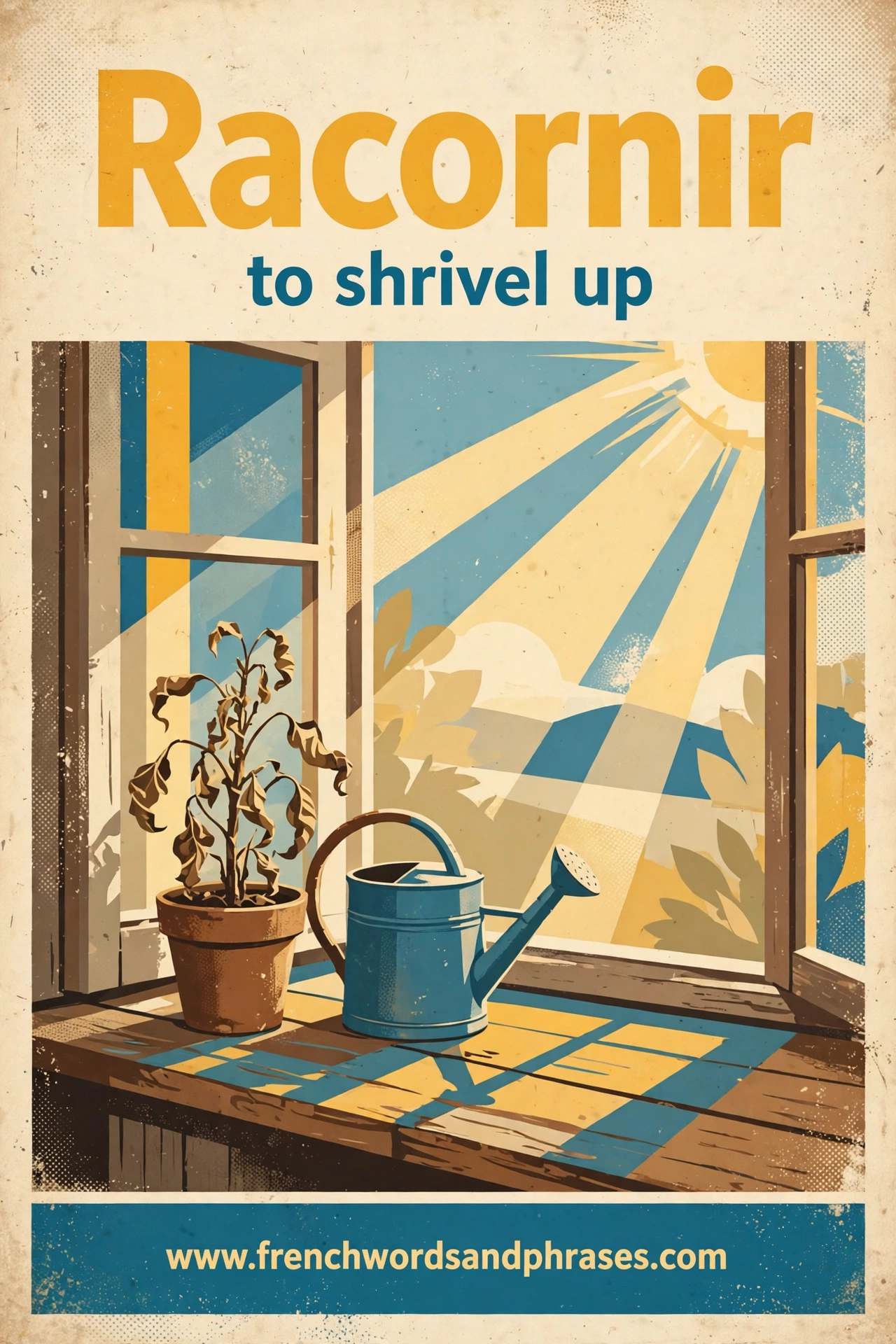
Racornir means to shrivel up.
Leather gloves forgotten by the stove, bread gone hard as wood, leaves curled by a dry summer — racornir is the verb of things that shrivel, stiffen and harden as the softness leaves them.
In this guide, you’ll learn how to conjugate racornir in all the major French tenses and moods. Explore complete conjugation tables, French examples, English translations, and practice quizzes.
Understanding the French Verb Racornir
Racornir is a regular French verb belonging to the second group of verbs, those ending in -ir.
It means to shrivel up. It is commonly used for bread and cake going hard, for leather and skin hardening and shrivelling, for leaves and plants curling in drought or frost, and figuratively for hearts and habits that have grown hard with the years.
Verb classification: Second group (-ir)
Auxiliary verb: Avoir
Past participle: racorni
Present participle: racornissant
English equivalents: To shrivel up, to harden, to make leathery; se racornir — to shrivel, to grow hard; racorni — shrivelled, hardened (du pain racorni, stale hard bread).
One important detail: racornir is built on la corne, horn — what racornit ends up horn-hard. The verb lives a double life: transitive, le soleil racornit la terre, the sun hardens the earth; and reflexive, les feuilles se racornissent, the leaves shrivel up. Its past participle is a kitchen word in its own right: du pain racorni is bread gone hard and stale, and des mains racornies are hands hardened by a life of work — a compliment and a warning in the same adjective.
Experience the Word
Racornir is the verb of lost softness — what was supple yesterday resists the knife today.
Imagine a farmhouse loaf left on the counter through a hot week. On Monday it perfumed the kitchen; by Friday it sits there racorni, hard as a doorstop, fit only for soup — and the grandmother who wastes nothing is already planning the soup.
The bread has not rotted or vanished. It has shrivelled and hardened — racorni, horn-hard to the core.
How to Conjugate Racornir: Complete French Conjugation Guide
Let’s explore every major conjugation of racornir, beginning with the indicative mood.
How to Conjugate Racornir in the Indicative Mood
The indicative mood is used to express facts, observations, actions, and events.
How to Conjugate Racornir in the Present Tense (Présent)
Used for actions happening now, habitual actions, and general truths.
| Subject | Conjugation |
|---|---|
| je | racornis |
| tu | racornis |
| il / elle | racornit |
| nous | racornissons |
| vous | racornissez |
| ils / elles | racornissent |
Example
La chaleur racornit les feuilles du potager.
The heat shrivels the leaves of the vegetable garden.
Quick Quiz 1
Complete the sentence:
Nous ______ le cuir à force de le laisser près du feu.
Reveal the answer
racornissons
Nous racornissons le cuir à force de le laisser près du feu.
We harden the leather by leaving it near the fire.
How to Conjugate Racornir in the Passé Composé
Used for completed actions in the past. Racornir takes the auxiliary verb avoir.
| Subject | Conjugation |
|---|---|
| j’ | ai racorni |
| tu | as racorni |
| il / elle | a racorni |
| nous | avons racorni |
| vous | avez racorni |
| ils / elles | ont racorni |
Example
Le pain a racorni en deux jours.
The bread went hard in two days.
How to Conjugate Racornir in the Imparfait (Imperfect Tense)
Used for habitual past actions, descriptions, and ongoing situations in the past.
| Subject | Conjugation |
|---|---|
| je | racornissais |
| tu | racornissais |
| il / elle | racornissait |
| nous | racornissions |
| vous | racornissiez |
| ils / elles | racornissaient |
Example
Sans crème, sa peau racornissait au soleil des montagnes.
Without cream, her skin used to harden in the mountain sun.
Quick Quiz 2
Choose the correct form:
The bread went hard.
Le pain ______ en deux jours. (a racorni / est racorni)
Reveal the answer
a racorni
Le pain a racorni en deux jours.
Racornir takes avoir.
How to Conjugate Racornir in the Plus-que-parfait
Used to describe an action that had already been completed before another past event.
| Subject | Conjugation |
|---|---|
| j’ | avais racorni |
| tu | avais racorni |
| il / elle | avait racorni |
| nous | avions racorni |
| vous | aviez racorni |
| ils / elles | avaient racorni |
Example
Le cuir avait racorni près du feu pendant des années.
The leather had hardened by the fire over the years.
How to Conjugate Racornir in the Passé Simple
Primarily used in formal writing, literature, and historical narratives. It is rarely used in everyday conversation.
| Subject | Conjugation |
|---|---|
| je | racornis |
| tu | racornis |
| il / elle | racornit |
| nous | racornîmes |
| vous | racornîtes |
| ils / elles | racornirent |
Example
La sécheresse racornit les vignes de tout le coteau.
The drought shrivelled the vines of the whole hillside.
How to Conjugate Racornir in the Passé Antérieur
A literary tense used to express an action completed immediately before another past action, generally in the passé simple.
| Subject | Conjugation |
|---|---|
| j’ | eus racorni |
| tu | eus racorni |
| il / elle | eut racorni |
| nous | eûmes racorni |
| vous | eûtes racorni |
| ils / elles | eurent racorni |
Example
Quand le pain eut racorni, on le garda pour la soupe.
When the bread had gone hard, it was kept for soup.
How to Conjugate Racornir in the Future Tense (Futur Simple)
Used to describe actions that will take place in the future.
| Subject | Conjugation |
|---|---|
| je | racornirai |
| tu | racorniras |
| il / elle | racornira |
| nous | racornirons |
| vous | racornirez |
| ils / elles | racorniront |
Example
Ce gâteau racornira si tu le laisses à l’air.
This cake will go hard if you leave it in the open air.
How to Conjugate Racornir in the Futur Antérieur (Future Perfect)
Used for an action that will have been completed before a particular point in the future.
| Subject | Conjugation |
|---|---|
| j’ | aurai racorni |
| tu | auras racorni |
| il / elle | aura racorni |
| nous | aurons racorni |
| vous | aurez racorni |
| ils / elles | auront racorni |
Example
À la fin de l’été, la terre aura racorni sous le soleil.
By the end of summer, the earth will have hardened under the sun.
How to Conjugate Racornir in the Near Future (Futur Proche)
Used to describe something that is going to happen soon. Formed with aller + infinitive.
| Subject | Conjugation |
|---|---|
| je | vais racornir |
| tu | vas racornir |
| il / elle | va racornir |
| nous | allons racornir |
| vous | allez racornir |
| ils / elles | vont racornir |
Example
Ces vieilles bottes vont racornir au grenier.
Those old boots are going to go hard in the attic.
How to Conjugate Racornir in the Conditional Mood
The conditional mood expresses what would happen under certain circumstances. It is also frequently used to make polite requests or express wishes.
How to Conjugate Racornir in the Present Conditional
| Subject | Conjugation |
|---|---|
| je | racornirais |
| tu | racornirais |
| il / elle | racornirait |
| nous | racornirions |
| vous | racorniriez |
| ils / elles | racorniraient |
Example
Avec de l’huile, le cuir ne racornirait pas si vite.
With oil, the leather would not harden so quickly.
How to Conjugate Racornir in the Past Conditional
| Subject | Conjugation |
|---|---|
| j’ | aurais racorni |
| tu | aurais racorni |
| il / elle | aurait racorni |
| nous | aurions racorni |
| vous | auriez racorni |
| ils / elles | auraient racorni |
Example
Le pain n’aurait pas racorni dans une boîte fermée.
The bread would not have gone hard in a closed box.
Racornir in the Literary Past Conditional Form
This less common literary form uses the imperfect subjunctive of avoir.
| Subject | Conjugation |
|---|---|
| j’ | eusse racorni |
| tu | eusses racorni |
| il / elle | eût racorni |
| nous | eussions racorni |
| vous | eussiez racorni |
| ils / elles | eussent racorni |
Example
La terre eût racorni sous un été sans pluie.
The earth would have hardened under a rainless summer.
How to Conjugate Racornir in the Subjunctive Mood
The subjunctive is used to express wishes, emotions, doubts, necessity, and uncertainty. It frequently follows expressions such as il faut que (it is necessary that) or bien que (although).
How to Conjugate Racornir in the Present Subjunctive
| Subject | Conjugation |
|---|---|
| que je | racornisse |
| que tu | racornisses |
| qu’il / qu’elle | racornisse |
| que nous | racornissions |
| que vous | racornissiez |
| qu’ils / qu’elles | racornissent |
Example
Je crains que les feuilles se racornissent avec ce gel.
I fear the leaves will shrivel with this frost.
Quick Quiz 3
Complete the sentence using the subjunctive:
Je crains que vous ______ le cuir près du feu.
Reveal the answer
racornissiez
Je crains que vous racornissiez le cuir près du feu.
I fear you are hardening the leather near the fire.
How to Conjugate Racornir in the Imperfect Subjunctive
A literary tense, rarely encountered in modern spoken French.
| Subject | Conjugation |
|---|---|
| que je | racornisse |
| que tu | racornisses |
| qu’il / qu’elle | racornît |
| que nous | racornissions |
| que vous | racornissiez |
| qu’ils / qu’elles | racornissent |
Example
Il fallait éviter que le cuir racornît près du poêle.
It was necessary to keep the leather from hardening near the stove.
How to Conjugate Racornir in the Pluperfect Subjunctive
A literary construction used to express an action completed before another past action.
| Subject | Conjugation |
|---|---|
| que j’ | eusse racorni |
| que tu | eusses racorni |
| qu’il / qu’elle | eût racorni |
| que nous | eussions racorni |
| que vous | eussiez racorni |
| qu’ils / qu’elles | eussent racorni |
Example
Elle regretta que le pain eût racorni avant le repas.
She regretted that the bread had gone hard before the meal.
How to Conjugate Racornir in the Past Subjunctive
| Subject | Conjugation |
|---|---|
| que j’ | aie racorni |
| que tu | aies racorni |
| qu’il / qu’elle | ait racorni |
| que nous | ayons racorni |
| que vous | ayez racorni |
| qu’ils / qu’elles | aient racorni |
Example
Je suis surpris que la terre ait racorni si tôt.
I am surprised the earth hardened so early.
How to Conjugate Racornir in the Imperative
The imperative is used to give commands, instructions, invitations, or suggestions. Subject pronouns are omitted.
How to Conjugate Racornir in the Present Imperative
| Person | Conjugation |
|---|---|
| (tu) | racornis |
| (nous) | racornissons |
| (vous) | racornissez |
Example
Ne laisse pas racornir le pain, mets-le dans un torchon !
Do not let the bread go hard, put it in a cloth!
Quick Quiz 4
How would you say Do not let the bread go hard (tu form)?
Reveal the answer
Ne laisse pas racornir le pain !
French Participles of Racornir
Participles are verb forms that can be used in compound tenses and other grammatical constructions.
Present Participle of Racornir
racornissant
En racornissant, les feuilles protégeaient la plante du froid.
By shrivelling, the leaves protected the plant from the cold.
Past Participle of Racornir
racorni
Racornies par le soleil, les vignes attendaient la pluie.
Shrivelled by the sun, the vines waited for rain.
Racornir in Everyday French: Real-Life Examples
Now that you know the conjugations, let’s see how racornir appears in everyday French.
Example 1 — Present
Le pain racornit vite dans cette cuisine chaude.
Bread goes hard quickly in this warm kitchen.
Example 2 — Passé composé
Les feuilles se sont racornies après le gel.
The leaves shrivelled after the frost.
Example 3 — Imparfait
Les bottes racornissaient près de la cheminée.
The boots used to harden by the fireplace.
Example 4 — Future
La terre racornira sans pluie.
The earth will harden without rain.
Example 5 — Conditional
Le cuir racornirait moins avec un peu d’huile.
Leather would harden less with a little oil.
Example 6 — Imperative
Ne racornis pas ton cœur, reste ouvert !
Do not harden your heart, stay open!
Beyond Translation: The Meaning of Racornir
English shrivel is mostly for plants and fruit; French racornir ranges from the bread bin to the human heart, with horn — la corne — as its measure of hardness.
Du pain racorni is a whole philosophy.
Nothing wasted: the loaf too hard for the table becomes soup, crumbs, pudding. Racornir describes the hardening; French thrift decides what happens next.
How to Remember the French Verb Racornir
Remember it this way: Racornir is about horn-hard — bread, leather and leaves that have lost their softness.
- La corne — horn: racornir is to go horn-hard, to shrivel and stiffen.
- Du pain racorni — stale, hardened bread; les feuilles se racornissent — the leaves shrivel.
- Regular -ir: je racornis, nous racornissons, past participle racorni.
The key idea is horn-hard — bread, leather and leaves that have lost their softness.
Test Your Knowledge of Racornir
Let’s see how much you’ve learned. Try answering these questions before revealing the answers.
Question 1
What is du pain racorni?
Reveal the answer
Bread that has gone hard and stale — shrivelled and horn-hard.
Question 2
How do you say The leaves shrivelled after the frost in French?
Reveal the answer
Les feuilles se sont racornies après le gel.
Question 3
Translate: The heat shrivels the leaves.
Reveal the answer
La chaleur racornit les feuilles.
Question 4
What is the past participle of racornir?
Reveal the answer
Racorni.
Question 5
Complete the sentence:
Je crains que les feuilles se ______ avec ce gel.
Reveal the answer
racornissent
Je crains que les feuilles se racornissent avec ce gel.
I fear the leaves will shrivel with this frost.
Your Final Challenge
Can You Use It?
How would you say this in French?
The bread goes hard on the counter, but tonight’s soup will save it.
Reveal the answer
Le pain racornit sur le comptoir, mais la soupe de ce soir le sauvera.
The bread goes hard on the counter, but tonight’s soup will save it.
A little French. A little curiosity. A richer everyday life.
LEARN FRENCH ONE WORD AT A TIME