
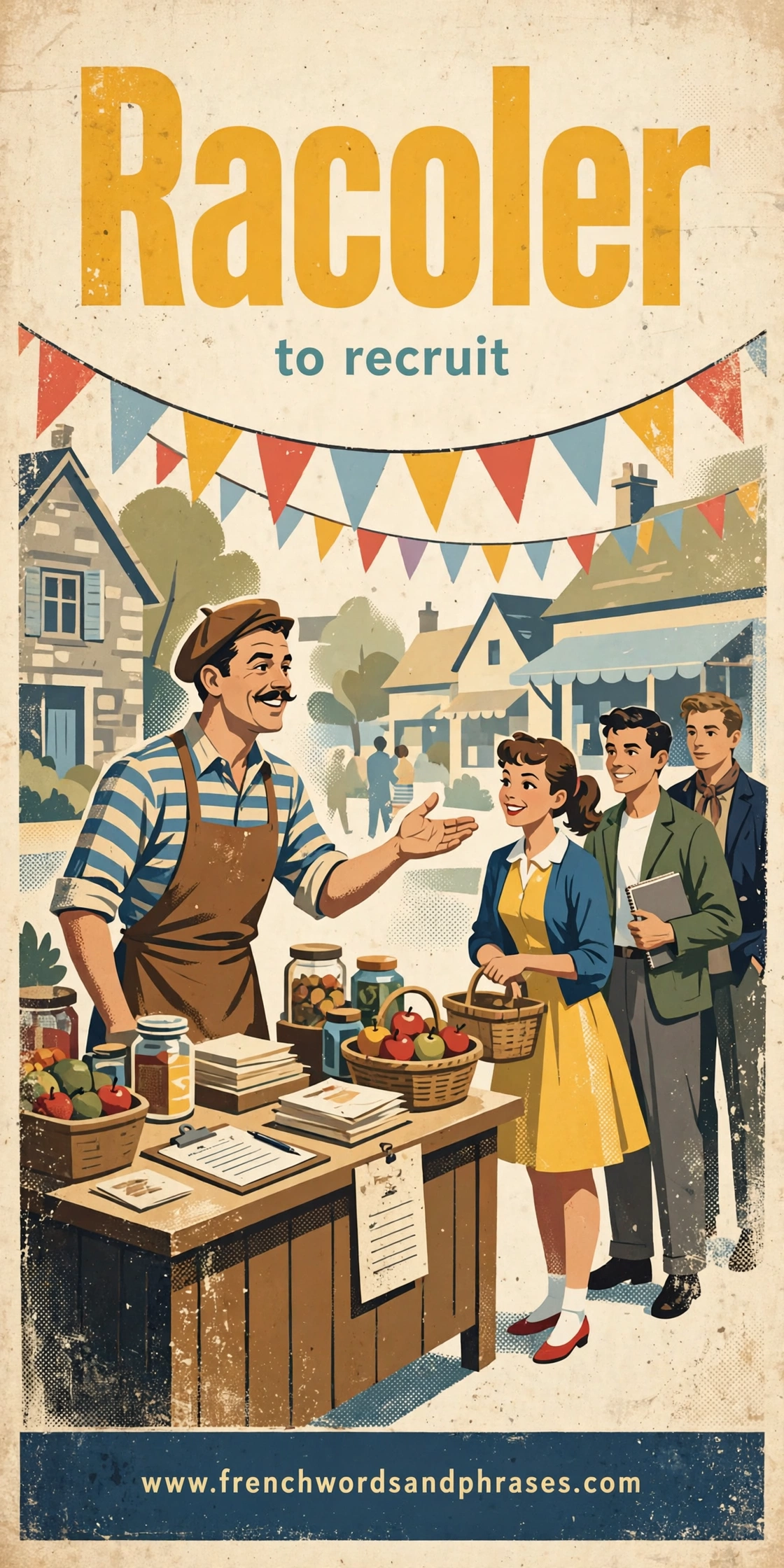
A French Word to Live By
How to Conjugate Racoler in French
/ʁa.kɔ.le/
Racoler means to recruit.
A barker outside a fairground booth, a student with a clipboard stopping passers-by, a party worker signing up members on the pavement — racoler is the verb of recruiting in the street, enthusiastic and not always entirely welcome.
In this guide, you’ll learn how to conjugate racoler in all the major French tenses and moods. Explore complete conjugation tables, French examples, English translations, and practice quizzes.
Understanding the French Verb Racoler
Racoler is a regular French verb belonging to the first group of verbs, those ending in -er.
It means to recruit. It is commonly used for touting for customers outside bars, clubs and market stalls, for recruiting members, supporters or voters with street-level energy, for signing up soldiers or volunteers in older texts, and in the noun le racolage for soliciting that the law keeps an eye on.
Verb classification: First group (-er)
Auxiliary verb: Avoir
Past participle: racolé
Present participle: racolant
English equivalents: To recruit, to tout for, to solicit; un racoleur — a tout, a recruiter; le racolage — touting, soliciting.
One important detail: racoler began in the army — the racoleurs of the old regiments signed up recruits in taverns, sometimes with more wine than honesty. The word keeps a whiff of the pushy pitch: racoler des clients is what touts do outside restaurants and clubs, and le racolage on the street is regulated by law. In politics, racoler des électeurs suggests chasing votes a little too eagerly. For neutral recruiting, French also has recruter — racoler is recruter with a raised voice and a hand on your sleeve.
Experience the Word
Racoler is the verb of the pitch on the pavement — nobody asked, everybody is a prospect.
Imagine a seaside promenade in August. Outside every restaurant a smiling racoleur waves a menu at the crowd — the best fish, the best terrace, just for you — and the holiday-makers learn to walk the exact middle of the street, out of reach.
Nobody has been hired or enrolled in an office. They have been recruited in the open air — racolés, with a smile and a leaflet.
How to Conjugate Racoler: Complete French Conjugation Guide
Let’s explore every major conjugation of racoler, beginning with the indicative mood.
How to Conjugate Racoler in the Indicative Mood
The indicative mood is used to express facts, observations, actions, and events.
How to Conjugate Racoler in the Present Tense (Présent)
Used for actions happening now, habitual actions, and general truths.
| Subject | Conjugation |
|---|---|
| je | racole |
| tu | racoles |
| il / elle | racole |
| nous | racolons |
| vous | racolez |
| ils / elles | racolent |
Example
Les associations racolent des membres à la sortie du métro.
The associations recruit members at the metro exit.
Quick Quiz 1
Complete the sentence:
Nous ______ des membres pour le club.
Reveal the answer
racolons
Nous racolons des membres pour le club.
We recruit members for the club.
How to Conjugate Racoler in the Passé Composé
Used for completed actions in the past. Racoler takes the auxiliary verb avoir.
| Subject | Conjugation |
|---|---|
| j’ | ai racolé |
| tu | as racolé |
| il / elle | a racolé |
| nous | avons racolé |
| vous | avez racolé |
| ils / elles | ont racolé |
Example
Il a racolé une cinquantaine de clients en une soirée.
He touted in some fifty customers in one evening.
How to Conjugate Racoler in the Imparfait (Imperfect Tense)
Used for habitual past actions, descriptions, and ongoing situations in the past.
| Subject | Conjugation |
|---|---|
| je | racolais |
| tu | racolais |
| il / elle | racolait |
| nous | racolions |
| vous | racoliez |
| ils / elles | racolaient |
Example
Autrefois, les sergents racolaient des recrues dans les tavernes.
In the old days, sergeants used to recruit soldiers in the taverns.
Quick Quiz 2
Choose the correct form:
He touted in fifty customers.
Il ______ cinquante clients. (a racolé / est racolé)
Reveal the answer
a racolé
Il a racolé cinquante clients.
Racoler takes avoir.
How to Conjugate Racoler in the Plus-que-parfait
Used to describe an action that had already been completed before another past event.
| Subject | Conjugation |
|---|---|
| j’ | avais racolé |
| tu | avais racolé |
| il / elle | avait racolé |
| nous | avions racolé |
| vous | aviez racolé |
| ils / elles | avaient racolé |
Example
Ils avaient racolé des centaines de signatures avant midi.
They had recruited hundreds of signatures before noon.
How to Conjugate Racoler in the Passé Simple
Primarily used in formal writing, literature, and historical narratives. It is rarely used in everyday conversation.
| Subject | Conjugation |
|---|---|
| je | racolai |
| tu | racolas |
| il / elle | racola |
| nous | racolâmes |
| vous | racolâtes |
| ils / elles | racolèrent |
Example
Le patron racola les passants devant son nouveau restaurant.
The owner touted for passers-by in front of his new restaurant.
How to Conjugate Racoler in the Passé Antérieur
A literary tense used to express an action completed immediately before another past action, generally in the passé simple.
| Subject | Conjugation |
|---|---|
| j’ | eus racolé |
| tu | eus racolé |
| il / elle | eut racolé |
| nous | eûmes racolé |
| vous | eûtes racolé |
| ils / elles | eurent racolé |
Example
Quand il eut racolé assez de joueurs, le tournoi commença.
When he had recruited enough players, the tournament began.
How to Conjugate Racoler in the Future Tense (Futur Simple)
Used to describe actions that will take place in the future.
| Subject | Conjugation |
|---|---|
| je | racolerai |
| tu | racoleras |
| il / elle | racolera |
| nous | racolerons |
| vous | racolerez |
| ils / elles | racoleront |
Example
Ce soir, les étudiants racoleront pour la fête de l’université.
This evening, the students will recruit for the university party.
How to Conjugate Racoler in the Futur Antérieur (Future Perfect)
Used for an action that will have been completed before a particular point in the future.
| Subject | Conjugation |
|---|---|
| j’ | aurai racolé |
| tu | auras racolé |
| il / elle | aura racolé |
| nous | aurons racolé |
| vous | aurez racolé |
| ils / elles | auront racolé |
Example
À la fin du mois, elle aura racolé deux cents adhérents.
By the end of the month, she will have recruited two hundred members.
How to Conjugate Racoler in the Near Future (Futur Proche)
Used to describe something that is going to happen soon. Formed with aller + infinitive.
| Subject | Conjugation |
|---|---|
| je | vais racoler |
| tu | vas racoler |
| il / elle | va racoler |
| nous | allons racoler |
| vous | allez racoler |
| ils / elles | vont racoler |
Example
Attention, ce vendeur va racoler tous les touristes du quai.
Watch out, that salesman is going to tout to every tourist on the quay.
How to Conjugate Racoler in the Conditional Mood
The conditional mood expresses what would happen under certain circumstances. It is also frequently used to make polite requests or express wishes.
How to Conjugate Racoler in the Present Conditional
| Subject | Conjugation |
|---|---|
| je | racolerais |
| tu | racolerais |
| il / elle | racolerait |
| nous | racolerions |
| vous | racoleriez |
| ils / elles | racoleraient |
Example
Sans les réseaux sociaux, les partis racoleraient encore dans la rue.
Without social media, parties would still be recruiting in the street.
How to Conjugate Racoler in the Past Conditional
| Subject | Conjugation |
|---|---|
| j’ | aurais racolé |
| tu | aurais racolé |
| il / elle | aurait racolé |
| nous | aurions racolé |
| vous | auriez racolé |
| ils / elles | auraient racolé |
Example
Il aurait racolé plus de clients avec un meilleur emplacement.
He would have touted in more customers with a better spot.
Racoler in the Literary Past Conditional Form
This less common literary form uses the imperfect subjunctive of avoir.
| Subject | Conjugation |
|---|---|
| j’ | eusse racolé |
| tu | eusses racolé |
| il / elle | eût racolé |
| nous | eussions racolé |
| vous | eussiez racolé |
| ils / elles | eussent racolé |
Example
Le racoleur eût racolé la moitié de la foire avant la nuit.
The tout would have recruited half the fair before nightfall.
How to Conjugate Racoler in the Subjunctive Mood
The subjunctive is used to express wishes, emotions, doubts, necessity, and uncertainty. It frequently follows expressions such as il faut que (it is necessary that) or bien que (although).
How to Conjugate Racoler in the Present Subjunctive
| Subject | Conjugation |
|---|---|
| que je | racole |
| que tu | racoles |
| qu’il / qu’elle | racole |
| que nous | racolions |
| que vous | racoliez |
| qu’ils / qu’elles | racolent |
Example
La mairie interdit qu’on racole devant les écoles.
The town hall forbids recruiting in front of schools.
Quick Quiz 3
Complete the sentence using the subjunctive:
Le règlement interdit que vous ______ devant la gare.
Reveal the answer
racoliez
Le règlement interdit que vous racoliez devant la gare.
The rules forbid you to tout in front of the station.
How to Conjugate Racoler in the Imperfect Subjunctive
A literary tense, rarely encountered in modern spoken French.
| Subject | Conjugation |
|---|---|
| que je | racolasse |
| que tu | racolasses |
| qu’il / qu’elle | racolât |
| que nous | racolassions |
| que vous | racolassiez |
| qu’ils / qu’elles | racolassent |
Example
Le capitaine ordonna que le sergent racolât des volontaires au village.
The captain ordered the sergeant to recruit volunteers in the village.
How to Conjugate Racoler in the Pluperfect Subjunctive
A literary construction used to express an action completed before another past action.
| Subject | Conjugation |
|---|---|
| que j’ | eusse racolé |
| que tu | eusses racolé |
| qu’il / qu’elle | eût racolé |
| que nous | eussions racolé |
| que vous | eussiez racolé |
| qu’ils / qu’elles | eussent racolé |
Example
On racontait qu’ils eussent racolé des électeurs avec des promesses creuses.
People said they had recruited voters with empty promises.
How to Conjugate Racoler in the Past Subjunctive
| Subject | Conjugation |
|---|---|
| que j’ | aie racolé |
| que tu | aies racolé |
| qu’il / qu’elle | ait racolé |
| que nous | ayons racolé |
| que vous | ayez racolé |
| qu’ils / qu’elles | aient racolé |
Example
Je suis étonné qu’elle ait racolé autant de monde en si peu de temps.
I am amazed she recruited so many people in so little time.
How to Conjugate Racoler in the Imperative
The imperative is used to give commands, instructions, invitations, or suggestions. Subject pronouns are omitted.
How to Conjugate Racoler in the Present Imperative
| Person | Conjugation |
|---|---|
| (tu) | racole |
| (nous) | racolons |
| (vous) | racolez |
Example
Ne racole pas les clients des autres restaurants !
Do not tout for the customers of other restaurants!
Quick Quiz 4
How would you say Recruit some players (tu form)?
Reveal the answer
Racole des joueurs !
French Participles of Racoler
Participles are verb forms that can be used in compound tenses and other grammatical constructions.
Present Participle of Racoler
racolant
En racolant sur les marchés, il a appris tous les accents de la région.
By touting at the markets, he learned every accent of the region.
Past Participle of Racoler
racolé
Racolés à la sortie du stade, les supporters ont signé sans réfléchir.
Recruited at the stadium exit, the fans signed without thinking.
Racoler in Everyday French: Real-Life Examples
Now that you know the conjugations, let’s see how racoler appears in everyday French.
Example 1 — Present
Ce restaurant racole les touristes sur le port.
That restaurant touts for tourists on the harbour.
Example 2 — Passé composé
Nous avons racolé dix nouveaux membres hier.
We recruited ten new members yesterday.
Example 3 — Imparfait
Les racoleurs racolaient devant les théâtres.
The touts used to tout in front of the theatres.
Example 4 — Future
Ils racoleront des bénévoles pour le festival.
They will recruit volunteers for the festival.
Example 5 — Conditional
Tu racolerais des clients avec ce sourire ?
You would recruit customers with that smile?
Example 6 — Imperative
Racolez des joueurs pour le match de dimanche !
Recruit some players for Sunday’s match!
Beyond Translation: The Meaning of Racoler
English splits this between the respectable recruit and the shady tout; French racoler holds both in one word, and tone of voice decides which.
Le racolage is recruiting with its sleeves rolled up.
Say a campaign racole and you have praised its energy and questioned its manners in a single breath — the leaflet, the smile, and just a hint of the tavern sergeant.
How to Remember the French Verb Racoler
Remember it this way: Racoler is about the pitch on the pavement — leaflets, smiles and a hand on your sleeve.
- Un racoleur — the tout with the leaflet; le racolage — touting, street soliciting.
- Racoler des clients, des membres, des électeurs — recruiting with a raised voice.
- Regular -er: je racole, nous racolons, past participle racolé.
The key idea is the pitch on the pavement — leaflets, smiles and a hand on your sleeve.
Test Your Knowledge of Racoler
Let’s see how much you’ve learned. Try answering these questions before revealing the answers.
Question 1
What is un racoleur?
Reveal the answer
A tout — someone who recruits customers or members in the street.
Question 2
How do you say We recruited ten new members in French?
Reveal the answer
Nous avons racolé dix nouveaux membres.
Question 3
Translate: That restaurant touts for tourists on the harbour.
Reveal the answer
Ce restaurant racole les touristes sur le port.
Question 4
What is the past participle of racoler?
Reveal the answer
Racolé.
Question 5
Complete the sentence:
La mairie interdit qu’on ______ devant les écoles.
Reveal the answer
racole
La mairie interdit qu’on racole devant les écoles.
The town hall forbids recruiting in front of schools.
Your Final Challenge
Can You Use It?
How would you say this in French?
The volunteers recruit players on the square, and Sunday’s tournament is saved.
Reveal the answer
Les bénévoles racolent des joueurs sur la place, et le tournoi de dimanche est sauvé.
The volunteers recruit players on the square, and Sunday’s tournament is saved.
A little French. A little curiosity. A richer everyday life.
LEARN FRENCH ONE WORD AT A TIME




