
A French Word to Live By
How to Conjugate Racler in French
/ʁa.kle/
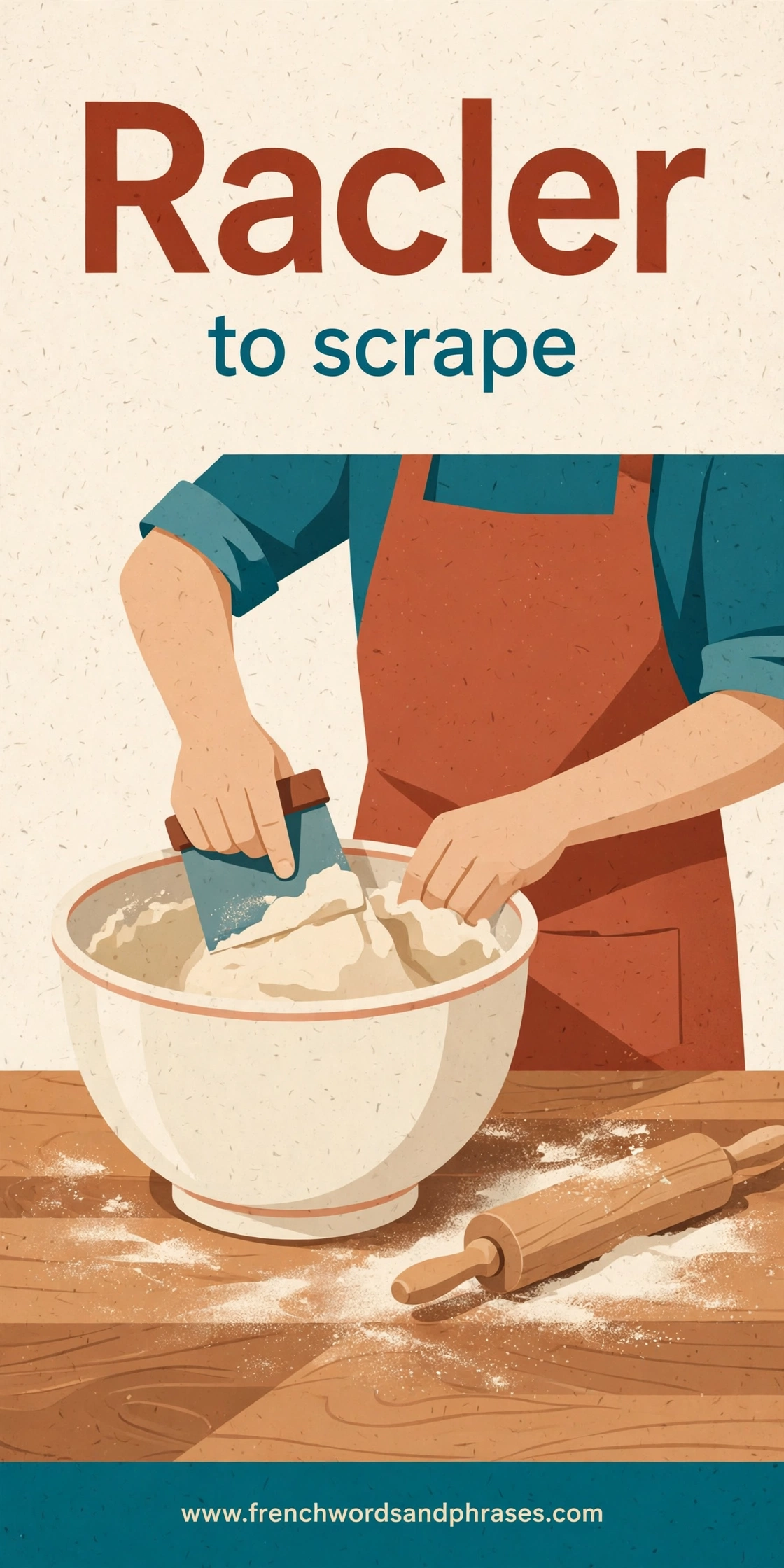
Racler means to scrape.
A spatula going round the last of the sauce, a blade clearing frost from a windscreen, boots on the mat at the door — racler is the verb of the scraping edge, of getting the last bit off a surface.
In this guide, you’ll learn how to conjugate racler in all the major French tenses and moods. Explore complete conjugation tables, French examples, English translations, and practice quizzes.
Understanding the French Verb Racler
Racler is a regular French verb belonging to the first group of verbs, those ending in -er.
It means to scrape. It is commonly used for scraping dishes, pots and plates clean, for clearing frost, snow and mud from windscreens, steps and shoes, for scraping off old paint before repainting, and in the reflexive se racler la gorge for clearing one’s throat before speaking.
Verb classification: First group (-er)
Auxiliary verb: Avoir
Past participle: raclé
Present participle: raclant
English equivalents: To scrape, to scrape off; se racler la gorge — to clear one’s throat; une raclette — a scraper (and the famous cheese dish).
One important detail: racler hides inside a word every cheese lover knows — la raclette, the Alpine dish, is named after the gesture of scraping melted cheese onto the plate, and the little tool is une raclette, a scraper, the same word that clears an icy windscreen. The verb’s most famous reflexive is se racler la gorge — to clear your throat, literally to scrape it — the little cough before a speech. You will also meet racler les fonds de tiroirs, to scrape the bottom of the drawers, when money runs short.
Experience the Word
Racler is the verb of the last layer — the sauce that clings, the frost that resists, the paint that has to go.
Imagine a January morning in the mountains. A driver works her raclette across the windscreen in slow arcs, breath fogging, while inside the chalet someone racle the raclette cheese onto hot potatoes — the same scraping gesture, once for the frost, once for breakfast.
Nothing has been washed or melted away. It has been scraped — edge against surface, until the surface is clear.
How to Conjugate Racler: Complete French Conjugation Guide
Let’s explore every major conjugation of racler, beginning with the indicative mood.
How to Conjugate Racler in the Indicative Mood
The indicative mood is used to express facts, observations, actions, and events.
How to Conjugate Racler in the Present Tense (Présent)
Used for actions happening now, habitual actions, and general truths.
| Subject | Conjugation |
|---|---|
| je | racle |
| tu | racles |
| il / elle | racle |
| nous | raclons |
| vous | raclez |
| ils / elles | raclent |
Example
Il racle le fond de la casserole avec une spatule.
He scrapes the bottom of the saucepan with a spatula.
Quick Quiz 1
Complete the sentence:
Nous ______ le fond de la casserole.
Reveal the answer
raclons
Nous raclons le fond de la casserole.
We scrape the bottom of the saucepan.
How to Conjugate Racler in the Passé Composé
Used for completed actions in the past. Racler takes the auxiliary verb avoir.
| Subject | Conjugation |
|---|---|
| j’ | ai raclé |
| tu | as raclé |
| il / elle | a raclé |
| nous | avons raclé |
| vous | avez raclé |
| ils / elles | ont raclé |
Example
Elle a raclé le givre du pare-brise ce matin.
She scraped the frost off the windscreen this morning.
How to Conjugate Racler in the Imparfait (Imperfect Tense)
Used for habitual past actions, descriptions, and ongoing situations in the past.
| Subject | Conjugation |
|---|---|
| je | raclais |
| tu | raclais |
| il / elle | raclait |
| nous | raclions |
| vous | racliez |
| ils / elles | raclaient |
Example
Le cantonnier raclait la neige devant l’école.
The roadman used to scrape the snow in front of the school.
Quick Quiz 2
Choose the correct form:
She scraped the plates.
Elle ______ les assiettes. (a raclé / est raclée)
Reveal the answer
a raclé
Elle a raclé les assiettes.
Racler takes avoir.
How to Conjugate Racler in the Plus-que-parfait
Used to describe an action that had already been completed before another past event.
| Subject | Conjugation |
|---|---|
| j’ | avais raclé |
| tu | avais raclé |
| il / elle | avait raclé |
| nous | avions raclé |
| vous | aviez raclé |
| ils / elles | avaient raclé |
Example
Ils s’étaient raclé la gorge avant de chanter.
They had cleared their throats before singing.
How to Conjugate Racler in the Passé Simple
Primarily used in formal writing, literature, and historical narratives. It is rarely used in everyday conversation.
| Subject | Conjugation |
|---|---|
| je | raclai |
| tu | raclas |
| il / elle | racla |
| nous | raclâmes |
| vous | raclâtes |
| ils / elles | raclèrent |
Example
Le peintre racla les murs avant de les repeindre.
The painter scraped the walls before repainting them.
How to Conjugate Racler in the Passé Antérieur
A literary tense used to express an action completed immediately before another past action, generally in the passé simple.
| Subject | Conjugation |
|---|---|
| j’ | eus raclé |
| tu | eus raclé |
| il / elle | eut raclé |
| nous | eûmes raclé |
| vous | eûtes raclé |
| ils / elles | eurent raclé |
Example
Quand elle eut raclé la dernière assiette, la cuisine fut propre.
When she had scraped the last plate, the kitchen was clean.
How to Conjugate Racler in the Future Tense (Futur Simple)
Used to describe actions that will take place in the future.
| Subject | Conjugation |
|---|---|
| je | raclerai |
| tu | racleras |
| il / elle | raclera |
| nous | raclerons |
| vous | raclerez |
| ils / elles | racleront |
Example
Demain, je raclerai la vieille peinture de la porte.
Tomorrow, I will scrape the old paint off the door.
How to Conjugate Racler in the Futur Antérieur (Future Perfect)
Used for an action that will have been completed before a particular point in the future.
| Subject | Conjugation |
|---|---|
| j’ | aurai raclé |
| tu | auras raclé |
| il / elle | aura raclé |
| nous | aurons raclé |
| vous | aurez raclé |
| ils / elles | auront raclé |
Example
À huit heures, il aura raclé tout le trottoir.
By eight o’clock, he will have scraped the whole pavement.
How to Conjugate Racler in the Near Future (Futur Proche)
Used to describe something that is going to happen soon. Formed with aller + infinitive.
| Subject | Conjugation |
|---|---|
| je | vais racler |
| tu | vas racler |
| il / elle | va racler |
| nous | allons racler |
| vous | allez racler |
| ils / elles | vont racler |
Example
Je vais racler le plat, il ne reste presque rien.
I am going to scrape the dish, there is almost nothing left.
How to Conjugate Racler in the Conditional Mood
The conditional mood expresses what would happen under certain circumstances. It is also frequently used to make polite requests or express wishes.
How to Conjugate Racler in the Present Conditional
| Subject | Conjugation |
|---|---|
| je | raclerais |
| tu | raclerais |
| il / elle | raclerait |
| nous | raclerions |
| vous | racleriez |
| ils / elles | racleraient |
Example
Avec une meilleure raclette, on raclerait le givre en une minute.
With a better scraper, we would scrape the frost off in a minute.
How to Conjugate Racler in the Past Conditional
| Subject | Conjugation |
|---|---|
| j’ | aurais raclé |
| tu | aurais raclé |
| il / elle | aurait raclé |
| nous | aurions raclé |
| vous | auriez raclé |
| ils / elles | auraient raclé |
Example
Elle aurait raclé la casserole si elle avait eu une spatule.
She would have scraped the saucepan if she had had a spatula.
Racler in the Literary Past Conditional Form
This less common literary form uses the imperfect subjunctive of avoir.
| Subject | Conjugation |
|---|---|
| j’ | eusse raclé |
| tu | eusses raclé |
| il / elle | eût raclé |
| nous | eussions raclé |
| vous | eussiez raclé |
| ils / elles | eussent raclé |
Example
Le cocher eût raclé la boue de ses bottes avant d’entrer.
The coachman would have scraped the mud off his boots before coming in.
How to Conjugate Racler in the Subjunctive Mood
The subjunctive is used to express wishes, emotions, doubts, necessity, and uncertainty. It frequently follows expressions such as il faut que (it is necessary that) or bien que (although).
How to Conjugate Racler in the Present Subjunctive
| Subject | Conjugation |
|---|---|
| que je | racle |
| que tu | racles |
| qu’il / qu’elle | racle |
| que nous | raclions |
| que vous | racliez |
| qu’ils / qu’elles | raclent |
Example
Il faut que tu racles le pare-brise avant de partir.
You must scrape the windscreen before leaving.
Quick Quiz 3
Complete the sentence using the subjunctive:
Il faut que vous ______ vos chaussures à l’entrée.
Reveal the answer
racliez
Il faut que vous racliez vos chaussures à l’entrée.
You must scrape your shoes at the entrance.
How to Conjugate Racler in the Imperfect Subjunctive
A literary tense, rarely encountered in modern spoken French.
| Subject | Conjugation |
|---|---|
| que je | raclasse |
| que tu | raclasses |
| qu’il / qu’elle | raclât |
| que nous | raclassions |
| que vous | raclassiez |
| qu’ils / qu’elles | raclassent |
Example
Elle voulait qu’il raclât le fond du plat sans bruit.
She wanted him to scrape the bottom of the dish quietly.
How to Conjugate Racler in the Pluperfect Subjunctive
A literary construction used to express an action completed before another past action.
| Subject | Conjugation |
|---|---|
| que j’ | eusse raclé |
| que tu | eusses raclé |
| qu’il / qu’elle | eût raclé |
| que nous | eussions raclé |
| que vous | eussiez raclé |
| qu’ils / qu’elles | eussent raclé |
Example
Il était gênant qu’il se fût raclé la gorge pendant tout le discours.
It was embarrassing that he had cleared his throat throughout the speech.
How to Conjugate Racler in the Past Subjunctive
| Subject | Conjugation |
|---|---|
| que j’ | aie raclé |
| que tu | aies raclé |
| qu’il / qu’elle | ait raclé |
| que nous | ayons raclé |
| que vous | ayez raclé |
| qu’ils / qu’elles | aient raclé |
Example
Je suis content que tu aies raclé les assiettes avant de les laver.
I am glad you scraped the plates before washing them.
How to Conjugate Racler in the Imperative
The imperative is used to give commands, instructions, invitations, or suggestions. Subject pronouns are omitted.
How to Conjugate Racler in the Present Imperative
| Person | Conjugation |
|---|---|
| (tu) | racle |
| (nous) | raclons |
| (vous) | raclez |
Example
Racle bien le fond, c’est le meilleur !
Scrape the bottom well, it is the best part!
Quick Quiz 4
How would you say Scrape the bottom well (tu form)?
Reveal the answer
Racle bien le fond !
French Participles of Racler
Participles are verb forms that can be used in compound tenses and other grammatical constructions.
Present Participle of Racler
raclant
En raclant le trottoir, il a trouvé une pièce ancienne.
While scraping the pavement, he found an old coin.
Past Participle of Racler
raclé
Raclée jusqu’à la dernière cuillère, la casserole brillait presque.
Scraped to the last spoonful, the saucepan almost shone.
Racler in Everyday French: Real-Life Examples
Now that you know the conjugations, let’s see how racler appears in everyday French.
Example 1 — Present
Je racle toujours le fond du plat de gratin.
I always scrape the bottom of the gratin dish.
Example 2 — Passé composé
Il s’est raclé la gorge avant de parler.
He cleared his throat before speaking.
Example 3 — Imparfait
On raclait la neige devant la porte chaque hiver.
We used to scrape the snow in front of the door every winter.
Example 4 — Future
Tu racleras le pare-brise demain matin.
You will scrape the windscreen tomorrow morning.
Example 5 — Conditional
On raclerait les fonds de tiroirs pour payer le loyer.
We would scrape the bottom of the barrel to pay the rent.
Example 6 — Imperative
Raclez vos chaussures avant d’entrer !
Scrape your shoes before coming in!
Beyond Translation: The Meaning of Racler
English scrape is a plain workhorse; French racler carries a cheese dish, a winter tool and a nervous cough inside it.
Se racler la gorge is pure theatre.
Before the speech, the announcement, the difficult question — the little throat-scrape that says: listen, here it comes. One verb for the windscreen and for the podium.
How to Remember the French Verb Racler
Remember it this way: Racler is about the scraping edge — frost, sauce, paint, and a throat cleared before speaking.
- Une raclette — the scraper, and the cheese dish named after scraping it.
- Se racler la gorge — to clear your throat, the gesture before a speech.
- Regular -er: je racle, nous raclons, past participle raclé.
The key idea is the scraping edge — frost, sauce, paint, and a throat cleared before speaking.
Test Your Knowledge of Racler
Let’s see how much you’ve learned. Try answering these questions before revealing the answers.
Question 1
How do you say to clear one’s throat in French?
Reveal the answer
Se racler la gorge.
Question 2
How do you say She scraped the frost off the windscreen in French?
Reveal the answer
Elle a raclé le givre du pare-brise.
Question 3
Translate: He cleared his throat before speaking.
Reveal the answer
Il s’est raclé la gorge avant de parler.
Question 4
What is the past participle of racler?
Reveal the answer
Raclé.
Question 5
Complete the sentence:
Il faut que tu ______ le pare-brise avant de partir.
Reveal the answer
racles
Il faut que tu racles le pare-brise avant de partir.
You must scrape the windscreen before leaving.
Your Final Challenge
Can You Use It?
How would you say this in French?
He scrapes the frost off the windscreen, clears his throat, and the winter day begins.
Reveal the answer
Il racle le givre du pare-brise, se racle la gorge, et la journée d’hiver commence.
He scrapes the frost off the windscreen, clears his throat, and the winter day begins.
A little French. A little curiosity. A richer everyday life.
LEARN FRENCH ONE WORD AT A TIME




