A French Word to Live By
Translate Racine to English
/ʁa.sin/
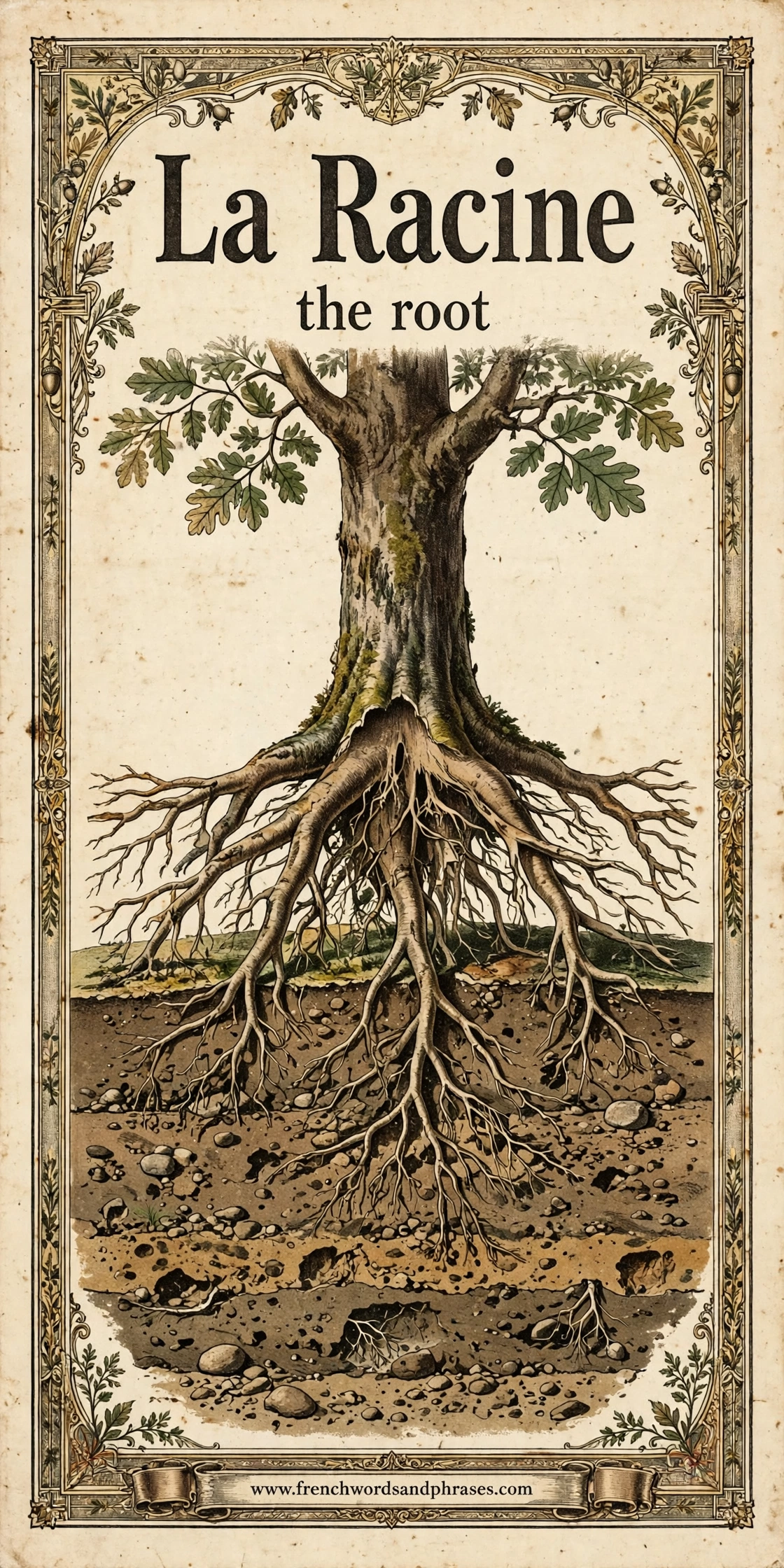
La racine means the root.
The storm has passed, the great pine lies on its side, and for the first time you can see its secret half — a vast dark wheel of earth and twisted ropes, torn out of the ground: les racines, the roots that held it for a hundred years.
In this guide, you’ll learn what racine means in English, how to use it with its articles, how to form its plural, and how it appears in everyday French. Explore French examples, English translations, and practice quizzes.
Understanding the French Noun Racine
Racine is a feminine French noun, learned with its article: la racine, une racine. The plural adds an -s: les racines. Few words travel further — from the soil to the dentist’s chair, from family history to the maths classroom.
It means the root — the underground part of a plant that drinks water, feeds the stem and anchors the whole tree against the wind. But racine also grows inside une dent (a tooth), under les cheveux (hair), at the heart of a word — la racine d’un mot — and in your own story: mes racines, my roots, the place and people I come from.
Gender: Feminine
Definite article: la — la racine (the root)
Indefinite article: une — une racine (a root)
Plural: les racines
In maths: la racine carrée — the square root
In your story: mes racines — my roots, my origins
Racine works underground everywhere. The dentist treats la racine d’une dent, the hairdresser touches up les racines of your hair, and the linguist hunts la racine d’un mot. Learn this one word and you have the hidden half of a dozen worlds.
Experience the Word
Racine is more than a part of a plant. It is everything that holds, feeds and explains — the half of the story you cannot see.
Imagine an old vine in Burgundy: above ground, a gnarled stump no taller than your knee; below ground, roots driving fifteen metres down through limestone, drinking the deep past of the hill.
You have not just seen a root. You have seen where things come from — and why they refuse to fall.
How to Use Racine in French: Complete Guide
Let’s explore how racine works in French, beginning with its articles — a feminine noun that digs into soil, teeth, words and families.
Racine with the Definite Article (La, Les)
Used for a particular root — the one lifting the pavement or aching in your jaw.
| Form | French |
|---|---|
| Singular | la racine |
| Plural | les racines |
Example
La racine du vieux chêne soulève le trottoir.
The old oak’s root is lifting the pavement.
Racine with the Indefinite Article (Une, Des)
Used for a root in general — any root, one root among many.
| Form | French |
|---|---|
| Singular | une racine |
| Plural | des racines |
Example
Une racine traverse le chemin de terre.
A root crosses the dirt path.
Racine with the Partitive and Quantities (Des, Un bout de…)
Roots are countable, so French speaks of pieces and depths rather than « some » root — except in the kitchen, where a piece of ginger root is exactly what you grate.
| Quantity | French |
|---|---|
| some roots | des racines |
| a piece of root | un bout de racine |
| deep roots | des racines profondes |
| many roots | beaucoup de racines |
| root vegetables | des légumes-racines |
Example
Le pissenlit a des racines très longues.
The dandelion has very long roots.
Quick Quiz 1
At the dentist’s. Complete the sentence:
______ racine de la dent est infectée. (The)
Reveal the answer
La
La racine de la dent est infectée.
The root of the tooth is infected — racine is feminine, so the is la.
The Plural of Racine
Racine adds an -s in the plural — les racines, the whole hidden web under the tree.
| Number | French |
|---|---|
| Singular | la racine |
| Plural | les racines |
Example
Les racines de cet arbre cherchent l’eau très loin.
This tree’s roots go looking for water a very long way away.
Racine with Possessive Adjectives (Ma, Ta, Sa…)
Possessives agree with the noun — racine is feminine, so it takes ma, ta, sa.
| Owner | French |
|---|---|
| my | ma racine |
| your (tu) | ta racine |
| his / her | sa racine |
| our | notre racine |
| your (vous) | votre racine |
| their | leur racine |
Example
Cette plante étend sa racine principale vers le bas.
This plant sends its main root downwards.
Quick Quiz 2
Complete the sentence:
Il n’oublie jamais ______ racines. (his)
Reveal the answer
ses
Il n’oublie jamais ses racines.
He never forgets his roots — ses, the plural of sa.
Racine with Demonstrative Adjectives (Cette, Ces)
Used to point at a root: cette racine, this one here.
| Form | French |
|---|---|
| Singular | cette racine |
| Plural | ces racines |
Example
Cette racine de gingembre est très parfumée.
This ginger root is very fragrant.
Racine with Adjectives
Adjectives agree with racine — feminine forms, mostly after the noun.
| Adjective | With Racine |
|---|---|
| profonde (deep) | une racine profonde |
| longue (long) | une racine longue |
| noueuse (gnarled) | une racine noueuse |
| forte (strong) | une racine forte |
| cassée (broken) | une racine cassée |
Example
Une racine noueuse dépasse du sol près du banc.
A gnarled root sticks out of the ground near the bench.
Quick Quiz 3
Complete the sentence:
Une racine ______ boit l’eau loin sous la terre. (deep)
Reveal the answer
profonde
Une racine profonde boit l’eau loin sous la terre.
A deep root drinks water far beneath the earth.
Everyday Expressions with Racine
Settling down, square roots and nipping things in the bud — racine is deep in daily French.
| Expression | In English |
|---|---|
| prendre racine | to take root — to settle in for good |
| les racines de quelqu’un | someone’s roots, their origins |
| la racine carrée | the square root |
| la racine d’un mot | the root of a word |
| couper le mal à la racine | to cut the evil at the root — to nip it in the bud |
| un légume-racine | a root vegetable |
Example
La nouvelle école a vite pris racine dans le quartier.
The new school quickly took root in the neighbourhood.
Words from the Same Family as Racine
Uprooting, settling and deep-rooted habits — the family of racine.
| French | In English |
|---|---|
| enraciné | rooted, deep-rooted |
| s’enraciner | to put down roots |
| déraciner | to uproot |
| enraciner | to root, to anchor firmly |
| le déracinement | uprooting, being torn from one’s roots |
| l’enracinement | rooting, becoming established |
Example
Après dix ans à Paris, elle s’est enracinée dans son quartier.
After ten years in Paris, she has put down roots in her neighbourhood.
Quick Quiz 4
What does prendre racine mean?
Reveal the answer
To take root — literally for a plant, and figuratively for anything that settles in for good.
Le jeune pommier prend racine dans le verger.
The young apple tree is taking root in the orchard.
Racine in Everyday French: Real-Life Examples
Now that you know the word, let’s see how racine appears in everyday French.
Example 1 — In the garden
Les racines du rosier boivent l’eau en profondeur.
The rose bush’s roots drink the water deep down.
Example 2 — At the dentist’s
La racine de cette dent est en mauvais état.
The root of this tooth is in bad shape.
Example 3 — Family history
Mes racines sont en Bretagne, près de la mer.
My roots are in Brittany, near the sea.
Example 4 — In maths class
La racine carrée de seize est quatre.
The square root of sixteen is four.
Example 5 — A stubborn weed
Cette mauvaise herbe a des racines impossibles à arracher.
This weed has roots that are impossible to pull out.
Example 6 — New beginnings
Le jeune arbre prend racine dans son nouveau jardin.
The young tree is taking root in its new garden.
Beyond Translation: The Meaning of Racine
Ask a French person about leurs racines and watch the conversation deepen: genealogy is a national passion, and millions spend weekends in archive rooms tracing the villages their names came from. The word holds both ends of a life — the root in the soil that feeds the tree, and the origin in the past that feeds the person.
To say racine is to name the hidden half of everything: plant, tooth, word, family.
It evokes the storm-felled pine with its secret wheel of earth, the dentist’s quiet warning, the square root on a school blackboard — and the village your great-grandparents left, still feeding you.
How to Remember the French Noun Racine
Remember it this way: Racine is the root — feminine: la racine, hidden underground and holding everything up.
- The underground anchor — la racine holds the tree and drinks for it.
- Your story has them too — mes racines, my roots, the place my family comes from.
- Even numbers grow them — la racine carrée, the square root.
The key idea is la racine — the hidden half that holds everything.
Test Your Knowledge of Racine
Let’s see how much you’ve learned. Try answering these questions before revealing the answers.
Question 1
Is racine masculine or feminine?
Reveal the answer
Feminine — la racine, une racine.
Question 2
Translate: The roots are deep.
Reveal the answer
Les racines sont profondes.
Question 3
What is la racine carrée de neuf?
Reveal the answer
Trois — la racine carrée de neuf est trois: the square root of nine is three.
Question 4
Complete the sentence:
Elle retourne au village de ______ racines.
Reveal the answer
ses
Elle retourne au village de ses racines.
She is going back to the village of her roots.
Question 5
What does déraciner mean?
Reveal the answer
To uproot — to tear a plant out by its roots, or a person from the place they belong.
Your Final Challenge
Can You Use It?
How would you say this in French?
“The roots of this tree are very deep.”
Reveal the answer
Les racines de cet arbre sont très profondes.
The roots of this tree are very deep.
A little French. A little curiosity. A richer everyday life.
LEARN FRENCH ONE WORD AT A TIME