A French Word to Live By
Translate Écorce to English
/e.kɔʁs/
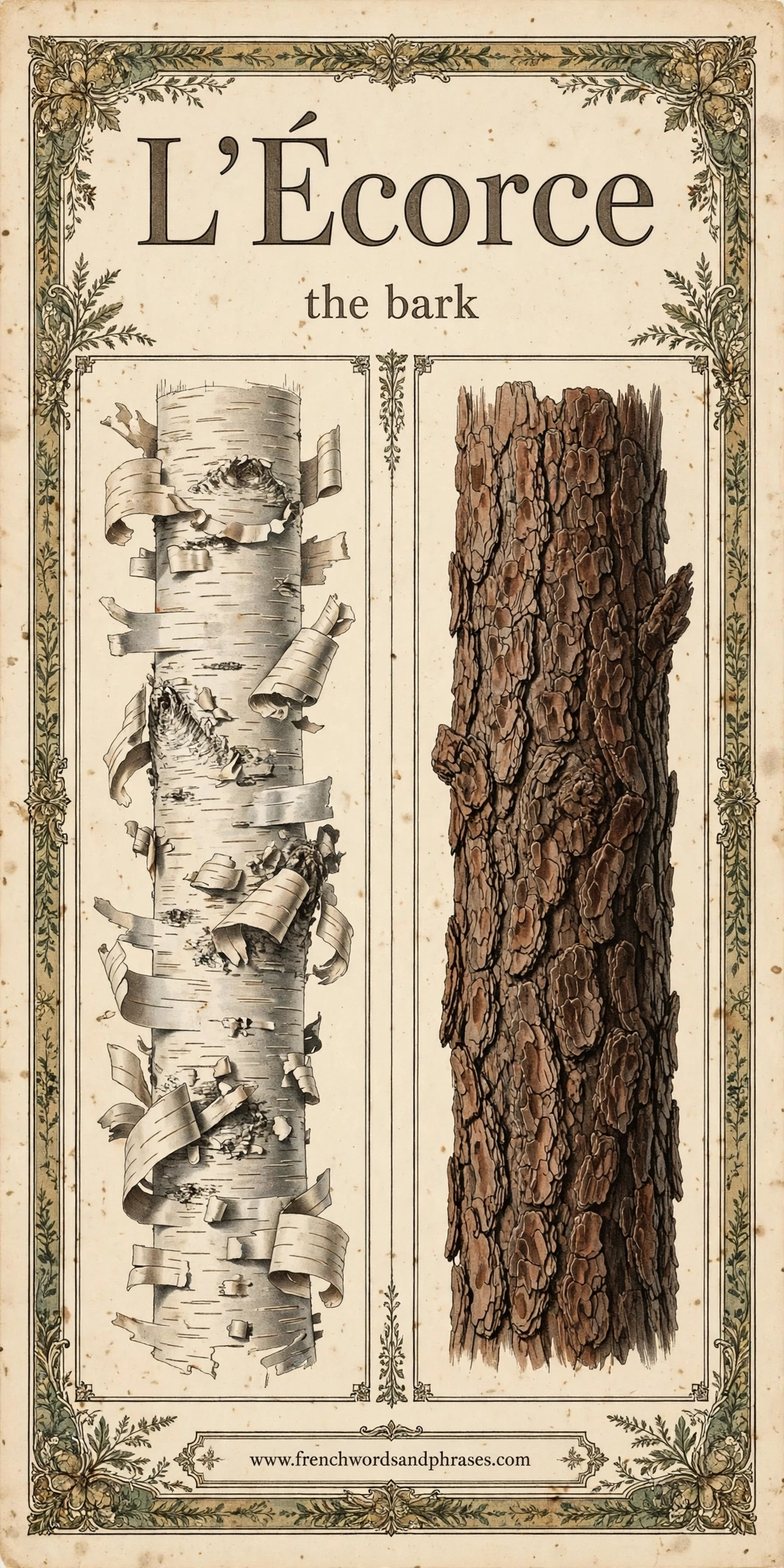
L’écorce means the bark.
Run your hand along the trunk: rough plates under your palm, deep cracks, the smell of resin and rain. The tree is wearing its armour — l’écorce, the bark that guards the living wood beneath.
In this guide, you’ll learn what écorce means in English, how to use it with its articles, how to form its plural, and how it appears in everyday French. Explore French examples, English translations, and practice quizzes.
Understanding the French Noun Écorce
Écorce is a feminine French noun that begins with a vowel, so it is learned with its shrunken article: l’écorce, une écorce. The plural adds an -s: les écorces. The same word covers a tree’s bark, the peel of an orange, and even the crust of the Earth.
It means the bark — the protective outer skin of le tronc and les branches, which shields the tree from cold, insects and fire. Écorce is also the peel of citrus fruit — l’écorce d’orange — and, scaled up to the whole planet, l’écorce terrestre is the Earth’s crust. Cinnamon, too, is an écorce: the fragrant bark of a tropical tree.
Gender: Feminine — but it begins with a vowel
Definite article: l’ — l’écorce (the bark)
Indefinite article: une — une écorce (a bark)
Plural: les écorces
The planet’s bark: l’écorce terrestre — the Earth’s crust
In the kitchen: la cannelle (cinnamon) is a bark; l’écorce d’orange is orange peel
Because écorce starts with a vowel, two things shrink around it: le and la become l’, and the possessives ma, ta, sa become mon, ton, son — you say mon écorce, never « ma écorce », exactly as with l’infirmière in the hospital. The ear cannot bear two vowels colliding, so French quietly swaps the word.
Experience the Word
Écorce is more than the skin of a tree. It is a coat, a shield and a diary — every crack a winter survived, every plate a summer endured.
Imagine the cork harvest in Provence: workers easing great curved sheets of bark off the oak in one piece, the tree standing pink and bare — and already growing its next coat.
You have not just touched a tree. You have felt its armour — and understood how the living wood survives the world.
How to Use Écorce in French: Complete Guide
Let’s explore how écorce works in French, beginning with its articles — a feminine noun hiding behind a vowel, so watch for l’ and mon.
Écorce with the Definite Article (L’, Les)
Écorce begins with a vowel, so la shrinks to l’ — the bark everyone is talking about.
| Form | French |
|---|---|
| Singular | l’écorce |
| Plural | les écorces |
Example
L’écorce du bouleau se détache en fines bandes.
The birch’s bark peels away in thin strips.
Écorce with the Indefinite Article (Une, Des)
Used for bark in general — a bark, one kind among many.
| Form | French |
|---|---|
| Singular | une écorce |
| Plural | des écorces |
Example
Une écorce épaisse protège le chêne du froid.
A thick bark protects the oak from the cold.
Écorce with the Partitive Article (De l’)
Bark can be treated as a material — something you peel, grate and burn — so the partitive works beautifully here: de l’écorce, some bark.
| Quantity | French |
|---|---|
| some bark | de l’écorce |
| a piece of bark | un morceau d’écorce |
| some oak bark | de l’écorce de chêne |
| some cinnamon bark | de l’écorce de cannelle |
| a lot of bark | beaucoup d’écorce |
Example
Il retire de l’écorce du tronc pour allumer le feu.
He takes some bark off the trunk to light the fire.
Quick Quiz 1
Complete the sentence:
______ écorce de ce pin sent la résine. (The)
Reveal the answer
L’
L’écorce de ce pin sent la résine.
This pine’s bark smells of resin — écorce begins with a vowel, so la becomes l’.
The Plural of Écorce
Écorce adds an -s in the plural — les écorces, the skins of many trees.
| Number | French |
|---|---|
| Singular | l’écorce |
| Plural | les écorces |
Example
Les écorces de ces arbres servent à faire des paniers.
The barks of these trees are used to make baskets.
Écorce with Possessive Adjectives (Mon, Ton, Son…)
The famous vowel rule: écorce is feminine, but because it starts with a vowel it takes mon, ton, son — never ma, ta, sa.
| Owner | French |
|---|---|
| my | mon écorce |
| your (tu) | ton écorce |
| his / her / its | son écorce |
| our | notre écorce |
| your (vous) | votre écorce |
| their | leur écorce |
Example
Le chêne-liège perd son écorce tous les neuf ans.
The cork oak sheds its bark every nine years.
Quick Quiz 2
Complete the sentence:
Le bouleau perd ______ écorce en bandes fines. (its)
Reveal the answer
son
Le bouleau perd son écorce en bandes fines.
The birch sheds its bark in thin strips — son, not sa, because écorce begins with a vowel.
Écorce with Demonstrative Adjectives (Cette, Ces)
Used to point at bark: cette écorce, this bark here — cette keeps its full form before a vowel.
| Form | French |
|---|---|
| Singular | cette écorce |
| Plural | ces écorces |
Example
Cette écorce rugueuse protège l’arbre des insectes.
This rough bark protects the tree from insects.
Écorce with Adjectives
Adjectives agree with écorce — feminine forms, mostly after the noun.
| Adjective | With Écorce |
|---|---|
| épaisse (thick) | une écorce épaisse |
| rugueuse (rough) | une écorce rugueuse |
| lisse (smooth) | une écorce lisse |
| brune (brown) | une écorce brune |
| craquelée (cracked) | une écorce craquelée |
Example
Une écorce craquelée couvre le vieux tronc.
Cracked bark covers the old trunk.
Quick Quiz 3
Complete the sentence:
L’écorce du platane est presque ______, sans crevasses. (smooth)
Reveal the answer
lisse
L’écorce du platane est presque lisse, sans crevasses.
The plane tree’s bark is almost smooth, without cracks.
Everyday Expressions with Écorce
Earth’s crust, orange peel and one wise warning — écorce reaches from geology to family quarrels.
| Expression | In English |
|---|---|
| l’écorce terrestre | the Earth’s crust |
| l’écorce de chêne | oak bark |
| l’écorce d’orange | orange peel |
| l’écorce de cannelle | cinnamon bark |
| entre l’arbre et l’écorce | between the tree and the bark — caught in the middle |
| ne pas mettre le doigt entre l’arbre et l’écorce | don’t get caught in the middle of a quarrel |
Example
Ne mets pas le doigt entre l’arbre et l’écorce : laisse les deux frères régler leur dispute.
Don’t get caught in the middle: let the two brothers settle their argument.
Words from the Same Family as Écorce
Cork, cortex and stripping bark — the family of écorce.
| French | In English |
|---|---|
| écorcer | to strip the bark, to bark a tree |
| le liège | cork — the bark of the cork oak |
| le chêne-liège | the cork oak |
| l’écorce cérébrale | the cerebral cortex — the brain’s « bark » |
| écorcher | to graze, to skin; to mangle a word |
| le cortex | the cortex |
Example
Le liège des bouchons vient de l’écorce du chêne-liège.
The cork in bottle stoppers comes from the bark of the cork oak.
Quick Quiz 4
What is le liège?
Reveal the answer
Cork — the light, springy bark of the cork oak, harvested without ever cutting the tree down.
Ce bouchon est en liège naturel.
This stopper is made of natural cork.
Écorce in Everyday French: Real-Life Examples
Now that you know the word, let’s see how écorce appears in everyday French.
Example 1 — A forest walk
L’écorce du bouleau est blanche et douce au toucher.
The birch’s bark is white and smooth to the touch.
Example 2 — Lighting the fire
Il utilise de l’écorce sèche pour allumer le feu.
He uses dry bark to light the fire.
Example 3 — At the market
Ce bâton de cannelle est un morceau d’écorce parfumée.
This cinnamon stick is a piece of fragrant bark.
Example 4 — In the garden
L’écorce de ce pin est pleine de résine.
This pine’s bark is full of resin.
Example 5 — The cork harvest
Les ouvriers retirent l’écorce du chêne-liège en été.
The workers strip the bark from the cork oak in summer.
Example 6 — Orange peel
Elle râpe l’écorce d’une orange dans le gâteau.
She grates orange peel into the cake.
Beyond Translation: The Meaning of Écorce
Every nine or ten summers, in the hills of Provence and Corsica, the cork oaks are undressed: workers slide axes under the écorce and peel away great curved panels, leaving the trunks blushing pink — and the tree, unharmed, grows its coat again. No other harvest asks so little and gives so much: the same écorce stops wine bottles for a century.
To say écorce is to name the skin that lets a tree survive fire, frost and time.
It evokes cinnamon in the kitchen and crust under the continents, orange peel and planet — one humble word for every protective skin in nature.
How to Remember the French Noun Écorce
Remember it this way: Écorce is the bark — feminine, and it begins with a vowel, so it hides behind l’: l’écorce.
- The tree’s coat — l’écorce is the jacket the trunk wears all winter.
- Vowel first, so l’ — never « la écorce »: l’écorce, and mon écorce for my bark.
- Your dessert eats it — la cannelle, cinnamon, is the bark of a tropical tree.
The key idea is l’écorce — the tree’s protective coat.
Test Your Knowledge of Écorce
Let’s see how much you’ve learned. Try answering these questions before revealing the answers.
Question 1
Is écorce masculine or feminine?
Reveal the answer
Feminine — l’écorce, une écorce (the le/la shrinks to l’ before the vowel).
Question 2
Why do we say mon écorce and not ma écorce?
Reveal the answer
Because écorce begins with a vowel sound — feminine nouns starting with a vowel take mon, ton, son.
Question 3
Translate: The bark is thick.
Reveal the answer
L’écorce est épaisse.
Question 4
What is l’écorce terrestre?
Reveal the answer
The Earth’s crust — the planet’s own bark, the thin skin we all live on.
Question 5
Complete the sentence:
Le liège vient de ______ du chêne-liège.
Reveal the answer
l’écorce
Le liège vient de l’écorce du chêne-liège.
Cork comes from the bark of the cork oak.
Your Final Challenge
Can You Use It?
How would you say this in French?
“The bark of the oak is thick and rough.”
Reveal the answer
L’écorce du chêne est épaisse et rugueuse.
The bark of the oak is thick and rough.
A little French. A little curiosity. A richer everyday life.
LEARN FRENCH ONE WORD AT A TIME