A French Word to Live By
Translate Qui to English
/ki/
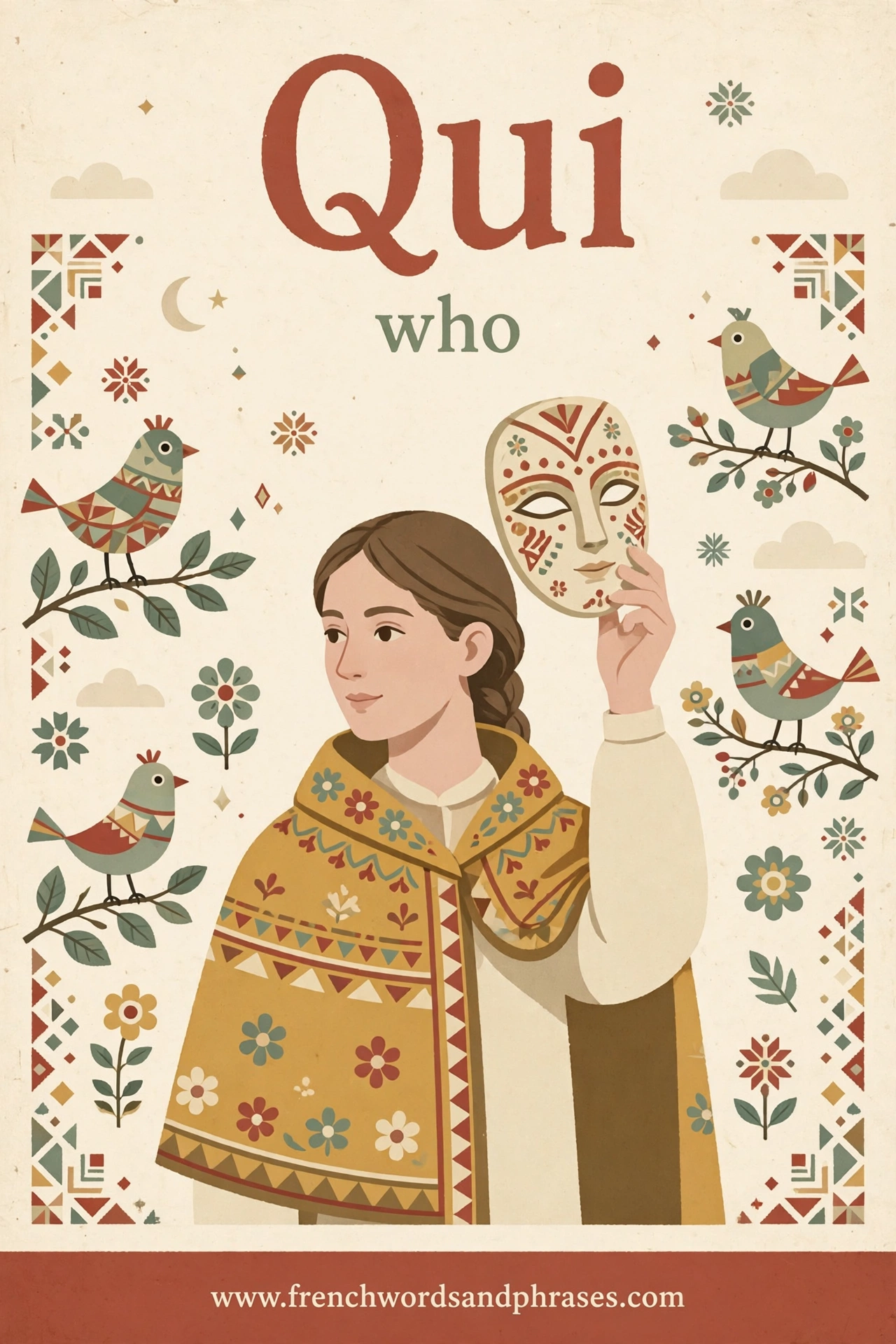
Qui means who.
A knock at the door of the little house, and the grandmother calls from the kitchen. « Qui est là ? » — Who is there? Qui is the French word for asking about a person: who is coming, who called, who is at the door — the question that opens every meeting.
Let’s explore how qui works in French, beginning with the whole word on one card.
Understanding the French Pronoun Qui
Qui is a French interrogative pronoun — the question word for people. As a question, it usually plays the subject: qui + verb asks who is doing the action, and it stays exactly the same for men, women, one person or many.
It means who — and, after a preposition, whom. The picture it paints is an empty chair at the table: someone is expected, someone knocked, someone telephoned — qui asks for the name that fills the space. Qui only ever asks about people, never about things.
Type: Interrogative pronoun — people only
Answers the question: It asks the question: Qui ? — Who?
What follows it: A verb: qui vient, qui parle, qui est-ce qui arrive
Watch the pair: qui (who — people) vs que / quoi (what — things) — qui vient ? = who is coming?; que fais-tu ? = what are you doing?
One important usage detail: after a preposition, qui is the form for people — avec qui (with whom), pour qui (for whom), chez qui (at whose house), and à qui asks ‘to whom’ or ‘whose’: À qui est ce manteau ? — Whose coat is this? Things in the same slot take quoi instead.
Experience the Word
Qui is the question of the doorstep and the telephone — the word that asks a person to step forward and give a name.
Imagine a village fête where nobody knows the tall stranger near the band. All evening the whisper runs from table to table: qui est-ce ? qui l’a invité ? — who is he? who invited him?
You have not just asked a question. You have pointed at a person-shaped mystery and asked the world to name it.
How to Use Qui in French: Complete Guide
Let’s explore how qui works in French, beginning with the whole word on one card.
Qui at a Glance
The Whole Word on One Card
Meaning, job, pattern and pair — qui in four lines.
| Point | Qui |
|---|---|
| Meaning | who (and whom after a preposition) |
| Job | interrogative pronoun — asks about a person |
| Who it can ask about | people only — one person or a whole group |
| Its special pattern | qui est-ce qui — the long, everyday way to ask who |
Example
Qui a téléphoné ce matin ?
Who phoned this morning?
The Pattern in Action: Asking for a Name
Qui connects a question to a missing person — the subject, the guest, the owner.
| Pattern | Example |
|---|---|
| qui + verb, subject | qui vient à la fête ? — who is coming to the party? |
| qui est-ce qui + verb | qui est-ce qui a fait ce gâteau ? — who made this cake? |
| à qui + verb | à qui parles-tu ? — who are you talking to? (to whom) |
| preposition + qui | avec qui pars-tu ? — who are you leaving with? |
Example
Qui est-ce qui a ouvert la fenêtre ?
Who opened the window?
Quick Quiz 1
Does qui ask about people or about things?
Reveal the answer
People — things are asked about with que or quoi.
Qui est à la porte ?
Who is at the door?
The Tricky Bit: Qui est-ce qui, and À qui
Qui has two patterns that catch learners out: the long spoken form, and à qui doing double duty.
| Pattern | How it works |
|---|---|
| the long pattern | spoken French loves qui est-ce qui + verb: qui est-ce qui chante ? — who is singing? |
| à qui = to whom | à qui écris-tu ? — who are you writing to? |
| à qui = whose | à qui est ce vélo ? — whose bike is this? (the answer: il est à Paul) |
| verb agreement | qui usually takes a singular verb, but it can go plural: qui sont ces gens ? — who are these people? |
Example
À qui sont ces clés sur la table ?
Whose are these keys on the table?
Where It Goes: At the Head of the Question
Qui leads the question — first the preposition if there is one, then qui, then the verb.
| Position / pattern | Example |
|---|---|
| at the head of the question | qui + verb: qui arrive ? — who is arriving? |
| after a preposition, for people | pour qui, avec qui, chez qui, de qui — the preposition comes first |
| inside est-ce que questions | qui est-ce que tu as vu ? — who did you see? (qui as the person seen) |
| as a quiet relative | qui also links clauses — l’homme qui parle (the man who is speaking) — its relative job, a neighbour of the question word |
Example
Avec qui est-ce que tu pars en vacances ?
Who are you going on holiday with?
Quick Quiz 2
How do you ask “Whose is this book?” with qui?
Reveal the answer
À qui est ce livre ? — à qui asks whose when it meets être.
À qui est ce livre ? — Il est à moi.
Whose is this book? — It is mine.
Everyday Expressions with Qui
Qui opens doors, telephones and conversations all over France.
| Expression | In English |
|---|---|
| qui est-ce ? | who is it? / who is that? |
| qui est là ? | who is there? |
| qui sait ? | who knows? |
| à qui le tour ? | whose turn is it? |
Example
Qui sait où il a mis les clés ?
Who knows where he put the keys?
Close Cousins: Qui, Que, Lequel
Three question words that learners blur — here is who does what.
| Word | The difference |
|---|---|
| que / quoi | what — for things: que fais-tu ? (what are you doing?); quoi after a preposition |
| lequel | which one — chooses from a known set: lequel préfères-tu ? |
| qui | who — always a person, singular or plural |
| qui est-ce qui | the full spoken pattern for a subject question: qui est-ce qui vient ? |
Example
Qui vient, et lequel d’entre vous conduit ?
Who is coming, and which one of you is driving?
Quick Quiz 3
You want to ask “who” about the new teacher. Qui or lequel?
Reveal the answer
Qui — lequel chooses between known options; qui asks for a person outright.
Qui est le nouveau professeur ?
Who is the new teacher?
Qui and Its Neighbours
The question shelf: the whole interrogative family, side by side.
| French | In English |
|---|---|
| qui | who |
| que / quoi | what |
| où / d’où | where / from where |
| quand / comment / pourquoi | when / how / why |
| combien | how much / how many |
Example
Qui vient, quand, et avec combien d’amis ?
Who is coming, when, and with how many friends?
Watch Out: The Traps Around Qui
The traps: qui for a thing, que after a preposition, and whose without à qui.
| Trap | The truth |
|---|---|
| using qui for a thing | things take que or quoi: que cherches-tu ? — what are you looking for? |
| saying ‘avec que’ for a person | after a preposition, people take qui: avec qui (never ‘avec que’) |
| breaking the long pattern | the spoken pattern is qui est-ce qui + verb — keep all its parts together |
| translating ‘whose’ with a possessive | whose asks with à qui + être: à qui est ce sac ? |
Example
Pour qui est cette lettre, et à qui dois-je la donner ?
Who is this letter for, and who should I give it to?
Quick Quiz 4
Complete: ______ a fermé la porte ? (Who closed the door?)
Reveal the answer
Qui — the question asks about a person, so qui takes the subject slot.
Qui a fermé la porte ?
Who closed the door?
Qui in Everyday French: Real-Life Examples
Now that you know the word, let’s see how qui appears in everyday French.
Example Example 1 — Doorstep
Qui est là ? C’est moi, ouvre !
Who is there? It is me, open up!
Example Example 2 — Telephone
Qui a appelé pendant le repas ?
Who called during the meal?
Example Example 3 — Family
Qui veut encore du gâteau ?
Who wants more cake?
Example Example 4 — School
Qui sait la réponse à cette question ?
Who knows the answer to this question?
Example Example 5 — Possession
À qui est ce parapluie oublié ?
Whose is this forgotten umbrella?
Example Example 6 — Meeting
Qui est-ce qui parle en premier ?
Who is speaking first?
Beyond Translation: The Meaning of Qui
Every language keeps a word for the knock at the door, and in French it is qui — two letters and a question that has opened a million conversations. Qui est là ? is how strangers become guests.
To say qui is to leave a space in the sentence shaped exactly like a person, and wait for a name to fill it.
French even lets qui ask about belonging — à qui est ce livre ? — as if every lost thing in the world were simply waiting for its person to be named.
How to Remember the French Pronoun Qui
Remember it this way: Remember it this way: Qui is the people-question — it asks for a name, and after a preposition it still points at a person.
- You check the mystery — a person? Then qui; a thing? Then que or quoi.
- You use the long pattern in speech — qui est-ce qui vient ?
- You ask ‘whose’ with it — à qui est ce livre ? — and answer il est à moi.
The key idea is qui means who and asks about people only — à qui covers to whom and whose, and things take que or quoi instead.
Test Your Knowledge of Qui
Let’s see how much you’ve learned. Try answering these questions before revealing the answers.
Question 1
What does qui mean?
Reveal the answer
Who — the interrogative pronoun for people (and whom after a preposition).
Question 2
How do you ask ‘Who made this cake?’ in the everyday spoken pattern?
Reveal the answer
Qui est-ce qui a fait ce gâteau ? — the long pattern keeps qui est-ce qui before the verb.
Question 3
Translate: Who is at the door?
Reveal the answer
Qui est à la porte ?
Question 4
What does à qui ask in ‘À qui est ce sac ?’
Reveal the answer
Whose — à qui + être asks who something belongs to: il est à Paul (it is Paul’s).
Question 5
Complete the sentence:
______ pars-tu en voyage ? (Who are you travelling with?)
Reveal the answer
Avec qui
Avec qui pars-tu en voyage ?
Who are you travelling with?
Your Final Challenge
Can You Use It?
How would you say this in French?
“How would you say this in French?”
Reveal the answer
Qui a préparé ce délicieux repas ?
Who prepared this delicious meal?
A little French. A little curiosity. A richer everyday life.
LEARN FRENCH ONE WORD AT A TIME