
A French Word to Live By
Translate Puzzle to English
/pœ.zœl/
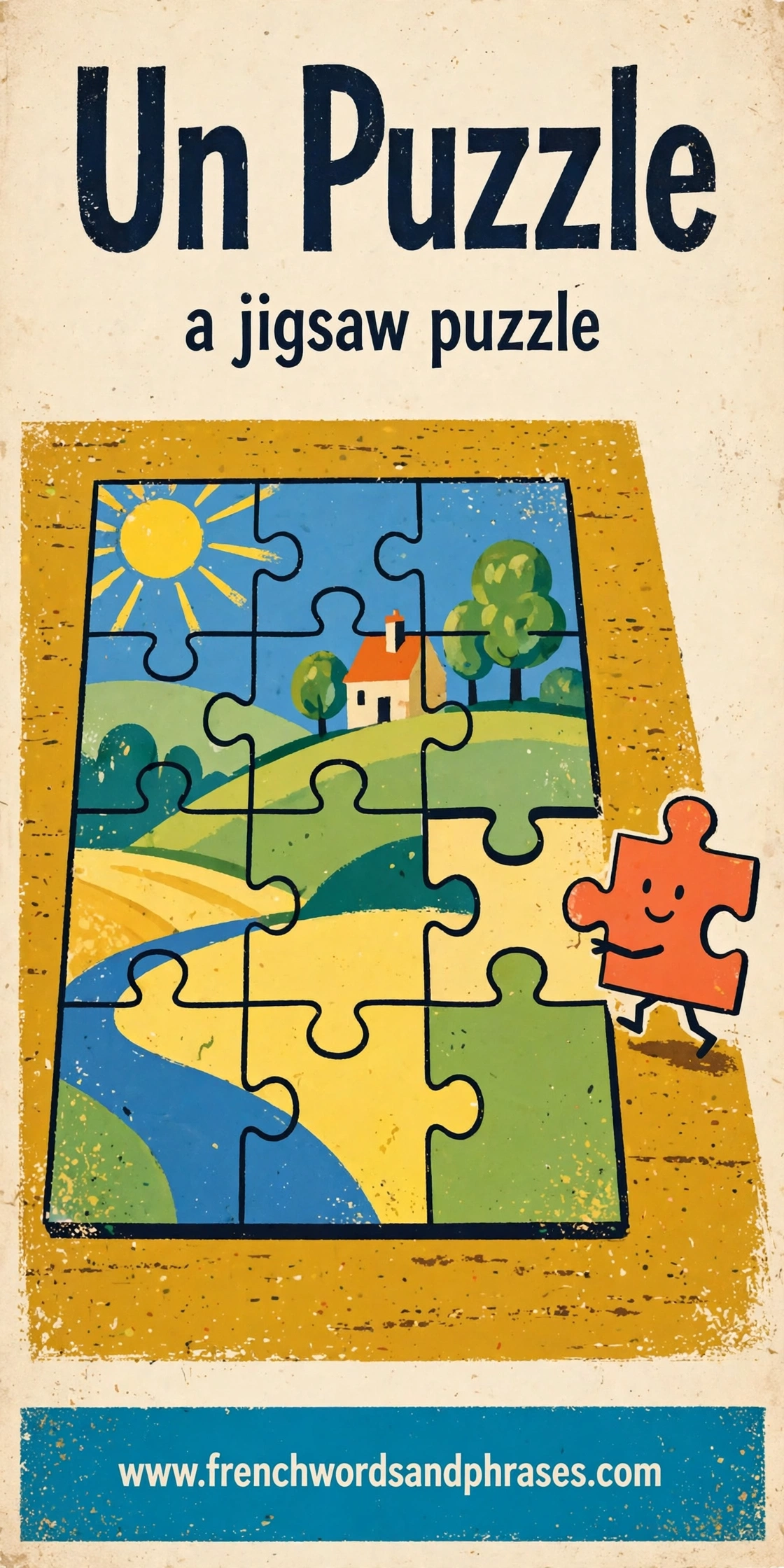
Le puzzle means a jigsaw puzzle.
A rainy Sunday, a big table cleared, and a box tipped out into a small mountain of cardboard sky. Somewhere in those thousand pieces is the corner of a castle — and the whole family is hunting for it: le puzzle has begun.
In this guide, you’ll learn what puzzle means in English, how to use it with its articles, how to form its plural, and how it appears in everyday French. Explore French examples, English translations, and practice quizzes.
Understanding the French Noun Puzzle
Puzzle is a masculine French noun, borrowed from English and pronounced the French way. It is learned together with its article: le puzzle, un puzzle. It names the jigsaw — the picture cut into pieces that you put back together — and, figuratively, any mystery you solve piece by piece.
It means a jigsaw puzzle — a picture in pieces: un puzzle de mille pièces, a thousand-piece jigsaw, worked on a table over days or weeks. French also uses the word in its figurative sense: les pièces du puzzle, the pieces of the puzzle, are the clues of any problem that slowly comes together — an enquiry, a mystery, a plan.
Gender: Masculine
Definite article: le — le puzzle (the jigsaw puzzle)
Indefinite article: un — un puzzle (a jigsaw puzzle)
Plural: les puzzles
English equivalents: A jigsaw puzzle; figuratively, a puzzle, a mystery in pieces.
One important usage detail: le puzzle is the jigsaw, but a puzzle you solve with your head is un casse-tête — literally a head-breaker. And mind how it sounds: French says it in two syllables, keeping the English spelling but not the English sound.
Experience the Word
Puzzle is more than a game in a box. It is the slowest pleasure in the house — no screen, no timer, just a picture coming back to life one piece at a time.
Imagine the last evening of the holidays: the table has been occupied for a week, the edges are done, the sky is nearly finished, and the whole family leans in as the final piece is found under the cat.
You have not just finished a picture. You have put the world back together, piece by piece.
How to Use Puzzle in French: Complete Guide
Let’s explore how puzzle works in French, beginning with its articles.
Puzzle with the Definite Article (Le, Les)
Used for the jigsaw everyone knows — the one spread out on the table.
| Number | French |
|---|---|
| Singular | le puzzle |
| Plural | les puzzles |
Example
Le puzzle occupe la table du salon depuis lundi.
The jigsaw has been taking up the living-room table since Monday.
Puzzle with the Indefinite Article (Un, Des)
Used for a jigsaw in general — the one in the shop window, the one you got for your birthday.
| Number | French |
|---|---|
| Singular | un puzzle |
| Plural | des puzzles |
Example
Pour Noël, elle a reçu un puzzle de la tour Eiffel.
For Christmas, she got a jigsaw of the Eiffel Tower.
The Pieces of the Puzzle
Edges, corners and the one piece that hides — the vocabulary of the jigsaw table.
| French | In English |
|---|---|
| une pièce de puzzle | a jigsaw piece |
| le bord | the edge |
| le coin | the corner |
| l’image | the picture |
| assembler les pièces | to put the pieces together |
| il manque une pièce | a piece is missing |
Example
On commence toujours par les bords et les coins.
You always start with the edges and the corners.
Quick Quiz 1
How do you say « a piece is missing » about a jigsaw?
Reveal the answer
Il manque une pièce — the saddest sentence in the jigsaw world.
Il manque une pièce, probablement sous le canapé.
A piece is missing, probably under the sofa.
The Plural of Puzzle
Puzzle adds an -s in the plural, like most borrowed words — les puzzles, a whole shelf of rainy Sundays.
| Number | French |
|---|---|
| Singular | le puzzle |
| Plural | les puzzles |
Example
Les puzzles de mille pièces demandent de la patience.
Thousand-piece jigsaws require patience.
Puzzle with Possessive Adjectives (Mon, Ton, Son…)
Possessives agree with the noun, not with the owner — and puzzle is masculine, so it takes mon, ton, son.
| Owner | French |
|---|---|
| my | mon puzzle |
| your (tu) | ton puzzle |
| his / her | son puzzle |
| our | notre puzzle |
| your (vous) | votre puzzle |
| their | leur puzzle |
Example
Mon puzzle représente un village de montagne.
My jigsaw shows a mountain village.
Quick Quiz 2
Complete the sentence:
______ puzzle est presque terminé, courage ! (Our)
Reveal the answer
Notre
Notre puzzle est presque terminé, courage !
Our jigsaw is nearly finished, hang in there!
Puzzle with Demonstrative Adjectives (Ce, Ces)
Used to point: this jigsaw here, those jigsaws there.
| Number | French |
|---|---|
| Singular | ce puzzle |
| Plural | ces puzzles |
Example
Ce puzzle est trop difficile pour les enfants.
This jigsaw is too difficult for the children.
Puzzle with Adjectives
Adjectives agree with puzzle, masculine — grand, difficile, géant.
| Adjective | With Puzzle |
|---|---|
| grand (big) | un grand puzzle |
| difficile (difficult) | un puzzle difficile |
| facile (easy) | un puzzle facile |
| géant (giant) | un puzzle géant |
| terminé (finished) | un puzzle terminé |
Example
Un puzzle géant couvre toute la table.
A giant jigsaw covers the whole table.
Quick Quiz 3
Complete the sentence:
Ce puzzle de trois mille pièces est vraiment ______. (difficult)
Reveal the answer
difficile
Ce puzzle de trois mille pièces est vraiment difficile.
This three-thousand-piece jigsaw is really difficult.
Everyday Expressions with Puzzle
At the table and in conversation — the puzzle phrases of daily life.
| Expression | In English |
|---|---|
| faire un puzzle | to do a jigsaw |
| un puzzle de mille pièces | a thousand-piece jigsaw |
| assembler les pièces | to put the pieces together |
| les pièces du puzzle | the pieces of the puzzle (also figurative) |
| terminer un puzzle | to finish a jigsaw |
| un puzzle en bois | a wooden jigsaw |
Example
Le soir, nous faisons un puzzle en famille.
In the evening, we do a jigsaw as a family.
Words from the Same Family as Puzzle
Pieces, patience and problems — the words that travel with puzzle.
| French | In English |
|---|---|
| la pièce | the piece |
| le casse-tête | a brain teaser, a puzzle to solve |
| la boîte | the box |
| la patience | patience |
| le jeu de société | a board game |
| chercher | to look for, to hunt |
Example
Ce casse-tête est plus rapide qu’un puzzle de mille pièces.
This brain teaser is quicker than a thousand-piece jigsaw.
Quick Quiz 4
A detective says: « Les pièces du puzzle se mettent en place. » Is he doing a jigsaw?
Reveal the answer
No — it is the figurative sense: the clues of his case are falling into place, piece by piece.
Les pièces du puzzle se mettent en place, l’enquête avance.
The pieces of the puzzle are falling into place, the investigation is moving forward.
Puzzle in Everyday French: Real-Life Examples
Now that you know the word, let’s see how puzzle appears in everyday French.
Example 1 — Rainy Sunday
Il pleut, on fait un puzzle en famille.
It’s raining, we’re doing a jigsaw as a family.
Example 2 — In the shop
Ce puzzle de mille pièces coûte quinze euros.
This thousand-piece jigsaw costs fifteen euros.
Example 3 — Nearly there
Il ne reste que dix pièces pour terminer le puzzle.
Only ten pieces left to finish the jigsaw.
Example 4 — The missing piece
Il manque une pièce, c’est toujours la même histoire.
A piece is missing, it’s always the same story.
Example 5 — A gift
Pour son anniversaire, il reçoit un puzzle en bois.
For his birthday, he gets a wooden jigsaw.
Example 6 — Figurative
Petit à petit, les pièces du puzzle se mettent en place.
Little by little, the pieces of the puzzle are falling into place.
Beyond Translation: The Meaning of Puzzle
The puzzle is the most patient game ever sold: a finished picture, deliberately broken, that you pay to repair. French borrowed the English word but kept its own philosophy of it — the puzzle belongs to rainy Sundays, holiday cottages and grandparents’ tables, where nobody is in a hurry and the last piece is a small family ceremony.
To say puzzle is to slow the world down to one piece at a time.
It evokes the edges sorted into piles, the blue pieces of sky all looking the same, and the shout from the kitchen when the missing piece turns up in a pocket.
How to Remember the French Noun Puzzle
Remember it this way: Puzzle is the jigsaw — masculine, borrowed from English, the picture you rebuild piece by piece.
- You do it — le dimanche, on fait un puzzle en famille.
- You count it — un puzzle de mille pièces, et il manque toujours une pièce.
- You use it figuratively — les pièces du puzzle se mettent en place.
The key idea is le puzzle is rebuilt — pièce par pièce.
Test Your Knowledge of Puzzle
Let’s see how much you’ve learned. Try answering these questions before revealing the answers.
Question 1
Is puzzle masculine or feminine?
Reveal the answer
Masculine — le puzzle, un puzzle.
Question 2
How do you say a thousand-piece jigsaw in French?
Reveal the answer
Un puzzle de mille pièces.
Question 3
Translate: We are doing a jigsaw this evening.
Reveal the answer
Nous faisons un puzzle ce soir.
Question 4
What is un casse-tête?
Reveal the answer
A brain teaser — a puzzle you solve with your head, not a jigsaw.
Question 5
Complete the sentence:
Il manque une pièce pour finir ______ puzzle.
Reveal the answer
le
Il manque une pièce pour finir le puzzle.
A piece is missing to finish the jigsaw.
Your Final Challenge
Can You Use It?
How would you say this in French?
“On Sundays, we do a big jigsaw together.”
Reveal the answer
Le dimanche, nous faisons un grand puzzle ensemble.
On Sundays, we do a big jigsaw together.
A little French. A little curiosity. A richer everyday life.
LEARN FRENCH ONE WORD AT A TIME




