A French Word to Live By
Translate Échecs to English
/e.ʃɛk/
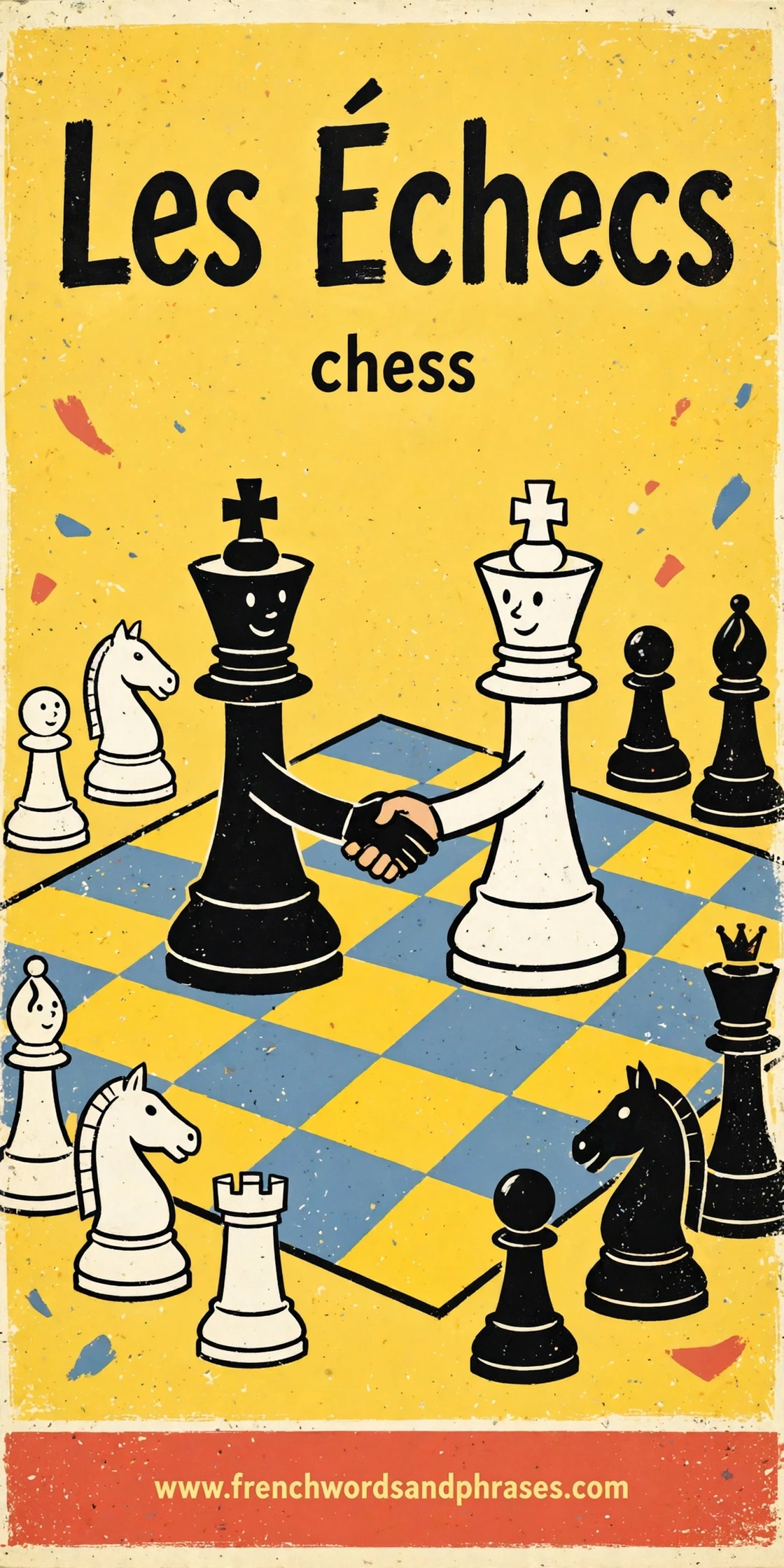
Les échecs means chess.
A quiet café, a rainy afternoon, and two old friends bent over a chequered board. Nobody speaks. A knight moves, a hand hovers, and the whole café seems to hold its breath — les échecs are under way.
In this guide, you’ll learn what échecs means in English, how to use it with its articles, how to form its plural, and how it appears in everyday French. Explore French examples, English translations, and practice quizzes.
Understanding the French Noun Échecs
Échecs is a masculine French noun that lives in the plural. It is learned together with its article: les échecs, chess. In this sense the word has no singular at all — the game is always plural, like its sixty-four squares and its thirty-two pieces. The singular exists, but it means something else entirely, as we will see.
It means chess — the game of kings, played on un échiquier (a chessboard) with le roi (the king), la dame (the queen), les tours (the rooks), les fous (the bishops), les cavaliers (the knights) and les pions (the pawns). You play it with jouer aux échecs — note the aux, the mark of a game in French.
Gender: Masculine — plural-led: the game is always plural
Definite article: les — les échecs (chess)
Indefinite article: des — des échecs (chess sets, games of chess)
Plural: les échecs — the word lives in the plural in this sense
English equivalents: Chess. (Singular un échec = a failure, a setback.)
One important usage detail — the great trap of this word: un échec, singular, is not one chess. It is a failure, a flop, a setback: le film a été un échec, the film was a failure. The game is always les échecs, plural. And when the game ends, French says échec et mat — checkmate.
Experience the Word
Échecs is more than a board game. It is the quietest battle in the world — two armies, no dice, no luck, and a silence you could hear a pawn drop in.
Imagine the park on a Sunday: the regulars at the stone tables, clocks ticking, a small crowd gathering as the endgame tightens. Nobody shouts. Everybody understands.
You have not just played a game. You have fought a war of pure thought.
How to Use Échecs in French: Complete Guide
Let’s explore how échecs works in French, beginning with its articles.
Échecs with the Definite Article (Les)
The game takes les — there is no singular for chess. Les échecs, the game itself, the world of chess.
| Number | French |
|---|---|
| Plural (the game) | les échecs |
| Singular | — (no singular in this sense) |
Example
Les échecs demandent de la patience et de la stratégie.
Chess requires patience and strategy.
Échecs with the Indefinite Article (Des)
Des échecs appears when you count sets or games — the physical boards in a shop or a cupboard.
| Number | French |
|---|---|
| Plural | des échecs |
| One set | un jeu d’échecs |
Example
Le magasin vend des échecs en bois et en marbre.
The shop sells chess sets in wood and marble.
On the Chessboard: the Pieces
King, queen and the jumping knight — the army of les échecs.
| French | In English |
|---|---|
| le roi | the king |
| la dame | the queen |
| la tour | the rook |
| le fou | the bishop |
| le cavalier | the knight |
| le pion | the pawn |
Example
Le cavalier saute par-dessus les autres pièces.
The knight jumps over the other pieces.
Quick Quiz 1
What is le fou in a game of chess?
Reveal the answer
The bishop — literally « the madman », the piece that runs diagonally across the board.
Le fou traverse l’échiquier en diagonale.
The bishop crosses the board diagonally.
A Word That Lives in the Plural
Plural échecs is the game; singular échec is a failure. Same letters, two different worlds — keep them apart.
| Form | Meaning |
|---|---|
| les échecs | chess — the game |
| un jeu d’échecs | a chess set |
| une partie d’échecs | a game of chess |
| un échec | a failure, a setback |
Example
Après trois échecs, il a enfin réussi son examen.
After three failures, he finally passed his exam.
Échecs with Possessive Adjectives (Mes, Tes, Ses…)
Possessives agree with the noun — and échecs is plural, so it takes the plural forms: mes, tes, ses.
| Owner | French |
|---|---|
| my | mes échecs |
| your (tu) | tes échecs |
| his / her | ses échecs |
| our | nos échecs |
| your (vous) | vos échecs |
| their | leurs échecs |
Example
Mes échecs en bois viennent de mon grand-père.
My wooden chess set comes from my grandfather.
Quick Quiz 2
Complete the sentence:
Il a rangé ______ échecs dans leur boîte. (His)
Reveal the answer
ses
Il a rangé ses échecs dans leur boîte.
He put his chess set away in its box.
Échecs with Demonstrative Adjectives (Ces)
Used to point: these chess sets here, this game of chess we are watching.
| Number | French |
|---|---|
| Plural | ces échecs |
| One set | ce jeu d’échecs |
Example
Ces échecs en marbre sont magnifiques.
This marble chess set is magnificent.
Échecs with Adjectives
Adjectives agree with échecs in the plural — anciens, beaux, passionnants.
| Adjective | With Échecs |
|---|---|
| ancien (old) | des échecs anciens |
| beau (beautiful) | de beaux échecs |
| en bois (wooden) | des échecs en bois |
| passionnant (thrilling) | des échecs passionnants |
| électronique (electronic) | des échecs électroniques |
Example
De beaux échecs en bois sont un cadeau classique.
A beautiful wooden chess set is a classic gift.
Quick Quiz 3
Complete the sentence:
Il collectionne des échecs ______. (old)
Reveal the answer
anciens
Il collectionne des échecs anciens.
He collects old chess sets.
Everyday Expressions with Échecs
Clubs, tournaments and the last move of the game — the échecs phrases of daily life.
| Expression | In English |
|---|---|
| jouer aux échecs | to play chess |
| une partie d’échecs | a game of chess |
| échec et mat | checkmate |
| un club d’échecs | a chess club |
| un tournoi d’échecs | a chess tournament |
| gagner une partie | to win a game |
Example
Tous les samedis, ils jouent aux échecs au café.
Every Saturday, they play chess at the café.
Words from the Same Family as Échecs
Boards, players and pieces — the words that travel with échecs.
| French | In English |
|---|---|
| l’échiquier | the chessboard |
| un joueur d’échecs | a chess player |
| la partie | the game, the match |
| le pion | the pawn |
| la dame | the queen |
| échouer | to fail (the verb of un échec) |
Example
L’échiquier est prêt, la partie peut commencer.
The board is ready, the game can begin.
Quick Quiz 4
A headline reads: « Le nouveau film est un échec. » Is it about chess?
Reveal the answer
No — un échec, singular, is a failure. The film is a flop; the game of chess is always les échecs, plural.
Le film est un échec, mais les échecs marchent toujours.
The film is a failure, but chess is still going strong.
Échecs in Everyday French: Real-Life Examples
Now that you know the word, let’s see how échecs appears in everyday French.
Example 1 — At the café
Ils jouent aux échecs en buvant un café.
They play chess while drinking a coffee.
Example 2 — Joining a club
Ma fille s’est inscrite au club d’échecs de l’école.
My daughter has joined the school chess club.
Example 3 — The end of the game
Échec et mat en trois coups, bravo !
Checkmate in three moves, well done!
Example 4 — A gift
Pour son anniversaire, il veut un beau jeu d’échecs.
For his birthday, he wants a beautiful chess set.
Example 5 — In the park
Les joueurs d’échecs se retrouvent près de la fontaine.
The chess players meet near the fountain.
Example 6 — A long game
La partie d’échecs a duré trois heures.
The game of chess lasted three hours.
Beyond Translation: The Meaning of Échecs
Chess arrived in France a thousand years ago and never left: Charlemagne was said to own a famous set, and the Café de la Régence in Paris was for two centuries the chess capital of the world. French kept the memory in its grammar — the game is plural, like the crowd around the board.
To say les échecs is to sit down at the oldest table in France.
It evokes the stone tables in the park, the clock ticking beside the board, and the handshake at the end — win or lose, the pieces go back in the box together.
How to Remember the French Noun Échecs
Remember it this way: Échecs is chess — masculine and always plural in this sense; the singular, un échec, is a failure.
- You play it — on joue aux échecs, avec aux, comme tous les jeux.
- You end it — échec et mat, et la partie est finie.
- You dodge the trap — un échec tout seul, c’est un raté, pas le jeu.
The key idea is les échecs is the game — un échec is a failure.
Test Your Knowledge of Échecs
Let’s see how much you’ve learned. Try answering these questions before revealing the answers.
Question 1
Is échecs singular or plural in French?
Reveal the answer
Plural — les échecs. The game has no singular.
Question 2
How do you say to play chess in French?
Reveal the answer
Jouer aux échecs — games take jouer à, here aux échecs.
Question 3
Translate: They play chess every Saturday.
Reveal the answer
Ils jouent aux échecs tous les samedis.
Question 4
What does un échec mean?
Reveal the answer
A failure, a setback — the singular is not the game.
Question 5
Complete the sentence:
Nous jouons ______ échecs après le dîner.
Reveal the answer
aux
Nous jouons aux échecs après le dîner.
We play chess after dinner.
Your Final Challenge
Can You Use It?
How would you say this in French?
“Every Sunday, my father plays chess with his friends.”
Reveal the answer
Tous les dimanches, mon père joue aux échecs avec ses amis.
Every Sunday, my father plays chess with his friends.
A little French. A little curiosity. A richer everyday life.
LEARN FRENCH ONE WORD AT A TIME