A French Word to Live By
Translate Promesse to English
/pʁɔmɛs/
La promesse means the promise.
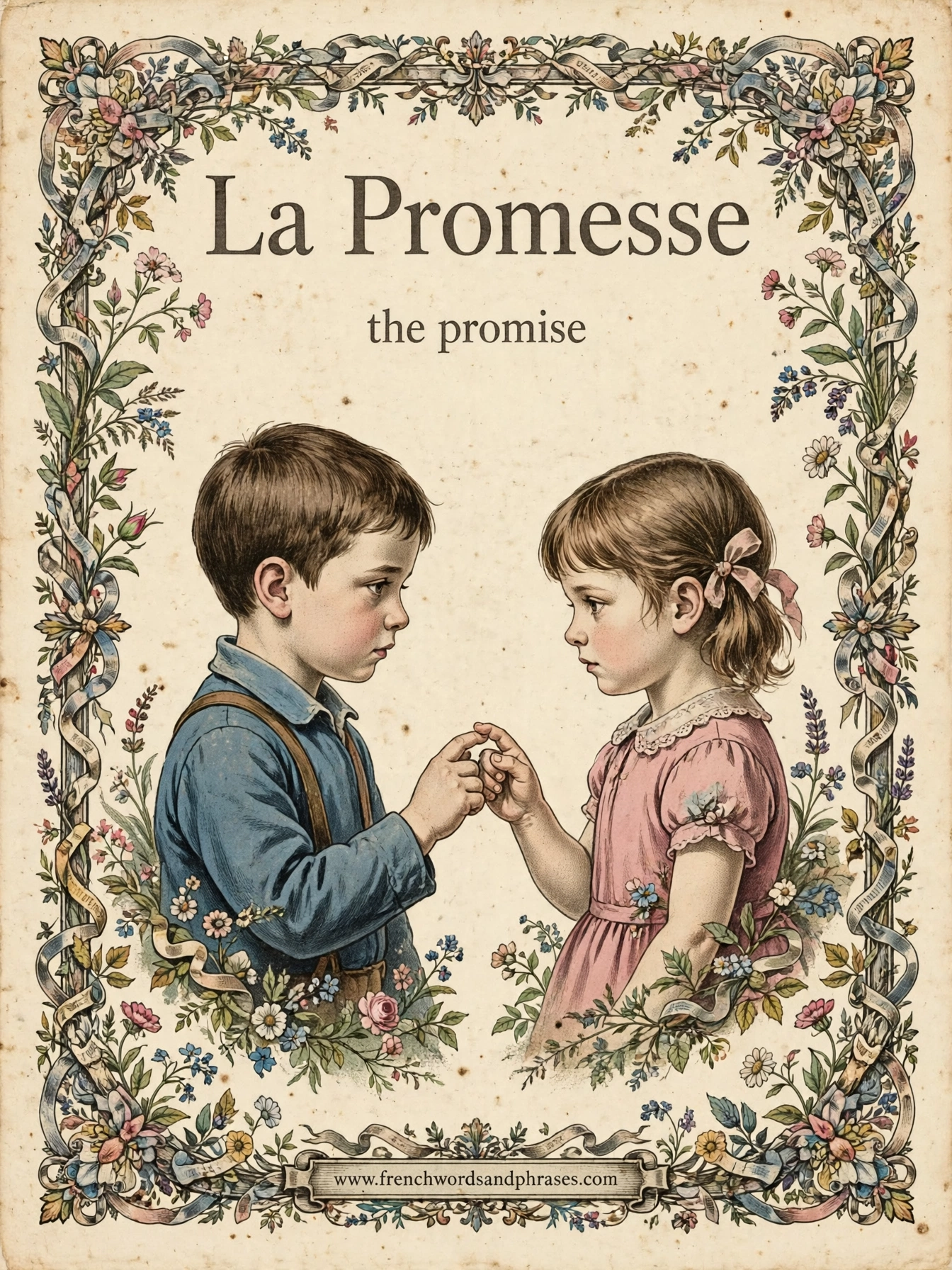
A small boy crosses his heart on the playground, solemn as a judge: « Promis, je ne le dirai à personne. » Behind that little ceremony stands la promesse, the promise — the word French uses whenever a person gives their word and means to be held by it.
In this guide, you’ll learn what promesse means in English, how to use it with its articles, how to form its plural, and how it appears in everyday French. Explore French examples, English translations, and practice quizzes.
Understanding the French Noun Promesse
Promesse is a feminine French noun, learned with its article: la promesse, une promesse. It comes from the verb promettre, to promise — from the Latin promittere, to send forth, to let go ahead: a promise is words sent out in front of you, which you then have to catch up with.
It means a promise — a commitment made in words, which the other person is entitled to rely on: faire une promesse, to make a promise, tenir sa promesse, to keep one’s promise, rompre une promesse, to break one. French also uses it for what the future holds in store: les promesses de l’aube, the promise of dawn, and for campaign pledges, les promesses électorales — famous for melting after the vote. A worthless one is une promesse en l’air, a promise thrown to the wind.
Gender: Feminine — la promesse
Definite article: la — la promesse (the promise)
Indefinite article: une — une promesse (a promise)
Plural: les promesses
Spelling note: built on promettre, to promise — the past participle promis lives in the playground cry « Promis ! »
Key verb: tenir — tenir sa promesse, to keep one’s promise
English equivalents: The promise, the pledge.
The verb that keeps a promesse is tenir: tenir sa promesse, never garder. And French children seal the bargain with a single word, promis — literally “promised” — often doubled for safety: promis, promis ! An adult who breaks one manque à sa promesse or rompt sa promesse, and everyone understands the verdict.
Experience the Word
Promesse is the lightest thing a person can carry and the heaviest thing they can drop: a few words, and suddenly the future has a witness.
Imagine the mayor on the steps of the mairie, the crowd, the microphones: « Je vous fais une promesse… » Every listener writes the words down somewhere — a promesse is a debt issued in public.
You have not just named a kind intention. You have named a bond made of speech — la promesse, your word, given away and still yours to honour.
How to Use Promesse in French: Complete Guide
Let’s explore how promesse works in French, beginning with its articles — la promesse, une promesse, tenir sa promesse.
Promesse with the Definite Article (La, Les)
Used for a specific promise — the one everyone is waiting to see kept.
| Form | French |
|---|---|
| Feminine singular | la promesse |
| Plural | les promesses |
Example
La promesse du maire a rassuré les habitants.
The mayor’s promise reassured the residents.
Promesse with the Indefinite Article (Une, Des)
Used for a promise in general — one commitment among all the commitments of a life.
| Form | French |
|---|---|
| Feminine singular | une promesse |
| Plural | des promesses |
Example
Une promesse est une promesse : il faut la tenir.
A promise is a promise: it must be kept.
Promesse in Action (Faire, Tenir, Rompre…)
A promesse is made, kept or broken — the verbs of the promise are its whole biography.
| Action | French |
|---|---|
| to make a promise | faire une promesse |
| to keep one’s promise | tenir sa promesse |
| to break a promise | rompre sa promesse |
| an empty promise | une promesse en l’air |
| a solemn promise | une promesse solennelle |
Example
Elle a tenu sa promesse et elle est revenue avant la nuit.
She kept her promise and came back before nightfall.
Quick Quiz 1
Complete the sentence:
______ promesse qu’il m’a faite compte beaucoup pour moi. (the)
Reveal the answer
La
La promesse qu’il m’a faite compte beaucoup pour moi.
The promise he made me means a lot to me — promesse is feminine, so la.
The Plural of Promesse
A regular plural in -s — promises are, alas, easy to multiply.
| Number | French |
|---|---|
| Singular | la promesse |
| Plural | les promesses |
Example
Les promesses électorales pleuvent pendant la campagne.
Election promises rain down during the campaign.
Promesse with Possessive Adjectives (Ma, Ta, Sa…)
Possessives agree with the noun: promesse is feminine, so ma, ta, sa in the singular — and sa promesse is the classic phrase, one’s own promise to keep.
| Owner | French |
|---|---|
| my | ma promesse |
| your (tu) | ta promesse |
| his / her | sa promesse |
| our | notre promesse |
| your (vous) | votre promesse |
| their | leur promesse |
Example
Il a tenu sa promesse malgré la fatigue.
He kept his promise despite the tiredness.
Quick Quiz 2
Complete the sentence:
Elle n’a pas tenu ______ promesse. (her)
Reveal the answer
sa
Elle n’a pas tenu sa promesse.
She did not keep her promise — sa, because promesse is feminine.
Promesse with Demonstrative Adjectives (Cette, Ces)
Used to point: cette promesse, this promise — usually the one under discussion, or under suspicion.
| Form | French |
|---|---|
| Feminine singular | cette promesse |
| Plural | ces promesses |
Example
Cette promesse-là, je n’y crois plus.
That promise, I no longer believe in it.
Promesse with Adjectives
Adjectives agree with promesse — feminine singular: une belle promesse, une promesse solennelle.
| Adjective | With Promesse |
|---|---|
| belle (fine, lovely) | une belle promesse |
| solennelle (solemn) | une promesse solennelle |
| électorale (electoral, campaign) | une promesse électorale |
| vaine (empty, vain) | une vaine promesse |
| tenue (kept) | une promesse tenue |
Example
C’était une belle promesse, et elle l’a tenue.
It was a fine promise, and she kept it.
Quick Quiz 3
Complete the sentence:
Le candidat a fait une promesse ______. (electoral)
Reveal the answer
électorale
Le candidat a fait une promesse électorale.
The candidate made a campaign promise — électorale, feminine, to agree with promesse.
Everyday Expressions with Promesse
Playgrounds, weddings and election nights — the promesse phrases of daily life.
| Expression | In English |
|---|---|
| tenir sa promesse | to keep one’s promise |
| faire une promesse | to make a promise |
| une promesse en l’air | an empty promise, words in the wind |
| promis ! | I promise! (the playground seal) |
| la Terre promise | the Promised Land |
Example
Ne fais pas de promesses en l’air, les enfants s’en souviennent.
Don’t make empty promises, children remember them.
Words from the Same Family as Promesse
Promising, pledging and owing — the words that travel with promesse.
| French | In English |
|---|---|
| promettre | to promise (the verb) |
| promis | promised — the past participle |
| un engagement | a commitment, an undertaking |
| la parole donnée | one’s given word |
| un serment | an oath, a sworn promise |
Example
Sa parole donnée vaut une promesse signée.
His given word is worth a signed promise.
Quick Quiz 4
What does une promesse en l’air mean?
Reveal the answer
An empty promise — words thrown to the wind, never meant to be kept.
Ses promesses en l’air ne trompent plus personne.
His empty promises no longer fool anyone.
Promesse in Everyday French: Real-Life Examples
Now that you know the word, let’s see how promesse appears in everyday French.
Example 1 — Childhood
Promis, je ne recommencerai plus !
I promise, I won’t do it again!
Example 2 — Keeping one’s word
Elle tient toujours ses promesses.
She always keeps her promises.
Example 3 — Politics
Les promesses du candidat ont convaincu les électeurs.
The candidate’s promises convinced the voters.
Example 4 — A wedding
Devant leurs familles, ils ont échangé leurs promesses.
Before their families, they exchanged their vows.
Example 5 — Doubt
Encore une promesse en l’air, comme d’habitude.
Another empty promise, as usual.
Example 6 — The future
Ce jeune pianiste est plein de promesses.
This young pianist is full of promise.
Beyond Translation: The Meaning of Promesse
Promesse carries a whole moral economy in six letters: to promise in French is to put your parole — your word — into circulation, and the language keeps the accounts strictly. One tient a promise as one holds a rope; one rompt it as one snaps a thread. And at the summit of the word stands la Terre promise, the Promised Land, the promise so large a whole people walked towards it for forty years. From the playground’s promis to the Bible, it is the same machinery: words first, then the long walk to meet them.
To say promesse is to sign a contract with the future.
It evokes crossed hearts, campaign posters and wedding rings — every place where French asks to be believed before it can be checked.
How to Remember the French Noun Promesse
Remember it this way: Promesse is the promise — the word you give and then must keep: la promesse, and the golden verb tenir, tenir sa promesse.
- Always feminine — la promesse, une promesse, sa promesse.
- The keeping verb — tenir sa promesse, to keep one’s promise; never garder.
- The trap — une promesse en l’air, an empty promise, words in the wind.
The key idea is la promesse — the promise, feminine; tenir sa promesse = to keep one’s promise.
Test Your Knowledge of Promesse
Let’s see how much you’ve learned. Try answering these questions before revealing the answers.
Question 1
Is promesse masculine or feminine?
Reveal the answer
Feminine — la promesse, une promesse.
Question 2
How do you say to keep one’s promise?
Reveal the answer
Tenir sa promesse.
Question 3
Translate: She made a promise.
Reveal the answer
Elle a fait une promesse.
Question 4
What do French children cry to seal a bargain?
Reveal the answer
Promis ! — literally “promised”, the past participle of promettre.
Question 5
Complete the sentence:
Il a rompu ______ promesse. (his)
Reveal the answer
sa
Il a rompu sa promesse.
He broke his promise — sa, because promesse is feminine.
Your Final Challenge
Can You Use It?
How would you say this in French?
“She always keeps her promises.”
Reveal the answer
Elle tient toujours ses promesses.
She always keeps her promises.
A little French. A little curiosity. A richer everyday life.
LEARN FRENCH ONE WORD AT A TIME