
A French Word to Live By
Translate S’attirer des ennuis to English
/sa.ti.ʁe de ɑ̃.nɥi/
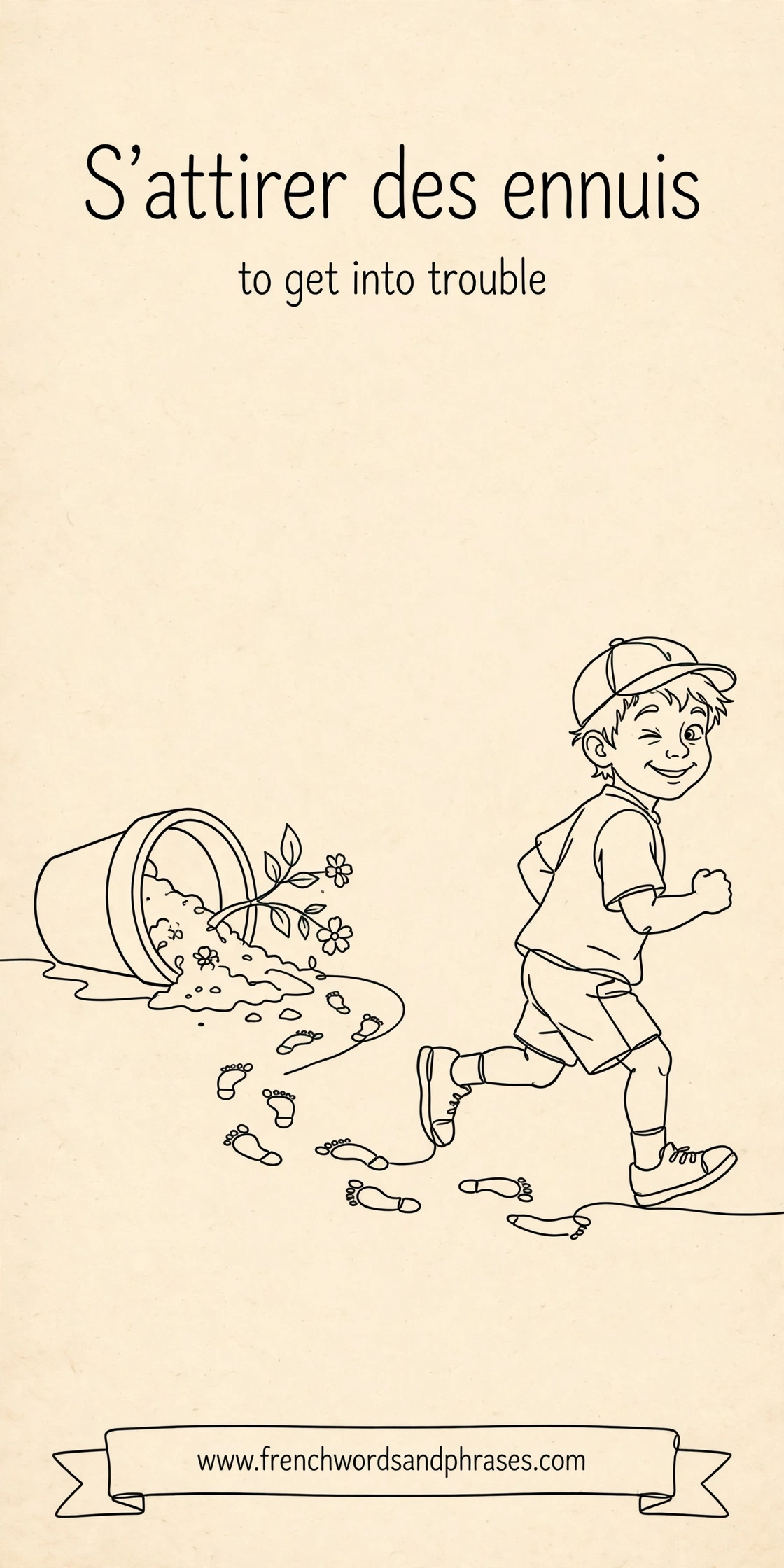
S’attirer des ennuis means to get into trouble — to bring trouble on yourself by what you do.
The apprentice has been told three times not to park the delivery van in front of the mayor’s gate. He does it a fourth time, whistling, while the old baker watches from the doorway and shakes his head slowly: « Toi, tu cherches à t’attirer des ennuis. »
Let’s explore how s’attirer des ennuis works in French, beginning with the whole phrase on one card.
Understanding the French Phrase S’attirer des ennuis
S’attirer des ennuis is a French everyday phrase built from the reflexive s’attirer (to draw onto oneself — from attirer, to attract, a verb that has its own page on this site) and des ennuis (troubles — ennui, trouble or bother, a masculine noun that has its own page on this site). The picture is magnetic: trouble is out there minding its own business, and the person in the phrase is pulling it toward themselves.
It means to get into trouble — by your own doing. Tu vas t’attirer des ennuis — you are going to get yourself into trouble. Il s’est attiré des ennuis avec la police — he got himself into trouble with the police. The reflexive is the whole moral of the phrase: this is not bad luck falling from the sky; it is trouble invited, attracted, practically sent for.
Type: Everyday phrase — self-inflicted trouble (s’attirer + des ennuis)
Answers the need: Warning or reporting that someone’s behaviour is bringing trouble on themselves
Register: Neutral and familiar — warnings, family talk, storytelling
Strength: Pointed — it assigns the blame to the person, gently or not
One important usage detail: ennuis is almost always plural in this phrase — des ennuis, never « un ennui » (a single ennui is a single bout of trouble or boredom; the phrase wants the plural swarm). And the reflexive pronoun moves with the person: je m’attire, tu t’attires, il s’attire, nous nous attirons des ennuis.
Experience the Word
S’attirer des ennuis is the phrase of grandmothers, foremen and old friends — the warning spoken while the trouble is still avoidable, and the verdict spoken when it no longer is.
Imagine the young journalist who keeps publishing one paragraph too many about the mayor’s brother. Her editor calls her in, closes the door, and says it almost kindly: « Vous vous attirez des ennuis, et moi avec. » The next article is exactly one paragraph shorter.
English says to get into trouble, as if trouble were a place you wander into. French is more accusing: s’attirer — you attracted it; the trouble was minding its own business until you called it over.
How to Use S’attirer des ennuis in French: Complete Guide
Let’s explore how s’attirer des ennuis works in French, beginning with the whole phrase on one card.
S’attirer des ennuis at a Glance
The Whole Phrase on One Card
Real meaning, literal picture, English twin and register — s’attirer des ennuis in five lines.
| Point | S’attirer des ennuis |
|---|---|
| What it really means | to get into trouble — trouble brought on yourself by your own behaviour |
| Word for word | to attract troubles to oneself — s’attirer (to draw to oneself) + des ennuis (troubles) |
| English equivalent | to get (oneself) into trouble / to ask for trouble |
| Register | neutral to familiar — warnings and verdicts |
| Use it for | risky behaviour, warnings to the reckless, trouble with authorities |
Example
Tu vas t’attirer des ennuis avec ces histoires.
You are going to get yourself into trouble with those stories.
Word by Word: Building the Magnet
Three pieces — take them one by one and the self-inflicted trouble assembles.
| Word | Literal meaning | Its job in the phrase |
|---|---|---|
| s’ (se) | oneself | the reflexive: the trouble lands on the same person who attracted it |
| attirer | to attract, to draw toward | the magnet verb — the trouble is pulled in, not stumbled upon |
| des ennuis | troubles, bother | the swarm that arrives: ennuis is plural here, almost without exception |
Example
Il s’attire toujours des ennuis.
He always gets himself into trouble.
Quick Quiz 1
What does the reflexive s’ accuse the person of?
Reveal the answer
Bringing it on themselves — s’attirer means the trouble was attracted by the person’s own behaviour, not dropped on them by luck.
Elle s’est attiré des ennuis toute seule.
She got herself into trouble all on her own.
When You Say It: The Warning Moments
S’attirer des ennuis fires at moments like these — wherever behaviour is visibly loading trouble onto its owner.
| Situation | Example |
|---|---|
| A warning | tu vas t’attirer des ennuis — you’re going to get yourself into trouble |
| Trouble with authority | il s’est attiré des ennuis avec la police — he got into trouble with the police |
| At school | elle s’attire des ennuis avec ses retards — she gets into trouble with her lateness |
| A reputation | il s’attire des ennuis partout où il passe — he gets into trouble wherever he goes |
| The verdict | tu t’es attiré des ennuis, cette fois — you’ve got yourself into trouble this time |
Example
Arrête, tu vas t’attirer des ennuis avec le directeur.
Stop, you are going to get yourself into trouble with the director.
Make It Yours: Moving the Reflexive
The pronoun and the verb move with the person — the ennuis stay plural and stay put.
| Form | French | In English |
|---|---|---|
| I | je m’attire des ennuis | I get myself into trouble |
| You (tu) | tu t’attires des ennuis | you get yourself into trouble |
| He / she | il s’attire des ennuis | he gets himself into trouble |
| We | nous nous attirons des ennuis | we get ourselves into trouble |
| In the past | elle s’est attiré des ennuis | she got herself into trouble |
Example
Nous nous sommes attiré des ennuis avec cette décision.
We got ourselves into trouble with that decision.
Quick Quiz 2
Say it about yourself in the past: I got myself into trouble.
Reveal the answer
Je me suis attiré des ennuis — reflexive verbs build their past with être, and the reflexive pronoun leads: je me suis attiré…
Je me suis attiré des ennuis avec cette remarque.
I got myself into trouble with that remark.
Everyday Expressions: Building on the Trouble
The phrase slots into these everyday frames — each one ready to use as it stands.
| Frame | In English |
|---|---|
| chercher des ennuis | to look for trouble — the deliberate hunt, one step worse |
| avoir des ennuis | to have troubles, to be in trouble — the state, whoever caused it |
| des ennuis avec quelqu’un | trouble with someone — the authority is named |
| s’attirer les foudres de… | to draw the wrath of… — the grand, literary escalation |
| éviter les ennuis | to avoid trouble — the wise opposite |
Example
Lui, il cherche des ennuis, c’est évident.
Him, he’s looking for trouble, it’s obvious.
Close Cousins: The Other Troubles
French sorts trouble by blame — s’attirer des ennuis points at the person; its cousins excuse, worsen or neutralise.
| Expression | The difference |
|---|---|
| s’attirer des ennuis | to get into trouble — self-inflicted, by your own doing |
| avoir des ennuis | to have trouble — the neutral state; luck may be to blame |
| chercher des ennuis | to look for trouble — deliberate, provocative, worse |
| être dans le pétrin | to be in a fix, in a jam — the trouble is here, cause unstated |
| se mettre dans une sale situation | to get oneself into a nasty situation — the long, explicit version |
Example
Il n’a pas eu des ennuis par hasard : il les a cherchés.
His trouble was no accident: he went looking for it.
Quick Quiz 3
Which cousin is worse — s’attirer des ennuis or chercher des ennuis?
Reveal the answer
Chercher des ennuis — looking for trouble is deliberate provocation; s’attirer des ennuis can still be carelessness.
Ne cherche pas des ennuis, ce soir.
Don’t go looking for trouble tonight.
S’attirer des ennuis and Its Neighbours
The trouble shelf around the phrase — problems, fixes and wrath.
| French | In English |
|---|---|
| un ennui | a trouble, a bother (also: boredom) |
| un problème | a problem — the neutral, solvable cousin |
| le pétrin | the kneading trough — the fix, the jam (être dans le pétrin) |
| la foudre | lightning — les foudres, someone’s wrath |
| un avertissement | a warning — what arrives before the ennuis |
Example
Un avertissement d’abord, des ennuis ensuite.
A warning first, trouble afterwards.
Watch Out: The Traps Around S’attirer des ennuis
The traps: the singular ennui, and ennui’s double life as boredom.
| Trap | The truth |
|---|---|
| « s’attirer un ennui » | the phrase wants the plural swarm: des ennuis |
| ennui = boredom here? | ennui means both trouble and boredom — in this phrase it is trouble; boredom takes mourir d’ennui |
| dropping the reflexive | attirer des ennuis without se would mean attracting trouble in general — the blame needs the reflexive |
| accord in the past | elle s’est attiré des ennuis: with a direct object after the verb, attiré stays invariable here |
Example
Des ennuis, au pluriel — et le se qui accuse.
Trouble, in the plural — and the little se that does the accusing.
Quick Quiz 4
True or false: ennui in this phrase means boredom.
Reveal the answer
False — here ennuis are troubles, bother, difficulties. Boredom is the word’s other life: mourir d’ennui, to die of boredom.
Des ennuis avec la voiture, pas de l’ennui au salon.
Trouble with the car, not boredom in the living room.
S’attirer des ennuis in Everyday French: Real-Life Examples
Now that you know the word, let’s see how s’attirer des ennuis appears in everyday French.
Example 1 — A warning
Tu vas t’attirer des ennuis.
You are going to get yourself into trouble.
Example 2 — At work
Il s’est attiré des ennuis avec son chef.
He got himself into trouble with his boss.
Example 3 — At school
Elle s’attire des ennuis avec ses retards.
She gets into trouble with her lateness.
Example 4 — A verdict
Tu t’es attiré des ennuis tout seul.
You got yourself into trouble all on your own.
Example 5 — Advice
Ne t’attire pas des ennuis pour si peu.
Don’t get yourself into trouble over so little.
Example 6 — A reputation
Partout où il passe, il s’attire des ennuis.
Wherever he goes, he gets himself into trouble.
Beyond Translation: The Meaning of S’attirer des ennuis
Most languages let trouble fall on people like weather. French, in this phrase, hands out magnets. S’attirer des ennuis refuses the excuse of bad luck: somewhere in the story there was a choice, a paragraph too many, a van parked once too often — and the trouble, politely, answered the call.
To say tu t’attires des ennuis is to hold up a mirror disguised as a weather forecast.
And the same verb, attirer, does the opposite work in happier phrases — attirer les regards, attirer la sympathie — as if French knew that magnetism itself is neutral: what you attract is up to you.
How to Remember the French Phrase S’attirer des ennuis
Remember it this way: S’attirer des ennuis means to get into trouble — attirer, to attract: the trouble is pulled in by the person it lands on.
- You keep the reflexive — the se is the blame: the trouble lands on the one who attracted it.
- You pluralise the trouble — des ennuis, the swarm, never a single ennui.
- You split the word’s lives — ennuis here are troubles; boredom is mourir d’ennui.
The key idea is s’attirer des ennuis means to get into trouble — reflexive = self-inflicted; ennuis plural.
Test Your Knowledge of S’attirer des ennuis
Let’s see how much you’ve learned. Try answering these questions before revealing the answers.
Question 1
What does s’attirer des ennuis mean?
Reveal the answer
To get into trouble — trouble brought on yourself by your own behaviour.
Question 2
What does the reflexive se add to the phrase?
Reveal the answer
The blame — the trouble lands on the same person who attracted it.
Question 3
Translate: You are going to get yourself into trouble.
Reveal the answer
Tu vas t’attirer des ennuis.
Question 4
Singular or plural: des ennui or des ennuis?
Reveal the answer
Des ennuis — the phrase takes the plural swarm, almost without exception.
Question 5
Complete the sentence:
Il s’est ______ des ennuis avec la police. (got himself into trouble)
Reveal the answer
attiré
Il s’est attiré des ennuis avec la police.
He got himself into trouble with the police.
Your Final Challenge
Can You Use It?
How would you say this in French?
“You are going to get yourself into trouble.”
Reveal the answer
Tu vas t’attirer des ennuis.
You are going to get yourself into trouble.
A little French. A little curiosity. A richer everyday life.
LEARN FRENCH ONE WORD AT A TIME




