A French Word to Live By
Translate Prix to English
/pʁi/
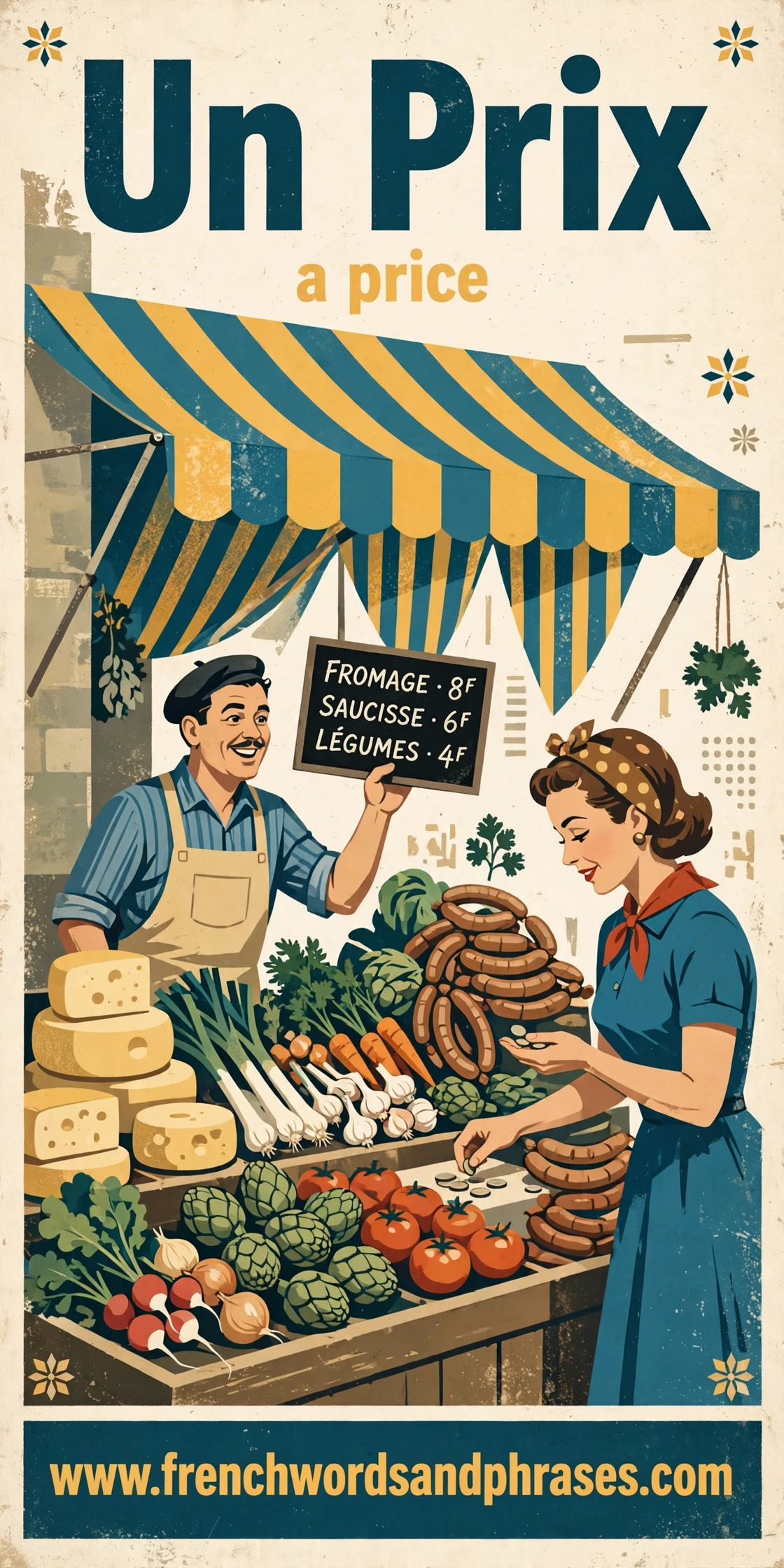
Un prix means a price.
Market morning: tomatoes stacked in red pyramids, chalk figures on a little slate, and the same question asked at every stall — quel est le prix ?
In this guide, you’ll learn what prix means in English, how to use it with its articles, how to form its plural, and how it appears in everyday French. Explore French examples, English translations, and practice quizzes.
Understanding the French Noun Prix
Prix is a masculine French noun. Like every French noun, it has a gender, and it is learned together with its article: le prix.
It means a price — what a thing costs. At the market it is the number on the slate; in wider life it is also what an effort is worth: le prix de la liberté, the price of freedom. The same word also means a prize in a competition: le premier prix, first prize.
Gender: Masculine
Definite article: le — le prix (the price)
Indefinite article: un — un prix (a price)
Plural: les prix — spelled exactly the same: prix never changes
English equivalents: A price; a prize; a fare.
One important spelling detail: prix never changes. It already ends in -x, so the plural is written les prix — the same word, no extra letter, and the final x is not pronounced in either form.
Experience the Word
Prix is more than a number. It is the pause before you answer at the market, the quick sum in your head, the small nod that says yes, I’ll take them.
Imagine a fisherman selling the morning’s catch under the harbour lights, calling his prices out to the first buyers of the day.
You have not just paid. You have agreed on the price.
How to Use Prix in French: Complete Guide
Let’s explore how prix works in French, beginning with its articles.
Prix and Its Articles
French nouns are almost never used alone. The small word in front of the noun — the article — does a great deal of work.
Prix with the Definite Article (Le, Les)
Used for a particular price — the one on the label.
| Number | French |
|---|---|
| Singular | le prix |
| Plural | les prix |
Example
Le prix du pain a encore augmenté.
The price of bread has gone up again.
Prix with the Indefinite Article (Un, Des)
Used when you judge a price in general: a good price, high prices.
| Number | French |
|---|---|
| Singular | un prix |
| Plural | des prix |
Example
C’est un prix raisonnable pour une chambre.
It’s a reasonable price for a room.
Prix in Short Phrases (À tout prix, Hors de prix…)
Prix takes no partitive article — instead, it powers some of the most useful phrases in everyday French.
| Expression | In English |
|---|---|
| à tout prix | at all costs |
| hors de prix | far too expensive |
| à prix réduit | at a reduced price |
| à moitié prix | at half price |
| quel prix ? | how much? what price? |
Example
Je veux ce tableau à tout prix.
I want this painting at all costs.
Quick Quiz 1
How do you ask the price of the cheese?
Reveal the answer
Quel est le prix du fromage ?
Quel est le prix du fromage, s’il vous plaît ?
What is the price of the cheese, please?
The Plural of Prix (It Never Changes!)
Prix ends in -x, so it takes no extra letter in the plural: le prix, les prix — one spelling for both.
| Number | French |
|---|---|
| Singular | le prix |
| Plural | les prix |
Example
Les prix ont augmenté cette année.
Prices have risen this year.
Prix with Possessive Adjectives (Mon, Ton, Son…)
Possessives agree with the noun, not with the owner — and prix is masculine, so a thing has son prix: its price.
| Owner | French |
|---|---|
| my | mon prix |
| your (tu) | ton prix |
| his / her / its | son prix |
| our | notre prix |
| your (vous) | votre prix |
| their | leur prix |
Example
Chaque produit a son prix affiché.
Every product has its price displayed.
Quick Quiz 2
Complete the sentence:
Les ______ sont les mêmes partout.
Reveal the answer
prix
Les prix sont les mêmes partout.
The prices are the same everywhere. (Prix is spelled the same in the plural.)
Prix with Demonstrative Adjectives (Ce, Ces)
Used to point: this price here, those prices there.
| Number | French |
|---|---|
| Singular | ce prix |
| Plural | ces prix |
Example
Ce prix me semble trop élevé.
This price seems too high to me.
Prix with Adjectives
Some adjectives come before the noun — bon, petit, gros, juste — and the rest follow it. All of them agree with prix, which is masculine.
| Adjective | With Prix |
|---|---|
| bon (good) | un bon prix |
| petit (small, low) | un petit prix |
| gros (big) | un gros prix |
| juste (fair) | le juste prix |
| élevé (high) | un prix élevé |
| raisonnable (reasonable) | un prix raisonnable |
Example
Nous avons trouvé un petit prix pour l’hôtel.
We found a low price for the hotel.
Quick Quiz 3
What does à tout prix mean?
Reveal the answer
At all costs
Je veux réussir à tout prix.
I want to succeed at all costs.
Everyday Expressions with Prix
Prix measures money — and, in the best expressions, things money cannot measure at all.
| Expression | In English |
|---|---|
| à tout prix | at all costs |
| hors de prix | unaffordable, overpriced |
| le juste prix | the fair price |
| le prix fort | the full price, top dollar |
| vendre à prix d’or | to sell for a fortune |
| ça n’a pas de prix | it’s priceless |
Example
La liberté n’a pas de prix.
Freedom is priceless.
Words from the Same Family as Prix
Learn these together and the whole market falls into place.
| French | In English |
|---|---|
| coûter | to cost (verb) |
| cher / chère | expensive, dear |
| gratuit | free (of charge) |
| les soldes | the sales |
| une réduction | a discount |
| payer | to pay |
Example
Combien coûte ce fromage, s’il vous plaît ?
How much does this cheese cost, please?
Quick Quiz 4
How do you say it’s priceless in French?
Reveal the answer
Ça n’a pas de prix.
Un bon ami, ça n’a pas de prix.
A good friend is priceless.
Prix in Everyday French: Real-Life Examples
Now that you know the word, let’s see how prix appears in everyday French.
Example 1 — At the market
Le prix des pêches est écrit sur une petite ardoise.
The price of the peaches is written on a little slate.
Example 2 — Petrol
Le prix de l’essence augmente encore.
The price of petrol is rising again.
Example 3 — Too expensive
C’est hors de prix, je n’achète pas.
It’s far too expensive, I’m not buying it.
Example 4 — Half price
Nous avons eu les billets à moitié prix.
We got the tickets at half price.
Example 5 — A prize
Elle a gagné le premier prix du concours.
She won the first prize in the competition.
Example 6 — A bargain
À ce prix-là, c’est une affaire !
At that price, it’s a bargain!
Beyond Translation: The Meaning of Prix
English says a price for prix — and French quietly uses the same word for a prize, as if value and reward were one and the same thing.
To say prix is to put a value on the world.
From the slate at the market stall to the great questions — le prix de la liberté, the price of freedom — the word measures both what things cost and what they are worth.
How to Remember the French Noun Prix
Remember it this way: Prix is the price — and the prize — spelled exactly the same in singular and plural.
- You ask at the market — quel est le prix du fromage ?
- You refuse a fortune — c’est hors de prix.
- You want something whatever it costs — à tout prix.
The key idea is un prix, des prix — the word never changes.
Test Your Knowledge of Prix
Let’s see how much you’ve learned. Try answering these questions before revealing the answers.
Question 1
Is prix masculine or feminine?
Reveal the answer
Masculine — le prix.
Question 2
What is the plural of prix?
Reveal the answer
Prix — exactly the same spelling. The word never changes.
Question 3
Translate: The price of bread has risen.
Reveal the answer
Le prix du pain a augmenté.
Question 4
How do you say at all costs in French?
Reveal the answer
À tout prix.
Question 5
Complete the sentence:
C’est ______ de prix, je pars.
Reveal the answer
hors
C’est hors de prix, je pars.
It’s far too expensive, I’m leaving.
Your Final Challenge
Can You Use It?
How would you say this in French?
“He sold his old car for a very good price.”
Reveal the answer
Il a vendu sa vieille voiture pour un très bon prix.
He sold his old car for a very good price.
A little French. A little curiosity. A richer everyday life.
LEARN FRENCH ONE WORD AT A TIME